 MortarDesk
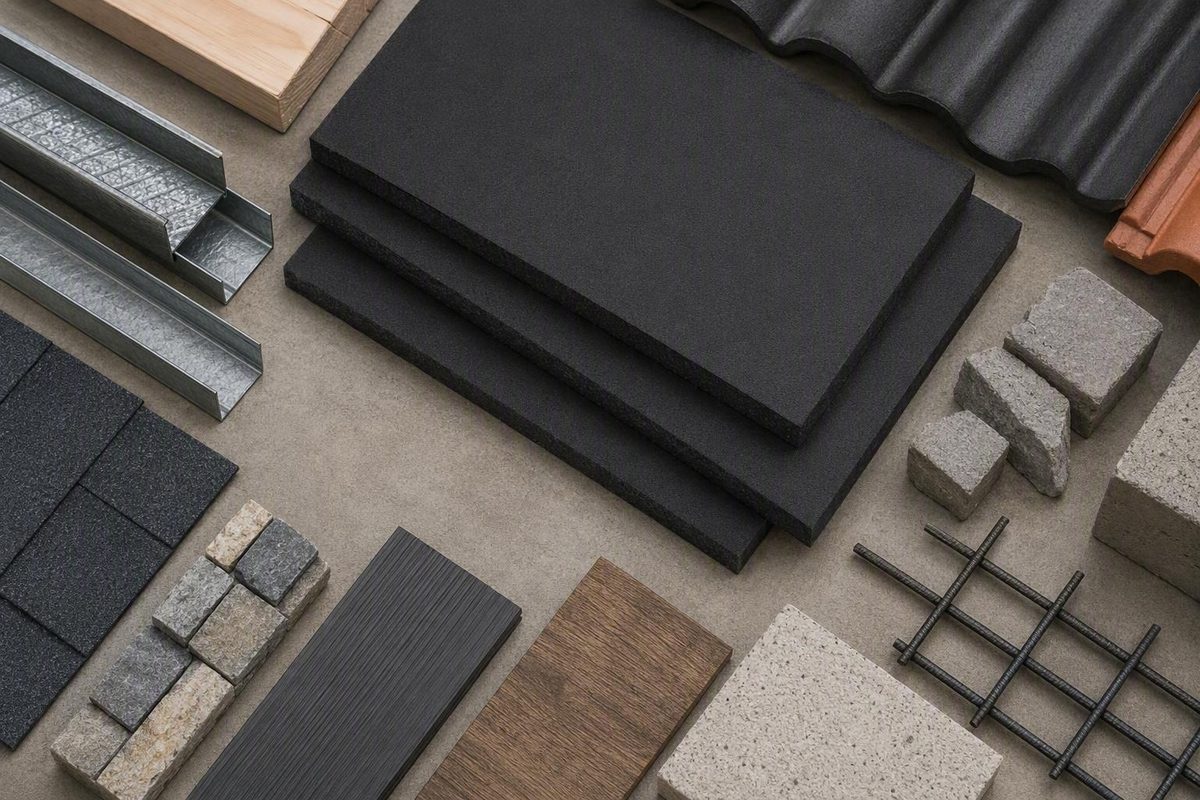
The direct answer: the board insulates, while the color may identify an additive
The primary purpose of black rigid foam insulation is the same as that of other rigid insulation boards: to reduce heat transfer through a building assembly. Installed in walls, roofs, floors, foundations, or similar locations, the board provides thermal resistance.
Some black or dark-gray boards are graphite-enhanced expanded polystyrene, commonly called graphite EPS or GPS. In those products, graphite contributes to the dark appearance and is intended to improve thermal resistance compared with a particular conventional white EPS product. A supplier’s overview of black rigid foam identifies graphite EPS as one explanation for a dark board but also notes that facings, composition, pigments, and branding can produce similar appearances.
That distinction separates two different questions:
- What does the board do? It resists heat flow.
- Why does it look black? It may contain graphite, or the color may come from a facer, coating, pigment, another component, or a manufacturer convention.
Darkness alone does not prove that an unidentified board has a higher R-value, a particular density, defined moisture properties, or approval for a specialized application. Applying black paint or a dark facing to ordinary foam would change its appearance without necessarily changing the thermal performance of the core.
To identify a board, work in this order:
- Determine whether it is a rigid panel or an expanding sealant.
- Inspect the foam core and any surface facers.
- Find the manufacturer, product code, material designation, thickness, and printed R-value.
- Check current technical literature for intended uses and limitations.
Color is a useful preliminary clue, not a substitute for a product label.
Why some rigid foam boards are black or dark gray
Graphite EPS is made by mixing fine graphite particles with polystyrene beads before expansion and molding. The graphite is distributed through the foam rather than applied as black paint to the finished board. It produces the gray or black appearance and is intended to reduce radiant heat transfer within the material.
A graphite EPS product may therefore provide greater thermal resistance per inch than a particular conventional white EPS product. The difference is product-specific, however. It should be established by comparing current technical data for the two products, not by applying a generic percentage to every graphite board.
The useful property comes from the material formulation, not darkness as a general principle. Coloring an arbitrary foam board black would not establish graphite content or improved thermal resistance.
A rigid board might also appear dark because:
- A black or dark facer has been laminated to the foam.
- A coating has been applied to one or both surfaces.
- Pigment has been added for identification or branding.
- The foam composition naturally produces a darker core.
- A manufacturer uses color to distinguish a product line.
The location of the color can help during an initial inspection. If a clean exposed edge is uniformly gray or black through its full thickness, the core may contain graphite or another pigment.
Neither observation is conclusive. A dark core is not necessarily graphite EPS, and a dark-faced board cannot be identified without determining what lies behind the facing. Manufacturer color conventions are descriptive rather than universal industry standards.
When comparing products, look for a declared R-value at a stated thickness and under stated rating conditions. Category-level guides show that EPS, XPS, and polyisocyanurate have different general thermal characteristics, but those approximations cannot be assigned to an unknown board. The rigid-foam R-value guide from R-Value Associates also notes that material, thickness, temperature, and product selection affect the result.
How rigid boards control heat flow in a building
Rigid insulation is manufactured as solid boards or panels of consistent thickness. This distinguishes it from flexible batts, loose-fill insulation, and liquid-applied foam that expands and cures in place.
Thermal performance is expressed as an R-value, which measures resistance to heat flow. Under the applicable rating conditions, a higher stated R-value generally indicates greater thermal resistance. Total board R-value depends partly on thickness, so “R-value per inch” and “R-value for the complete board” are not interchangeable.
Continuous insulation and thermal bridging
Rigid boards are often installed continuously across the face of framing. Studs, plates, and headers can conduct heat more readily than insulated framing cavities. A continuous board layer crosses those components and reduces thermal bridging.
Rigid board does not necessarily replace cavity insulation. Many assemblies combine the two:
- Insulation between studs fills the framing cavities.
- Rigid board inside or outside the framing creates a more continuous thermal layer.
- Other materials manage drainage, air leakage, vapor movement, finishes, and cladding attachment.
Rmax’s explanation of continuous rigid insulation describes boards spanning studs, plates, and headers and notes that they may be paired with cavity insulation. The wall must still be considered as a complete assembly rather than a collection of unrelated products.
Thermal control is not every kind of control
Rigid foam’s principal role is thermal control. It should not automatically be assumed to provide:
- Air control
- Bulk-water control
- Drainage
- Vapor control
- Structural bracing
- Finish protection
Some products can contribute to more than one function. For example, sealed board seams may support an air-control strategy when the board, compatible joint materials, penetrations, transitions, and complete assembly are designed for that purpose. Taping the seams of an unidentified board does not by itself establish a complete air- or water-control layer.
Facers also matter. Foil, film, paper, glass-fiber, and other surfaces can affect vapor behavior, adhesion, durability, fastening, and compatibility with tapes, membranes, coatings, or cladding systems. Two boards with similar-looking cores may therefore require different installation details.
A dark color may suggest something about a core or facing, but it cannot establish how the complete wall, roof, or foundation manages air, water, or vapor.
Where black or graphite EPS boards may be used
Graphite EPS and other rigid boards are manufactured for many parts of a building. A broad list of possible applications does not mean that every dark board is suitable for every location.
Exterior walls and recladding
On an exterior wall, rigid board can provide continuous insulation across studs and other framing components. It may be used in new construction or incorporated into a recladding project when the selected product and wall design support that application.
Before using a board behind cladding, verify:
- The intended wall application
- Required thickness and R-value
- Facer orientation, if applicable
- Fastening and cladding-attachment provisions
- Compatibility with drainage and air-control layers
- Exposure and protection limitations
Do not treat the board as a drainage plane or weather-resistive layer unless the product documentation and complete wall details assign it that function.
Roof assemblies
Rigid insulation is widely used in roof construction, but roof products can differ in density, facer, dimensional properties, attachment method, and suitability for a particular roofing system. A generic black EPS panel should not be substituted for specified roof insulation merely because both products are rigid.
Confirm that the exact board is documented for the proposed roof assembly. Placement, construction traffic, overlying materials, temperature, moisture exposure, and attachment method can all affect selection.
Floors and crawl spaces
A suitable rigid board may form part of a floor or crawl-space insulation strategy. Product choice depends on whether the board is above or below the floor, exposed or enclosed, and subject to moisture, physical impact, or other service conditions.
“Rigid” does not prove that a board can carry floor loads. Compressive properties must be verified independently from thermal resistance.
Beneath slabs
Some EPS, XPS, and other rigid-insulation products are manufactured for under-slab use. This placement can involve soil contact, moisture exposure, imposed loads, installation damage, and required protection.
Do not place an unidentified dark board beneath concrete based on appearance. Once a slab has been poured, replacement is difficult, making confirmed product identity and documented use especially important.
Foundation and below-grade walls
Certain rigid boards are intended for foundation walls or below-grade contact; others are not. Selection can depend on product grade, water absorption, vapor behavior, compressive properties, drainage design, soil conditions, and protective layers.
Moisture-resistant does not mean completely waterproof. Bulk-water management and vapor movement are separate concerns, and insulation does not eliminate the need for the drainage or waterproofing measures required by the assembly.
A manufacturer’s comparison of EPS, XPS, and polyisocyanurate illustrates that applications, facings, and vapor characteristics vary both between and within rigid-foam categories. Such comparisons can narrow the possibilities, but they do not replace the data sheet for the exact product.
For any proposed location, verify:
- Product name and material type
- Actual thickness
- Stated R-value at that thickness
- Intended application
- Facing and vapor properties
- Relevant water-related properties
- Compressive rating where loads are involved
- Installation and protection requirements
- Requirements applicable to the project
Specifications change, and requirements vary by edition and locality. Use current product literature and the rules applicable to the actual project rather than relying on an old label, a seller’s generic description, or color alone.
How to identify an unknown black foam board
Identification should proceed from stronger evidence to weaker clues. Printed product information is more dependable than appearance, and a current technical data sheet is more useful than a guess based on color or texture.
1. Confirm the product form
First determine whether the material is a stiff, factory-made panel. Rigid boards normally have consistent thickness and defined edges.
If the material is an irregular cured mass around a window, pipe, crack, or penetration, it is more likely to be an expanding foam or sealant. Establish the product form before interpreting its color.
2. Search for markings
Inspect both faces and every edge for:
- Manufacturer name or logo
- Product-line name
- Product code
- Material designation
- Printed R-value
- Nominal or actual thickness
- Lot or manufacturing information
- Intended-use wording
- Certification or evaluation markings
- Installation warnings
Photograph the complete board and close-ups of every marking before cutting or installing it. Even a partial product code may help locate the corresponding manufacturer literature.
Do not assume that a printed R-value applies at every thickness. Confirm that the marking describes the board in front of you rather than another size in the same product family.
3. Inspect a clean exposed edge
A clean edge can reveal whether the dark color continues through the core:
- Dark throughout: This may suggest graphite EPS or another pigmented formulation.
- Dark only at the surface: This may indicate a facer, coating, film, or skin over a differently colored core.
- Multiple layers: The board may be a composite rather than a single foam material.
Conventional EPS commonly has a recognizable fused-bead structure. These are visual tendencies, not definitive identification tests.
4. Identify the facing separately from the core
Record whether the board is faced on one side, both sides, or neither side. Describe what is visible—foil-like, film-like, paper-like, fibrous, coated, or another finish—rather than assuming that a facing identifies the underlying foam.
Conversely, a gray EPS core may be sold unfaced or with a facing of another color.
5. Measure the actual thickness
Measure the board at several undamaged points, excluding crushed edges, raised facers, and debris. Thermal resistance depends partly on thickness, so visually identical boards may have different total R-values.
Do not calculate an R-value until the product and its declared rating are known. Multiplying thickness by a generic category value can mislead because formulations, grades, densities, facers, and rating conditions differ.
6. Retrieve the current technical data
Use the product code to find the manufacturer’s current technical data sheet and installation instructions. Confirm:
- Foam type
- Rated thermal resistance
- Thickness represented by the rating
- Intended installation locations
- Facer type and orientation
- Water and vapor properties
- Compressive properties where relevant
- Joint-treatment requirements
- Attachment methods
- Exposure and protection limitations
- Compatibility restrictions
Retail buying guides can explain the broad purpose of foam board, including its use from roofs to foundations, but they cannot identify an unknown panel. The Home Depot overview of insulation types, for example, provides category-level guidance rather than specifications for an unidentified black board.
7. Stop at “unidentified” when evidence runs out
If labels are absent and the product cannot be matched reliably to current documentation, describe it as unidentified rigid foam.
Do not assign an R-value or approve the board for concealed, wet, below-grade, roof, under-slab, load-bearing, or similarly demanding applications based on color. Reuse is appropriate only when the material’s identity, condition, and suitability can be established for the intended assembly.
Graphite EPS compared with standard EPS, XPS, and polyiso
The following table is a screening tool, not an identification chart. Appearance varies by manufacturer, and suitability remains product- and grade-dependent.
| Material | Typical visual clues | General thermal characteristic | Moisture or vapor caveat | Common application pattern |
|---|---|---|---|---|
| Standard EPS | Commonly white with a visible fused-bead structure; may be faced or unfaced | Declared thermal resistance varies by product, density, thickness, and rating conditions | Vapor and water behavior depend on grade, thickness, and facing | Walls, roofs, floors, and selected below-grade applications when documented for them |
| Graphite EPS/GPS | Gray, charcoal, or black bead-like core; may also be faced | May provide more thermal resistance per inch than a particular conventional EPS product | Dark color does not establish water absorption, vapor permeance, or below-grade suitability | Walls, roofs, floors, slabs, and foundations where the specific product is intended for that location |
| XPS | Often pink, blue, or green, although colors are manufacturer conventions | Generally associated with greater nominal R-value per inch than conventional EPS | Moisture performance varies with product, thickness, exposure, and service conditions | Often considered where moisture resistance or compressive strength is a priority |
| Polyisocyanurate | Commonly faced; the core may be concealed by foil or another facing | Often associated with a comparatively high nominal R-value per inch | Facer affects vapor behavior, and reported thermal performance can vary with temperature | Common in roofs and above-grade assemblies where thickness efficiency is important |
Category-level references generally place conventional EPS below XPS and polyiso in nominal R-value per inch under standard rating conditions. These generalizations can assist preliminary planning, but they cannot establish the rating of an unknown board. Polyiso also requires particular attention to temperature because its reported performance can differ from its nominal rating under colder conditions.
Graphite EPS versus standard EPS
Graphite EPS remains a form of EPS; the distinction is its modified formulation. If a graphite product has a higher rated R-value per inch than a particular white EPS product, it may reach the same target thermal resistance with a thinner layer.
That does not support a universal thickness reduction. Compare:
- The rated R-value of the white EPS at its proposed thickness.
- The rated R-value of the graphite EPS at its proposed thickness.
- The rating conditions used for both products.
- The grades and other properties required by the installation.
A thickness advantage matters only if the graphite board also satisfies the assembly’s application, moisture, vapor, attachment, protection, and loading requirements.
XPS is not identified reliably by color
XPS is frequently sold in recognizable colors such as pink, blue, or green. Those colors identify manufacturers or product families rather than a universal material standard. A differently colored XPS product remains possible, as does a similarly colored product made from another foam.
XPS may be selected where moisture exposure or compressive strength is a priority, but those characteristics must come from product documentation. They cannot be inferred reliably from a smooth surface or familiar color.
Faced polyiso requires attention to temperature and facer
Polyisocyanurate is commonly sold with facers and is often selected where a comparatively high nominal R-value per inch is useful. The facing can affect vapor behavior, attachment, durability, and integration with adjacent layers.
Temperature can affect reported polyiso performance, so a nominal rating does not describe every service condition. Product documentation and assembly requirements remain essential.
No rigid-foam category is universally best. Selection depends on thickness constraints, climate, moisture exposure, placement, facers, loading, installation details, and the complete assembly design.
Black rigid board is not the same as black expanding foam
The term “black foam” can refer to two very different products:
- A factory-made rigid insulation panel
- An expanding sealant dispensed from a canister or applicator gun
Rigid board supplies thermal resistance across a broad area. Expanding sealant is applied locally to cracks, joints, and openings, where it expands or cures to fill irregular gaps.
A gun-applied black foam may be used around:
- Doors and windows
- Attic penetrations
- Basement gaps
- Exterior wall penetrations
- Small cracks and openings
The product discussed by Conservation Mart is a low-expansion sealant supplied in a canister and applied with a foam gun. Its stated reason for being black is cosmetic: it is intended to blend with dark exterior surfaces. The source does not present the color itself as the cause of enhanced insulation performance.
That explanation cannot be transferred to rigid board. A black panel may contain graphite, have a dark facer, or use color for another reason. Likewise, a sealant’s properties and installation instructions do not apply to panel insulation.
The products are not interchangeable. Expanding sealant fills localized openings but does not replace a board intended to provide consistent thermal resistance over a wall or roof. Cutting strips from a rigid board does not reproduce the way an expanding product fills an irregular gap.
Always identify the product form first. Only then consider what its color might mean.
What to verify before buying, reusing, or installing the board
Use this checklist before relying on a black or dark-gray rigid foam board.
Product identity
- [ ] Manufacturer
- [ ] Product-line name
- [ ] Product code
- [ ] Foam type: graphite EPS, standard EPS, XPS, polyiso, or another material
- [ ] Grade or density designation, where provided
- [ ] Lot or manufacturing information
- [ ] Current technical data sheet
- [ ] Current installation instructions
Thermal properties
- [ ] Actual measured thickness
- [ ] Stated R-value for that thickness
- [ ] Applicable rating conditions
- [ ] Relevant temperature or aging qualifications
- [ ] Whether the target applies to the board alone or the complete assembly
Facing and surfaces
- [ ] Faced or unfaced
- [ ] Facing material
- [ ] One-sided or two-sided facing
- [ ] Required orientation
- [ ] Compatible tapes, adhesives, coatings, or membranes
- [ ] Surface preparation requirements
Proposed location
Determine whether the exact product is documented for:
- [ ] Above-grade exterior walls
- [ ] Interior wall applications
- [ ] Recladding
- [ ] Roofing
- [ ] Floors or crawl spaces
- [ ] Under-slab placement
- [ ] Foundation walls
- [ ] Below-grade or ground contact
- [ ] Expected moisture exposure
- [ ] Expected compressive demand
Do not extend suitability from one location to another. A board intended for an above-grade wall is not automatically suitable beneath a slab, and roof insulation is not automatically interchangeable with wall sheathing.
Assembly functions
Identify which layer is responsible for each function:
- Thermal control
- Air control
- Bulk-water management
- Drainage
- Vapor control
- Physical protection
- Finish or cladding support
Check whether seams are intended to be left open, butted, taped, sealed, or treated another documented way. Also determine whether the assembly requires a separate air-, water-, or vapor-control layer. There is no universal seam detail for every rigid foam product.
Facers, placement, climate, indoor conditions, and moisture exposure can change vapor and condensation behavior. A detail that works in one assembly may not be appropriate in another.
Claims that need supporting data
Treat broad sales descriptions cautiously:
- “Closed-cell” does not prove waterproofing.
- “Moisture-resistant” does not mean unaffected by every water exposure.
- “Rigid” does not establish a particular load capacity.
- “High R-value” is incomplete without a number and thickness.
- “For construction” does not identify a suitable location.
- “Black graphite foam” does not establish grade, facing, or application.
Check current product documentation and requirements applicable to the project. As the Mortar Desk About page explains, specifications change and codes vary locally, so figures and requirements should be checked against the edition used for the work.
A practical decision rule has three steps:
- Determine the product form. Is it a rigid panel or a can- or gun-applied expanding sealant?
- Treat black as a clue, not proof. A dark core may indicate graphite EPS or another pigment, while a dark surface may be a facer or coating.
- Decide from verified documentation. Use the manufacturer’s product code, current technical data, stated R-value, intended applications, installation limits, and applicable requirements.
The board’s primary purpose is thermal insulation. Only a verified graphite-enhanced formulation—not dark color by itself—supports a claim that it provides greater thermal resistance than a particular conventional EPS product.
Mortar Desk publishes general building-material reference information. It is not a contractor and does not provide project-specific engineering advice.
Frequently asked questions
Is all black rigid foam insulation graphite EPS?
No. Some graphite-enhanced EPS products have a gray, charcoal, or black core, but other boards may look dark because of a facer, coating, pigment, composition, or manufacturer convention.
Inspect a clean edge and search for labels or product codes. If the dark layer appears only on the surface, it may be a facing over a differently colored core. Even when the color continues through the board, documentation is needed for conclusive identification.
Does black color itself increase a foam board’s R-value?
No. Color alone does not increase or establish R-value.
In graphite EPS, graphite is part of the formulation and is intended to reduce radiant heat transfer within the foam. The dark appearance accompanies that formulation. Painting or otherwise coloring ordinary foam black would not demonstrate the same performance.
Use the product’s stated R-value at its actual thickness instead of assuming that a darker board is better insulation.
Can graphite EPS replace a thicker layer of white EPS?
Sometimes, but only when the product ratings support the substitution. A graphite EPS board may provide greater thermal resistance per inch than a particular conventional white EPS board, potentially allowing a thinner layer for the same target R-value.
Compare current data sheets for both products. The replacement must also satisfy the assembly’s requirements for application, facing, moisture and vapor behavior, attachment, loading, and protection.
Is black rigid foam waterproof and suitable below grade?
Not necessarily. Moisture resistance is not the same as complete waterproofing, and color does not establish suitability for ground contact or below-grade exposure.
Check the exact product’s intended applications, water-related properties, vapor behavior, compressive rating, installation instructions, and required drainage or protective layers. If the board cannot be identified, do not approve it for below-grade or under-slab use based on appearance.
How is black rigid foam board different from black expanding sealant?
Black rigid foam board is a factory-made panel used to provide thermal resistance across an area. Black expanding sealant is dispensed from a canister or gun and used to fill localized cracks, joints, and penetrations.
An expanding sealant may be dark so that it blends with exterior surfaces. That cosmetic purpose does not explain every black rigid board, and the sealant’s properties or instructions cannot be transferred to panel insulation. Identify the product form before interpreting its color or selecting an application.