 MortarDesk
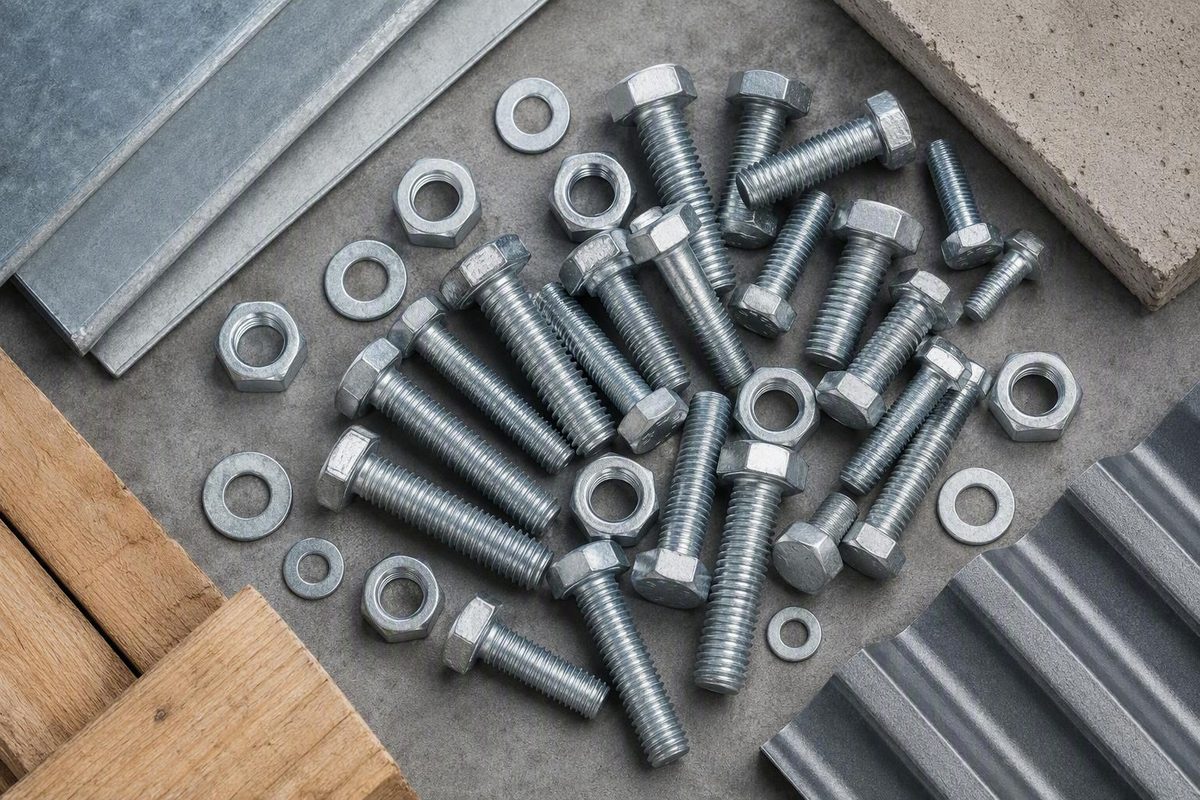
What “galvanized bolt” actually tells you—and what it does not
A galvanized bolt is generally a steel fastener protected by a zinc coating intended to reduce corrosion. Zinc acts as a barrier between the underlying steel and environmental exposure. It can also preferentially corrode where a limited area of steel becomes exposed, helping protect small scratches or coating discontinuities.
That definition is useful, but it is not enough to place an order. “Galvanized” describes a finish, not the bolt’s strength grade, dimensions, thread, shape, or suitability for a particular connection. A zinc coating does not turn a general-purpose fastener into a structural bolt, make a wood fastener interchangeable with a concrete anchor, or establish how much load an assembly can carry.
Mechanical strength depends on factors such as:
- Base material
- Grade or property class
- Nominal diameter
- Threaded cross-sectional area
- Manufacturing and heat treatment
- Connection geometry
- Installation and preload requirements
- Governing design documents and standards
In short, the coating’s principal job is corrosion protection. It should not be treated as a strength upgrade.
The label can also be ambiguous. These processes deposit zinc differently and can produce substantially different coating profiles. Commercial guidance specifically warns that a product described as galvanized is not necessarily hot-dip galvanized, so the actual process must be verified (WA Fasteners’ comparison of zinc plating and galvanizing).
A practical order description should answer more than “Is it galvanized?” Use this formula:
Bolt type + diameter and thread + length + material or grade + full or partial threading + coating process or coating standard + compatible nut and washer
For example, “galvanized 1/2-inch bolt” leaves several questions unanswered:
- Is it a hex bolt, carriage bolt, lag-style fastener, wedge anchor, or cast-in anchor bolt?
- Is the thread 1/2-13 or another series?
- How long is it?
- Is it fully or partially threaded?
- What grade is the steel?
- Does “galvanized” mean hot-dip, mechanical, or electroplated zinc?
- Has the nut been manufactured to fit the coated thread?
A complete specification helps prevent three common purchasing errors:
- Buying the right finish on the wrong fastener form
- Buying the right nominal thread with an incompatible nut
- Assuming the coating label establishes grade, strength, or environmental suitability
This guide is therefore a pre-purchase specification reference, not a structural design manual or definitive standards crosswalk. Do not infer guaranteed outdoor service life, connection capacity, or lifecycle savings from a zinc-colored appearance. Exposure, coating requirements, installation damage, connected materials, drainage, maintenance, and project documents all affect performance.
Hot-dip galvanized, mechanically galvanized and zinc-plated finishes
Hot-dip galvanizing, mechanical galvanizing, and zinc electroplating all apply zinc to steel, but they are not interchangeable purchasing terms.
Hot-dip galvanizing immerses prepared steel in molten zinc. Commercial sources place the bath at approximately 450°C and describe the resulting coating as thicker than ordinary electroplated zinc. One supplier reports an illustrative hot-dip range beginning at approximately 45 micrometers and extending beyond 100 micrometers; these are vendor-reported figures, not project minimums (WA Fasteners’ process and thickness comparison).
Because the coating adds material to threaded surfaces, thread fit and compatible nut preparation become important.
Zinc electroplating, sometimes called electro-galvanizing, deposits zinc from a zinc-containing solution by electrical current. The same supplier reports an illustrative plating range of approximately 5–25 micrometers and describes the result as smoother and thinner than hot-dip galvanizing. Commercial sources often position ordinary plating for less demanding or lower-moisture exposure, but that is a broad market distinction rather than a universal application rule.
Mechanical galvanizing is a batch process for discrete parts. Cleaned components are tumbled with zinc powder, impact media, and controlled process chemistry. Zinc is deposited without immersing the parts in molten zinc and without using electrical current during deposition. A coating vendor associates the process with ASTM B695 and reports an achievable range of approximately 25–100 micrometers; both the range and the standards description are vendor-supplied and must be checked against the current purchase specification (Plateco’s mechanical-galvanizing overview).
These reported ranges may overlap. Thickness alone does not establish environmental suitability, service life, thread fit, or compliance.
| Purchasing question | Hot-dip galvanized | Mechanically galvanized | Zinc electroplated |
|---|---|---|---|
| Process | Prepared steel is immersed in molten zinc | Parts tumble with zinc powder, media, and controlled chemistry | Electrical current deposits zinc from a zinc-containing solution |
| General coating profile | Commonly described as thicker than ordinary electroplating | Can provide a substantial coating on suitable discrete parts | Commonly described as thinner than hot-dip galvanizing |
| Typical visual clue | Often dull gray, uneven, or rough | Often matte gray | Often smoother, brighter, or shinier |
| Thread-fit implications | Buildup can require specification-compatible oversized-tapped nuts | Dimensional effect depends on the specified coating and process control | Usually less buildup than hot-dip, but fit still requires verification |
| Reference appearing in supplied commercial evidence | ASTM A153 or ASTM F2329, depending on the cited product or guidance | ASTM B695 | No plating standard is established by the available evidence |
| Buyer must verify | Current coating requirement, nut compatibility, grade, documentation, and product scope | Current B695 requirement, coating class, dimensions, grade, and availability | Exact plating specification, thickness, grade, exposure, supplementary treatment, and documentation |
Appearance can prompt a question, but it cannot answer one. A dull, rough fastener may be hot-dip galvanized, while a smooth, bright one may be plated. Color and texture do not prove:
- Coating process or thickness
- Compliance with a named standard
- Base steel or bolt grade
- Thread dimensions
- Lot identity
- Suitability for the exposure
- Whether the nut and washer belong to the approved assembly
Where compliance matters, rely on the purchase description, packaging, certifications, lot traceability, and supplier documentation—not visual inspection alone.
The practical tradeoff is not simply “thicker is always better.” A heavier coating provides more zinc but can complicate thread fit and dimensional control. A thinner plated finish may preserve a smoother surface and closer dimensions but contains less zinc. Mechanical galvanizing may be considered where its specified coating and dimensional characteristics suit the product, but the available commercial evidence does not establish equivalence with hot-dip galvanizing in every exposure.
Choose the bolt form for the connection
The connection and substrate come before the finish. Galvanizing does not make different fastener forms interchangeable.
Hex bolts
A hex bolt has an external six-sided head driven with a wrench or socket. Its machine threads engage a nut or suitable tapped hole.
In a through-bolted wood assembly, for example, the bolt passes through drilled components and is tightened with a nut. That is fundamentally different from driving a coarse-threaded lag-style fastener directly into wood.
Carriage bolts
A carriage bolt normally has a rounded head and a square neck beneath it. When the square neck seats correctly in the connected material or matching hole, it helps resist rotation while the nut is tightened.
Carriage bolts are commonly encountered in timber assemblies and connections where a low-profile rounded head is useful. The square neck still needs an appropriate seat; it does not prevent rotation in every material or hole configuration.
Lag-style fasteners
Lag screws or lag-style bolts are coarse-threaded products commonly marketed for wood connections. They generally rely on their threads engaging wood or another approved receiving material rather than passing through to a conventional machine-thread nut.
Do not substitute a lag-style fastener where a drawing specifies a through-bolt, proprietary connector fastener, or engineered bolted assembly. The load path, withdrawal behavior, installation hole, penetration, head bearing, and connection design differ.
Wedge anchors
Do not assume that a wedge anchor may be used in brick, block, grout-filled masonry, or any other substrate merely because a catalog uses the broad term “masonry.”
A wedge anchor is also not interchangeable with a cast-in anchor bolt, even when both products are zinc-coated and share a nominal diameter. Those requirements must come from the approved anchor instructions and governing design.
Cast-in anchor bolts
Common configurations identified in manufacturer guidance include:
- L-bolts
- J-bolts
- Straight anchor rods or bolts
- Headed anchor bolts
- Pre-assembled anchor arrangements
Manufacturer guidance also emphasizes templates, thread protection, specified embedment, and engineer-directed tightening (AAA Anchor Bolt’s guide to galvanized anchor bolts).
These products may connect columns, base plates, equipment, posts, or other assemblies to concrete, but shape alone does not establish capacity. Project documents must define the anchor diameter, grade, location, projection, embedment, orientation, and installation tolerances.
A quick form-to-context map
| General context | Form commonly considered | Key distinction to verify |
|---|---|---|
| Wood assembly | Carriage bolt, through-bolt, or lag-style fastener | Through-bolting versus direct thread engagement in wood |
| Steel or general through-connection | Hex bolt or specified structural assembly | Grade, hole type, grip, washers, tightening, and assembly requirements |
| Concrete expansion anchoring | Wedge anchor or another approved post-installed anchor | Approved substrate, installation procedure, embedment, spacing, and product approval |
| Cast-in foundation connection | L-, J-, straight, headed, or pre-assembled anchor | Position, template, projection, embedment, grade, and placement details |
Commercial catalogs may group hex bolts, carriage bolts, lag screws, wedge anchors, nuts, and other hardware under one broad galvanized-fastener category. That illustrates the breadth of the retail label, not interchangeability between the products.
Before selecting the coating, establish what the fastener must connect, how it transfers force, how it is installed, and whether it is removable, post-installed, or cast into place.
Read diameter, thread, length, grip and threading before ordering
Galvanized-bolt catalogs commonly organize products by measurement system, nominal diameter, thread pitch, length, grip length, head type, grade or class, and full or partial threading. Catalog filters reveal the attributes buyers may need to specify, but they do not prove that every possible combination is stocked. McMaster-Carr, for example, shows inch and metric categories together with filters for thread size, length, grade or class, grip, head, and threading extent (McMaster-Carr’s galvanized-bolt catalog).
Inch and metric designations
For an inch-series thread, 1/2-13 means:
- 1/2 inch: nominal bolt diameter
- 13: threads per inch
It does not state the bolt length. Length must appear separately, commonly after an “x,” as in 1/2-13 x 1 inch.
An inch nut and metric bolt are not interchangeable simply because their measured diameters appear close.
Worked example: 1/2-13 x 1-inch hex bolt
One seller lists a 1/2-13 x 1-inch hot-dip galvanized hex bolt with the following attributes:
- Nominal diameter: 1/2 inch
- Thread count: 13 threads per inch
- Length: 1 inch
- Thread series: coarse
- Thread direction: right-hand
- Head: six-sided external hex
- Threading: fully threaded
- Width across flats: 3/4 inch
- Head height: 0.302–0.323 inch
- Coating reference: ASTM A153
- Dimensional reference: ASME B18.2.1
These figures and standards references belong to that seller’s specific listing, not every product described as a 1/2-inch galvanized bolt (Bolt Depot’s documented 1/2-13 x 1-inch product listing).
The example shows why nominal diameter is not wrench size. The bolt is called 1/2 inch because of its nominal shank and thread diameter, while the listed head is 3/4 inch across the flats. Head height is another independent dimension. Check tool space, socket clearance, recesses, and edge access separately.
Full versus partial threading
A fully threaded product has threads extending along the listed body length, subject to its product definition and end details. A partially threaded bolt includes an unthreaded shank or grip between the head and threaded portion.
Neither arrangement is universally stronger or preferable. The required choice depends on connection design, where threads may fall relative to the connected parts, whether an unthreaded grip is required, and the applicable specification.
“Grip length” can also be ambiguous. In a partially threaded product, it may describe the usable unthreaded portion. Check how both the catalog and project documents use the term.
Selecting length from the actual stack
Do not select bolt length from nominal material names alone. Establish the complete stack, including:
- Connected plates, boards, brackets, or flanges
- Flat, beveled, hardened, or other specified washers
- Nut thickness
- Locknut or secondary nut, if required
- Required usable thread engagement
- Required thread projection
- Recesses, counterbores, gaps, or packers
- Project-defined tolerances
A bolt may pass through the named materials yet still be too short after washers and the nut are added. Excessive projection can also interfere with covers, equipment, access, or required clearances.
Use the applicable product specification, connection design, and manufacturer or engineer requirements.
Separate bolt grade, dimensions and coating standards
A defensible galvanized-bolt specification has four separate layers:
- Bolt material or strength grade
- Physical and thread dimensions
- Zinc-coating process and requirement
- Connection or assembly requirements
A reference used in one layer does not automatically answer questions in another. A dimensional standard does not establish steel strength. An anchor-bolt material standard does not identify the required coating process. A coating standard does not prescribe embedment or connection capacity.
The available evidence for the standards discussed below consists primarily of seller and manufacturer summaries rather than the full current standards. Use it to identify questions for the supplier—not as a substitute for checking the governing edition and product scope.
Material or strength grade
The grade or property class identifies mechanical requirements associated with the fastener material and manufacture. It should be stated rather than inferred from the finish, head shape, or seller category.
Manufacturer literature identifies ASTM F1554 Grades 36, 55, and 105 as anchor-bolt grades with stated minimum yield strengths of 36, 55, and 105 ksi, respectively. These figures apply only to the named anchor-bolt grades, and the source does not replace the current standard or the engineer’s selection (AAA Anchor Bolt’s F1554 grade summary).
The worked retail example provides a useful warning: its material is described as low-carbon steel conforming to either Grade 2 or A307A, rather than one exact designation. That may suit a general retail description, but it is insufficient where a project requires an unambiguous grade and certification. Never infer exact mechanical properties from “low carbon,” “general purpose,” or the galvanized finish.
Dimensional standard
Dimensions cover the thread, head, body, tolerances, and related geometry. The worked example’s seller lists ASME B18.2.1 as its dimensional reference. That listing does not make the standard a strength specification or coating requirement.
A complete dimensional description may need to identify:
- Nominal diameter
- Thread series and pitch
- Length
- Full or partial threading
- Head form
- Dimensional standard
- Special point, end, or shank details
- Required tolerances or fit
Coating standard
Several references appear in the supplied commercial material:
- ASTM A153 appears as the coating reference on the worked hot-dip galvanized hex-bolt listing.
- ASTM F2329 appears in manufacturer guidance concerning hot-dip zinc coatings on threaded fasteners, nuts, and washers.
- ASTM B695 appears in coating-vendor material concerning mechanically deposited zinc.
This article does not provide a definitive applicability crosswalk among them. Before placing an order, check the current edition, product scope, coating class or requirement, sampling provisions, and relationship to the project specification.
A coating callout must be precise enough for the supplier to identify the required process and documentation. “Zinc coated” or “galvanized finish” may not accomplish that.
Connection and assembly requirements
Structural bolting can introduce additional requirements concerning:
- Permitted fastener grades and coatings
- Process-related embrittlement precautions
- Lubrication
- Nut fit and washer type
- Tightening method
- Preload
- Lot control
- Rotational-capacity or other assembly testing
- Storage and handling
- Inspection and acceptance
A structural-fastener manufacturer discusses increased dimensions after galvanizing, grade-related restrictions, and rotational-capacity testing. These are consequential supplier statements, not universal rules; verify them against the current governing documents before applying them to a structural assembly (Birmingham Fastener’s galvanized structural-bolt overview).
For structural work, resolve every layer against the purchase specification, approved drawings, certifications, current standards, and engineer-of-record requirements. If documents appear to conflict, use the project’s formal clarification process rather than choosing the most convenient interpretation.
Treat the bolt, nut and washer as a matched assembly
A hot-dip galvanized bolt should not be purchased in isolation from its mating hardware.
The coating adds material to the threads. As a result, an ordinary nut with the same nominal diameter and pitch may bind. The available seller and manufacturer guidance calls for compatible hot-dip galvanized or specification-compliant oversized-tapped nuts, subject to the applicable coating specification and supplier documentation.
Specify the assembly together:
- Bolt form, grade, dimensions, and coating
- Nut style, grade, thread, finish, and required tapping
- Washer type, dimensions, material, hardness where applicable, and finish
- Lubrication or assembly condition if governed
- Required testing, certification, and traceability
The documented 1/2-13 x 1-inch product listing pairs the bolt with 1/2-13 hot-dip galvanized nuts and several galvanized washer options. That demonstrates catalog matching, not automatic approval for a structural connection. Nut grade, washer type, lubrication, and assembly testing still depend on the governing specification.
Matching 1/2-13 on two packages establishes only nominal diameter and pitch. It does not prove:
- Coating compatibility
- Correct oversize tapping
- Compatible grades
- Correct washer type
- Approved lubrication
- Structural assembly compliance
- Common lot identity or required traceability
What to do when a nut binds
Use this as a conservative troubleshooting sequence, not as a substitute for the project’s formal acceptance procedure:
- Stop assembly. Do not overcome unexplained binding with a longer wrench or impact tool.
- Confirm diameter and pitch. Check bolt and nut markings, labels, or packaging.
- Verify both coating processes. A hot-dip bolt and ordinary plated nut may share a nominal thread without having the required fit.
- Confirm that the nut was supplied for the coated thread.
- Inspect the threads. Look for impact damage, burrs, dirt, concrete paste, excess coating, corrosion products, or cross-threading.
- Check alignment. A nut started at an angle can mimic a fit problem.
- Consult the purchase specification and supplier. Segregate suspect hardware where identity or compliance is uncertain.
Do not casually chase, cut, grind, or re-tap coated threads. Commercial descriptions conflict about post-coating thread alteration. Alteration can remove zinc, change fit, and obscure compliance, so the applicable specification, approved procedure, and supplier documentation must control.
Match the finish to exposure without relying on an “outdoor” label
“Outdoor” is too broad to serve as a corrosion specification. An inland fence, coastal railing, bridge connection exposed to road spray, persistently damp anchor, and fastener in pressure-treated lumber may all be outdoors while presenting different moisture and chemical conditions.
Questions that can change the coating decision include:
- Is the connection sheltered or directly exposed to rain?
- Can it dry between wetting cycles?
- Is salt present from coastal air, deicing chemicals, or spray?
- Are industrial or cleaning chemicals present?
- Is the fastener below grade or embedded?
- Can water collect around the connection?
- Will installation damage the coating?
- Which preservatives are in connected lumber?
- Which other metals touch the fastener?
- Is inspection or replacement practical?
Hot-dip galvanized fasteners are commonly marketed for inland outdoor construction such as decks, fences, and sheds. That does not prove every hot-dip product is suitable for every outdoor connection. Grade, coating requirement, connected materials, and exposure still must match the project.
Commercial sources generally position hot-dip galvanizing above ordinary zinc electroplating for wet outdoor exposure because hot-dip coatings are typically thicker. This is a useful starting distinction, not a universal boundary between indoor and outdoor products.
Comparing common material and finish categories
| Option | What the label establishes | Questions to ask |
|---|---|---|
| Plain steel | No zinc coating is identified | Is the location dry and protected? Is another corrosion-control system specified? |
| Zinc-plated steel | Zinc was electrically deposited, but exact thickness and treatment may be unknown | Which plating specification applies? For what exposure was it selected? |
| Hot-dip galvanized steel | Steel was immersed in molten zinc | Which coating requirement applies? Are the nuts compatible? How will coating damage be handled? |
| Mechanically galvanized steel | Zinc was mechanically deposited on discrete parts | Which current B695 requirement applies? Is the process approved for the product and connection? |
| Stainless steel | Corrosion behavior derives from the alloy rather than a zinc coating | Which alloy, strength class, mating hardware, and environmental compatibility are required? |
This is not a universal ranking. Plain steel may be correct within a protected system. A specified zinc-plated product may be adequate in one exposure and unsuitable in another. Hot-dip galvanizing supplies a substantial zinc coating but is not immune to damage or aggressive environments. Mechanical galvanizing has distinct process characteristics but should not be assumed equivalent to hot-dip galvanizing under every condition.
Appropriately selected stainless steel merits comparison in coastal, salt-spray, marine, or chemical exposure. Supplier guidance identifies 304 as a general-purpose stainless grade and describes 316 as more resistant to salt water, while also noting that stainless threads can gall or seize. Actual selection still depends on alloy, strength, environment, connected materials, and project requirements (Marsh Fasteners’ material and coating comparison).
Stainless steel is not automatically stronger than galvanized steel or automatically the best option. Mechanical properties depend on the specific grade and dimensions, while corrosion behavior depends on the alloy and environment.
Exposure-question matrix
| Exposure or connection | What to verify before ordering |
|---|---|
| Sheltered or dry interior | Whether a coating is required; base material and grade; condensation or washdown exposure |
| Inland exterior rain and humidity | Coating process and specification; drainage; installation damage; compatible nuts and washers |
| Coastal air or salt spray | Salt severity; stainless comparison; specified alloy or coating; inspection plan |
| Road-salt or deicing exposure | Direct splash and concentration; approved coating system; documentation; replaceability |
| Marine contact or immersion | Project-defined material system; alloy and galvanic compatibility; specialist requirements |
| Industrial or chemical exposure | Contaminant identity and concentration; coating or alloy resistance; maintenance conditions |
| Below-grade or persistently damp service | Soil and moisture conditions; coating specification; drainage; inspection access |
| Pressure-treated lumber | Preservative chemistry; fastener and connector compatibility; retained moisture; applicable requirements |
| Dissimilar-metal connection | Metals in electrical contact; wetness; isolation details; relative exposed areas |
| Cast-in or concrete anchor | Coating approval, anchor grade, placement details, exposed projection, and concrete interface |
Verify preservative chemistry, connector and fastener requirements, moisture conditions, and applicable manufacturer or code information.
The same caution applies when galvanized steel contacts stainless steel, aluminum, copper-containing materials, or other metals. Compatibility depends on the complete material pairing and environment.
Avoid fixed service-life promises. A stated number of years is not meaningful unless tied to a defined coating measurement, tested environment, installation condition, damage allowance, maintenance regime, and acceptance criterion.
Pre-purchase and installation checklist
Turn the selection into a written order line before requesting a price:
Quantity — bolt form — nominal diameter and thread — length — full or partial threading or required grip — material and exact grade or class — coating process and applicable specification — dimensional standard — matching nut and washer requirements — certification, testing, and lot requirements
An example structure—not a project specification—might read:
100 — hex bolts — 1/2-13 — project-defined length — partially threaded with required grip — specified steel grade — hot-dip galvanized to the applicable project coating requirement — required dimensional standard — compatible galvanized nuts and specified washers — certifications and lot traceability required.
Complete every field from the governing documents. Do not use the example to select a grade, length, coating standard, or structural requirement.
Before requesting a quote
- Confirm the connection type and substrate.
- Confirm whether the product is a through-bolt, direct-threaded wood fastener, post-installed anchor, or cast-in anchor.
- State inch or metric dimensions explicitly.
- Identify diameter, pitch, length, and threading extent.
- Identify the exact material grade or property class.
- Name the coating process rather than its color.
- Cite the required coating and dimensional references where applicable.
- Specify compatible nuts and washers as part of the assembly.
- State packaging, marking, and lot-separation requirements.
- Request applicable material certifications and coating-compliance documents.
- Request lot traceability.
- Request structural assembly-test records where the project requires them.
- Confirm that supplied documents apply to the actual production lot.
Verify stock, price, and lead time separately. Catalog filters indicate categories, while individual product pages show only what a seller listed at a particular time. Neither proves current availability or that a required grade-finish-size combination can be supplied.
Additional checks for anchors
For cast-in or post-installed anchors, project documents and approved product instructions must establish, as applicable:
- Diameter and grade
- Approved substrate
- Exact position and spacing
- Orientation
- Projection above concrete
- Embedment
- Edge distance
- Template and restraint details
- Hole preparation and cleaning for post-installed products
- Thread protection during concrete placement
- Required nuts and washers
- Tightening instructions
- Inspection and acceptance requirements
Anchor embedment, load capacity, torque, preload, spacing, edge distance, and acceptance testing cannot be selected from a general article.
Delivery and handling
When the order arrives:
- Compare labels and packing lists with the purchase specification.
- Keep lots separated where traceability matters.
- Check markings and certificates before distributing hardware.
- Protect threads during transport, storage, and concrete placement.
- Keep threads and mating surfaces free of grit, concrete, paint, and other contamination.
- Do not install visibly damaged or cross-threaded components.
- Do not assume that bright or dull appearance proves compliance.
- Inspect nuts and washers with the bolts.
- Escalate missing markings, mixed lots, damaged threads, or unexplained coating variation before installation.
Inspect the whole connection, not only the bolt coating. Water traps, damaged connectors, incompatible metals, deteriorated timber, cracked concrete, loose nuts, and missing washers may be equally significant.
Commercial safety guidance expressly flags the fume hazard (Marsh Fasteners’ galvanized-steel safety discussion). Do not derive a hot-work procedure from this article. Use qualified personnel, project-approved methods, suitable exposure controls, and applicable workplace-safety requirements.
Specifications change and codes vary by locality, so structural work must follow current project documents and qualified direction (About Mortar Desk).
Frequently asked questions
Are galvanized bolts stronger than plain steel bolts?
Not because they are galvanized. Galvanizing is a zinc finish intended to reduce corrosion; it does not establish the bolt’s strength.
Compare the base material, exact grade or property class, diameter, thread area, manufacturing requirements, and governing design. A plain high-strength bolt may have greater mechanical capacity than a galvanized low-carbon bolt. Coating-related processing and assembly requirements must still comply with the applicable specification.
Is hot-dip galvanized the same as zinc plated?
No. Hot-dip galvanizing immerses prepared steel in molten zinc. Zinc electroplating deposits zinc from a solution using electrical current.
Commercial descriptions generally characterize ordinary electroplated zinc as thinner and smoother than hot-dip galvanizing. Because retail terminology can blur the distinction, verify the process and applicable specification instead of relying on the word “galvanized.”
Do hot-dip galvanized bolts need special nuts?
They commonly require nuts prepared and supplied for the coated threads. The zinc coating changes thread dimensions, so an ordinary nut with the same nominal diameter and pitch may bind.
Specify compatible hot-dip galvanized or specification-compliant oversized-tapped nuts, together with the required washers. Do not force a binding nut or alter the threads without an approved procedure.
When should stainless steel be compared with galvanized bolts?
Compare an appropriately selected stainless grade when the connection faces coastal air, salt spray, marine exposure, chemicals, persistent moisture, difficult maintenance, or another environment requiring a different corrosion strategy.
The comparison should include alloy, strength, mating hardware, galling controls, dissimilar-metal contact, availability, and cost. Stainless steel is a family of alloys, not a single performance level, and it is not automatically stronger or universally preferable.
Can galvanized bolts be welded, cut, or heated?
Only under an approved procedure with suitable professional controls. Heating or welding galvanized steel can generate hazardous zinc-containing fumes, while cutting or grinding can remove the zinc coating and alter the supplied component.
Qualified personnel must address structural implications, exposure controls, fire precautions, coating repair, and acceptance under the applicable project and workplace requirements. Do not weld, torch-cut, or deliberately heat a galvanized bolt merely because an uncoated steel component could be treated that way.
The final specification sequence is straightforward: choose the connection and bolt form; establish the required dimensions and grade; name the zinc-coating process or applicable specification; match the nut and washer to the coated threads; and verify the complete assembly against current project documents. “Galvanized” alone is not enough to place an order. Exposure, structural capacity, embedment, preload, testing, and local requirements must be confirmed through the responsible supplier, inspector, governing documents, or qualified professional.