 MortarDesk
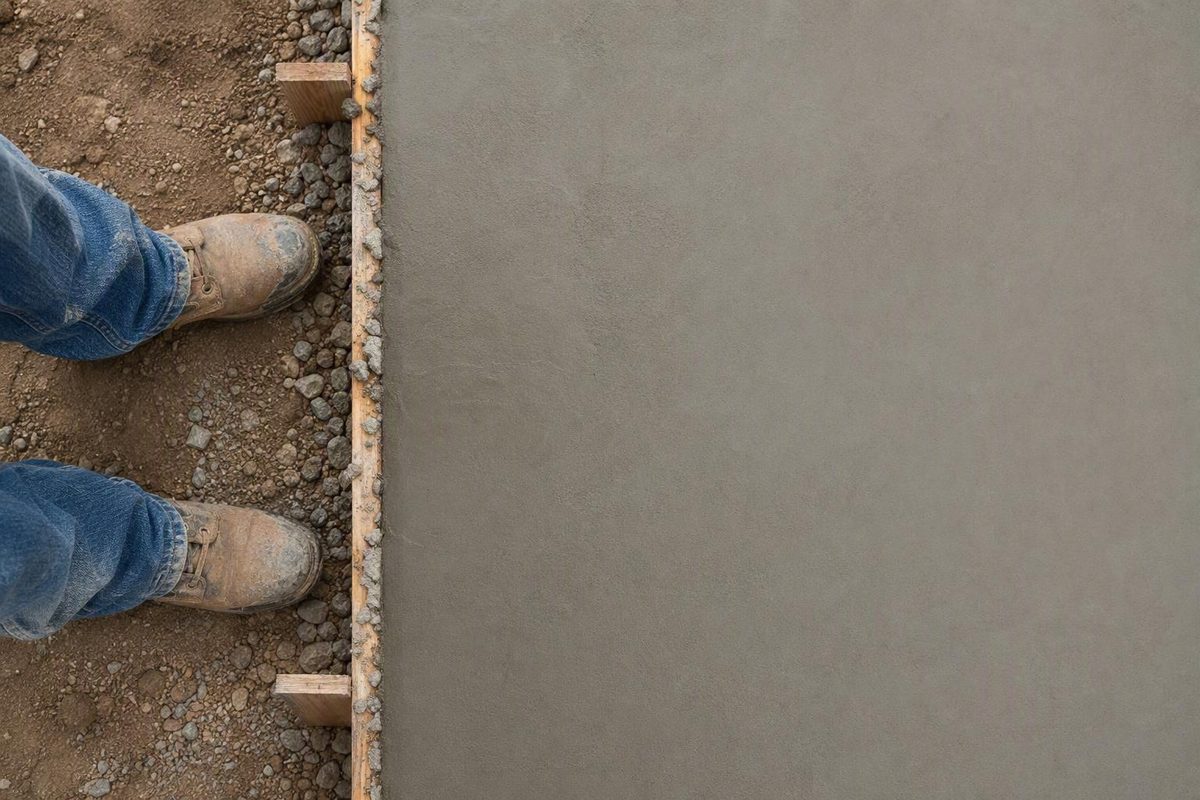
The short answer: wait at least 24 hours, and preferably 48
For ordinary residential concrete placed and cured in favorable conditions, 24 hours is the earliest reasonable point for cautious, light foot traffic. It is a conditional minimum, not a guarantee. Concrete Network recommends waiting at least 24 hours before walking on standard broom- or trowel-finished concrete in its guidance on walking on new concrete.
If you do not know the mix, temperature history, finish, curing method, or installer’s intended schedule, waiting 48 hours is the safer general choice. Some contractors recommend keeping people and pets off altogether for that period, illustrating why 48 hours provides a more conservative margin when project details are uncertain. Kent Home Services advises a 48-hour closure.
Walk in a straight line without shuffling, pivoting, jogging, jumping, or repeatedly using the same route. This is not permission for routine household traffic.
Do not walk on concrete after only 4 hours; it may appear firm while still being vulnerable to marks and surface damage, according to this four-hour access assessment. Twelve hours is also too early as general guidance, even when the surface looks pale, dry, hard, or firm. A supplier’s fresh-concrete timeline treats 24 hours as the minimum under favorable conditions and specifically advises against walking at 12 hours.
Apparently conflicting recommendations usually describe different levels of risk and use:
- 24 hours is the earliest conditional point for one or two careful passes in favorable conditions.
- 48 hours is a more conservative recommendation when the project details are unknown.
- 48–72 hours or longer is a cautious planning window for routine household walking, less favorable conditions, or sensitive finishes.
- Longer closures may reflect the installer’s mix, climate, finishing sequence, or quality-control policy.
None of these pedestrian windows authorizes construction work, ladders, wheeled equipment, furniture, stored materials, vehicles, or structural loading. A careful footstep creates a different demand from a wheelbarrow turning, a ladder bearing on four small feet, or a tire braking on the surface.
Project instructions come first: Follow the installer’s directions, the concrete or proprietary-product instructions, the project specification, and any documented strength results. If any of them requires a longer wait, use the longer project-specific period.
A specified rapid-setting or high-early-strength product may have an approved schedule shorter than ordinary concrete. That schedule must come from the product and project instructions—not from appearance or a generic timeline.
A practical concrete access timeline by activity
Concrete should be opened by activity, not by one all-purpose date. Total weight matters, but so do contact area, movement, impact, twisting, and how often the load crosses the same place.
The following is planning guidance assembled from contractor, supplier, and concrete-industry publications. It is not a tested opening criterion for an individual slab.
| Time after placement | General access guidance | What should remain off |
|---|---|---|
| 0–12 hours | No access. Protect the slab from accidental entry; even apparently firm concrete remains too young for general walking. Guidance for the initial setting period recommends waiting at least 24 hours. | Adults, children, pets, wheels, tools, bins, furniture, deliveries, and loose objects |
| At least 24 hours | Under favorable conditions and with installer approval, one or two careful, straight-line crossings may be possible. The 24-hour point is presented as a minimum for standard finishes. | Routine traffic, pets, play, pivoting, wheels, furniture, ladders, and equipment |
| About 48 hours | A safer general planning point for light walking when project details are uncertain. One paving contractor advises keeping everything off for 48 hours before walking in its new-driveway timeline. | Concentrated, rolling, dragging, twisting, or impact loads unless specifically approved |
| 48–72 hours or longer | A cautious window for routine household walking or less favorable circumstances—not proof that the slab is ready. A more conservative contractor schedule calls for at least 48 hours without pedestrian or pet access. | Unapproved wheels, point loads, heavy objects, construction activity, and unusual traffic |
| About 7 days | Common qualified guidance for a passenger car or light vehicle on an appropriate residential driveway. A concrete supplier recommends at least seven days before cars or light vehicles. | Heavy trucks, machinery, major deliveries, and loads outside the slab’s intended use |
| About 28 days | A conventional planning benchmark for heavy vehicles or major loads, subject to design and project approval. Concrete Network recommends at least 28 days before heavier vehicles. | Any load exceeding the slab’s design or lacking project-specific approval |
During the initial closure, use barriers that can stop visitors, delivery workers, children, and pets rather than merely reminding household members. If the slab blocks a normal entrance, establish another route.
Once careful walking has been approved, use broad, clean footwear and take deliberate steps. Avoid heels, cleats, gravel trapped in shoe treads, sharp turns, and repeated testing. If access is unnecessary, waiting another day provides additional margin at little cost.
Even after light walking becomes acceptable, small wheels remain a separate concern. Strollers, bicycles, scooters, skateboards, bins, wheelbarrows, and hand trucks transfer their loads through relatively small contact areas. Their wheels may also turn, skid, or carry grit across the finish.
Pets are not simply lighter pedestrians. Claws create small contact points, and animals may run, stop abruptly, scratch, or travel repeatedly over the same route.
Furniture also differs from a standing person. Narrow legs concentrate weight, while positioning furniture may involve twisting or dragging. Grills, planters, storage boxes, umbrella bases, and loaded carts can produce concentrated loads that remain in one place.
When vehicle access is eventually approved, avoid sharp steering, sudden braking, spinning tires, and driving close to unsupported edges. Approval for a passenger car does not automatically cover a moving van, delivery truck, recreational vehicle, loaded trailer, refuse truck, or construction machine.
The 28-day benchmark is not an automatic permission date. The slab must still be suitable for the intended load, adequately supported, properly cured, and accepted under the project requirements. Concrete may permit limited foot traffic much earlier, while an unusual point load or commercial vehicle may still need verification after 28 days.
Why concrete can look dry before it is ready
Concrete does not become serviceable in the same way that paint becomes dry. Several overlapping processes occur, and the visible surface reveals only part of them.
Setting is the early transition from plastic, workable material to a rigid mass. Setting does not mean the slab has developed enough strength for unrestricted use.
Curing supports hydration—the chemical reaction between cement and water that develops strength and wear resistance. Hydration continues after the surface hardens.
Drying is moisture leaving the concrete. It matters for uses such as floor coverings and coatings, but visible surface dryness does not establish internal strength. Evenson Concrete Systems explains this distinction in its overview of curing through hydration versus moisture evaporation.
That leads to a practical rule:
Dry-looking is not the same as traffic-ready.
Sun, wind, or dry air may remove the surface sheen and lighten the concrete’s color while the slab is still young. A hard surface may remain susceptible to scuffing or disruption, and the concrete below it may be less developed than appearance suggests.
Repeatedly “testing” the slab also introduces the traffic the closure is intended to prevent.
Concrete develops strength progressively rather than switching from uncured to cured at one exact moment. That is why limited pedestrian access may be allowed before curing is complete, while wheels, furniture, vehicles, and major loads remain restricted.
The commonly cited month-long or 28-day period is best treated as a conventional strength-development and planning benchmark. It does not mean:
- The slab must remain entirely unused for a month
- Every concrete mixture has identical strength at that age
- Every slab is automatically approved for every load on that date
- Strength development stops after 28 days
- Elapsed time replaces specifications or testing
Avoid relying on claims that every slab reaches an exact percentage of its strength on a particular day. Actual development depends on the mixture, temperature, moisture control, dimensions, and other project conditions. A generic timeline can help plan access; it cannot report the measured strength of an individual slab.
What early traffic can do to young concrete
The clearest risks from premature pedestrian traffic are surface and finish damage:
- Footprints and paw prints
- Indentations
- Scuffs and scratches
- Displaced or disrupted surface paste
- Smeared texture
- Damage to decorative detail
- Marks at edges or corners
- Uneven areas caused by rubbing
A careful straight-line step primarily applies downward pressure. Shuffling adds lateral movement. Pivoting concentrates weight over part of the shoe while grinding the sole across the finish. Jogging adds impact, and repeated crossings expose the same area over and over. Contractor guidance on early access similarly warns against twisting, jogging, dragging, and repeated traffic.
Contact area matters as well. A broad shoe distributes weight differently from a high heel, pet claw, ladder foot, narrow furniture leg, small hard wheel, sharp-edged tool, or loaded caster.
Small wheels can be deceptive. A stroller or scooter may weigh less than an adult, but its load passes through small contact patches. Turning introduces sideways force, and embedded grit can scratch the finish.
Dragging creates a different demand from placing an object down. A stationary object primarily presses downward. A dragged chair, planter, bin, or tool also moves laterally across the surface, potentially disrupting the finish along its entire path.
Early marks should not automatically be described as structural failure. It does not by itself prove internal cracking, lost capacity, or future slab failure.
The reverse is also important: the absence of a visible footprint does not prove readiness for a heavier load. A shoe may leave no obvious mark while a narrow leg, turning wheel, loaded vehicle, or sharp object still imposes a more demanding load. Appearance can reveal damage, but it cannot certify strength.
Edges and corners deserve particular caution when wheels or concentrated loads first enter the slab. Avoid making an edge the first location used for a heavy object, sharp turn, or repeated crossing.
Conditions that can lengthen the waiting time
A 24- or 48-hour recommendation assumes ordinary residential concrete and reasonably favorable placement and curing conditions. The actual schedule can vary with:
- Air and concrete temperature
- Humidity and moisture exposure
- Rain
- Wind and direct sun
- Mix composition
- Water-to-cement ratio
- Cement and aggregate characteristics
- Accelerating or retarding additives
- Slab thickness and geometry
- Subgrade and edge support
- Surface finish
- Curing method and protection
- Intended load
- Project specifications
Cold conditions
Cold slows setting and strength development. A 24-hour minimum taken from mild-weather guidance should not automatically be applied to a cold-weather pour. Contractor guidance identifies temperature, humidity, additives, slab thickness, and mixture composition as variables that can extend the time before pedestrian access.
Near-freezing conditions require project-specific advice. Do not invent an additional number of hours. Ask the installer how the concrete was protected, whether the specified protection remained in place, and what revised opening schedule applies.
Humidity and damp weather
High humidity or a damp-looking surface is not, by itself, a measure of strength development. Humidity affects evaporation and appearance, while actual readiness also depends on temperature, mixture, protection, and curing history.
Nevertheless, cool or persistently damp project conditions often justify a more cautious access decision when the slab’s history is uncertain. Color alone is not a reliable guide: neither a dark, damp-looking surface nor a pale surface establishes readiness.
Heat, sun, and wind
Hot, dry, or windy weather can make the surface look ready sooner by increasing moisture loss. That appearance is not proof of adequate strength. Rapid moisture loss can also contribute to curing and cracking concerns; warm-weather guidance therefore does not support shortening the schedule merely because the top changed color quickly. A supplier’s overview notes both faster setting and the risk associated with rapid moisture loss.
Mix composition and water content
Concrete mixtures develop strength at different rates. Cementitious materials, aggregates, water content, additives, and mixture proportions can all affect setting and later performance.
Excess mix water can reduce strength and durability and prolong drying. Homeowners should not respond by adding cement, spreading dry material on the surface, changing the mixture, or applying an accelerator without an approved design and the installer’s direction.
Thickness, finish, and curing method
Finish type can influence how vulnerable or visible an early mark will be. Smooth troweled work, broom finishes, exposed aggregate, stamped patterns, overlays, and polished systems should not be assumed to have identical schedules.
Curing methods also vary. A project may use curing compounds, coverings, or controlled-moisture procedures. Because the correct treatment depends on the project, do not remove protection or improvise watering, sheeting, sealing, or chemical treatment based solely on general online advice.
Rain and failed protection
If rain falls soon after placement, ask the installer whether it affected the finish or curing plan. The answer depends on the timing, intensity, finishing stage, protection, and actual surface condition.
Contact the responsible professional if curing protection blew away, sprinklers operated unexpectedly, standing water formed, or temperatures approached freezing. These events cannot reliably be converted into a universal rule such as “add another day.”
A useful decision rule is:
Wait longer when conditions are cool or uncertain, when the load rolls, twists, drags, or rests on small contact points, or when important project details are unknown.
Stamped concrete, rapid-set mixes, and other exceptions
Decorative and specialized concrete may depart from the ordinary residential timeline.
Stamped and decorative surfaces
One general industry guide suggests allowing roughly one additional day for stamped concrete before walking so that excess release material can be addressed, but this is not a universal rule; the installer’s decorative process controls. See the discussion of stamped-concrete pedestrian timing.
Do not wash off release material, clean the surface, apply a treatment, or move furniture onto decorative concrete merely because ordinary broom-finished concrete might permit careful walking. The surface may still be awaiting a specified finishing step.
Minor traffic damage can also be more noticeable on decorative work. A scuff on a plain utility slab and one crossing a carefully textured pattern may have similar depth but very different visual consequences.
Rapid-set and high-early-strength mixtures
High-early-strength concrete, accelerator-containing mixtures, and proprietary rapid-setting products may permit earlier access. Use only the product-specific, installer-approved opening schedule. “Rapid set” is not permission to guess when walking, loading, or driving is acceptable.
The reverse can also apply: some additives or project requirements may extend the schedule. Knowing that an additive was used is not enough; its purpose and the approved mixture matter.
Finishing crews on the slab
A worker accessing concrete during a controlled finishing operation does not prove that normal pedestrian traffic is safe.
Controlled construction access should never be converted into permission for children, pets, delivery workers, or homeowners to cross the slab later that day.
Slabs outside the ordinary residential case
Do not apply a residential walkway or driveway schedule unchanged to:
- Bonded or unbonded overlays
- Thin sections
- Polished concrete systems
- Industrial floors
- Structural or suspended slabs
- Loading areas
- Precast or specialty products
- Surfaces awaiting coatings
- Slabs carrying racks, lifts, machinery, or other point loads
These applications may have separate product requirements, load criteria, sequencing rules, or testing provisions.
When opening time affects structural work, commercial traffic, unusual loading, or a critical construction schedule, approval may require project-specific verification or documented strength testing rather than elapsed time alone. The contractor, supplier, testing agency, or engineer responsible for the project should determine what evidence is required.
What to do if someone walked on the slab too early
First, stop further traffic. Do not send someone else onto the slab to check the first person’s path, and do not test nearby areas with a shoe, finger, tool, or wheel. Repeated investigation can enlarge the affected area.
From outside the protected area, look for:
- Footprints or paw prints
- Scuffs and scratches
- Depressions
- Smears or displaced surface paste
- Damaged broomed or stamped texture
- Cracks
- Chipped or disturbed edges
- Material adhering to footwear
- Tracks from wheels or dragged objects
Take clear photographs of the entire area and close views of individual marks. Record when the concrete was placed, when the traffic occurred, what crossed it, and whether there had been rain, cold, or a protection failure.
If a mark is visible, contact the installer before scraping, patching, rubbing, washing, grinding, or applying a repair product. An improvised repair can change the color or texture, obscure the original condition, and complicate assessment.
A shallow cosmetic mark does not by itself prove structural failure. General online guidance cannot, however, determine its depth or significance. Contact the installer or responsible project professional if you see:
- Cracking
- Deep impressions
- Displaced or loose material
- Edge or corner damage
- A broad area of disturbed finish
- Evidence that a wheel or heavy object crossed the slab
- Any condition you cannot confidently classify
Seek advice even without a visible mark if the accidental load was substantial—for example, a vehicle, loaded wheelbarrow, ladder, pallet, or heavy delivery. No imprint is reassuring only in a limited visual sense; it is not a strength measurement.
The numerical windows in this article are general reference guidance drawn mainly from contractor, supplier, and concrete-industry publications. They are not standards-backed guarantees for a particular slab and do not replace project specifications, product instructions, testing, or individual engineering advice.
Mortar Desk describes itself as a building-material reference desk, not a contractor or engineering adviser. The installer or responsible project professional is the appropriate source for a decision about a specific slab.
Frequently asked questions
Can you walk on concrete after 12 hours?
No—not as general guidance. Twelve hours is too early for ordinary pedestrian access, even if the surface looks dry, light-colored, or firm. Guidance addressing this question directly says to wait at least 24 hours and prefer 48 hours when conditions are less favorable. See the supplier’s 12-hour and light-traffic guidance.
Keep people, children, pets, and objects off the slab. If the installer prescribed a longer closure, follow that schedule.
Can children and pets use new concrete after 24 hours?
They should generally remain off longer than a careful adult making one necessary crossing. Children may run, jump, pivot, or repeatedly cross the same area. Pets can scratch with their claws, stop abruptly, or concentrate pressure through small contact points.
Even after the first 24 hours, guidance recommends keeping pets and small wheeled traffic away while the surface remains vulnerable. See this pedestrian-access guidance for pets and wheels.
Use a physical barrier rather than expecting a child or animal to avoid the slab. A leash, closed gate, or alternate route can prevent accidental entry.
When can you put patio furniture or use a wheelbarrow on new concrete?
Do not treat furniture or a wheelbarrow as ordinary foot traffic. Furniture legs concentrate weight and may be dragged while being positioned. A wheelbarrow applies its load through one or two small wheels and may turn sharply.
Some general supplier guidance places light furniture or wheelbarrow use no earlier than about 48 hours, but that is still conditional rather than automatic approval. The distinction appears in this walking, furniture, and wheelbarrow timeline.
Wait longer for heavy objects, narrow legs or wheels, decorative finishes, or unfavorable conditions. Once approved, lift furniture rather than dragging it and keep concentrated loads away from slab edges.
How long after pouring concrete can you drive a car on it?
About seven days is common general guidance for a passenger car or light vehicle on a suitable residential driveway, subject to installer approval. Some contractors use longer closures depending on the mix, weather, support, and intended use. One contractor’s new-concrete driving guidance recommends at least one week.
When access is approved, avoid sharp steering, sudden braking, spinning tires, and driving close to unsupported edges. A passenger-car date does not automatically apply to vans, trailers, refuse trucks, recreational vehicles, or machinery.
Heavy vehicles and major loads are often planned around approximately 28 days, but the date alone is not permission. The slab must be designed and approved for the load.
Does rain or cold weather mean you should wait longer?
Often, a longer wait is prudent. Cold conditions slow setting and strength development. Rain may affect the surface or curing process depending on when it falls, how intense it is, and what protection was in place.
High humidity or damp appearance does not by itself prove slow strength development, but neither does it establish readiness. Hot, dry weather can make the surface look ready sooner without proving that the concrete can accept traffic.
If rain arrived soon after placement, temperatures approached freezing, or specified protection failed, contact the installer rather than inventing an additional number of hours. Concrete-access guidance similarly advises allowing more time for rain, cold, and decorative work.
The rule to remember is simple: treat 24 hours as the earliest conditional point for careful light walking and 48 hours as the safer default when details are uncertain. Keep pets, wheels, furniture, dragging, vehicles, and concentrated loads off longer. Extend the closure in unfavorable conditions, and follow the installer’s or project specification’s schedule whenever it differs from general guidance. A full-day minimum is also reflected in broader residential concrete curing guidance.