 MortarDesk
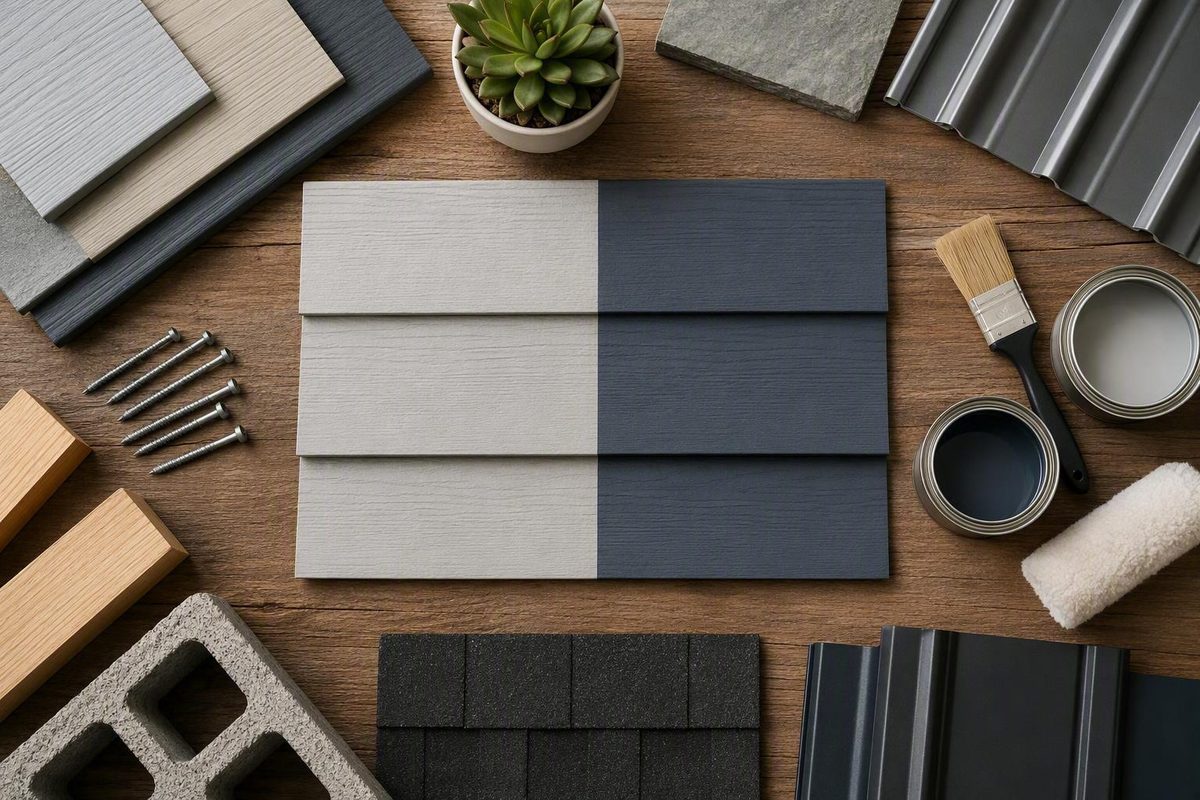
James Hardie’s headline 30-year limited warranty is not a 30-year paint warranty. The underlying fiber-cement product has a separate 30-year term, while the factory-applied ColorPlus finish has a 15-year limited warranty. On 2,000 square feet of siding, one repaint at the reported $1.50–$4 per square foot adds $3,000–$8,000 after that shorter finish window (James Hardie; This Old House).
That does not mean every ColorPlus home must be painted in year 16. A warranty expiration is not a maintenance deadline, and an intact finish may remain acceptable beyond year 15. It means buyers comparing fiber cement with vinyl should budget for the possibility of a second exterior-finish bill during a 30-year ownership period rather than treating the substrate warranty as finish coverage.
Why the 30-Year Story Is Persuasive
The conventional case for fiber cement is reasonable. James Hardie describes its substrate warranty as transferable, non-prorated and 30 years long. ColorPlus is factory finished, so it can avoid the initial field-painting stage and reduce dependence on jobsite preparation, painting weather and painter availability.
Fiber cement is also commonly presented as a durable upgrade over vinyl. Consumer cost comparisons report installed prices of $3–$12 per square foot for vinyl and $7–$18 per square foot for fiber cement (AOL’s siding comparison). A buyer may accept the higher initial bid if the upgrade appears to carry a matching 30-year finish promise.
The problem is narrower than the consensus suggests: the two warranties do not run on the same clock or cover the same layer. The 30-year term supports the case for the board, not a claim that its original color will be maintained or routinely renewed for three decades.
Enter your siding area, local bids and expected ownership year; the calculator shows which material has the lower modeled cost.
This model compares installation cost with one optional fiber-cement repaint after year 15. The default rates are the midpoints of the supplied cost ranges.
| Ownership Year | Vinyl Total | Fiber-Cement Total | Lower Cost |
|---|---|---|---|
| 0 | $15,000 | $25,000 | Vinyl by $10,000 |
| 5 | $15,000 | $25,000 | Vinyl by $10,000 |
| 10 | $15,000 | $25,000 | Vinyl by $10,000 |
| 15 | $15,000 | $25,000 | Vinyl by $10,000 |
| 16 | $15,000 | $30,500 | Vinyl by $15,500 |
| 20 | $15,000 | $30,500 | Vinyl by $15,500 |
| 25 | $15,000 | $30,500 | Vinyl by $15,500 |
| 30 | $15,000 | $30,500 | Vinyl by $15,500 |
Scope: installation plus one optional fiber-cement repaint after year 15. Vinyl replacement, other maintenance, inflation, financing, performance and resale value are — because supported figures were not supplied.
Sources: James Hardie warranty summaries; This Old House repaint range of $1.50–$4/sq. ft.; AOL comparison ranges of $3–$12/sq. ft. for vinyl and $7–$18/sq. ft. for fiber cement. Midpoint defaults are calculated from those ranges.
The calculator deliberately makes no assumption about vinyl replacement, financing, inflation or resale value because the supplied evidence does not provide defensible figures for them. It compares initial installation with one possible post-year-15 fiber-cement repaint. Local bids can produce a much smaller or larger difference than the default midpoint example.
The Two Hardie Warranties Cover Different Layers
The useful way to read the warranty structure is by component rather than by brand name.
| Coverage | Reported Term | Component | What Is Established |
|---|---|---|---|
| ColorPlus finish | 15 years | Original factory coating | Qualifying peeling, cracking and chipping; paint and labor are described as covered |
| Hardie substrate | 30 years | Siding, trim or soffit product | Product conditions meeting the applicable substrate warranty |
| Replacement paint | Varies | Field-applied coating | Only what the paint maker’s written warranty covers |
| Painter workmanship | Varies | Preparation and application | Only what the painting contract covers |
James Hardie’s ColorPlus summary says the limited finish warranty covers paint and labor for qualifying peeling, cracking and chipping (ColorPlus overview). That wording does not establish that an approved claim produces a whole-house repaint, reimbursement for a homeowner’s chosen contractor or replacement of every affected board. The controlling warranty and written claim decision determine the remedy.
The longer substrate term does not extend the original finish term. ColorPlus can be outside its stated coverage period while the board remains within the substrate warranty. A coating problem also does not prove that the board has failed.
Once the siding is repainted, the new field-applied coating introduces another set of terms. Its performance should not be assumed to receive ColorPlus coverage because ColorPlus applies to the original factory finish. The paint manufacturer may cover its coating, while the painter may separately cover preparation and workmanship.
A Repaint Adds $3,000–$8,000 on 2,000 Square Feet
The reported painting-labor range is $1.50–$4 per square foot. Applied to 2,000 square feet, that produces a planning range of $3,000–$8,000. The source describes project and location variation, so this is not a national quote or a guaranteed future price.
The initial installed-price ranges are broad:
| Cost Item | Per Square Foot | 2,000-Square-Foot Total |
|---|---|---|
| Vinyl installation | $3–$12 | $6,000–$24,000 |
| Fiber-cement installation | $7–$18 | $14,000–$36,000 |
| One repaint | $1.50–$4 | $3,000–$8,000 |
The ranges overlap, which is why comparing their endpoints does not identify a universal winner. A detailed local fiber-cement bid should be compared with a detailed local vinyl bid for the same house, scope, removal work and accessories.
Using the range midpoints solely as a transparent default, vinyl starts at $7.50 per square foot and fiber cement at $12.50. The initial difference on 2,000 square feet is $10,000. A midpoint repaint at $2.75 per square foot adds $5,500, equal to 55% of that initial premium. By year 20, the modeled totals are $15,000 for vinyl and $30,500 for fiber cement.
That example does not prove vinyl will last 30 years without expense, nor does it price differences in performance or resale value. No supported vinyl replacement interval or replacement cost was supplied. It shows the narrower purchasing issue: the 30-year substrate term does not remove finish maintenance from the fiber-cement budget.
Year 15 Is a Coverage Boundary, Not a Paint Date
The end of the ColorPlus term does not mean the coating fails on its anniversary. A warranty period defines a limited coverage window; it is not an exact service-life prediction or an instruction to repaint.
If the coating remains intact and its appearance is acceptable, reaching year 15 alone does not create a painting requirement. Climate, orientation, shade, cleaning, detailing, workmanship and exposure can all affect when an owner chooses to repaint, but the supplied evidence does not support a universal 10-, 15- or 20-year cycle.
The cost model therefore treats repainting after year 15 as a scenario rather than a certainty. Turn off the repaint option if you expect to sell earlier, believe the finish will remain acceptable or want to compare installation costs alone.
The distinction still matters during purchase. A homeowner expecting to remain for 20 or 30 years bears the risk of a maintenance repaint after the finish warranty ends. A buyer planning a shorter hold may place less weight on that future expense.
Routine Repainting Is Not an Established Warranty Benefit
ColorPlus coverage is described as applying to qualifying peeling, cracking and chipping. The supplied manufacturer material does not identify normal aging, routine maintenance painting, gradual fading or an elective color change as covered benefits.
“Fade resistant” is a performance statement, not necessarily an express promise to pay for fading. An owner can reasonably find the appearance unacceptable without the condition satisfying the warranty definition of a covered defect.
The practical distinctions are:
| Observed Condition | Evidence Supports | Initial Response |
|---|---|---|
| Peeling, cracking or chipping | Potential finish claim, subject to official terms | Preserve evidence and request review |
| Gradual fading or aging | No established repaint benefit | Check the warranty; plan as maintenance |
| Impact or cleaning damage | Not automatically a factory defect | Document the cause and obtain guidance |
| Unwanted color | Elective design change | Price a repaint and new coating warranty |
An approved factory-finish claim may include paint and labor, but that is different from using the warranty as a routine repaint allowance. The applicable product, installation date, country, region and warranty version control.
Preserve a Possible Claim Before Painting
If the original finish is peeling, cracking or chipping, stop before scraping, sanding, priming, replacing boards or repainting. Permanent work can remove evidence needed to assess the cause and extent of the condition.
Photograph the full elevation, the pattern across several boards and close views of the coating edges. Record when the condition was discovered and whether it has spread. Gather the product name, ColorPlus color if known, proof of purchase, installation records, installer details and cleaning or repair history.
Request a written coverage determination from James Hardie. Confirm the applicable notice deadline, inspection process, claim form, preauthorization requirements and whether any work may begin before a decision.
A contractor summary reports written notice within 90 days after discovery and before permanent repair, but that is secondary guidance rather than verified language from every applicable warranty (GP General Corp). Do not assume the reported deadline governs a different product, date or region.
Describe observable facts rather than declaring an unverified cause. “The coating is separating at these locations” preserves a useful record; “the factory finish is defective” reaches a conclusion that may require inspection.
Repainting Does Not Have One Proven Warranty Effect
The available evidence does not establish that repainting automatically cancels every remaining James Hardie warranty. It also does not establish that every preparation method, coating choice or application error leaves substrate coverage unaffected.
A dated contractor article says repainting ends the existing ColorPlus finish warranty but not the material warranty when replacement paint meets James Hardie recommendations. It also recommends 100% acrylic exterior paint (Blue Jay Exterior Renovations). Those statements are third-party guidance from January 22, 2018, not current first-party warranty or technical instructions.
Before authorizing work, ask James Hardie in writing whether painting the affected boards changes remaining ColorPlus coverage, whether work on one elevation affects coverage elsewhere and whether the proposed preparation and coating system affect substrate coverage.
Ask the painter and paint supplier which written coating warranty applies, who is responsible for adhesion failure, which preparation failures are excluded and whether labor and materials are both covered. The factory-finish warranty, substrate warranty, paint warranty and workmanship warranty remain separate agreements.
ColorPlus Still Has a Valid Initial-Cost Advantage
The warranty split does not erase ColorPlus’s practical benefit. A factory finish can eliminate the initial field-painting stage and reduce exposure to jobsite application conditions. That advantage is real when the comparable primed-siding proposal requires separate preparation, primer, paint and labor.
Primed, field-painted Hardie siding offers broader custom-color flexibility, but application quality and painter warranty terms become part of the original project. ColorPlus may cost more initially while simplifying that stage.
A useful bid separates siding, trim, accessories, installation, preparation, primer, paint and labor. It should also state which elevations and repairs are included. Without that breakdown, a ColorPlus premium can be confused with differences in trim, demolition or installation scope.
The decision is therefore not that the 30-year warranty is worthless or that repainting is guaranteed in year 16. The defensible reading is that James Hardie supplies two limited warranties for two layers. Price the board using the 30-year substrate term, but price the finish using its 15-year term and a possible $1.50–$4-per-square-foot repaint.
Evidence Limits
The supplied evidence includes James Hardie marketing summaries and secondary cost and contractor sources, but not the controlling ColorPlus warranty contract or current first-party repainting instructions. It cannot determine coverage, claim deadlines, remedies, transfer requirements or repainting consequences for a particular property.
Use the warranty for the exact product, installation date, country and region. If a finish defect may exist, preserve the original condition and obtain a written claim decision before permanent work. For purchase budgeting, keep the 30-year substrate promise and the 15-year finish promise on separate lines.