 MortarDesk
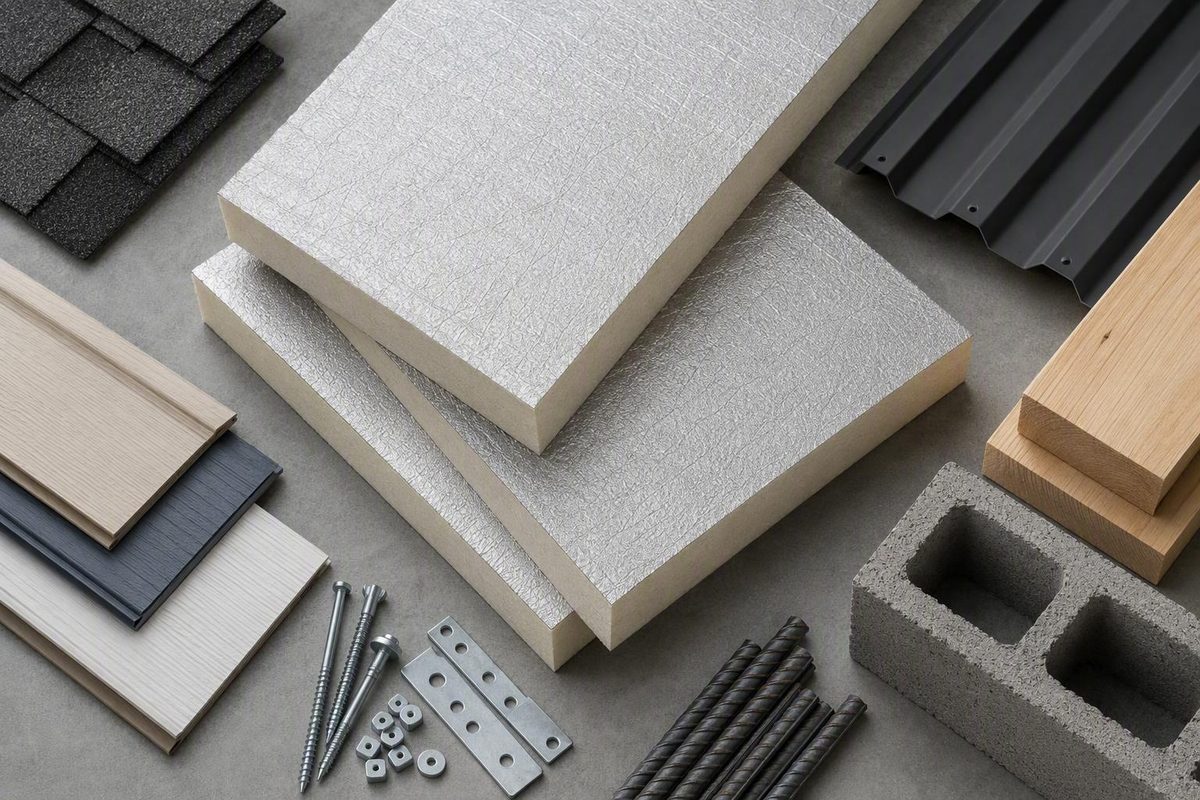
Polyisocyanurate—usually shortened to polyiso—is commonly published at approximately R-6 to R-6.5 per inch under nominal or standard conditions. For quick budgeting and preliminary thickness estimates, R-6 per inch is the most practical starting point, but it is not a guaranteed value for every board or service condition (see the approximate published range).
The number used for purchasing or final calculations should come from the current data sheet for the exact product, thickness, facer, aging method, and test temperature. A board rating also describes the insulation under stated test conditions; it does not automatically equal the effective performance of a completed roof or wall.
The short answer: polyiso is usually about R-6 per inch
Use about R-6 per inch for an early estimate. Then replace that assumption with the named product’s published total R-value before ordering material or evaluating the assembly.
A product-specific example shows why that distinction matters. IKO lists its 1-inch, foil-faced Enerfoil board at R-6.2 under the conditioning requirements and test methodology stated for that product. R-value measures resistance to heat flow, so a higher value means heat moves through the tested material more slowly (see IKO’s Enerfoil chart and qualifications).
Rmax, by contrast, makes the broader manufacturer statement that polyiso provides R-6.5 per inch. That can be an appropriate headline description for the material or certain products, but it is not a universal specification that can be assigned to every polyiso board (review Rmax’s R-6.5 statement).
A practical hierarchy is:
- Use R-6 per inch for preliminary sizing.
- Use the exact product’s published total R-value when comparing or purchasing boards.
- Identify whether the value is initial, nominal, conditioned, labeled, or LTTR.
- Check the mean test temperature when cold-weather performance matters.
- Evaluate joints, fasteners, framing, penetrations, and other assembly effects separately.
Important: A published value in the R-6 to R-6.5-per-inch range does not guarantee identical performance after aging, in freezing conditions, or in a completed assembly.
Why R-6, R-6.2, and R-6.5 can all appear in polyiso specifications
The numbers usually differ because they describe different products, conditions, or reporting methods.
R-6 per inch is a rounded material estimate. It is easy to apply during initial planning and falls within the commonly published range, but it does not identify a particular board.
R-6.2 may be a conditioned rating for a named product, facer, and thickness. In the Enerfoil example, it applies to a 1-inch foil-faced board under the manufacturer’s stated testing and conditioning procedures. It should not be transferred automatically to an unrelated product.
R-6.5 per inch may be an initial, nominal, or broadly stated manufacturer value. Before using it, determine whether it covers the exact product and thickness being purchased and whether the rating accounts for aging.
Product literature may use several related terms:
- Initial R-value describes performance near the beginning of the product’s life. For foam containing captive cell gases, initial performance may be higher than aged performance.
- Nominal R-value is an approximate category or convenient shorthand. It is not necessarily the assigned value for every available thickness.
- Conditioned R-value is measured after a specimen undergoes a defined conditioning procedure.
- Labeled R-value is the value represented on the product label or fact sheet under the applicable reporting and test basis.
- Long-Term Thermal Resistance, or LTTR, reports projected aged thermal performance rather than only the foam’s initial result.
These terms should not be treated as interchangeable. Published performance can vary with age, temperature, test method, installation quality, facing material, and whether the reporting method uses LTTR or another conditioning approach.
Polyiso is also not simply an unfaced block of generic foam. It consists of a rigid foam core laminated between facers. Those facers may include foil, coated glass-fiber mat, reinforced felt, or other product-specific materials. A rating for one facer configuration should not automatically be applied to another.
Published values may depend on:
- Manufacturer and formulation
- Exact board thickness
- Facer type and permeability
- Aging or conditioning method
- Mean test temperature
- Temperature differential
- Test standard
- Production facility
- Product function and intended application
Thickness deserves particular attention. A generic “R-value per inch” may suggest simple multiplication, while the manufacturer’s data sheet may assign total R-values separately to each available thickness. Where a target falls between stocked sizes, select an actual board or combination of boards and add their verified published values.
A useful worksheet label is:
R-6 per inch—preliminary estimate
An unsafe label would be:
R-6.2 per inch—exact value for every polyiso board
The first records an assumption. The second incorrectly turns one product example into a universal rule.
Verified polyiso thickness and R-value chart
The following is a product example for foil-faced IKO Enerfoil, not a generic chart guaranteed to apply to every polyiso board.
| Enerfoil thickness | Published total R-value |
|---|---|
| 0.5 inch | R-3.1 |
| 0.625 inch | R-3.9 |
| 0.75 inch | R-4.5 |
| 1 inch | R-6.2 |
| 1.5 inches | R-9.3 |
| 2 inches | R-12.4 |
| 2.5 inches | R-15.5 |
| 3 inches | R-18.6 |
| 3.5 inches | R-21.7 |
| 4 inches | R-24.8 |
IKO ties these figures to conditioning requirements and test methodology in ASTM C1289 and ASTM C518 for foil-faced polyisocyanurate insulation. The manufacturer also qualifies them by stating that joints and penetrations must be detailed appropriately (consult the complete IKO product example).
The table illustrates how product documentation should be read:
- A 0.5-inch board is listed at R-3.1.
- A 1-inch board is listed at R-6.2.
- A 2-inch board is listed at R-12.4.
- A 3-inch board is listed at R-18.6.
- A 4-inch board is listed at R-24.8.
Those values happen to track R-6.2 per inch in this table. That does not establish R-6.2 as a universal conversion factor for every manufacturer, formulation, facer, or thickness.
When comparing boards, favor a current thickness-by-thickness product table over a generic material description. Confirm that the table:
- Names the manufacturer and product
- Identifies the facer or product type
- Includes the thickness being purchased
- States the conditioning and test basis
- Applies to the intended application
- Has not been superseded by a newer data sheet
If the calculated target falls between published values, choose a stocked configuration that satisfies the verified requirement. Do not create an imaginary fractional board thickness merely because the arithmetic produced one.
How to estimate polyiso thickness for R-20, R-30, or R-40
The preliminary formula is:
Required thickness = target R-value ÷ assumed R-value per inch
For example, at R-6 per inch:
R-30 ÷ 6 = 5 inches
That result is an estimate based on the selected multiplier. It is not yet a product specification, an installed assembly value, or proof of code compliance.
The table below compares a nominal R-6 assumption with two historical conservative design assumptions:
| Target R-value | At R-6/inch, preliminary estimate | At R-5.6/inch, historical warm-climate assumption | At R-5/inch, historical cold-climate assumption |
|---|---|---|---|
| R-20 | 3.3 inches | 3.6 inches | 4 inches |
| R-30 | 5 inches | 5.4 inches | 6 inches |
| R-40 | 6.7 inches | 7.1 inches | 8 inches |
The R-5.6 and R-5 assumptions were NRCA recommendations summarized in a 2013 Building Science Corporation technical article. They are older conservative references, not current universal requirements (review the historical assumptions and context).
The comparison demonstrates how strongly the selected assumption affects the result. For an R-30 target, changing the multiplier from R-6 to R-5 adds a full inch to the preliminary calculation.
What to do after the calculation
A result such as 5.4 inches does not mean a 5.4-inch board exists or that the resulting configuration is suitable. Continue with these steps:
- Identify actual stocked thicknesses. The target may require one board or several layers.
- Find the published total R-value for each board. Replace the generic multiplier with product-specific values.
- Confirm the product and facer. Do not calculate from one product line and purchase another without checking its documentation.
- Identify the rating basis. Determine whether the value is initial, conditioned, labeled, or LTTR.
- Review temperature-specific data. This matters where the insulation will experience sustained cold.
- Account for assembly effects. Joints, fasteners, penetrations, framing, decking, and other materials are outside simple board arithmetic.
- Verify governing requirements. Climate, code edition, assembly type, product listing, and local approval remain separate checks.
The useful sequence is:
Target R-value → preliminary thickness → stocked board combination → verified product rating → assembly and code review
None of the calculated thicknesses is automatically code compliant. The calculation does not establish which target applies, whether the product is approved for the intended use, or whether the complete assembly achieves the required effective performance.
Temperature and aging: why the label may not predict winter performance
R-value can change with temperature. A product tested under one set of laboratory conditions may perform differently when the temperature profile through a roof or wall changes.
Building Science Corporation discusses label testing conducted at a 75°F mean temperature with a 50°F temperature differential, commonly represented by a cold side near 50°F and a warm side near 100°F. Its review found that measured polyiso performance changed as test temperatures moved away from the 75°F mean, and all tested samples declined when simulated outdoor temperatures fell below freezing. Results also differed by manufacturer and production facility (see the test conditions and findings).
A 75°F mean test temperature does not reproduce every winter condition. If the interior is warm and the exterior is far below freezing, portions of the insulation may experience a substantially lower mean temperature. The relationship between temperature and R-value is not necessarily linear, so one universal “cold-weather penalty” is not a reliable substitute for product data.
The detailed cold-temperature research also has limitations:
- It dates from 2013.
- Results varied among manufacturers and facilities.
- Some specimens were tested as received rather than after long-term aging.
- Current formulations may not behave exactly like the products tested.
- Laboratory temperature profiles do not reproduce every field assembly.
These limitations support product-specific verification. They do not support assigning the same freezing-weather R-value to every polyiso board.
Aging is a separate consideration. Polyiso cells initially contain gases that help resist heat flow. Over time, some of that gas can diffuse out and be replaced by air, reducing resistance from its initial level.
LTTR—Long-Term Thermal Resistance—is used to represent projected aged performance as a 15-year time-weighted average, rather than relying only on the initial R-value. Participating manufacturers may have LTTR values independently certified through the voluntary QualityMark program administered by FM Global.
ASTM C1289 is reported as specifying thermal-resistance reporting at a 75°F mean temperature and requiring values at mean temperatures of 40°F and 110°F to be available on request. The same technical overview explains the 15-year time-weighted basis for labeled LTTR values (read GAF’s discussion of temperature and LTTR).
For cold-region analysis, request the 40°F mean-temperature value for the exact product and thickness. That is more defensible than assuming every polyiso board becomes R-5, R-4.5, or another fixed value whenever outdoor air falls below a selected temperature.
Questions for the manufacturer include:
- Is the information for the current formulation?
- Does it cover the exact thickness?
- Which facer was tested?
- Is the value initial, conditioned, labeled, or LTTR?
- What mean temperature and temperature differential were used?
- Is a 40°F mean-temperature value available?
- Does the manufacturer provide assembly-specific limitations or guidance?
Temperature and aging should not be combined into one unsupported adjustment. A board can have an aged value reported at a standard mean temperature and a different resistance at a colder mean temperature. Both may matter.
Product type, facer, and cover board are not interchangeable details
“Polyiso board” describes a family of products, not one universal component. A useful specification identifies the product’s construction, function, and intended application.
Polyiso generally consists of a rigid foam core laminated between facers. Available facers include foil and reinforced or coated mat products, while roofs and exterior walls are common applications. Manufacturer comparisons commonly place XPS near R-5 per inch and polyiso near a nominal R-6 per inch, but that approximate comparison does not determine suitability for a particular climate or assembly (see the manufacturer’s construction and comparison discussion).
Facers belong in the specification because products with different facers may use different conditioning or reporting approaches. Formulation and thickness may also affect the published rating.
Two boards described as polyiso may differ in:
- Facer type
- Density
- Intended application
- Thickness options
- Compressive characteristics
- Conditioning basis
- Labeled or LTTR value
Standard insulation board versus high-density cover board
Standard insulation board and high-density cover board should not be assumed to have the same thermal value merely because both contain polyiso. Their exact characteristics must be taken from their respective product documentation.
PIMA gives the example that a typical 0.5-inch high-density polyiso cover board adds R-2.5 to a roof insulation system and advises consulting individual manufacturers for product-specific relationships between thickness and R-value (review PIMA’s cover-board example).
That example does not mean:
- Every 0.5-inch polyiso product is R-2.5.
- Every cover board has the same thermal resistance.
- Cover board and standard insulation board are interchangeable.
- The cover-board result can be extrapolated to thicker standard boards.
Read the complete product name and intended use before comparing values. A half-inch cover board and a half-inch foil-faced insulation board may both contain polyiso while having different published thermal values.
A limited comparison with XPS
Approximate per-inch comparisons can help estimate how much nominal thickness different materials may require. They do not settle product selection.
Suitability may depend on temperature exposure, interfaces, facer selection, approved uses, and the complete assembly. A higher headline R-value is one input, not a complete selection rule. The available evidence does not support broad claims that polyiso is always superior in cost, moisture performance, fire performance, environmental impact, or every climate.
Board R-value is not the same as whole-assembly R-value
A product sheet generally reports the thermal resistance of the insulation board under defined conditions. A roof or wall contains additional materials and connections that can alter heat flow.
Assembly performance may be affected by:
- Gaps between boards
- Aligned joints in multiple layers
- Poorly fitted edges
- Penetrations
- Mechanical fasteners and plates
- Decking
- Structural framing
- Clips and other conductive components
- Changes in insulation thickness
- Transitions at openings, parapets, and roof edges
These features can create paths through or around the insulation. Effective assembly R-value may therefore be lower than the result obtained by multiplying nominal board thickness by a per-inch figure.
A 2-inch board published at R-12.4 does not, by itself, establish that the completed roof or wall performs at R-12.4. Likewise, adding two board ratings does not automatically account for fasteners, framing, penetrations, or gaps.
IKO’s product figures assume that joints and penetrations are detailed appropriately. Product data and installation details must therefore be considered together.
For new and replacement roofs, PIMA recommends multiple insulation layers with joints staggered between layers. Its bulletin says multilayer placement can improve thermal performance and condensation control (see PIMA’s multilayer recommendation).
The bounded benefit is straightforward: when joints are staggered, a board-edge gap in one layer is less likely to align continuously with a gap in the next layer.
Staggered layers do not:
- Eliminate all thermal bridging
- Remove heat flow through fasteners
- Correct every gap or penetration
- Guarantee condensation control
- Establish the effective R-value of the assembly
Effective R-value and condensation analysis require more than multiplying board thickness by a nominal per-inch rating.
Board data answers:
“How much tested thermal resistance does this insulation product contribute?”
Whole-assembly analysis answers:
“How does the complete roof or wall perform after its layers, joints, connections, and thermal bridges are included?”
Those are related but different questions.
A purchase and specification checklist
Before buying or specifying polyiso, collect enough information to connect the preliminary estimate to a real board and assembly.
Product identity
- [ ] Manufacturer
- [ ] Full product name
- [ ] Current data-sheet revision
- [ ] Intended roof, wall, or other application
- [ ] Standard insulation board or high-density cover board
- [ ] Facer type on each side
- [ ] Exact board thickness
- [ ] Stocked dimensions and thickness options
Do not rely only on a generic product description such as “polyiso, R-6.5 per inch.” The current manufacturer documentation should identify the rating for the board actually being supplied.
Thermal rating
- [ ] Published total R-value at the selected thickness
- [ ] Published per-inch value, if stated
- [ ] Initial, nominal, conditioned, labeled, or LTTR basis
- [ ] Aging or conditioning procedure
- [ ] Test standard
- [ ] Mean test temperature
- [ ] Temperature differential, where relevant
- [ ] Available 40°F mean-temperature data
- [ ] Confirmation that the rating covers the selected facer and formulation
If the estimate used R-6 per inch but the product table gives a different total, revise the calculation around the product table. If the design depends on R-6.5 per inch to fit within a limited depth, obtain documentation showing that the exact product and thickness support that figure.
Thickness and layer arrangement
- [ ] Preliminary calculated thickness
- [ ] Actual available board combination
- [ ] Number of layers
- [ ] Joint layout
- [ ] Whether joints are staggered
- [ ] Attachment method
- [ ] Treatment at penetrations and transitions
- [ ] Tapered or variable-thickness areas, if applicable
A calculated result of 6.7 inches may become a different nominal thickness once available boards and layer arrangements are selected. Add the published values of the exact boards instead of assuming that every layer supplies one universal R-value per inch.
Assembly considerations
- [ ] Gaps and edge fit
- [ ] Penetrations
- [ ] Fasteners and plates
- [ ] Framing or deck thermal bridges
- [ ] Adjacent insulation types
- [ ] Other roof or wall layers
- [ ] Assembly-specific thermal analysis, where required
- [ ] Condensation analysis, where required
Keep board-only and whole-assembly values clearly separated. A request for effective assembly performance cannot be answered by board thickness alone.
Code and approval checks
- [ ] Applicable local code edition
- [ ] Climate requirements
- [ ] Correct assembly type
- [ ] Product listing or approval
- [ ] Required total or continuous-insulation value
- [ ] Inspector or authority expectations
- [ ] Current manufacturer installation instructions
A target such as R-20, R-30, or R-40 should not be treated as sufficient until the applicable requirements have been checked. Specifications change and codes are local, so figures should be verified against the edition and requirements used by the relevant authority (about Mortar Desk’s scope and limitations).
Frequently asked questions
Is polyiso R-6 or R-6.5 per inch?
Both can be valid in a defined context. R-6 per inch is a useful rounded preliminary estimate, while R-6.5 per inch may be an initial, nominal, or broadly stated manufacturer value. Commercial descriptions commonly place polyiso in the approximate R-6 to R-6.5-per-inch range, but that range is not an exact rating for every board (see the qualified approximate range).
For purchasing or specification, use the current total R-value for the exact product, facer, and thickness.
How thick should polyiso be for R-30?
At an assumed R-6 per inch, the preliminary calculation is:
R-30 ÷ 6 = 5 inches
Using the older conservative design assumptions discussed above, the result would be approximately 5.4 inches at R-5.6 per inch or 6 inches at R-5 per inch.
These are sizing estimates, not guaranteed board configurations or code-compliant assemblies. Select actual stocked layers and verify their published total R-values.
What does LTTR mean on a polyiso data sheet?
LTTR means Long-Term Thermal Resistance. It represents projected aged performance as a 15-year time-weighted average, rather than relying only on the foam’s initial R-value (review the LTTR reporting basis).
Check that the LTTR value covers the exact product, facer, and thickness. An initial R-6.5 claim and an LTTR rating do not necessarily describe the same performance basis.
Does polyiso have a lower R-value in freezing weather?
It can. Published comparisons report that polyiso’s measured R-value may decline at low temperatures, particularly below freezing, but the amount is not universal and can vary by product, manufacturer, thickness, aging, and temperature profile.
For cold-region analysis, request the exact product’s available 40°F mean-temperature data rather than applying one fixed cold-weather penalty to every polyiso board.
Does a polyiso cover board have the same R-value per inch as standard insulation board?
Not necessarily. High-density cover boards and standard insulation boards can have different constructions and published thermal values. PIMA’s example of a typical 0.5-inch high-density cover board at R-2.5 should not be converted into a universal rule for every half-inch polyiso product.
Verify the data sheet for the exact cover board or insulation board being used.
About R-6 per inch remains the most useful preliminary estimate for polyiso. Values such as R-6.2 and R-6.5 can also be valid when tied to a clearly defined product or reporting context.
The final purchase or design number should come from the exact board’s current documentation, including its facer, thickness, aging basis, test temperature, and available cold-temperature rating. Board R-value is only one part of roof or wall performance; joints, fasteners, penetrations, framing, layer arrangement, local requirements, and other assembly details must be evaluated separately.
Mortar Desk publishes independent general-reference information. It is not a contractor or engineering adviser and does not make project-specific design or compliance determinations.