 MortarDesk
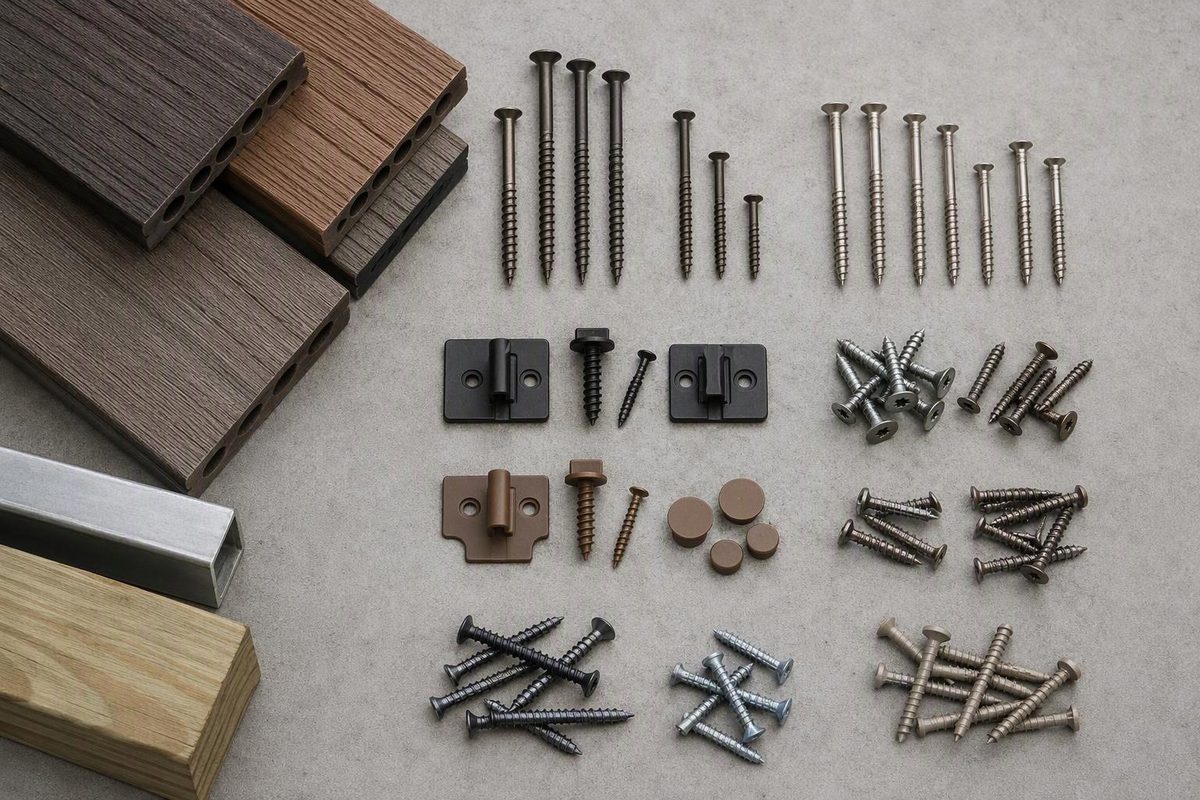
For face-fastened composite decking on wood joists, #8 or #10 screws around 2-1/2–2-3/4 in. (63.5–69.9 mm) long are common manufacturer-listed choices—not a universal specification. Buy a composite-deck screw approved for the exact board line, thickness and exposure. Trex’s 2026 guide lists that range for its 1 × 6 and 1 × 4 profiles; Fiberon’s September 2026 PE decking instructions recommend a minimum #8 × 2-1/2 in. stainless-steel or coated composite-deck screw for best results. Trex guide, p. 15; Fiberon instructions, p. 13.
The screw number identifies diameter; the inch dimension identifies length. Neither alone confirms compatibility.
Size and substrate lookup
These are product-specific references checked in October 2026. They are not interchangeable specifications for every composite board.
| Board or framing condition | Published screw guidance | Buying check |
|---|---|---|
| Trex 1 × 6 or 1 × 4 decking profiles | #8 or #10; 2-1/2 or 2-3/4 in. (63.5 or 69.9 mm) | Select a screw approved for the particular Trex line and application |
| Trex 2 × 6 decking profile | #8 or #10; 2-3/4 or 3 in. (69.9 or 76.2 mm) | The guide separately permits supplied 2-1/2 in. plug-system screws for this profile |
| Fiberon PE decking, face fastening into wood | For best results: minimum #8 × 2-1/2 in. (63.5 mm), stainless steel or coated composite-deck screw | Fiberon recommends its branded Starborn Cap-Tor xd for color matching |
| Fiberon decking on metal joists | Specialized metal-compatible face fasteners required | Do not substitute the wood-framing screw; verify the metal framing system |
Sources: Trex 2026 guide, pp. 14–15; Fiberon September 2026 instructions, pp. 4 and 13.
Measure actual board thickness rather than treating “1 × 6” as a 1-in.-thick measurement. For the broader length calculation, see deck-board screw sizing by actual thickness.
Choose the fastening method before the box of screws
Visible face screws: The screw passes through the board face into the joist, with its head left flush. Composite-specific designs address the hard cap and raised material around the hole, often called mushrooming. For example, Cap-Tor xd uses an undercut head and reverse threads for those purposes. Fiberon expressly excludes plain galvanized face fasteners and traditional bugle-head screws from its recommended method. Starborn specifications; Fiberon instructions, p. 13.
Hidden edge clips: These engage compatible board grooves. Order the approved clip-and-screw assembly for the board and framing, rather than choosing a loose screw by length. Trex allows square-edge boards to be routed according to its instructions for Hideaway fasteners. Trex 2026 guide, pp. 15 and 25.
Plug-covered face screws: These are matched systems with a screw, depth-setting tool and decking plug. Approval can depend on the board’s underside profile. In particular, Trex’s 2026 guide permits only Trex Hideaway deck plugs as its recommended plug-based fastener for Enhance profiles—not other plug systems. A blanket claim that all scalloped boards accept, or reject, plugs is therefore unreliable. Trex guide, pp. 14–15.
Thin fascia is a separate purchase: Trex distinguishes fascia fasteners from fasteners for full-thickness deck boards used as fascia. Do not assume the deck-surface screw suits both. Trex guide, pp. 15–18.
Match corrosion resistance to exposure
An exterior coating is not automatic approval for saltwater exposure. Trex calls for approved stainless-steel screws near bodies of saltwater. Starborn offers Cap-Tor xd in epoxy-coated steel, Grade 305 stainless and Grade 316 stainless, and specifies Grade 316 for saltwater or other corrosion-concern areas. Its product is also approved for ACQ and pressure-treated lumber. Those approvals apply to that product, not every coated screw. Trex guide, p. 15; Starborn product specifications.
Worked selection and quantity example
Suppose an inland project uses square-edge Fiberon PE boards measuring 15/16 in. (23.8 mm) thick, face-fastened directly to wood joists. A color-matched #10 × 2-1/2 in. Grade 305 stainless Cap-Tor xd is a documented candidate: Fiberon recommends Cap-Tor xd, and Starborn lists that size and material. Confirm the board’s current instructions, corrosion exposure and exact color code before ordering. Fiberon instructions, pp. 13–14; Starborn size listing.
The approximate tip penetration is:
2-1/2 − 15/16 = 1-9/16 in. (39.7 mm)
That assumes tight board-to-joist contact. It is not a measurement of fully threaded engagement or a load rating.
Fiberon requires two face fasteners at every joist location. If ten boards each have thirteen supported joist intersections, the base count is 10 × 13 × 2 = 260 screws. Add fasteners for any perimeter boards, seams and stairs not included in that count, plus installation spares. Hidden clips need their own takeoff. Fiberon instructions, p. 13.
For installation, keep ordinary face-screw heads flush—not buried like plug-system screws. Fiberon directs perpendicular driving, shows 1-in. (25.4 mm) end and edge setbacks, and requires end-hole predrilling at or below 40°F (about 4°C). Plan additional support where needed to maintain those setbacks at seams; a longer screw does not replace properly positioned framing. Fiberon instructions, pp. 13–14.