 MortarDesk
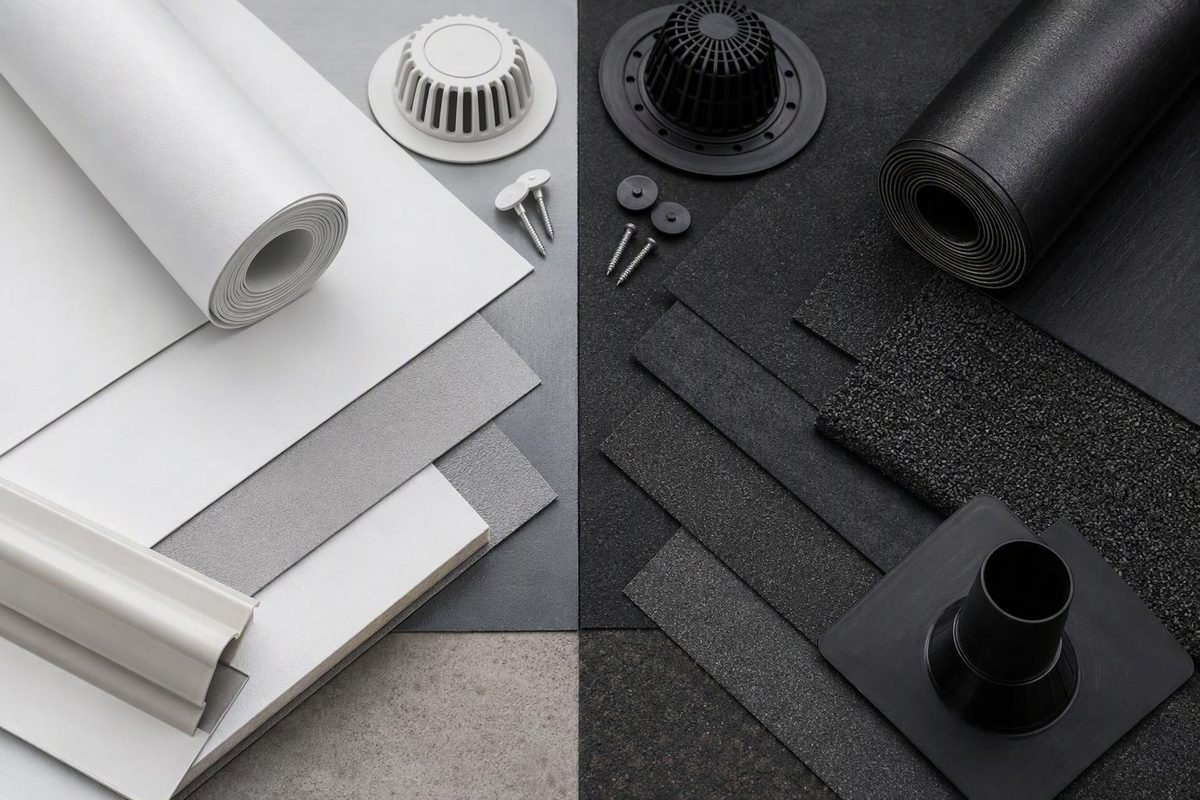
TPO is a single-ply thermoplastic membrane; modified bitumen is polymer-modified asphalt, commonly installed in multiple plies. Documented TPO options include 45, 60 and 80 mil thicknesses—approximately 1.14, 1.52 and 2.03 mm. A modified-bitumen cap sheet may be substantially thicker: CertainTeed Flintlastic SA Cap is nominally 4.0 mm, about 157 mil, before any underlying plies. Those numbers describe different materials, not a direct strength ranking. Carlisle’s July 2026 specification and CertainTeed’s cap-sheet data document these examples.
Shortlist TPO when you want a reflective single-ply system with welded seams. Shortlist modified bitumen when multiple plies or a granulated surface complementing adjacent shingles matter. Neither name alone establishes suitability: drainage, deck condition, attachment, flashing and the complete assembly must also be specified.
Material and installation differences
| Comparison | TPO | Modified bitumen |
|---|---|---|
| Material | Thermoplastic polyolefin membrane | Asphalt modified with SBS—styrene-butadiene-styrene—or APP—atactic polypropylene |
| Waterproofing arrangement | Single-ply membrane with separate flashing details | Commonly base/interply sheets plus an exposed cap sheet; exact configuration varies |
| Thickness example | 60 mil = 0.060 in. ≈ 1.52 mm | Flintlastic SA Cap: 4.0 mm ≈ 0.157 in.; cap only |
| Attachment and seams | Mechanically fastened or adhered systems; adjoining sheets are hot-air welded | Self-adhered systems are available; APP is commonly torch-applied |
| Surface options | White, gray and tan among documented options | Granulated colors, including solar-reflective options |
Sources: Carlisle mechanically fastened TPO, Carlisle fully adhered TPO, CertainTeed self-adhered SBS and GAF’s APP overview.
A mil is 0.001 inch, not a millimeter. “Single-ply” also does not mean the whole roof has one layer: insulation, cover board, vapor-control components and the deck remain separate parts of the assembly.
Do not equate modified bitumen with torch-down roofing. Self-adhered SBS avoids an open-flame application, but it is not tool-free or weather-independent. CertainTeed’s residential guide specifies a 70 lb weighted roller, clean and dry substrates, and additional cold-weather procedures. Flintlastic residential application guide
Leave torch-applied roofing to trained roofing professionals, not DIY installation. NRCA’s CERTA training combines safety instruction with hands-on demonstrations of torching ability. NRCA torch-safety training
Drainage comes before the membrane choice
For U.S. residential work, the 2021 IRC specifies a minimum design slope of ¼ inch per foot, or ¼:12, for both modified bitumen and thermoplastic single-ply roofing. That is approximately 2.08%, expressed as 2% in the code. See R905.11.1 and R905.13.1. Verify the locally adopted edition, amendments and manufacturer requirements; this model-code reference is not a statement of what every jurisdiction enforces. 2021 IRC, Chapter 9
Over a 20 ft horizontal drainage run, ¼ inch per foot produces 5 inches of elevation difference. This is a geometry check, not a tapered-insulation design: low spots, deck deflection and drain placement still need assessment. Switching to TPO or adding a thicker cap sheet does not correct inadequate drainage.
Heat, service traffic and damage resistance
A cool roof is a surface-performance choice, not an exclusive TPO benefit. Reflective roofing can reduce cooling demand, but it may increase winter heating demand. Compare the specific product’s solar reflectance, thermal emittance or solar reflectance index against local requirements and climate—not simply “white” versus “black.” Modified-bitumen cap sheets are available with reflective granules too. Cool Roof Rating Council guidance and CertainTeed cap-sheet options
For HVAC service routes or hail exposure, request assembly-specific protection rather than assuming the thicker material wins. Carlisle’s July 2026 guide, for example, ties certain hail coverage to membrane thickness, adhesion and an approved cover board; its additional puncture coverage requires 80-mil TPO. These are product-specific warranty conditions, not universal damage thresholds. Carlisle system requirements
Worked selection example: a 600 sq. ft. addition
Suppose an addition has a 20 × 30 ft roof plan, a wood deck, drainage along the 20 ft direction and an adjacent asphalt-shingle roof. Its plan area is 600 sq. ft., equivalent to six roofing squares. For ordering, use the measured sloped roof area and allow for laps, flashing and waste.
Request two complete alternatives:
- TPO: a named 60-mil product, specified attachment, insulation/cover board and compatible wall, edge and penetration details.
- Modified bitumen: a named SBS system with every base/interply and cap sheet identified; request a compatible granulated color if complementing the shingles matters.
These are bid comparison descriptions, not approved designs. Confirm deck suitability, loads, drainage and local approvals before selection. If reflectivity is the priority, compare white TPO with a reflective modified-bitumen cap—not a dark cap by default. If appearance is the priority, the granulated SBS option deserves consideration.
For cost, match tear-off, deck repairs, insulation, drainage corrections, flashings, access, disposal and warranty scope before comparing totals. A membrane-only price is not an installed-roof comparison. Likewise, a warranty duration is not a predicted service life; CertainTeed explicitly makes warranty type and duration dependent on system configuration and contractor selection. CertainTeed warranty provisions
If the existing roof is modified bitumen, first consider whether replacement is necessary; see modified-bitumen repair options by condition. A recover proposal also needs scrutiny: 2021 IRC R908.3.1.1 prohibits recovering a roof that is water-soaked or deteriorated to the point that it cannot serve as an adequate base for additional roofing. It also prohibits recover where the existing roof has two or more applications of roof covering. These are applications of roof covering, not the individual plies within one modified-bitumen system. 2021 IRC recover limits