 MortarDesk
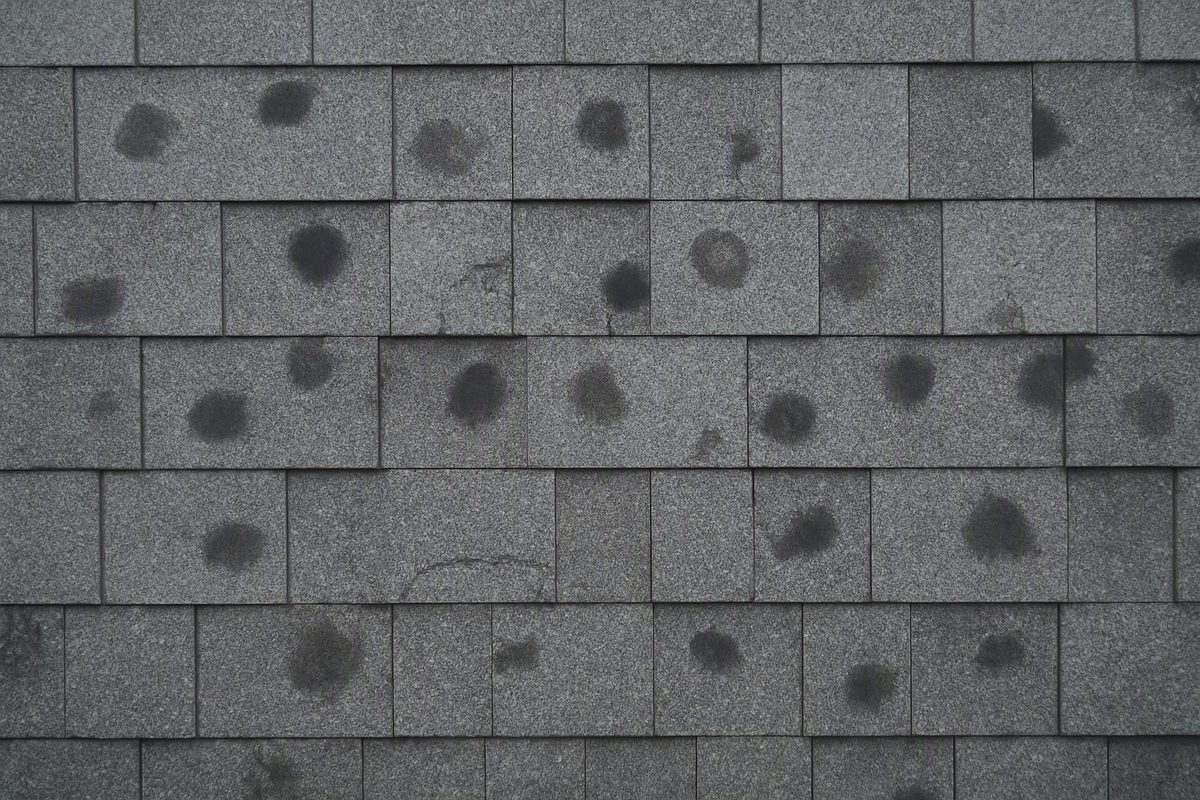
The short answer: look for scattered impacts, not one supposedly definitive sign
Roof hail damage can look like scattered dark spots, shallow depressions, bruises, displaced surface material, cracks, fractures, punctures, or dimples in metal. Its appearance depends heavily on whether the roof is asphalt, metal, wood, tile, slate, or a low-slope membrane. Across these materials, the most useful general clue is a collection of localized impacts rather than broad, uniform deterioration. Material-specific guidance from Travelers similarly describes asphalt and wood damage as random impacts while emphasizing that roof condition, wind, hail characteristics, and nearby barriers affect the result (see Travelers’ roof hail-damage guide).
Randomness is not proof. Marks may cluster on one slope, concentrate near an exposed edge, or be too faint to see from the yard. A pattern alone cannot establish the cause, date the damage, or connect it to a particular storm.
It helps to sort observations into three levels:
- Direct roof evidence: Marks on shingles, panels, tiles, shakes, membranes, seams, flashing, vents, skylights, fasteners, or other roof-system components. Damage to an accessory is direct evidence about that component, but it does not establish damage to a different material or to the main roof field.
- Collateral evidence of hail exposure: Dents, cracks, punctures, or displaced material on gutters, downspouts, siding, screens, trim, vehicles, HVAC equipment, and other exterior items. These observations support the conclusion that hail reached the property, but they do not prove that the roof covering was damaged.
- Possible interior consequences: Active leaks, stains, damp insulation, daylight through the deck, or visible openings. These can reveal moisture intrusion or a breach in the roof assembly, but they are not specific to hail. Older roof defects, plumbing leaks, condensation, and other moisture sources can create similar symptoms.
Quick visual questions
- Is the mark depressed or raised?
- Is it isolated and localized, or part of uniform deterioration?
- Has material been displaced, fractured, punctured, or exposed?
- Do nearby metal components show compatible impacts?
- Could wind, age, foot traffic, debris, installation, or mechanical contact explain it?
- Are compatible observations present on more than one material or part of the property?
The aim is not to find one “definitive” spot. It is to determine whether several observations form a coherent reason for further assessment.
An apparently intact roof may still warrant inspection after a storm because some bruises, coating defects, seam concerns, and small fractures are difficult to see from the yard. The reverse is equally important: visible marks do not automatically mean that repair or replacement is necessary. Appearance, cause, extent, and effect on roof performance are separate questions.
Visual guidance is not a universal diagnostic standard. Available references come from a mixture of insurers, manufacturers, professional inspectors, government-affiliated risk programs, and roofing contractors. Their examples are useful for screening, but cause and functional significance still require material-specific evaluation.
What hail damage can look like on asphalt shingles
On asphalt shingles, possible hail impacts commonly appear as round or irregular dark spots, localized patches of missing granules, shallow dents or divots, bruised areas, and cracks at or near an impact point. More severe impacts can expose asphalt, reinforcement mat, underlayment, or—at the extreme—create a puncture. Illustrated roofing guidance identifies dents, dark indentations, missing granules, cracks, and exposed underlying material among the visible conditions associated with hail impacts (compare the asphalt examples).
A dark mark often forms because granules have been knocked aside, revealing darker asphalt or mat beneath the surface. That does not mean every dark area is a deep breach. Staining, algae, manufacturing variation, older abrasion, and ordinary granule loss can also change a shingle’s color.
Surface profile offers another clue. A suspected impact is often depressed: the shingle may be indented, bruised, or locally crushed. A blister is generally raised or bubble-like. The distinction can be much harder to read on an older roof where weathering, previous repairs, cracking, and widespread granule loss obscure the original surface.
Some bruising is subtle and may require close access by a trained inspector to evaluate the reinforcement mat and distinguish superficial granule loss from a more consequential impact. Homeowners should not walk onto the roof or press suspected bruises. Roof access creates a fall risk, and probing or walking may dislodge granules or damage brittle materials, complicating later interpretation (review the homeowner safety warning).
Distribution matters most when considered with the shape and condition of each mark. Multiple localized depressions scattered across an exposed area are more suggestive of separate impacts than gradual thinning over most of a slope. Uniform granule loss, fading, brittle edges, curling, and broad cracking fit aging more readily, although an older roof can show both age-related wear and newer impacts.
Granule loss alone is nonspecific. A concentration of granules in a gutter or near a downspout documents surface loss, not its cause. A sudden accumulation after a storm is worth recording, but it still needs context.
Keep direct impact signs separate from wind effects. Lifted, torn, shifted, creased, or missing shingles may result from strong wind during the same storm rather than from hailstone impact. A roof can therefore contain two overlapping sets of storm evidence: localized impacts associated with hail and displacement associated with wind.
Conditions that deserve prompt attention include a visible puncture, an open shingle break, exposed underlayment, or exposed decking. Those conditions differ materially from an isolated dark spot because they may create a direct route for water. They still require assessment rather than an assumption that every nearby blemish represents equivalent damage.
Use this visual comparison key when reviewing photographs:
| Appearance | What to notice | Why it matters |
|---|---|---|
| Localized dark depression | A confined, round or irregular indentation with surrounding granules largely intact | Compatible with a localized impact, but not proof of cause |
| Missing-granule patch | Dark asphalt or mat visible within a limited area | May reflect impact, abrasion, wear, or another surface disturbance |
| Raised blister | Bubble-like material projecting above the surrounding surface | Less characteristic of a depressed hail bruise |
| Uniform age-related loss | Broad, relatively even thinning or fading across many shingles | More consistent with gradual weathering |
| Lifted or missing shingle | An edge or tab that has shifted, torn, or disappeared | Possible wind damage rather than a direct hail impact |
No photograph can confirm cause without context.
What hail marks look like on metal roofs and roof components
On a conventional metal roof, hail may leave scattered dents, dings, dimples, or shallow depressions.
Assessment should extend beyond the middle of each panel. Relevant components include:
- Standing seams, laps, and joints
- Exposed or concealed fastening areas
- Protective paint or coatings
- Ridge, eave, wall, chimney, and penetration flashing
- Roof vents and vent caps
- Fascia and edge metal
- Gutters and downspouts
- Skylight frames and other rooftop accessories
A visible dent is not automatically a confirmed functional problem. Some dents may alter appearance without affecting water shedding. Other impacts may damage a coating, affect a seam, puncture thin metal, or disturb a fastening area. Those conditions raise different performance questions. Progressive’s material guide identifies depressions, coating damage, and concerns at seams or fasteners as possible metal-roof findings, while the significance of each condition remains a matter for qualified assessment (review the metal-roof examples).
Coating damage can expose underlying metal to weather and possible corrosion. It should not be assumed, however, that every dent has broken or detached the coating.
Material and thickness influence how readily metal dents. InterNACHI’s inspection training describes aluminum gutters as easier to damage than steel and notes that metal thickness also changes the result (see its collateral-damage guidance). A dented gutter therefore cannot be used as a direct measure of what happened to a thicker roof panel—or to adjacent shingles.
Mechanical marks provide a useful comparison. Paired scraped dents near a practical ladder position, scratches within an indentation, creased metal, or damage concentrated at a contact point can point away from hail and toward a ladder, tool, maintenance activity, or another mechanical cause.
Dents on flashing, vents, or gutters are direct evidence about those particular components. When used to infer what happened to the main roof field, however, they are only collateral evidence. They do not prove that adjacent shingles or panels sustained functional damage.
Homeowners should not climb onto a metal roof or access a roof merely to rub chalk across panels. Hands-on methods belong to trained personnel using appropriate access and safety procedures; roof inspection guidance warns against climbing steep roofs or working without proper safety equipment (consult the roof-inspection safety guidance).
Use this comparison key for metal surfaces:
| Appearance | Possible interpretation |
|---|---|
| Randomly scattered, smooth dimples | Compatible with separate hail impacts |
| Dent with chipped, split, or visibly disturbed finish | Possible coating damage requiring assessment |
| Deformation at a seam or fastening area | Potential performance concern beyond panel appearance |
| Puncture or sharply deformed thin component | Possible opening or loss of component integrity |
| Paired, scraped, scratched, or creased marks | More suggestive of ladder or mechanical contact |
The distinction between appearance and function is especially important on metal.
Hail signs on wood, tile, slate, and low-slope roofing
Wood shingles and shakes can split, chip, bruise, or develop impact scars. A suspected recent split may expose brown or orange wood, retain sharp edges, and show little deterioration along the fracture. An impact mark may lie along or near the split. These characteristics can suggest relative freshness, but they cannot reliably date the damage or connect it to one storm (compare Travelers’ wood-shingle criteria).
A sharp-looking split may therefore be recent without having been caused by hail, while a hail-related split can weather at different rates depending on its location.
Clay and concrete tiles may show chips, cracks, shattered units, displaced pieces, punctures, or missing fragments. Slate may develop fractures, gouges, chips, breaks, punctures, or displaced units. Durability does not make these materials immune to impact, and broken pieces may expose underlying layers.
Homeowner inspection should remain at ground level or inside the building; manufacturer guidance specifically warns that walking on clay or concrete tile can itself cause damage (see the material comparison and access warning).
Low-slope systems require particular caution because cracks, blisters, displaced surfacing, and fractures are not unique to hail. Modified-bitumen roofing may show localized cracks or fractures. On thermoplastic polyolefin, or TPO, reported storm indicators include cracks, crow’s-feet, and concentric semicircle patterns. These are specialist observations, not homeowner-level proof of cause.
Tar-and-gravel roofing may show displaced gravel, exposed areas, cracks, or blisters. Wind can redistribute gravel, and the presence of cracking or blistering does not establish hail by itself. A risk-management checklist illustrates these low-slope observations but treats them as reasons to consider further evaluation, not as a conclusive diagnostic formula.
Low-slope signs should therefore be treated as screening observations requiring specialist interpretation.
| Roofing material | Possible hail appearance | Common look-alikes or uncertainties | What may be visible safely from the ground | What requires professional assessment |
|---|---|---|---|---|
| Asphalt shingles | Dark localized spots, depressed bruises, divots, missing granules, cracks, exposed asphalt or mat | Aging, blisters, staining, foot traffic, installation or manufacturing conditions | Dark spots, broad surface loss, missing pieces, damaged vents or flashing | Bruising, mat condition, small fractures, lifted materials, exposed layers |
| Metal panels | Scattered dents, dimples, coating disturbance, punctures | Ladder contact, tools, debris contact, normal panel waviness | Larger dents, damaged vents, edge metal, gutters | Coating integrity, seams, clips, fasteners, concealed deformation |
| Wood shingles or shakes | Sharp-looking splits, chips, bruises, scars | Older checks, weathering, moisture-related splitting, other impacts | Missing pieces, larger splits, displaced shakes | Recency, impact association, substrate condition |
| Clay or concrete tile | Chips, cracks, shattered or displaced units | Existing breaks, foot-traffic damage, prior repairs | Missing pieces, obvious breaks, debris on the ground | Hairline cracks, underlayment exposure, stability and safe access |
| Slate | Fractures, chips, gouges, punctures, displaced slates | Existing fractures or concentrated debris impacts | Missing or visibly broken units | Subtle fractures, attachment condition, safe access |
| Modified bitumen | Localized cracks or fractures | Cracking is not specific to hail | Large open defects or displaced surfacing near visible edges | Membrane continuity and concealed moisture |
| TPO and similar membranes | Cracks or reported crow’s-feet and semicircular patterns | Similar-looking conditions require specialist interpretation | Usually little beyond large openings or edge damage | Pattern interpretation, seam integrity, punctures |
| Tar and gravel | Displaced gravel, exposed areas, cracks, blistering | Wind-displaced gravel; cracks and blisters are not hail-specific | Uneven surfacing near visible edges | Membrane condition beneath gravel and blister evaluation |
Hail damage versus aging, blistering, wind, traffic, and mechanical marks
No single symptom separates hail from every alternative. A more reliable comparison uses shape, surface profile, distribution, location, weathering, and timing together.
| Observation | Possible hail interpretation | Plausible alternative |
|---|---|---|
| Round or irregular localized depression | Impact point or bruise | Older abrasion, tool contact, debris |
| Raised bubble-like area | Less typical of a hail bruise | Blistering |
| Random scattered marks | Compatible with separate impacts | Debris or multiple mechanical events |
| Broad, even granule thinning | Less characteristic of localized hail | Aging and ordinary weathering |
| Linear granule loss | Not a typical random-impact pattern | Foot traffic, dragging, maintenance access |
| Repeating marks along seams or courses | May point away from hail | Installation or manufacturing condition |
| Lifted, shifted, or missing material | Associated storm damage may be present | Wind rather than direct impact |
| One concentrated break or gouge | Could be an impact | Falling branch or other debris contact |
| Scratched, paired, or creased metal dents | Less consistent with hail | Ladder or mechanical contact |
| Clean dark asphalt or sharp wood edges | May appear relatively recent | Recent non-hail damage; visual dating remains uncertain |
| Gray, worn, rounded split edges | Suggests extended weather exposure | Older splitting or checking |
Aging usually develops over a wider area and may produce fading, curling, cupping, brittleness, broad cracking, or relatively uniform granule loss. Hail more often creates individual points of impact. This is not an absolute division: sun exposure can make one slope age faster, and wind-driven hail can concentrate marks on one side of a building.
Blisters tend to rise above the surface, while suspected hail bruises are typically depressed. On a weathered shingle, however, broken blister surfaces and older impacts may both appear as irregular areas of missing granules. Close visual interpretation can remain uncertain even for an experienced observer.
It can appear as linear scuffing or concentrated granule loss rather than isolated round marks. Installation and manufacturing conditions may align with shingle courses, seams, nail locations, or repeating product features.
Wind effects should be classified separately. Lifted, torn, shifted, creased, and missing shingles can occur in the same storm as hail, but they are not necessarily hailstone impacts. Similarly, concentrated damage around one branch strike or debris contact differs from scattered impact marks, even when both occurred during the same storm.
Mechanical damage can be especially persuasive when location and shape agree. Paired scraped dents where a ladder would rest, a crease in sheet metal, or a scratch within a dent suggests direct contact by an object. Smooth, scattered dimples without scraping fit hail more readily, although causation still requires context.
Mixed-condition roofs are common. A weathered roof can have widespread granule loss, brittleness, and curling and still receive new localized impacts. Existing deterioration neither proves nor rules out storm damage. Comparative guidance likewise distinguishes sudden localized marks from gradual, widespread wear while acknowledging that granule accumulation can arise from either hail or advanced age (review the hail-versus-wear criteria).
A clean-looking patch of exposed asphalt or a sharp brown wood split may appear newer than its surroundings. Visual freshness is useful context, not an accurate clock.
The conservative rule is to look for several consistent observations across multiple materials and locations. A group of depressed shingle marks, compatible dents on exposed metal, and collateral damage on an exposed elevation supports suspicion more than any one spot. Determining cause, functional effect, and repair scope should remain the work of a qualified inspector.
A safe ground-to-attic inspection sequence
Keep the safety boundary clear: observe from stable ground or a safe interior location. Do not walk on a steep, wet, brittle, slate, tiled, or visibly damaged roof. Roof-access guidance consistently recommends ground-level observation for homeowners because climbing can cause falls and may damage fragile roofing materials (see the ground-inspection advice).
Step 1: Record the storm information and establish context. Write down the known or approximate date and time. Before focusing on individual marks, photograph wide views of every property elevation. Include the roofline, walls, gutters, windows, doors, landscaping, and nearby objects where practical.
Step 2: Examine the roof from stable ground. Use binoculars or a camera with optical zoom. Look for dark localized spots, missing or displaced materials, broken tile, visible dents, damaged vents, distorted flashing, and cracked skylights. Change your viewing angle only where you can remain on stable ground.
Step 3: Look at accessible gutters and downspouts. From the ground, check for dents, cracks, deformation, and granules around discharge points. If an open gutter is plainly visible from a safe interior position, note unusual accumulations. Do not climb merely to retrieve granules. Neither denting nor granule buildup is diagnostic by itself.
Step 4: Check collateral exterior surfaces. Examine siding, trim, windows, screens, doors, outdoor furniture, vehicles, satellite equipment, and HVAC housings or fins. Look for dents, cracks, punctures, broken glass, torn screens, or displaced pieces. Record which elevation each observation faces. These clues can establish exposure without establishing roof damage.
Step 5: Inspect the ground. Look for shingle fragments, broken tile or slate, wood pieces, displaced flashing, or other roofing material. Photograph objects where found before moving them. A branch or piece of debris may have been carried by wind, so ground debris should not automatically be classified as direct hail evidence.
Step 6: Check the attic or interior from an established safe area. Look for active dripping, recent stains, damp insulation, visible openings, or daylight through the roof deck. Do not enter an area where there is no suitable walking or observation surface. These findings can reveal a possible opening or moisture problem, but not hail as the proven cause. Inspection guidance includes water stains, damp insulation, and daylight through the deck among the interior conditions worth documenting.
Take both context photographs and closer zoomed views. A close-up without location is difficult to interpret; a wide shot without detail may not show the condition. Retain original files, avoid overwriting them with edited copies, and label the elevation, approximate location, viewing direction, and date.
Use neutral descriptions. “Small depressed dark area on west-facing lower slope” is more useful than “confirmed hail hit.” Note the mark’s shape, color, profile, and approximate size relative to a familiar object visible in the same plane.
A lack of visible damage from the yard does not rule out subtle impacts. It also does not establish that hidden damage must exist. Ground-level inspection is a screening and documentation method, not a diagnosis.
Reserve roof access, shingle lifting, bruise testing, seam evaluation, membrane probing, and determinations of functional damage for a qualified professional. Those tasks may require fall protection, material-specific knowledge, and an understanding of how inspection itself can alter a fragile surface.
Why damage can be uneven—and why a roof may not leak immediately
Hail does not necessarily strike every roof surface with the same force. Severity and distribution can vary with hailstone size, density, shape, wind speed and direction, impact angle, roof pitch, material, age, condition, construction, and the number of existing shingle layers. A steep slope facing the wind may receive different impacts from a sheltered or leeward slope.
Trees, neighboring buildings, parapets, landscaping, and other barriers can shield portions of a roof or change exposure. Unequal damage between slopes can therefore be consistent with wind-driven hail. Every slope does not need to look the same.
A roof can sustain localized granule displacement, bruising, a weakened shingle mat, coating damage, or a seam concern without an immediate hole or active leak. That does not mean every subtle impact will later leak, nor does appearance alone support assigning a precise reduction in service life.
Immediate concern rises when there is a clear water pathway or visibly disrupted assembly, such as:
- A puncture or open fracture
- Shattered or displaced tile
- Broken or displaced slate
- Cracked skylight or window glazing
- An open or distorted seam
- Exposed underlayment
- Exposed decking
- A visibly affected fastening area
These conditions differ from a shallow dent because the roof or accessory may already have an opening or disrupted drainage path.
Cosmetic and functional damage are not interchangeable labels. A dent may change appearance without affecting water resistance, while a visually small defect at a seam or fastener may have greater performance implications.
Seek prompt professional attention for:
- Active water entry
- A visible puncture or open fracture
- Broken skylight or window glazing
- Exposed underlayment or roof deck
- Wet insulation
- Daylight visible through the deck
- An open or distorted seam
- Broken or displaced roofing material that may no longer be secure
Interior stains, mold, and damp insulation still require investigation rather than automatic attribution to hail. They can originate from an older roof leak, plumbing, air leakage, condensation, or mechanical equipment.
The practical distinction is between absence of visible leakage and evidence of sound condition. The first does not prove the second. But subtle marks also do not justify predicting inevitable failure. Inspection should determine what was affected, whether water-shedding components remain intact, and whether monitoring, repair, or another response is appropriate.
Documenting suspected damage and choosing the next step
Good documentation records what exists without deciding the conclusion in advance. Assemble a simple file containing:
- Known or approximate storm date and time
- Wide views of the full property and each elevation
- Every roof slope visible from the ground
- Safely obtained zoomed views of suspected marks
- Dents, cracks, or breaks on exterior collateral surfaces
- Fallen or displaced roofing materials
- Interior stains, dampness, dripping, or visible openings
- Notes identifying location, direction, and date photographed
- Original, unedited image files
Describe each observation rather than labeling it. Record whether the mark is raised or depressed, isolated or widespread, smooth or scraped, and fresh-looking or weathered. Include color, shape, and approximate size relative to a known object only when that comparison can be made safely.
Professional assessment is appropriate when findings are subtle, inaccessible, mixed with existing deterioration, or specific to materials such as slate, tile, coated metal, or low-slope membranes. It is also appropriate when the question involves seam integrity, underlayment, concealed fasteners, substrate damage, or whether an observed condition affects water resistance.
Prompt attention is warranted for active leaks, punctures, broken glazing, exposed roof layers, unstable or displaced tiles and slates, visibly affected seams, wet insulation, or daylight through the deck. Where water is entering, protect occupants and belongings without entering an unsafe roof or attic area.
A repair-versus-replacement decision cannot be made from one dent or photograph. It may depend on the number and distribution of affected areas, the roof’s existing condition, which layers are involved, whether replacement materials can be matched and integrated, and what a qualified inspection finds. A dramatic collateral dent does not establish that the roof must be replaced; a subtle opening may need attention even when collateral damage is limited.
For insurance questions, review the current policy rather than relying on a general article or a contractor’s summary. Check the deductible, reporting provisions, documentation requirements, exclusions, settlement terms, and applicable local requirements. Coverage and settlement terms vary by policy (see Progressive’s general discussion of policy-dependent coverage).
Do not assume that a universal reporting deadline applies. Filing periods and procedures can vary, and neither an inspection nor a particular impact count guarantees approval, payment, or replacement. Roofing guidance likewise cautions that coverage and filing deadlines depend on the policy (review the policy-variability note).
Mortar Desk provides independent general reference information. It is not a contractor, roof inspector, insurer, claim representative, or provider of individualized engineering advice.
The restrained decision rule is straightforward: scattered, material-specific impacts combined with collateral evidence may justify suspicion, but no isolated mark confirms hail or determines repair scope. Document safely from the ground and interior, seek prompt help for openings or water entry, and use a qualified inspection for subtle, inaccessible, or mixed-condition findings.
Can a roof have hail damage without leaking or missing shingles?
Yes. Hail may displace granules, bruise an asphalt shingle, deform metal, or affect a coating or seam without creating an immediate hole. Missing shingles may be caused by wind during the same storm and are not, by themselves, evidence of direct hail impact.
No current leak does not prove the roof is undamaged, but a visible mark also does not mean leakage is inevitable. Assessment should focus on the water-shedding surface, reinforcement, seams, fasteners, and underlying layers.
Do dents in gutters, vents, or siding prove that the roof is hail-damaged?
No. They show that those components may have been struck and can support evidence of hail exposure. They do not establish what happened to a different roof material.
Scraped, creased, paired, or contact-point dents may instead indicate ladder or mechanical damage. Interpret collateral marks together with direct roof observations and material differences.
Do shingle granules in the gutter mean hail damaged the roof?
Not by themselves. Granules can enter gutters because of hail, aging, ordinary weathering, foot traffic, installation activity, or another surface disturbance.
Record whether the accumulation appeared suddenly after the storm and whether localized roof marks are also visible. Granules document surface loss, not its cause.
What size hail damages a roof?
There is no universal damaging hailstone diameter. Damage potential also depends on hailstone density, hardness, shape, velocity, wind, impact angle, roof pitch, material, age, condition, construction, and shielding.
A size threshold quoted for one product, storm, or test condition should not be applied to every asphalt, metal, wood, tile, slate, or membrane roof. Travelers identifies size and density as only two of several variables that affect damage, while contractor guidance describing average thresholds also cautions that they are not universal (compare the listed damage variables).
Can an older roof have both normal wear and new hail impacts?
Yes. An older roof may already show uniform granule loss, fading, curling, brittleness, blisters, or broad cracking and then acquire new localized impacts during a later storm.
The challenge is to separate pre-existing deterioration from newer marks without assuming that every defect is age-related—or that every defect came from the recent storm. Distribution, surface profile, weathering, collateral evidence, and qualified close assessment should be considered together.