 MortarDesk
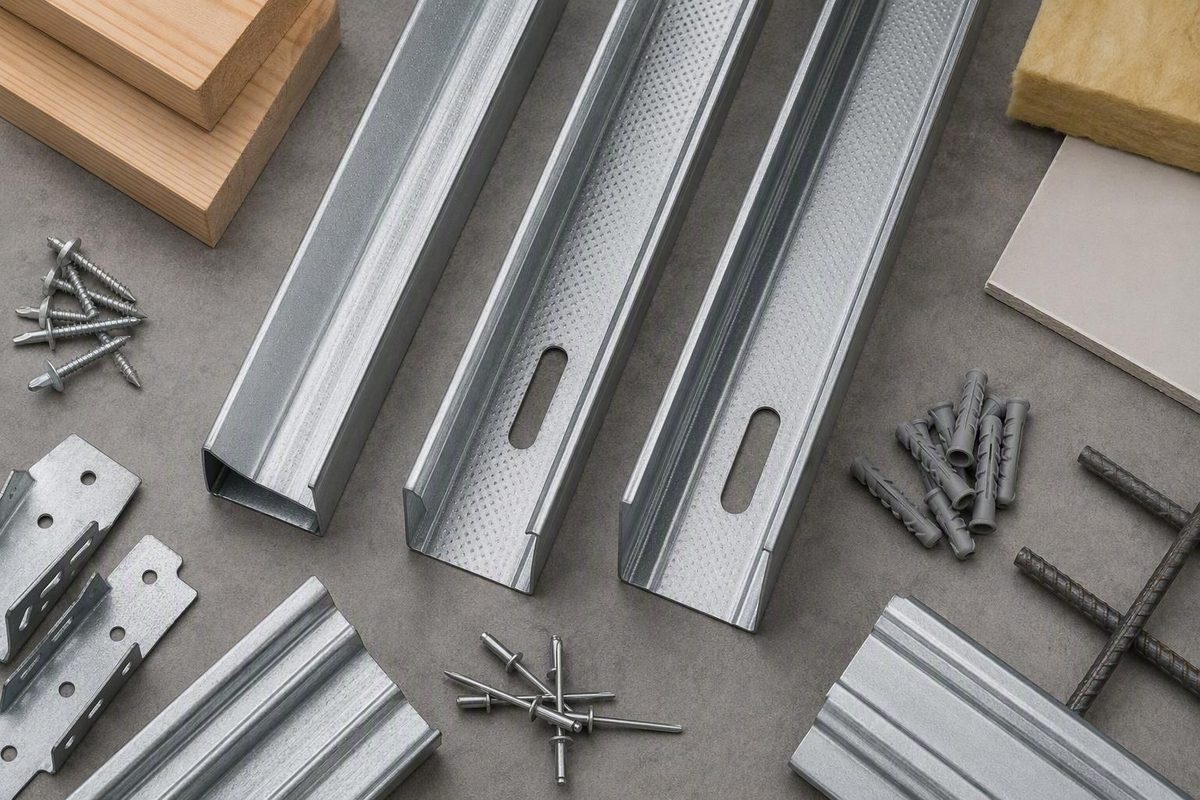
A “25 gauge” label does not identify one universal metal-stud thickness, strength, or capacity. For an ordinary interior partition, first confirm that the wall is non-load-bearing. Then verify the exact stud profile, minimum thickness in mils, yield strength, coating, matching track, and product-specific limiting-height data.
Shaft walls, exterior or load-bearing walls, unusually tall partitions, and walls carrying concentrated loads require separate product or project documentation. Do not select framing for those conditions from the gauge label alone.
The short answer: where 25-gauge studs fit
ClarkDietrich specifies ProSTUD 25 for interior non-load-bearing drywall walls, not axial load-bearing construction. The manufacturer identifies it more precisely as a 15-mil, 50-ksi, 25-gauge-equivalent stud. That complete description—not “25 gauge” by itself—defines the product and its intended use (ClarkDietrich ProSTUD technical page).
A documented non-load-bearing partition product can therefore be a candidate for a basic interior wall, but it is not an automatic choice. Products sold under the same gauge number can have different profiles, thicknesses, strengths, and intended applications.
| Wall condition | Is an ordinary 25-gauge partition stud a candidate? | What to verify |
|---|---|---|
| Ordinary interior non-load-bearing partition | Potentially | Exact product, matching track, spacing, board configuration, and limiting-height table |
| Shaft-wall construction | Do not infer suitability | Specialized profile and shaft-wall documentation |
| Load-bearing or exterior wall | Do not select from the gauge label | Project specification and structural or manufacturer documentation |
| Unusual height or concentrated loads | Not without further checking | Product capacity and applicable project details |
For an ordinary partition, use the current manufacturer lookup for the precise stud and complete wall configuration. Do not choose the product merely because the room height seems typical.
A shaft-wall product is materially different from an ordinary C-shaped drywall stud. One retailer lists a 2-1/2-inch-wide, 9-foot CH/CT shaft-wall stud as 25 gauge and 18 mil. That listing establishes that a specialized CH/CT profile is sold for shaft-wall use; it does not establish that an ordinary partition stud is interchangeable with it (25-gauge CH/CT shaft-wall listing).
If a wall is load-bearing, exterior, unusually tall, subject to unusual lateral loads, or expected to carry concentrated loads, stop before selecting the stud. Follow the project specification, consult the manufacturer’s technical service department, or obtain guidance from an appropriate design professional.
Why 25 gauge is not one exact thickness
There is no single supported thickness for every product sold as a 25-gauge metal stud. The label may describe a conventional member, a performance-based equivalent-gauge product, or a specialized profile.
| Product | Nominal label | Listed properties | Profile and intended use |
|---|---|---|---|
| ClarkDietrich ProSTUD 25 | 25ga EQ | 15 mil; 50 ksi (manufacturer specifications) | C-shaped drywall stud; interior non-load-bearing walls |
| Retailer-listed CH/CT stud | 25 gauge | 18 mil; strength not supplied (retailer listing) | CH/CT profile; shaft-wall or area-separation use |
The comparison shows why a generic gauge-to-inch conversion is unreliable here. ProSTUD 25 uses a performance-based equivalent-gauge designation: ClarkDietrich identifies it as 15 mil and 50 ksi rather than presenting it as a conventional stud whose thickness can be inferred from “25 gauge.” The specialized CH/CT product carries the same gauge number but is listed at 18 mil.
Equivalent-gauge products use their documented material properties and profile to satisfy defined performance criteria. They should not automatically be treated as interchangeable with conventional products—or with another equivalent-gauge product—sharing the same nominal gauge.
Look for the minimum thickness and strength in current manufacturer literature and on the product marking. A ClarkDietrich overview of non-structural stud specifications also discusses conventional and equivalent-gauge framing, but it dates from 2013 and should not replace current product reports, standards, or locally adopted requirements.
In practical terms, if the wall documents call for ProSTUD 25, put “15 mil, 50 ksi, ProSTUD 25” on the order rather than merely “25 gauge.”
Sizes, profiles and matching track
Metal-framing dimensions describe different parts of a member:
- Web width is the depth across the broad back of the stud, such as 3-5/8 inches.
- Flange width is the return on each side where wallboard is fastened.
- Length is the end-to-end dimension.
- Profile describes the member’s shape and function.
The profile distinction matters. A conventional wall stud is not track, utility angle, resilient channel, or a CH/CT shaft-wall stud. Retail category pages may group those components under the same gauge filter even though they perform different jobs.
ClarkDietrich documents ProSTUD web widths of 1-5/8, 2-1/2, 3-1/2, 3-5/8, 4, 5-1/2, and 6 inches, with a 1-1/4-inch flange. The manufacturer also cautions that not every combination is available.
They do not establish that every width or product line is available in every length (retailer size and length examples).
A documented ordering example for a 3-5/8-inch ProSTUD 25 is:
- Stud:
362PDS125-15 - Corresponding ProTRAK:
362PDT125-15
Those exact designations identify compatible named components in the manufacturer’s system. They do not, by themselves, establish a permissible wall height, make every track configuration equivalent, or give the finished assembly a particular fire or sound rating.
Match the track to the stud’s web width within the selected manufacturer’s framing system. Check the complete product designations rather than assuming any track marked 25 gauge will fit or perform correctly. Also distinguish ordinary top and bottom track from deep-leg or deflection track, because track configuration affects which wall data apply.
Wall height, spacing, fire and sound are assembly questions
There is no universal maximum wall height for 25-gauge framing. Limiting height depends on the exact stud profile, stud spacing, gypsum configuration, fasteners, track, bracing, deflection criterion, and whether the wall is evaluated as composite or non-composite.
Layouts at 16 and 24 inches on center appear in steel-framing guidance, but neither spacing is automatically acceptable. The applicable wallboard requirements, manufacturer’s design table, and any tested fire or sound assembly must permit the selected layout.
ClarkDietrich’s composite-table conditions show why these details matter. Certain data assume one layer of full-height, vertically installed 5/8-inch Type X gypsum board on both stud flanges. Under the cited conditions, screw spacing is no more than 16 inches on center when studs are at 12 or 16 inches on center, and no more than 12 inches on center when studs are at 24 inches on center (ClarkDietrich interior-wall lookup and conditions).
Change the construction and that table may no longer apply. ClarkDietrich states that full-composite data must not be used with deflection tracks, resilient channels, sound clips, 1/2-inch gypsum board, or horizontally installed board. Head-of-wall composite data also depend on stated track, gap, connection, board, and fastening conditions.
Fire resistance and sound control belong to a complete tested assembly, not an isolated stud. A retailer’s “one-hour” statement should not be interpreted as a rating that follows a loose stud into any wall. Verify the actual construction details against the applicable engineering evaluation or recognized laboratory listing, as the manufacturer’s design tool instructs.
Check all assembly details, including:
- stud model, depth, and spacing;
- top and bottom track;
- gypsum manufacturer, type, thickness, orientation, and number of layers;
- insulation, where included in the assembly;
- screw type and spacing;
- joints and attachment details; and
- head-of-wall and deflection conditions.
If a proposed wall differs from the documented configuration, do not assume the same limiting height, fire resistance, or sound performance applies.
Coatings, punchouts and jobsite checks
“Galvanized” does not identify one universal coating level. For the documented ProSTUD system, ClarkDietrich lists G40EQ as standard, G40 as available by request, and G60 and G90 as special-order options. Availability varies, and these options should not be extrapolated to other manufacturers.
A coating designation is only one part of exposure suitability. Do not assume that galvanizing alone approves an interior partition stud for exterior, wet, corrosive, or direct-concrete exposure. Use the product and isolation details required by the project documents.
Factory punchouts provide routes through the stud web for building services. Their presence does not establish which plumbing, wiring, or penetrations are permitted in a particular wall, especially where a tested assembly applies.
ClarkDietrich instructs installers to orient the same ends of the studs consistently so the punchouts align. Its documented pattern also varies by region: East Coast and Central products use one spacing pattern, while West Coast products use another. Inspect the delivered material instead of assuming every stud has the same opening layout.
Before and during installation:
- Verify the manufacturer, product label, and printed markings.
- Confirm that the stud and track web widths match.
- Check the profile; do not confuse a partition stud with CH/CT framing.
- Orient stud ends consistently so factory punchouts align.
- Follow the specified stud spacing and connection details.
- Confirm the board type, orientation, and fastener schedule.
- Retain the technical data, limiting-height table, and assembly listing used for selection.
A pre-purchase specification checklist
Build the order from the wall requirements outward. Before buying 25-gauge metal studs, record the following.
Product identity
- [ ] Manufacturer and product line
- [ ] Product type: stud, track, deflection track, CH/CT member, channel, or angle
- [ ] Exact profile
- [ ] Intended application
- [ ] Manufacturer’s product designation and markings
Dimensions and material
- [ ] Web width
- [ ] Flange width
- [ ] Required stud length
- [ ] Minimum steel thickness in mils
- [ ] Yield strength
- [ ] Coating designation
System compatibility
- [ ] Matching track manufacturer and designation
- [ ] Track web width and leg configuration
- [ ] Required stud spacing
- [ ] Fasteners and connection details shown in the applicable wall documents
- [ ] Any project-specified backing or reinforcement
- [ ] Head-of-wall or deflection detail, if applicable
Documentation
- [ ] Current product certification report, when required
- [ ] Applicable composite or non-composite limiting-height table
- [ ] Exact fire or sound listing, when required
- [ ] Project specification
- [ ] Requirements of the locally adopted code and jurisdiction
Retail pages are useful for dimensions, local stock, price, and fulfillment terms, but they often omit minimum thickness, yield strength, coating, capacity, and compliance documentation. Some category pages also mix studs with track, angles, and resilient channels.
Treat every displayed price as a dated regional snapshot. Listings can vary by seller, member dimensions, location, promotion, quantity increment, stock, and delivery method. Lowe’s, for example, states that prices and availability can change and that local stores may not honor online pricing (Lowe’s metal-stud listings and pricing notice).
Do not substitute an ordinary partition stud, CH/CT stud, track, utility angle, or resilient channel merely because a category page assigns it the same gauge. If the necessary specifications are absent, pause the order and obtain current product documentation. Specifications change and codes vary locally, so the selected documents must be checked against the project requirements and the rules used by the jurisdiction.
Frequently asked questions
Can cabinets, doors, televisions or grab bars be attached to 25-gauge studs?
The gauge label alone does not establish attachment capacity for cabinets, doors, televisions, grab bars, or equipment. These are concentrated-load conditions, while a limiting-height table addresses a wall only under the conditions stated in that table.
Do not infer attachment capacity from nominal gauge, stud thickness, or limiting height. Use the attachment requirements in the project or product documentation for the specific wall and item. If those requirements are unavailable, obtain an applicable approved detail or qualified project guidance before installation.
Are current retail prices a reliable way to compare 25-gauge studs?
Only after confirming that the products are technically equivalent. A lower price may refer to a different width, length, profile, thickness, strength, coating, brand, or purchase quantity. Pickup location, stock status, delivery charges, and promotions can also change the effective cost.
First compare the complete specification. Then obtain same-date quotes for the required stud and matching track from suppliers serving the project location. Use price as the final comparison—not as evidence that two products carrying the same gauge label are interchangeable.
The compact ordering rule is simple: do not buy from the words “25 gauge” alone. Confirm that the wall is an eligible non-load-bearing application, then record the profile, web width, length, minimum mil thickness, yield strength, coating, matching track, limiting-height table, and any required tested assembly. If those details are unavailable—or the wall is structural, unusually tall, exterior, shaft-wall construction, or carries concentrated loads—pause the purchase and obtain the applicable system documentation or qualified project guidance.