 MortarDesk
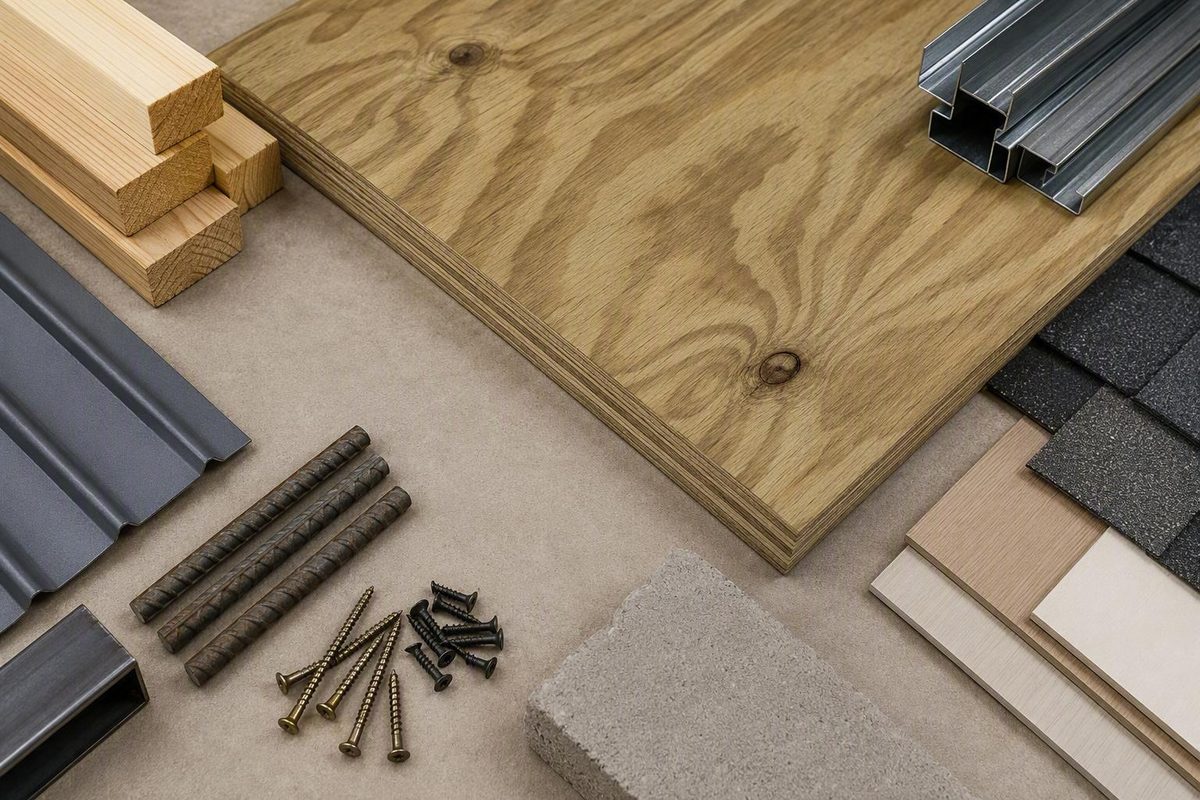
A shelf label reading “3/4 treated plywood” narrows the search, but it does not identify a complete building product. The label could describe preservative-treated exterior sheathing, specialized foundation plywood, or pressure-impregnated fire-retardant plywood intended for enclosed interior construction. Those products are not interchangeable.
The practical buying method is to examine two sets of documentation:
- The structural panel stamp, which identifies the panel’s grade, thickness category, bond or exposure classification, span rating, edge designation, and applicable product markings.
- The treatment tag or technical data sheet, which identifies the treatment, approved exposure, restrictions, drying status, hardware guidance, and installation requirements.
This article compares documented retailer listings and general manufacturer or trade guidance. Most of the listings do not provide complete manufacturer data sheets, treatment certifications, panel-stamp details, or assembly approvals. Treat them as candidates for comparison—not as proof that a product is approved for your project.
Nominal thickness is only a starting filter. The exact panel documentation, rather than color, price, or a broad retailer description, should determine whether a sheet belongs in the assembly.
What “3/4 treated plywood” can—and cannot—tell you
Plywood is a panel made from bonded layers of wood veneer. Treatment adds a separate property to that underlying panel. It may be a preservative treatment intended to improve resistance to decay and insects, or a fire-retardant treatment intended for a qualifying building assembly. Treatment does not erase differences in panel grade, veneer quality, adhesive bond, span rating, species, edge profile, or structural classification.
Retailers commonly list nominal 3/4-inch treated plywood as 4-foot-by-8-foot sheets. Smaller formats also exist. Home Depot, for example, documents a nominal 3/4-inch-by-2-foot-by-4-foot pressure-treated pine project panel, although the supplied listing does not disclose its treatment chemistry, actual thickness, price, or approved applications.
The word treated is incomplete by itself. It does not tell you:
- Whether the treatment addresses decay, insects, or fire
- Whether it is a preservative or fire-retardant treatment
- Which treatment chemistry or treatment level was used
- Whether the panel is approved above ground, in ground contact, or for another exposure
- Whether it can remain exposed to weather
- Whether it belongs in a permanent foundation or another specialized assembly
- Whether it has finishing, handling, hardware, or end-use restrictions
Similarly, 3/4 inch does not establish the actual measured thickness, grade, bond classification, span rating, structural capacity, support spacing, preservative retention, or acceptance in a code-regulated assembly.
Do not treat CDX as a complete specification either. Retail listings use that label while disclosing different—and sometimes incomplete—information about veneer grades and adhesive bonds. The panel stamp must identify the applicable bond or exposure classification. CDX terminology alone does not prove preservative treatment, waterproofing, ground-contact approval, or suitability for a particular roof, floor, deck, or foundation.
The two-document buying method
Before buying, compare the panel itself with the product paperwork:
- Read the structural stamp: Confirm the grade, thickness category, span rating, bond or exposure classification, product standard, edge designation, and other identifying marks.
- Read the treatment tag or data sheet: Confirm the treatment category and chemistry, treatment level or use category, approved exposure, drying status, hardware requirements, restrictions, and field-treatment directions.
If either source is missing, the product is not fully specified for comparison. A retailer’s suggested-use list may help identify candidates, but it cannot replace the panel stamp and treatment documentation.
Bottom line: Do not select a panel solely because the shelf label contains “3/4,” “treated,” or “CDX.”
Nominal 3/4 inch versus actual panel thickness
“3/4 inch” is commonly a nominal product designation. It should not automatically be interpreted as an exact measured thickness of 0.750 inch.
One bounded example shows the difference. Moscow & Pullman Building Supply lists a CCA .60 foundation-grade sheet as nominal 3/4 inch while stating an actual thickness of 23/32 inch. The listing describes the sheet as 4 feet by 8 feet.1
That difference is 1/32 inch, which can matter when:
- Matching a repair panel to existing material
- Aligning adjoining floor surfaces
- Selecting edge trim or channels
- Sizing a dado, groove, or recess
- Laminating multiple panel layers
- Planning transitions to tile or finished flooring
- Choosing fasteners whose effective penetration depends on assembly thickness
Flooring guidance also uses 23/32 inch, or 18.3 millimeters, when identifying minimum 3/4-inch plywood in specified wood-subfloor-over-concrete systems. That corroborates the terminology within those systems, but it does not prove that every treated product advertised as 3/4 inch has the same actual thickness.
| Size characteristic | What the documented information shows | Buying implication |
|---|---|---|
| Nominal thickness | 3/4 inch | Treat it as a product category, not a guaranteed 0.750-inch measurement |
| Documented actual-thickness example | 23/32 inch1 | Applies to the cited CCA .60 panel; do not automatically transfer it to another product |
| Common full-sheet format | 4 feet by 8 feet | Confirm dimensions and applicable manufacturing tolerances |
| Full-sheet face area | 32 square feet | Useful for coverage and price-per-square-foot calculations before waste |
| Documented smaller format | Nominal 2 feet by 4 feet | May reduce repair waste, but treatment and exposure approval still require verification |
Most of the retailer listings compared here do not publish actual measured thickness. Do not fill that omission by assumption. If fit matters, measure a representative sheet from the exact stack or obtain the manufacturer’s published dimensional information.
Panels from different manufacturers or treatment categories may not align perfectly merely because both labels say “3/4 inch.” Check again when switching suppliers, matching existing construction, or combining preservative-treated sheathing with untreated, fire-retardant, sanded, or specialty panels.
Preservative-treated, ground-contact and fire-retardant panels are different products
Pressure treatment describes a process used to introduce treatment chemicals into wood. It does not identify one universal chemistry, performance level, or end use.
Preservative-treated plywood is marketed to improve resistance to biological deterioration such as decay and attack by wood-destroying insects. The treatment type and level still have to match the project’s exposure. Fire-retardant-treated plywood belongs to a separate category intended to provide specified fire performance within qualifying assemblies.
| Category | Intended hazard | Documented example | Stated exposure or application | Specifications still requiring confirmation |
|---|---|---|---|---|
| Preservative-treated sheathing | Decay, rot, termites, or other wood-destroying insects | Pressure-treated pine performance-rated sheathing | Home Depot explicitly labels its example for ground contact.2 | Actual thickness, chemistry, treatment level, panel-stamp information, and assembly requirements |
| Specialized foundation-grade preservative panel | Decay and insect exposure in specialized construction | CCA .60 treated CDX foundation-grade sheathing | Seller identifies post-frame buildings and permanent wood foundations | Design approval, installation details, restrictions, fasteners, exposure limits, and local acceptance |
| Exterior pressure-treated CDX with conflicting listing language | Biological deterioration in exterior work | LENCO product P34T | Description says ground contact; features recommend non-ground-contact exterior use.3 | Approved exposure, chemistry, retention or use category, certification, and span rating |
| Interior fire-retardant-treated panel | Fire hazard in a qualifying enclosed assembly | Pyro-Guard Southern Yellow Pine CDX | Interior, enclosed structural applications.4 | Assembly acceptance, fastening, finishing, exposure limits, and confirmation that it is not being substituted for an exterior preservative panel |
Explicit ground-contact labeling
Home Depot lists one nominal 3/4-inch-by-4-foot-by-8-foot panel as pressure-treated pine performance-rated sheathing and explicitly labels it for ground contact.2 That is stronger evidence of the seller’s stated exposure category than a generic “treated plywood” title.
Even then, match the online listing to the tag on the physical sheet. Confirm that the panel loaded onto the cart has the expected product identifier and treatment marking rather than relying on the appearance or location of the stack.
Specialized CCA .60 foundation plywood
The documented CCA .60 CDX sheet is more specialized than generic treated sheathing. Its seller identifies the preservative as CCA, describes the panel as foundation-grade, and associates it with post-frame buildings and permanent wood foundations. The seller also says CCA-treated wood should be used only where that protection is important and approved.1
That is not a general recommendation to use CCA .60 plywood for every wet, outdoor, or residential project.
Interior fire-retardant plywood
Lowe’s lists a nominal 3/4-inch-by-4-foot-by-8-foot Pyro-Guard panel as pressure-impregnated interior fire-retardant-treated Southern Yellow Pine CDX plywood for enclosed structural applications. It has a square edge and unfinished surface, but the listing does not establish exterior preservative treatment or ground-contact suitability.4
Do not substitute this type of panel for exterior preservative-treated plywood simply because both products use the phrase “pressure treated.” Conversely, ordinary preservative-treated sheathing is not automatically a substitute where a fire-retardant panel is required.
When the listing contradicts itself
LENCO’s page illustrates why the treatment tag matters. Its description says the panel is for ground-contact applications, while the feature list recommends non-ground-contact exterior use. The page also omits the preservative chemistry, treatment retention, use category, and span rating.3
The correct response is not to choose whichever sentence suits the project. Treat the approved exposure as unresolved until the seller or manufacturer provides unambiguous documentation for the exact product.
Exterior adhesive, preservative treatment, fire-retardant treatment, and ground-contact approval are separate characteristics. Verify each one required by the assembly.
The specifications to verify on the stamp, tag and data sheet
A complete comparison goes beyond dimensions and sticker price. Use the following checklist in the store or when requesting a quote.
Structural-panel information
- Nominal thickness: The merchandising category, such as 3/4 inch.
- Actual or published thickness: Important when the panel must fit an existing assembly.
- Sheet dimensions: Commonly 4 by 8 feet among the listings compared here, although smaller formats exist.
- Panel or veneer grade: Do not assume every treated panel has the same surface quality or permitted defects.
- Bond or exposure classification: Use the exact marking required by the assembly.
- Edge profile: Square, tongue-and-groove, or another configuration.
- Span rating: Use the rating printed on the exact panel where applicable.
- Product-standard markings: Record the standard, agency, mill, and other identifying information.
- Orientation requirements: Check for a specified face or strength-axis direction.
Treatment information
- Treatment category: Preservative or fire retardant.
- Treatment chemistry: Obtain the exact chemical system rather than relying on panel color.
- Treatment level or use category: Confirm whether it covers above-ground, ground-contact, freshwater, foundation, or another exposure.
- Approved exposure: Look for direct language matching the intended condition.
- KDAT status: Kiln drying after treatment can matter in flooring, coating, fit, and moisture-sensitive assemblies.
- Restrictions: Check limits involving enclosed spaces, finishes, specialized construction, contact conditions, or end uses.
- Field treatment: Obtain instructions for cuts, holes, notches, and damaged areas.
Application information
- Approved assembly: A panel may be acceptable only as one component in a documented roof, wall, floor, deck, or foundation system.
- Support spacing: Never derive it from nominal thickness alone.
- Fastening schedule: Confirm fastener type, diameter, length, spacing, edge distance, penetration, and installation method.
- Connector and flashing compatibility: Match hardware to the exact treatment chemistry.
- Finishing directions: Confirm acceptable moisture condition, preparation, coating type, and edge treatment.
- Manufacturer instructions: These may be more restrictive than the retailer overview.
- Locally applicable requirements: Check current code, permit, inspection, and design requirements.
Purchasing information
- Product identifier: Record the SKU, model, manufacturer, and treatment brand.
- Current stock: Online inventory is location- and time-dependent.
- Pickup and delivery: Confirm lead time, delivery charges, unloading terms, and minimum quantities.
- Returns: Ask about condition requirements and restocking rules.
- Cutting services: Verify before planning transport around store cutting; LENCO states that it does not cut treated lumber.
- Documentation availability: Request the technical data sheet, treatment certificate, safety information, and installation instructions before payment.
Missing information matters. Two nominal 3/4-inch-by-4-foot-by-8-foot sheets are not meaningfully comparable when one identifies its chemistry and actual thickness while the other supplies little beyond a part number.
A sparse listing does not necessarily prove that a panel is unsuitable. It means the buyer needs another authoritative document. Broad phrases such as “code compliant,” “ideal for roofing,” or “suitable for decks” should not be treated as assembly approval.
Structural capacity and support spacing must come from the exact panel marking, design documents, manufacturer instructions, and locally applicable requirements—not from nominal 3/4-inch thickness.
Can it be used for decks, sheds, roofs, subfloors or foundations?
Treated plywood is marketed for many moisture-prone projects, but a seller-suggested application is not universal approval. The useful question is: Is this exact panel documented for this exposure, structural role, and assembly?
| Project | Documented or commonly seller-suggested use | What must be verified before use |
|---|---|---|
| Shed floor | Retailers mention shed flooring and damp exterior construction | Ground clearance, exposure rating, floor design, support spacing, span rating, edge support, fasteners, drainage, and finish-floor requirements |
| Shed wall | Treated sheets are marketed for walls and sheds | Structural stamp, bond classification, bracing requirements, siding or coating system, flashing, and ventilation |
| Ramp or walkway | Listings mention ramps and walkways | Structural design, traction, support spacing, drainage, edge protection, exposure rating, and approval to remain exposed |
| Roof sheathing | Sellers and manufacturers mention roof sheathing | Span rating, strength-axis direction, bond classification, panel spacing, fastening, roofing-system instructions, and local requirements |
| Wall sheathing | Listed among treated-plywood applications | Structural rating, bracing design, weather-resistive barrier, flashing, cladding attachment, and drying potential |
| Subflooring | Retail and manufacturer pages suggest subfloor use | Joist spacing, span rating, edge profile, fastening, flooring compatibility, treatment moisture, exposure, and assembly instructions |
| Deck | Some sellers mention decks | Whether the panel is protected within an assembly or intended as an exposed walking surface; also drainage, finish, fasteners, exposure, and structural design |
| Raised-bed supports | A retailer suggests this use | Exact treatment restrictions, approved exposure, separation details, finish, and suitability for the intended environment |
| Concrete forming | Manufacturer guidance lists forming as a possible use | Form design, pressure, supports, release treatment, finish expectations, reuse plan, and whether preservative treatment is needed |
| Post-frame construction | The CCA .60 seller identifies this application | Approved design, treatment level, connections, hardware compatibility, exposure, and local acceptance |
| Permanent wood foundation | The CCA .60 seller identifies this specialized use | Foundation-grade documentation, engineered or prescribed design, drainage, waterproofing, backfill, connections, restrictions, and approval |
Hamshaw Lumber suggests its treated CDX sheet for sheds, roof sheathing, subflooring, ramps, and raised-garden-bed supports. It describes a C-grade plugged face, D-grade back, and exterior-grade glue, but does not disclose actual thickness, preservative chemistry, treatment level, ground-contact rating, or the span-rating value.
That pattern is common: the suggested-use list is broad while the decisive technical information is incomplete.
Sheds, ramps, walls and walkways
First define whether the sheet will be enclosed, covered but intermittently damp, exposed to weather, near soil, or in direct ground contact. These are different exposure conditions.
Then identify the structural role. A decorative wall panel, floor diaphragm, equipment ramp, and exterior walkway do not impose the same demands. Each requires an appropriate structural rating, support arrangement, fastening schedule, and exposure designation.
Roof and wall sheathing
A 3/4-inch sheet may appear substantial, but thickness alone does not establish allowable support spacing or load capacity. Check:
- Span rating
- Bond or exposure classification
- Strength-axis direction
- Panel-edge support
- Required gaps
- Fastener type and schedule
- Roof-covering or cladding instructions
- Shear, bracing, or diaphragm requirements where applicable
Subfloors
Confirm that the exact panel is approved for the floor system and support spacing. Treatment moisture also matters: a freshly treated panel may not be ready for immediate installation beneath moisture-sensitive flooring or adhesive.
A general retailer recommendation for subfloors does not override the flooring, adhesive, panel, or moisture-control manufacturer’s requirements.
Decks
“Suitable for decks” is ambiguous. It may refer to a panel used within a protected structural detail, or readers may interpret it as permission to use plywood as exposed deck flooring. Those are not equivalent.
Do not assume that a deck reference proves approval for an exposed walking surface. Verify weather exposure, structural design, drainage, finish, joint detailing, edge protection, and maintenance requirements.
Ground contact and foundations
Require explicit ground-contact documentation for the exact panel. Do not infer it from:
- Green or brown coloration
- The phrase “pressure treated”
- A neighboring product in the rack
- Another sheet sold by the same retailer
- A suggested-use photograph
- A general statement about meeting a standard
For a permanent wood foundation, the documented CCA .60 panel is a relevant example, not blanket permission. Confirm the complete design, panel approval, installation requirements, drainage and moisture control, hardware, handling restrictions, and local acceptance.
Appearance-sensitive outdoor work
Pressure-treated CDX can have a rough surface, knots, patches, or other visible defects. A smoother exterior panel may be preferable where appearance and finish quality dominate, provided its exposure classification and durability suit the project.
Exterior-bonded veneers can still absorb moisture, so finish quality does not replace exposure verification or moisture management.
For structural or code-regulated work, stop if you cannot obtain the exact product documentation and appropriate project-specific design or trade guidance.
Using treated plywood over concrete requires special moisture checks
Installing a wood subfloor over concrete is a specialized flooring application. Guidance for that system should not be generalized to roof sheathing, decks, foundation walls, or other treated-plywood uses.
The cited flooring guidance describes glued, floated, and mechanically fastened wood-subfloor systems over concrete. It permits pressure-treated plywood only when the material is kiln dried after treatment and its moisture content matches the building’s in-use environment. For the specified glue-down and nail-down systems, it identifies minimum 3/4-inch plywood as 23/32 inch or 18.3 millimeters. It also calls for approximately 1/8 inch between panel sections and at least 3/4 inch at walls and vertical obstructions in the applicable systems.5
Those conditions explain why an ordinary treatment-wet sheet should not automatically be substituted. Resistance to specified biological hazards does not mean a panel is dimensionally ready for flooring, compatible with a particular adhesive, or conditioned for an occupied building.
Three system concepts
The guidance describes three broad approaches:
- Glued system: Prepared plywood sections are bonded to the slab with an adhesive and method appropriate to the system.
- Floated system: The plywood rests over a moisture-control layer without mechanical fasteners penetrating it.
- Mechanically fastened system: Panels are fastened to the concrete, subject to the system’s moisture-control and fastening requirements.
These are system descriptions, not universal installation instructions. The floor covering, adhesive, slab condition, moisture-control product, and panel manufacturer may impose more specific requirements.
Moisture control is central
Concrete can transmit moisture into a wood assembly. Preservative treatment does not make slab moisture irrelevant. The system still requires an appropriate moisture-control strategy.
Mechanically fastening through a slab can puncture a moisture-control membrane and create potential moisture paths. A floated system can avoid those penetrations, but it has its own panel configuration and installation requirements.
Adding plywood also raises the finished floor. Check the effect on:
- Door clearance
- Cabinets and appliances
- Plumbing fixtures
- Baseboards and trim
- Stair and landing geometry
- Floor registers
- Transitions to adjacent rooms
Follow the most specific requirements for the flooring, adhesive, moisture-control system, and structural panel. Do not proceed with pressure-treated plywood unless its KDAT status and moisture condition satisfy the selected system.
Price comparison: local snapshots, not a national average
A 4-foot-by-8-foot sheet covers 32 square feet before cuts and waste. Price per square foot can help compare full sheets, but only after treatment, grade, exposure approval, and structural properties are aligned.
The figures below are historical retailer-listing snapshots. No common verification date accompanies the listings, so they should not be treated as current quotes. Recheck the exact SKU, local inventory, technical documentation, and delivered price before ordering.
| Retailer | Product description | Nominal size | Stated actual thickness | Treatment or grade information | Captured price | Approx. price per sq. ft. | Location or inventory context | Major specification gaps |
|---|---|---|---|---|---|---|---|---|
| LENCO Supplies | CDX exterior-grade pressure-treated plywood sheathing | 3/4 in. × 4 ft. × 8 ft. | Not stated | Pressure-treated CDX; exposure statements conflict | $49.95 | $1.56 | No location-specific inventory in the listing | Chemistry, retention, use category, species, span rating, resolved exposure3 |
| Moscow & Pullman Building Supply | CCA .60 treated CDX foundation-grade plywood | 3/4 in. × 4 ft. × 8 ft. | 23/32 in. | CCA .60; foundation-grade | $60.00 | $1.88 | 24 in stock; pickup and delivery shown | Detailed approval, installation, hardware, handling, and exposure limitations1 |
| Hamshaw Lumber | Pressure-treated CDX plywood | 3/4 in. × 4 ft. × 8 ft. | Not stated | C plugged face, D back, exterior-grade glue; preservative unidentified | $60.15 | $1.88 | Keene, New Hampshire; availability and seasonality apply | Chemistry, retention, ground-contact rating, span-rating value6 |
| Home Depot | Ground-contact pressure-treated pine performance-rated sheathing | 3/4 in. × 4 ft. × 8 ft. | Not stated | Explicitly labeled ground contact | $63.38 each; $57.04 each for 24+ | $1.98; bulk $1.78 | Captured for Brooklyn ZIP code 11232 | Chemistry, retention, actual thickness, detailed stamp information2 |
| Kempf | Pressure-treated rated sheathing plywood | 3/4 in. × 4 ft. × 8 ft. | Not stated | Rated sheathing; treatment details absent | $92.80 | $2.90 | 42 shown for pickup and 42 for delivery in King of Prussia | Grade, species, chemistry, retention, exposure, span rating, approved uses7 |
The clear 4-by-8 examples span $49.95 to $92.80 per sheet, or approximately $1.56 to $2.90 per square foot. This is not a national market range. It compares different products, sellers, locations, disclosure levels, and unknown capture dates.
Two other listings cannot be included in that calculated range:
- Matt’s Building Materials displays “$5579 /each” for a nominal 3/4-inch-by-4-foot-by-8-foot sheet in Pharr, Texas. Because no decimal separator is visible, the figure should not be converted to $55.79 without confirmation.8
- Lowe’s does not display a price for the documented Pyro-Guard panel and instead instructs shoppers to obtain local pricing and availability.4
The lowest sticker price can be a false economy if the listing omits treatment category, chemistry, actual thickness, structural rating, or approved exposure. Compare:
- Delivered cost
- Taxes and fees
- Minimum order or bulk quantity
- Current stock
- Waste and cutting plan
- Return conditions
- Required coatings and hardware
- Availability of technical documentation
Price per square foot becomes meaningful only after the specifications match.
Fasteners, drying, finishing and the final purchase check
Preservative treatment is intended to improve resistance to specified biological deterioration. It should not be equated with waterproofing.
Plywood veneers can still absorb moisture. Exterior adhesive, preservative treatment, and surface coatings address different concerns:
- Exterior or exposure-rated bonding concerns the bond between veneers.
- Preservative treatment addresses specified biological hazards.
- Coatings and assembly details help manage weathering and moisture uptake.
A durable assembly may still depend on drainage, ventilation, flashing, protected or treated edges, suitable coatings, and avoidance of trapped water.
Fasteners, connectors and flashing
LENCO recommends hot-dipped galvanized or stainless-steel fasteners for its listed panel. That is product-specific retailer guidance, not a universal compatibility rule for every preservative chemistry, connector, screw, nail, anchor, or flashing material.
Obtain written compatibility information from:
- The treatment supplier
- The fastener manufacturer
- The connector manufacturer
- The flashing manufacturer
- The applicable assembly instructions
Confirm the metal type and coating classification as well as fastener length, diameter, head style, spacing, edge distance, and required penetration.
Drying and finishing
LENCO advises allowing its treated plywood to dry after installation before applying paint or stain. That does not establish a universal drying period or moisture threshold for every treated panel and coating.
Before finishing, determine:
- Whether the panel is KDAT or still treatment-wet
- Whether the coating manufacturer specifies a moisture limit
- Whether all faces or only exposed surfaces require coating
- How edges, cuts, holes, and repairs must be prepared
- Whether primer is required
- Whether treatment affects coating compatibility
- Whether the finish requires periodic maintenance
Do not assume that exterior adhesive makes the completed sheet waterproof. Pressure treatment also does not eliminate the need for paint, stain, sealant, flashing, drainage, or ventilation where the assembly requires them.
Handling and field modifications
The retail listings do not establish universal handling rules for every preservative. Obtain directions for the exact product covering:
- Freshly cut edges
- Drilled holes and notches
- Field-applied preservative
- Dust control and personal protective measures
- Cleanup
- Storage before installation
- Disposal
- Restricted uses
- Coating preparation
- Contact with other materials
Do not transfer instructions from one treated product to another merely because the panels look similar.
Final pre-purchase sequence
Use this order to make the decision:
- Define the exposure: Enclosed interior, above-ground exterior, weather-exposed, near soil, ground contact, over concrete, or specialized foundation use.
- Identify the structural role: Finish panel, sheathing, subfloor, walking surface, diaphragm, formwork, or foundation component.
- Read the structural stamp: Confirm grade, thickness category, bond classification, span rating, product markings, and edge profile.
- Read the treatment tag: Confirm treatment type, chemistry, level or use category, approved exposure, drying status, and restrictions.
- Request the technical data sheet: Resolve missing or contradictory retailer information.
- Verify the assembly: Check support spacing, orientation, fastening, moisture control, finishing, and edge details.
- Verify hardware compatibility: Match fasteners, connectors, and flashing to the exact treatment.
- Check actual dimensions: Measure where fit, trim, transitions, or layered thickness matter.
- Confirm purchasing terms: Recheck current local price, stock, delivery, returns, minimum quantities, and cutting policy.
- Compare with locally applicable requirements: Structural and code-regulated work requires suitable project-specific design or trade guidance.
Mortar Desk publishes general building-material reference information; it does not provide engineering approval or project-specific code determinations. Specifications change, and applicable requirements vary by location and edition.9
Frequently asked questions
What is the actual thickness of 3/4 treated plywood?
“3/4 inch” is a nominal designation and does not guarantee an exact measured thickness of 0.750 inch. One documented foundation-grade product states an actual thickness of 23/32 inch. The cited flooring guidance also uses 23/32 inch or 18.3 millimeters for minimum 3/4-inch plywood in its specified over-concrete systems.5
Do not generalize that measurement to every treated panel. Confirm the published thickness or measure the exact sheet when fit matters.
Is all 3/4 treated plywood rated for ground contact?
No. Ground-contact approval must be explicit for the exact product. One compared Home Depot panel is directly labeled for ground contact, while several other listings do not disclose that rating. LENCO’s listing contains contradictory ground-contact and non-ground-contact statements.
Check the treatment tag or technical data sheet. Do not rely on panel color, generic pressure-treatment language, or another product from the same retailer.
Is pressure-treated plywood waterproof?
Pressure treatment by itself does not establish that the completed panel or assembly is waterproof. The wood veneers may still absorb moisture even when the bond or treatment is appropriate for a particular exposure.
The assembly may still need drainage, ventilation, flashing, edge protection, compatible coatings, and maintenance.
Can 3/4 pressure-treated plywood be used over a concrete slab?
Only when it satisfies the selected subfloor system. The cited flooring guidance allows pressure-treated plywood in its over-concrete systems only when the panel is kiln dried after treatment and moisture-matched to the building’s in-use environment.5
The slab also needs an appropriate moisture-control strategy. Follow the flooring, adhesive, moisture-control, and panel manufacturers’ requirements.
What does a 4-by-8 sheet of 3/4 treated plywood cost?
The cited comparison table contains historical local examples from approximately $50 to more than $90 per sheet, but the listings do not share a verification date and should not be treated as current quotes.
Compare treatment category, actual thickness, grade, structural rating, exposure approval, stock, delivery cost, minimum quantities, and documentation before deciding which panel is genuinely less expensive.
The final decision rule is simple: first define whether the panel will be enclosed, above ground, in ground contact, over concrete, or used in a specialized foundation assembly. Then match that exposure to the exact treatment tag and structural panel stamp. Nominal 3/4-inch size and retailer descriptions are useful filters, but the technical data sheet, approved assembly, compatible hardware, current local price, and locally applicable requirements should decide the purchase.