 MortarDesk
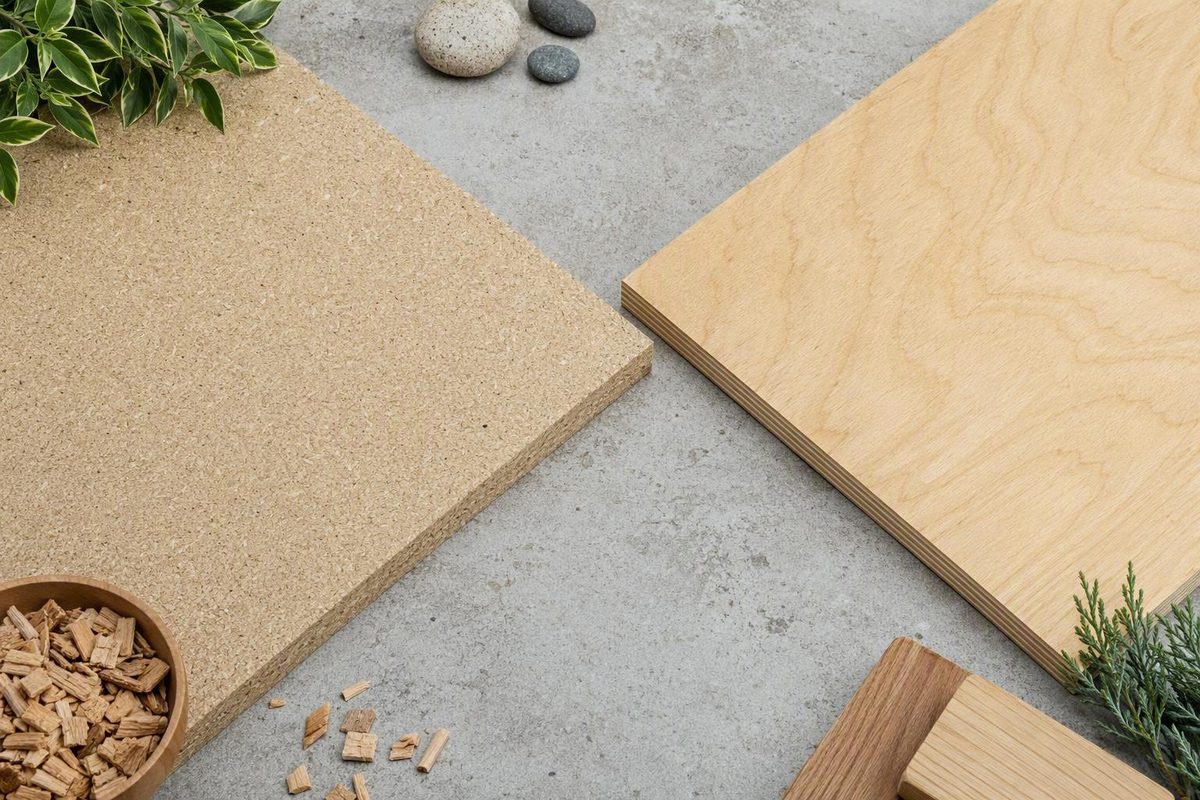
When comparing chipboard vs plywood, the safest starting point is not “Which material is best?” but “What must this panel do?”
Choose appropriately graded plywood when a project involves demanding loads, longer unsupported spans, conventional screw fastening, repeated use, disassembly and reassembly, or a realistic chance of dampness. Consider faced chipboard when low initial cost, a flat decorative surface, and efficient indoor construction matter—and when the component will remain dry, lightly loaded, and well supported.
Neither name is a complete specification. Thickness, grade, density, bond or moisture classification, finish, edge protection, support layout, and installation can all change the result.
Quick verdict: when to choose chipboard or plywood
Plywood is generally the lower-risk category for heavily loaded shelves, furniture frames, cabinet boxes, work surfaces, and locations where occasional dampness is plausible. Its layered construction usually provides better bending resistance and conventional fastener retention than standard chipboard.
Faced chipboard is a rational economical choice for dry bedroom furniture, short supported shelves, decorative cabinet components, and other low-stress indoor parts. Melamine, laminate, or veneer can provide a consistent finished face, although the underlying core remains vulnerable at cut edges and penetrations.
| Decision factor | Chipboard is more plausible when… | Plywood is more plausible when… |
|---|---|---|
| Load | Loads are light or moderate and distributed through a well-supported assembly | The panel carries heavier, concentrated, or repeated loads |
| Unsupported span | Spans are short, with close supports or intermediate dividers | Longer spans are unavoidable, subject to product-specific span data |
| Moisture exposure | The assembly remains dry and vulnerable edges are protected | Dampness, leaks, condensation, or intermittent wetting are plausible and the grade suits the exposure |
| Fastening method | The design uses dowels, adhesive, cam fittings, confirmat-style fasteners, or other purpose-designed connectors | The assembly relies on conventional screws or nails, particularly near edges |
| Visible finish | A factory-applied melamine, laminate, or veneer surface is wanted | A visible timber face, clear coating, stain, paint, veneer, or laminate is wanted |
| Expected service | Use is moderate and repeated dismantling is unlikely | The item will experience hard use, movement, repairs, or refastening |
| Budget | Lowest initial sheet cost is a major constraint | A higher initial cost may reduce failure or replacement risk |
Treat the table as a category-level guide, not authorization to buy any sheet carrying the preferred name. Thin, low-grade plywood with core defects may be a worse choice than a thicker, well-made chipboard component in a carefully supported dry assembly. Conversely, a decorative coating does not turn ordinary chipboard into a structural or waterproof panel.
The decisive purchase question is more specific:
Which product, at which actual thickness and grade, has documented performance for this span, load, fastening system, finish, and exposure?
General buying guidance similarly cautions that strength, suitable applications, and other features vary by the specific board, grade, and dimensions. It also notes that regulated work may require designated products rather than generic sheet goods (Lowe’s guide to particle board, plywood, MDF, and OSB).
Avoid shopping by assumed strength multiples, lifespan estimates, or fixed price percentages. The supplied evidence does not establish universal figures based on matched products of equal thickness, finish, grade, and intended use.
What chipboard and plywood are—and what the names do not mean
Chipboard is commonly another name for particle board. It is made by combining wood particles—such as chips, shavings, and sawdust—with resin or another binder, forming the mixture into a mat, and consolidating it with heat and pressure.
Particle size, particle distribution, resin system, compression, and panel density can influence the finished board. Some products have denser surface layers and a coarser core. Others are factory faced with melamine, laminate, or veneer and intended to be installed as finished furniture components.
Plywood is made from thin wood veneers bonded into a panel. The grain direction normally changes between adjacent layers. This cross-laminated construction helps resist splitting and distribute loads in more than one direction, although performance can still vary with veneer species, face orientation, core construction, defects, and loading direction. These fundamental construction differences are summarized in this comparison of engineered wood panels.
Those constructions lead to broad—but not universal—differences:
- Plywood generally offers better bending resistance, dimensional stability, and conventional fastener retention.
- Chipboard generally offers uniform broad faces and a lower initial price.
- Faced chipboard can provide an excellent decorative surface even though its exposed core and edges are comparatively weak.
- Plywood can provide a visible timber face, but lower grades may have patches, rough veneers, exposed plies, or core gaps that require covering.
The materials are often easiest to identify at a cut edge. Chipboard shows compressed particles with a granular or coarse texture. Plywood shows distinct veneer layers. Faces can be misleading because either product may be covered with veneer or laminate.
Do not use MDF, OSB, and chipboard as interchangeable names:
- MDF, or medium-density fiberboard, is produced from much finer wood fibers and is commonly selected for smooth machined or painted components.
- OSB, or oriented strand board, uses comparatively large strands arranged in directional layers and is commonly manufactured as a structural panel.
- Chipboard or particle board uses smaller particles rather than MDF’s fine fiber structure or OSB’s oriented strands.
The names also conceal substantial variation. For chipboard, look beyond the label to product class or density, moisture classification, resin system where disclosed, factory facing, and intended use. For plywood, consider species, face grade, veneer quality, core type, ply construction, voids, bond or exposure classification, and structural rating.
“Plywood” can describe anything from thin decorative paneling to structurally rated sheathing or cabinet-grade hardwood-faced material. “Chipboard” can mean raw standard board, moisture-resistant flooring panels, or finished furniture board with coordinated surfaces, edge treatments, and connectors. Category names alone do not establish that two sheets are substitutes.
Strength, shelf sag and fastener holding
For demanding loads, plywood is generally stronger and more reliable than standard chipboard. That does not make every plywood sheet suitable for every load. Panel thickness, unsupported span, support position, load duration and distribution, face-grain direction, defects, and grade all affect performance.
Why shelves sag
A shelf behaves like a beam between supports. Increasing the unsupported distance can greatly increase deflection even if the material and thickness stay the same.
Standard chipboard is comparatively prone to sag when a shelf is too long or inadequately supported. Plywood generally performs better, but it is not immune. A poorly proportioned plywood shelf can still deflect under sustained loading.
- Shorten the unsupported span. Add a divider, center support, cleat, or bracket.
- Increase panel thickness. Confirm the effect with technical data for the actual product.
- Reinforce the edge. Use a properly designed deeper edge member where appropriate.
- Improve load distribution. Do not impose concentrated loads on a shelf designed for distributed storage.
There is no universal safe shelf span or load capacity for either category. Obtain a span table, load table, or written design value for the exact panel and support arrangement.
An informal workshop demonstration found substantial differences among its plywood and particle-board samples, including differences related to plywood construction and loading direction. Because it used a limited setup and incompletely specified materials, it is illustrative only—not engineering data for long-term shelf sag, screw withdrawal, impact resistance, or a complete cabinet (small-sample panel bending demonstration).
Face durability is not edge strength
A melamine-faced chipboard desktop or cabinet shelf can feel hard, smooth, and durable. Its coating may provide an easy-clean surface and protect the broad face from ordinary wear. That performance does not describe the entire panel.
At exposed edges, holes, or damaged corners, the particle core can crumble or fracture. Similarly, an undamaged laminate can protect the main surface while an unsealed cutout or joint admits water.
A practical carpenter’s overview makes the same distinction between useful laminated faces and vulnerable edges and unsupported spans (The Honest Carpenter’s particle-board discussion).
Screws and repeated assembly
Plywood generally holds conventional screws and nails more reliably because fasteners engage multiple veneers. This is particularly useful where a joint experiences movement, the fastener is near an edge, or hardware may need to be removed and installed again.
Chipboard presents several common fastening limitations:
- An edge may crumble if a fastener is oversized, overdriven, or placed too close to a corner.
- Threads can strip the particles surrounding a hole.
- A screw removed and replaced in the same hole may no longer tighten securely.
- Repeated movement can enlarge a fixing point.
- A damaged fixing area can be difficult to restore reliably.
A chipboard assembly can still perform well when designed around the material. Useful measures include purpose-designed furniture connectors, dowels for alignment, compatible adhesive where the joint design permits it, correctly sized pilot holes, controlled driving torque, adequate edge distance, short shelf spans, and close supports.
These measures improve the assembly but do not make ordinary chipboard structurally equivalent to rated plywood. Where connection capacity is important, use the panel and hardware manufacturers’ documented values rather than extrapolating from an improvised test.
Moisture resistance depends on grade and edge protection
Moisture is often the deciding factor in a chipboard vs plywood comparison, but “plywood resists water” is too broad to be a useful specification.
What happens to standard chipboard
When water reaches standard chipboard, the core can swell, distort, soften, crumble, or lose strength. The highest-risk locations usually include:
- raw cut edges;
- drilled holes;
- sink and appliance cutouts;
- panel joints and seams;
- fixing penetrations;
- chipped corners;
- separated laminate or melamine; and
- cabinet bottoms exposed to leaks or wet floor cleaning.
A decorative facing may delay water entry without protecting every route into the core. Moisture-resistant chipboard differs from standard chipboard and may be suitable for designated damp-interior uses. Its classification does not automatically establish suitability for standing water, regular wetting, an unprotected sink cutout, or exterior weather. Commercial comparisons likewise distinguish moisture-resistant grades from standard chipboard while emphasizing the importance of exposed edges and recurring wet conditions (Ply Online’s plywood and chipboard comparison).
Plywood grades are not interchangeable
An exterior or marine designation generally indicates a more moisture-resistant bond or other defined quality requirements. It does not make the completed project automatically waterproof. Water can still enter through exposed plies, faces, fastener holes, damaged coatings, or poorly detailed joints.
A moisture-tolerant plywood assembly may require:
- a bond or exposure classification suited to the environment;
- sealed or suitably finished faces and edges;
- protected fastener and service penetrations;
- compatible adhesives, coatings, and fasteners;
- joints that shed rather than retain water;
- appropriate drainage and ventilation; and
- inspection and maintenance of the finish.
A practical hierarchy of moisture risk
Dry bedroom furniture: Moisture risk is relatively low. Faced chipboard can be appropriate if cleaning routines and adjacent surfaces do not expose raw edges to water.
Kitchen cabinets away from plumbing: Either material may work when its grade, finish, support, and assembly are suitable. Allow for steam, spills, wet cleaning, and appliance leaks rather than treating the entire kitchen as dry.
Sink cabinet or bathroom vanity: Risk is higher because plumbing joints, supply lines, traps, condensation, wet objects, and floor water create several potential entry points. Suitably graded and sealed plywood is generally the lower-risk category choice. Moisture-resistant chipboard requires careful protection at every cut edge, seam, hole, and penetration.
Garage or utility area: Classify the actual exposure. A conditioned, consistently dry garage differs from one exposed to condensation, wet vehicles, plumbing leaks, or water entering beneath doors.
Exterior work: Recurring rain, humidity cycles, sunlight, and retained water require a panel and completed assembly designed for exterior exposure. Ordinary interior plywood and standard chipboard are unsuitable.
Compare products intended for the same service condition. A test between raw standard chipboard and sealed marine or exterior plywood does not establish a universal difference between all products in the two categories.
Best material by project: furniture, shelves, cabinets and floors
Different components within one project may justify different panels. A cabinet might have a plywood box, chipboard shelves, MDF doors, and solid-wood edging. Specifying by component is often more economical than forcing one material into every role.
| Project or component | Likely choice | Why | Important exceptions | Specifications to verify |
|---|---|---|---|---|
| Budget wardrobe in a dry bedroom | Faced chipboard | Economical, uniform, finished surface | Plywood may suit frequently moved or heavily loaded furniture better | Thickness, connectors, shelf support, edge banding |
| Flat-pack desk | Faced chipboard | Suits factory-machined fittings and supported spans | Repeated dismantling can weaken fixing points | Hardware, pilot holes, support layout, replaceable connectors |
| Long bookshelf or heavily loaded shelving | Plywood | Better general bending resistance and fastening | Any panel can sag if too thin or poorly supported | Span/load data, thickness, face direction, reinforcement |
| Heavy-use furniture frame or work surface | Plywood | Better suited to repeated loads and screw joints | Critical loads may require another rated assembly | Grade, core quality, joint design, fastener data |
| Decorative laminated cabinet component | Chipboard can be appropriate | Uniform substrate for melamine, laminate, or veneer | Avoid vulnerable locations unless rated and protected | Facing, edge treatment, moisture class, hardware instructions |
| Sink cabinet or bathroom vanity | Suitably graded and sealed plywood | Lower general risk where dampness or leaks are plausible | Grade and detailing remain decisive | Exposure class, coating, edge and penetration treatment |
| Countertop substrate | Laminated chipboard is common | Flat, economical base for a finished surface | Cutouts, seams, and damaged laminate are high-risk points | Substrate approval, sealing, joint details, support |
| Painted cabinet door | Often MDF rather than either main option | Fine fibers can provide a smooth painted face | Moisture and door dimensions still matter | Coating system, moisture suitability, hinge fixing |
| Dry, non-structural underlayment | Product-dependent | Chipboard may be permitted in some dry systems | Generic chipboard should not be assumed suitable | System approval, moisture limits, installation instructions |
| Structural floor, wall, or roof panel | Structurally rated product only | Generic names do not establish capacity | Rated OSB may also be an option | Rating, span data, fixing schedule, applicable requirements |
| Outdoor furniture or exterior work | Exposure-rated plywood or another exterior product | Suitable products can be detailed for weather | Interior plywood remains unsuitable | Exposure rating, sealing, drainage, fastening, maintenance |
Furniture and wardrobes
For a wardrobe, dresser, or desk in a dry room, melamine-faced chipboard can provide good value. The covering supplies a finished surface without separate painting or veneering, while factory-machined connectors can make assembly efficient.
Keep shelf spans short and joints supported. Avoid repeated dismantling unless the connection system is designed for replaceable hardware. Protect lower edges from wet floors, and avoid moving a loaded assembly in a way that places excessive force on corner fixings.
Plywood is generally more attractive for furniture that will be moved frequently, subjected to demanding use, or repaired and modified over time. It also suits projects where visible timber faces or conventional screw joints are important.
Shelves
For long shelves carrying books, tools, dishes, or records, plywood is generally preferable. Material selection cannot, however, compensate for an unsuitable shelf design. Evaluate the actual span and expected load, panel thickness, support locations, edge stiffness, and connection to the surrounding cabinet.
Short decorative shelves with close side supports may work well in faced chipboard. Long pantry shelves carrying concentrated loads present a different problem even though both components are called shelving.
Cabinetry
Assess cabinet parts separately:
- Boxes: Plywood is often preferred for heavy-use or moisture-prone cabinetry. Faced chipboard can work for dry, economical cases.
- Shelves: Choose according to load and unsupported span rather than automatically matching the box.
- Doors and drawer fronts: Plywood can provide a visible wood face; MDF may be preferable for a very smooth painted finish.
- End panels and fillers: Faced chipboard can be efficient where the core remains protected.
- Sink bases: Suitably graded and sealed plywood is generally the lower-risk choice, but plumbing access and prompt leak detection still matter.
Cabinet manufacturers commonly use particle board, MDF, and plywood as different cores beneath melamine, laminate, or veneer. This reflects the importance of component function and desired finish rather than a need to use one material throughout (Maplewood Cabinetry’s cabinet-panel comparison).
Countertops
Laminated chipboard is commonly used as a countertop substrate in controlled indoor conditions. Its broad face can support a smooth decorative laminate, but protection is only as complete as the weakest opening.
Pay particular attention to sink and faucet cutouts, field-cut ends, corner joints, backsplash seams, appliance openings, and chipped laminate. Follow the countertop or substrate manufacturer’s sealing and support instructions rather than assuming the laminate makes the entire assembly waterproof.
Underlayment and structural floors
Chipboard may be considered for dry, non-structural underlayment only when the specific product and complete flooring system permit it. General flooring guidance similarly treats chipboard as a budget option for controlled dry conditions while favoring plywood where dampness is plausible (Wood and Beyond’s plywood and chipboard subfloor discussion).
A structural subfloor is a different application. Select a product with documented structural suitability, span information, edge details, and installation instructions. Verify the requirements applying to the project rather than assuming that any sheet called plywood is suitable or that every particle-board product is treated identically.
Apply the same principle to roof decking and wall sheathing. Generic panel names are not structural ratings, and requirements can vary by product and jurisdiction.
Outdoor projects
For outdoor furniture, signs, enclosures, and similar work, ordinary interior plywood is insufficient. Choose a product documented for the exposure, protect edges and penetrations, use compatible fasteners and coatings, provide drainage, and maintain the finish.
Exterior or marine plywood should be treated as one component of a weather-resistant assembly—not as a substitute for suitable joint design and water management.
Cutting, joining and finishing the panels
Both materials can be worked with ordinary woodworking equipment, but their typical failure modes differ.
It can nevertheless chip at the edge, produce substantial fine dust, abrade cutting edges, and break around poorly supported cuts. Plywood can splinter or tear out where a blade crosses the face veneer, particularly on lower-grade or brittle-faced sheets.
Cutting plywood
For cleaner plywood cuts:
- use a sharp, fine-tooth blade intended for sheet goods;
- support both sides of the cut;
- orient the show face according to the tool and likely breakout side;
- use tape or score the cut line where appropriate;
- minimize vibration and avoid forcing the feed rate; and
- test the setup on an offcut before cutting a visible component.
Exposed plies can be left visible as a design feature or concealed with veneer edge banding, solid edging, filler, or trim. A practical plywood guide likewise recommends checking veneer quality and using sharp tooling and edge treatment to manage tear-out and visible plies (Woodshop Diaries’ plywood selection and cutting guide).
Cutting and drilling chipboard
For chipboard:
- use sharp tooling and a stable cutting setup;
- support the offcut so it cannot tear away the final corner;
- drill clean, correctly sized pilot holes;
- avoid placing fasteners too close to edges;
- control driving torque;
- use the connector system specified for the board; and
- protect freshly cut edges that may encounter moisture or abrasion.
If a faced panel must be modified, decide how the new edge will be sealed and finished before making the cut.
Machining chipboard can create substantial fine dust. Use effective dust collection and appropriate eye and respiratory protection as specified by the tool manufacturer, panel safety documentation, and applicable workplace guidance; commercial machining guidance also notes chipboard’s tendency to create fine dust (Ply Online’s workability comparison).
Joining
Core gaps, thin face veneers, and low-quality edges can still complicate joinery, so inspect the sheet before relying on a narrow edge connection.
Cam fittings, dowels, confirmat-style fasteners, inserts, connector bolts, and adhesive-assisted joints may be appropriate when specified for the board. Pilot-hole diameter, embedment, edge distance, and driving torque matter.
Finishing
Chipboard is frequently sold with:
- melamine;
- high-pressure or decorative laminate;
- wood veneer;
- foil;
- edge banding; or
- another factory-applied surface.
A durable facing protects only the areas it covers. Cutouts, holes, seams, damaged corners, and unbanded edges still require treatment appropriate to their exposure.
Raw chipboard can be painted. Finish quality depends on preparation rather than a categorical inability to accept paint. Faces—and especially porous edges—may need filling, sanding, compatible primer, and a coating approved for the substrate. Factory-faced board may require different preparation, and some surfaces may not be suitable for repainting without product-specific confirmation.
Plywood can be painted, stained, clear-coated, veneered, or laminated. Results depend on face grade and species. Patches, grain variation, sanding marks, and veneer defects may remain visible under transparent finishes, while thin face veneers limit aggressive sanding.
Measure actual panel thickness before cutting grooves, ordering hardware, stacking laminations, or reproducing an existing part. Nominal descriptions may differ from measured dimensions, affecting dados, hinges, edge banding, and replacement fit. Mortar Desk’s guide to nominal and actual dimensions explains why the label should not replace measuring the panel in front of you.
Cost, service life and total project value
Standard chipboard usually has a lower initial purchase price than plywood, but the comparison must use equivalent sheet dimensions, actual thickness, grade, finish, and intended use. Local stock and market conditions also affect the result (Wood and Beyond’s cost comparison).
One sheet may be raw while another is factory faced. One may carry a structural rating while the other is decorative. Compare:
- identical or functionally equivalent dimensions;
- actual rather than nominal thickness;
- face and core grade;
- moisture or bond classification;
- factory-applied finish;
- structural rating where relevant;
- emissions and sourcing documentation; and
- delivery, cutting, and handling costs.
Do not rely on a universal price premium or lifespan estimate.
Calculate total installed cost
A useful comparison includes more than the sheet:
Total installed cost = panel price + cutting + finishing + edge treatment + hardware + supports + labor + transport + maintenance + likely repair or replacement cost
Chipboard may require edge banding, purpose-designed connectors, additional supports, careful drilling, and protection around penetrations. Plywood may require sanding, filling, decorative edging, sealing, or a separate finish. Either material can become the more expensive choice if it creates unnecessary labor or fails in the intended environment.
When chipboard’s lower price remains economical
Chipboard can provide good value when:
- service conditions remain dry;
- loads are light or moderate;
- spans are short and closely supported;
- factory coverings remain intact;
- exposed edges are protected;
- rough movement is unlikely;
- repeated disassembly is not expected; and
- replacement would have limited consequences.
A melamine-faced wardrobe carcass in a dry bedroom is a good example. Premium plywood may add little practical value when the chipboard product, connectors, and support layout already suit the intended service.
When plywood’s premium may be worthwhile
Plywood may provide better total value where:
- loads are demanding;
- unsupported spans are longer;
- screws may need to be removed and replaced;
- the item will be moved or modified;
- cabinet use is intensive;
- edge impacts are likely;
- occasional dampness is plausible;
- a visible timber face is desired; or
- failure would damage adjoining work.
The advantage is not a guaranteed lifespan. It is lower avoidable material risk when the project asks more of the panel.
Environmental claims need product-level evidence
There is no responsible category-wide answer to whether chipboard or plywood is greener.
Chipboard may incorporate recovered wood particles. Plywood may be available with certified timber sourcing. Neither fact settles the comparison.
Ask for:
- product-specific emissions documentation under the applicable test regime;
- chain-of-custody or sourcing certification where relevant;
- documented recycled content;
- local disposal or recycling guidance; and
- durability information appropriate to the intended exposure.
Labels such as E0, E1, E2, “low VOC,” “eco,” or “green” should not be treated as proof that an unidentified product complies with a particular local requirement. Verify the finished panel, test method, issuing organization, and current documentation.
What to check before buying a sheet
Start with a written use case. Record whether the panel will be structural or decorative, its maximum unsupported span, expected load, fastening method, finish, and likely moisture exposure. Then assess the actual product rather than relying on the rack label.
General purchase checklist
- Intended use: Furniture, shelving, underlayment, cabinetry, sheathing, countertop substrate, or exterior work.
- Actual thickness: Measure where joinery, hardware, grooves, or replacement fit matters.
- Sheet dimensions: Confirm usable width and length, allowing for damaged or factory-trimmed edges.
- Grade or rating: Determine whether the panel is decorative, non-structural, or structurally rated.
- Bond or moisture classification: Match the documented classification to the exposure.
- Surface finish: Check whether the panel is raw, sanded, veneered, melamine-faced, or laminated.
- Edge condition: Look for swelling, crumbling, impact damage, voids, or delamination.
- Flatness: Sight along the length and width for bow, twist, or cupping.
- Visible defects: Examine faces, corners, patches, blisters, and damaged coverings.
- Technical data: Obtain instructions for spans, loads, fasteners, coatings, and installation.
- Emissions documentation: Confirm the product and test regime applicable to the project.
- Price basis: Compare matched dimensions, thickness, grade, finish, and certification.
Additional checks for plywood
Check whether the face grade suits the intended finish. A clear-coated visible panel requires a different face quality from concealed sheathing.
Inspect exposed edges for gaps, overlaps, irregular veneer thickness, or delamination. Confirm the species or product family where appearance, machining, or strength matters.
For moisture-prone or exterior work, identify the bond or exposure classification and read what it permits. For load-bearing floors, roofs, walls, or other regulated assemblies, verify the rating, span information, installation schedule, applicable requirements, and locally adopted rules. Building-product guidance cautions that codes may call for specific products rather than generic panel categories (Lowe’s engineered-wood buying guide).
Additional checks for chipboard
Look for the product class, stated density, and moisture classification where available. Confirm the factory-facing material and whether cut edges require a particular banding or sealing system.
Obtain the manufacturer’s instructions for:
- compatible fasteners and connectors;
- pilot-hole sizes;
- minimum edge distances;
- maximum spans or support spacing;
- joint and edge protection;
- compatible coatings or adhesives; and
- permitted dry- or damp-interior uses.
Do not assume that green-colored material, a decorative label, or moisture-related marketing language means the board tolerates recurring wetting.
Inspect before leaving the store
Chipboard corners can be crushed beneath an apparently intact decorative face. Look for powdering, bulges, chipped laminate, swollen edges, and damaged connector areas.
On plywood, look for face splits, lifting veneer, bubbles, edge gaps, delamination, damaged corners, and excessive warping. Select sheets individually where appearance or precise joinery matters.
For shelving or other load-bearing assemblies, require span or load information for the actual panel and support arrangement. Do not invent a thickness, bracket spacing, or maximum load from a generic comparison.
Mortar Desk publishes general reference information and is not a contractor or engineering adviser. Specifications change and requirements vary by location, so structural and regulated work should be checked against the applicable product documentation and local rules (about Mortar Desk and its scope).
Frequently asked questions
Is chipboard the same as particle board?
Usually, yes. In furniture and sheet-goods discussions, chipboard is commonly another name for particle board: wood particles bonded with resin under heat and pressure.
Terminology can vary by seller or region. MDF and OSB have distinct constructions and should not be treated as synonyms for chipboard.
Which is stronger, chipboard or plywood?
Plywood is generally stronger and more reliable for demanding loads because its bonded veneers distribute forces through alternating grain directions. Standard chipboard is more prone to sagging, edge failure, and fastener damage under demanding use.
That is a category-level comparison, not a load rating. Grade, actual thickness, span, support, defects, loading direction, and the complete assembly determine whether a particular panel is adequate.
Can moisture-resistant chipboard be used in a kitchen or bathroom?
It may be suitable for some damp-interior components if the manufacturer permits that use and all cut edges, seams, holes, and penetrations are protected as specified.
Moisture-resistant does not mean waterproof. Sink cabinets, vanity bases, and components exposed to recurring leaks or wet cleaning are higher-risk applications. Suitably graded and sealed plywood is generally the lower-risk choice, although it also requires correct edge treatment and detailing.
Which material is better for shelves and screw fastening?
Plywood is generally better for long or heavily loaded shelves and joints that rely on conventional screws. It also tends to tolerate movement and refastening more reliably.
Chipboard can work for short, supported shelves assembled with appropriate furniture connectors, dowels, compatible adhesive, correctly sized pilot holes, and suitable edge distances. Obtain product-specific span and fastening guidance for meaningful loads.
Can chipboard or plywood be used for structural subfloors or outdoor projects?
Only when the specific product is documented for the application. Generic chipboard should not be assumed suitable for a structural floor, and generic plywood should not be assumed suitable for structural or exterior work merely because it is plywood.
For structural floors, walls, and roofs, verify the panel rating, span information, installation instructions, and locally applicable requirements. Outdoor projects need a product rated for the exposure plus suitable edge protection, drainage, fastening, detailing, and maintenance.
Final specification-first rule
Use faced chipboard where the assembly will remain dry, lightly loaded, closely supported, and cost-sensitive. Use appropriately graded plywood where loads, span, fastening, repeated use, or moisture increase the consequences of failure.
Before ordering, compare matched thicknesses and finishes, inspect the panels, protect vulnerable edges, and verify manufacturer data. For structural or regulated work, confirm the product rating and requirements that apply to the project’s location.