 MortarDesk
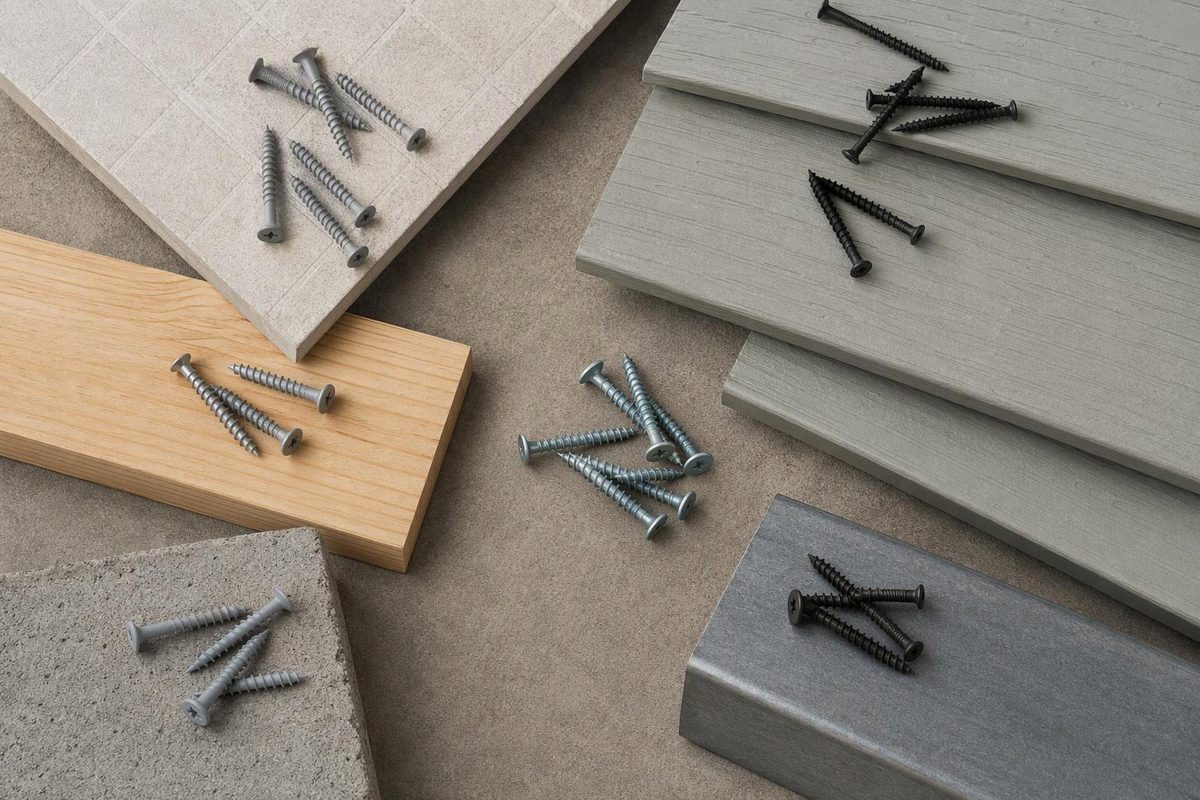
For interior HardieBacker floors and walls, the standard published screw specification is minimum 1-1/4 in. (31.8 mm) long, No. 8, with a 0.375 in. (9.5 mm) head. It calls for corrosion-resistant, self-drilling ribbed wafer-head screws. That is not a universal specification for exterior fiber-cement siding. The board, supporting material and exposure must all match the fastener’s documented use. HardieBacker installation guide, “Materials Required”
A screw sold for tile backer board is not automatically an exterior siding screw; a screw intended for wood is not automatically suitable for steel studs.
Which type belongs on the order?
These U.S. manufacturer specifications are documented product examples, not interchangeable approvals for every board assembly.
| Application | Documented screw example | Compatibility check |
|---|---|---|
| Cement or fiber-cement tile backer board | Simpson CBHL: No. 8, 1-1/4, 1-5/8 or 2-1/4 in. (31.8, 41.3 or 57.2 mm); coated zinc, high-low threads, ribbed wafer head, sharp point, T25 drive | Match the exact board instructions, substrate and required length. A sharp point is not a steel drill point. |
| Fiber-cement lap siding to wood | Simpson fiber-cement screw: No. 8, 1-5/8 in. (41.3 mm) listed for blind fastening; Type 316 stainless steel, coarse threads, Type-17 point, No. 2 square drive | Confirm the siding manufacturer permits that screw and fastening method for the project. |
| Fiber cement through furring strips to steel studs | Simpson self-drilling fiber-cement screw: No. 8, 1-5/8 or 2-1/4 in. (41.3 or 57.2 mm); coated Type 410 stainless steel, No. 3 drill point, No. 2 square drive | Check steel drilling capacity, maximum grip length and the moisture warning below. |
Specifications: CBHL cement-board screws, wood-substrate fiber-cement screws and self-drilling steel-substrate screws.
No. 8 identifies screw size, not head diameter or drive size. The two siding screw families above have different points, threads and stainless grades despite sharing that number.
Exterior siding: approval comes before length
Do not transfer an interior backer-board screw specification to lap siding. For James Hardie products covered by ICC-ES ESR-2290, revised May 2026, Section 3.3 requires the fastener type, size, spacing and installation method shown in the report’s tables. The wind tables distinguish product dimensions, framing, stud spacing, building height and exposure category. A fastener manufacturer’s application statement alone does not establish the siding assembly’s wind resistance. ESR-2290, Sections 3.3–4.2 and fastening tables
For attachment into wood framing, the length check is:
Siding thickness at the fastening point + intervening layers + required framing penetration.
Use the penetration required by the approved detail—not an assumed universal value. Foam and furring can change the attachment arrangement, not just the screw length. ESR-2290, Section 4.2.1 contains specific provisions for continuous insulation and designed furring-strip attachment.
For steel, overall length also overstates usable grip. Simpson lists maximum grip lengths of 1.151 in. (29.2 mm) for its 1-5/8 in. self-drilling screw and 1.801 in. (45.7 mm) for its 2-1/4 in. version. Its grip definition includes the side member, steel thickness, any air gap and allowance for three threads protruding through the steel. Self-drilling fiber-cement screw table and footnote
Corrosion and steel-framing limits
“Stainless” is not a complete exposure specification. Simpson states that its hardened Type 410 self-drilling screws do not offer the corrosion resistance of Type 305 or 316. It also warns against hardened stainless fasteners in steel framing where high humidity, condensation or other moisture will occur at the dissimilar-metal interface. Do not select that product merely because the package says stainless steel. Manufacturer warning
Older instructions may name Backer-On. As of October 19, 2026, ITW marks that product discontinued; its retained guidance says it is not approved for exterior applications or treated lumber and limits steel use to 26–22 gauge. That range should not be assumed to cover a board assembly specifying 20-gauge studs. ITW product guidance
Worked selection: interior tile underlayment
For 1/4 in. (6.4 mm) HardieBacker over 23/32 in. (18.3 mm) Exposure 1 OSB, first verify that the floor meets the board manufacturer’s structural requirements. Then select a screw documented for that board and wood substrate, at least 1-1/4 in. (31.8 mm) long, with the required head and corrosion protection. A general drywall or deck screw is not an equivalent merely because its length matches.
The HardieBacker floor instructions also require:
- A supporting mortar bed beneath the board; screws do not replace it.
- Fasteners every 8 in. (203 mm) over the entire surface, using the board’s pattern as a guide.
- Fasteners 3/8–3/4 in. (9.5–19.1 mm) from edges and 2 in. (50.8 mm) from corners.
- Heads flush with the surface, without overdriving.
Those are floor instructions, not an exterior siding fastening schedule. HardieBacker guide, “Floor Installation” and “Materials Required”
Before buying, write down the board product, substrate, screw size and length, head diameter, point/thread type, exposure rating and fastening pattern. Match that complete description to the current instructions and locally accepted assembly—not just the words “fiber cement screws.”