 MortarDesk
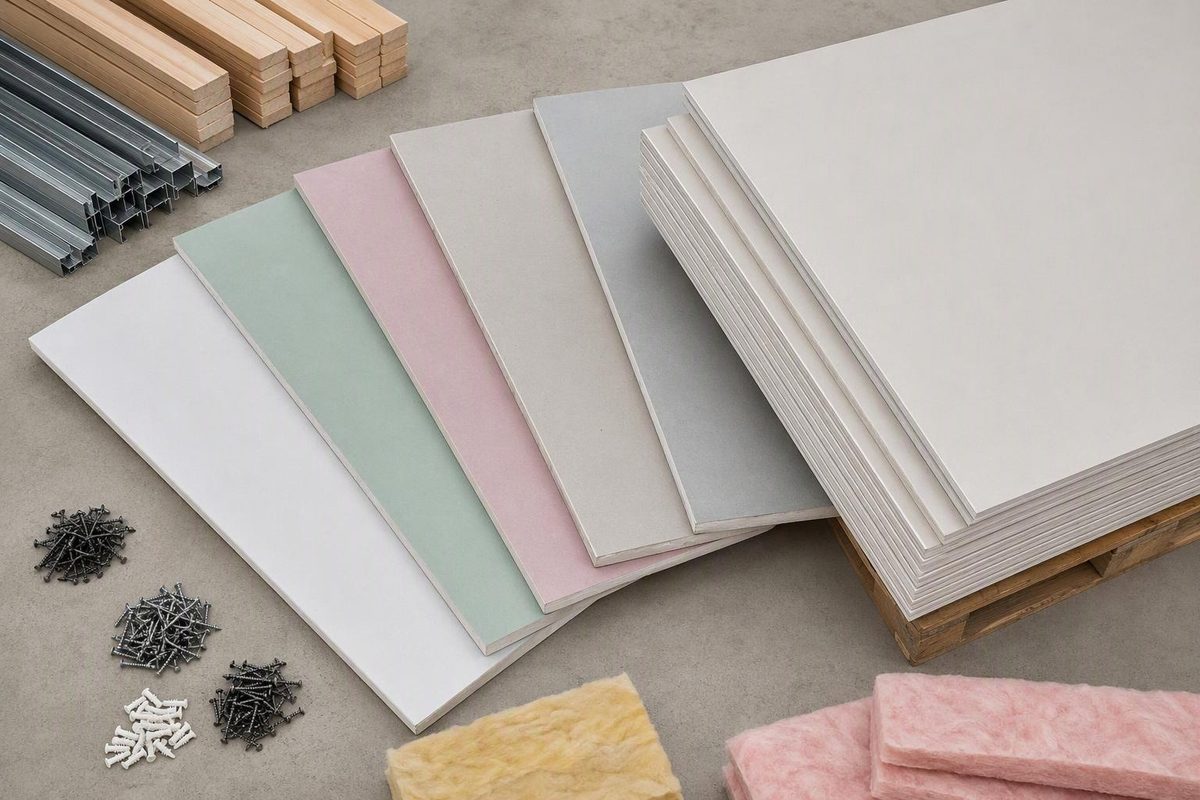
A 4 ft × 8 ft sheet of 1/2-inch USG Sheetrock UltraLight drywall weighs about 40 lb (18 kg). The same size in 5/8-inch USG Sheetrock Firecode X weighs about 70 lb (32 kg). These estimates use the nominal weights published for UltraLight and Firecode X. There is no single weight for a sheet of drywall: the dimensions and exact product line matter as well as thickness.
Choose the product and enter its sheet dimensions; open the order field to calculate multiple sheets.
Sheet and Order Weight
Calculate an order
Use a whole sheet count. Paired bundles contain two sheets in the cited USG submittals.
Estimated weight per sheet
~40 lb (18 kg)
Nominal rate: 1.25 lb/ft² · Area: 32 ft²
Order: 1 sheet · ~40 lb (18 kg)
Board only. Packaging, pallets and other cargo are excluded. Nominal rates are estimates, not measured sheet weights.
Sources: Gold Bond Gypsum Board product data; USG UltraLight and Firecode X product data; *CertainTeed Regular as listed in USG’s comparison. Source links and regional-weight caveats are in the chart below.
Drywall Sheet Weight Depends on the Exact Product
A description such as “half-inch drywall” does not give enough information to calculate the load. In the examples below, 1/2-inch UltraLight has a published nominal weight of 1.25 lb/ft², while CertainTeed Regular is listed at 1.6 lb/ft² in USG’s product comparison. Those rates produce different sheet weights even when the width, length and thickness are identical.
The calculator uses only the named products in the chart. Its result is an estimate for that product and sheet area, not a measured weight for every board sold under the same thickness description. If the supplier carries a different line, use that line’s published weight rather than choosing the closest-looking row.
Identify the product from the listing, label or submittal before calculating. In particular, do not treat “lightweight,” “regular” and “Type X” as interchangeable weight categories across manufacturers. A named product’s nominal rate is the basis for the estimate; the category name alone is not.
Published Sheet Weights for Common Sizes
Each entry below is one sheet, excluding packaging and finishing materials. Pounds are calculated from the published nominal rates; kilograms are rounded. The rates are not universal specifications for every brand of drywall.
| Example Product | lb/ft² | 4 × 8 ft | 4 × 12 ft |
|---|---|---|---|
| 1/4-in. Gold Bond | 1.1 | 35.2 lb / 16 kg | 52.8 lb / 24 kg |
| 3/8-in. Gold Bond | 1.3 | 41.6 lb / 19 kg | 62.4 lb / 28 kg |
| 1/2-in. UltraLight | 1.25 | 40 lb / 18 kg | 60 lb / 27 kg |
| 1/2-in. CertainTeed Regular* | 1.6 | 51.2 lb / 23 kg | 76.8 lb / 35 kg |
| 5/8-in. Firecode X | 2.2 | 70.4 lb / 32 kg | 105.6 lb / 48 kg |
The 1/4-inch and 3/8-inch rates come from the Gold Bond Gypsum Board product data. Their metric thicknesses are 6.4 mm and 9.5 mm respectively. The listed 1/2-inch thickness is 12.7 mm, and 5/8 inch is 15.9 mm.
*The CertainTeed Regular figure is as listed in USG’s comparison with UltraLight, rather than a separate CertainTeed submittal cited here. Confirm the current product specification with the supplier if that is the board you will receive.
USG describes its nominal weights as approximate figures for design and shipping and recommends confirming the specific regional product weight when precision matters. Its Firecode X submittal sheet provides that qualification. The calculated decimals in this chart do not mean each delivered sheet will weigh exactly that amount.
A 4 × 8 Sheet Can Weigh Less at a Greater Thickness
Within these examples, 3/8-inch Gold Bond weighs 41.6 lb for a 4 × 8 sheet, while 1/2-inch UltraLight weighs 40 lb. That comparison is enough to show why thickness alone is not a reliable weight lookup. It does not establish that thicker drywall is generally lighter; it compares two particular products with different nominal rates.
The same distinction applies to the two 1/2-inch rows. UltraLight is approximately 40 lb per 4 × 8 sheet, while the CertainTeed Regular example is 51.2 lb. A transport estimate based only on “1/2-inch board” could therefore use the wrong rate before the sheet count even enters the calculation.
A Longer Sheet Adds Area, Not a New Weight Rate
For a given product, calculate the longer sheet with the same pounds-per-square-foot rate. The 4 × 12 UltraLight example is 60 lb, compared with 40 lb for 4 × 8. Firecode X is 105.6 lb at 4 × 12, compared with 70.4 lb at 4 × 8.
These are area-based estimates. They do not confirm which lengths a particular supplier stocks or which dimensions are offered for every product in every region. Check availability separately; a calculated weight is not proof that the sheet size is available to buy.
Calculate a Different Sheet Size From Its Area
Sheet weight in pounds equals width in feet × length in feet × the product’s nominal weight in pounds per square foot.
For a 4 ft × 10 ft UltraLight sheet at 1.25 lb/ft², the calculation is 4 × 10 × 1.25 = approximately 50 lb (23 kg). Use the panel’s face dimensions, not its thickness, for the width and length fields. Thickness helps identify the correct product but is already reflected in that product’s published weight rate.
Keep the units consistent. The chart’s rates are in pounds per square foot, so enter width and length in feet. Entering an inch dimension into a field labeled feet would calculate the wrong area even if the product choice were correct. The calculator’s labels specify the units rather than attempting to infer them from the number.
If the board’s nominal rate is missing from its listing, the examples here cannot supply an exact replacement rate. Ask for the product data or shipping weight. The cited material does not give a nominal weight for every specialty board, brand or thickness, and the calculator should not be used to turn an unknown product into a seemingly precise answer.
For boards with different dimensions or product lines, calculate each group separately. Multiplying one sheet weight by the entire order count is appropriate only when all those sheets share the dimensions and nominal rate used in the calculation. Otherwise, add the group totals after calculating them individually.
An Order Total Includes Every Sheet, Not Just Every Bundle
For an order of 20 sheets, all 4 ft × 8 ft, the board-only totals are:
| Product | Per Sheet | 20 Sheets |
|---|---|---|
| 1/2-in. UltraLight | 40 lb | 800 lb / 363 kg |
| 5/8-in. Firecode X | 70.4 lb | 1,408 lb / 639 kg |
Those totals exclude pallets, packaging, compound, tools and other cargo. They are useful for estimating the board load, but they are not the complete transported weight. The sources cited here do not provide a packaging allowance that can simply be added to every order.
For the order calculation, multiply the unrounded pounds-per-sheet result by the number of sheets, then round the displayed total. The opening answer uses “about 70 lb” for readability; the Firecode X order example uses 70.4 lb because that is the result of the published rate and dimensions. Repeatedly multiplying the rounded introductory figure would lose part of the estimate.
A Paired Bundle Is Not One Sheet
Both cited USG submittals specify two panels per bundle. Consequently, the panels in a paired 4 × 8 UltraLight bundle weigh about 80 lb before packaging, not 40 lb. The USG UltraLight product data gives the bundle quantity as well as the product specifications.
Confirm whether the supplier’s quantity describes individual sheets or bundles before entering the order count. The calculator counts sheets. If the invoice uses paired bundles, convert that quantity to the actual panel count first. Do not assume that every supplier or every product uses the same bundle arrangement as these USG examples.
A quoted bundle weight also needs its own definition. It may describe the panels alone or a packaged unit; the sheet estimates here cover the panels alone. Where a load is close to a limit, obtain the supplier’s shipment weight rather than assigning an unsupported allowance for wrapping or pallets.
Board Weight Alone Does Not Establish Vehicle Capacity
Compare the complete load with the vehicle’s available payload, not just the drywall total. The 800 lb and 1,408 lb examples describe boards only. Other carried materials and cargo still belong in the load calculation, and neither example establishes that a particular vehicle can carry the order.
Use the capacity information for the actual vehicle and loading arrangement. This article does not supply a vehicle rating or a universal safe sheet count. A nominal board-weight estimate cannot answer the capacity question without that separate information.
The dimensions also remain relevant after the weight calculation. A longer sheet may have a manageable calculated weight while still requiring suitable support and a workable loading arrangement. Choosing a smaller or lighter panel solely to simplify transport can create a different material order from the one the job specifies, so confirm the panel requirement before changing it.
If the nominal estimate approaches the available payload, confirm the regional product weight and the complete shipment weight. The manufacturer’s approximation is appropriate for planning, but it should not be treated as a guaranteed maximum for a close capacity decision.
Lower Weight Does Not Make a Panel an Approved Substitute
Choose the required panel first, then calculate its weight. Standard 1/2-inch UltraLight is intended for non-fire-rated applications. Where a fire-rated assembly is required, verify the specified panel against the published assembly design. The UltraLight product data and Firecode X submittal linked above are the relevant starting points for those named products.
A lighter board is not automatically a permitted replacement for the specified panel. Likewise, the weight chart does not establish that any board carrying the same thickness description satisfies an assembly requirement. Weight is one handling and transport characteristic, not an approval criterion.
This matters when comparing the 40 lb UltraLight example with the roughly 70 lb Firecode X example. The difference helps estimate carrying and delivery loads; it does not provide a choice between equivalent products for every wall or ceiling. If the assembly calls for a specific board, use that board’s weight even when another row would produce a lower total.
The chart also does not provide installation requirements for every listed product. It is a weight reference, so fastening, permitted applications and assembly details still need to come from the appropriate product and project documents.
Handling and Storage Need Separate Checks
USG recommends carrying gypsum panels vertically by their edges, using mechanical assistance where possible, and storing them flat with their weight distributed so the floor is not overloaded. Those instructions are in the USG handling guide.
Knowing the weight of one sheet helps describe the task, but it does not establish a safe individual lifting limit. Panel dimensions, access and available assistance remain part of the handling arrangement. Treat the calculated weight as load information, not as clearance to carry a sheet alone.
For storage, the order total is more relevant than the single-sheet figure. Stacking the order concentrates its weight in the storage location; a board-only total still does not establish a safe floor-stacking load. That requires a separate check of the supporting structure and how the load is distributed.
For purchasing and delivery, the usable sequence is specific: identify the exact panel, confirm its dimensions, count individual sheets, calculate the nominal board weight, and obtain any missing shipment or capacity information. That keeps a quick sheet-weight estimate from being mistaken for a complete transport or storage assessment.