 MortarDesk
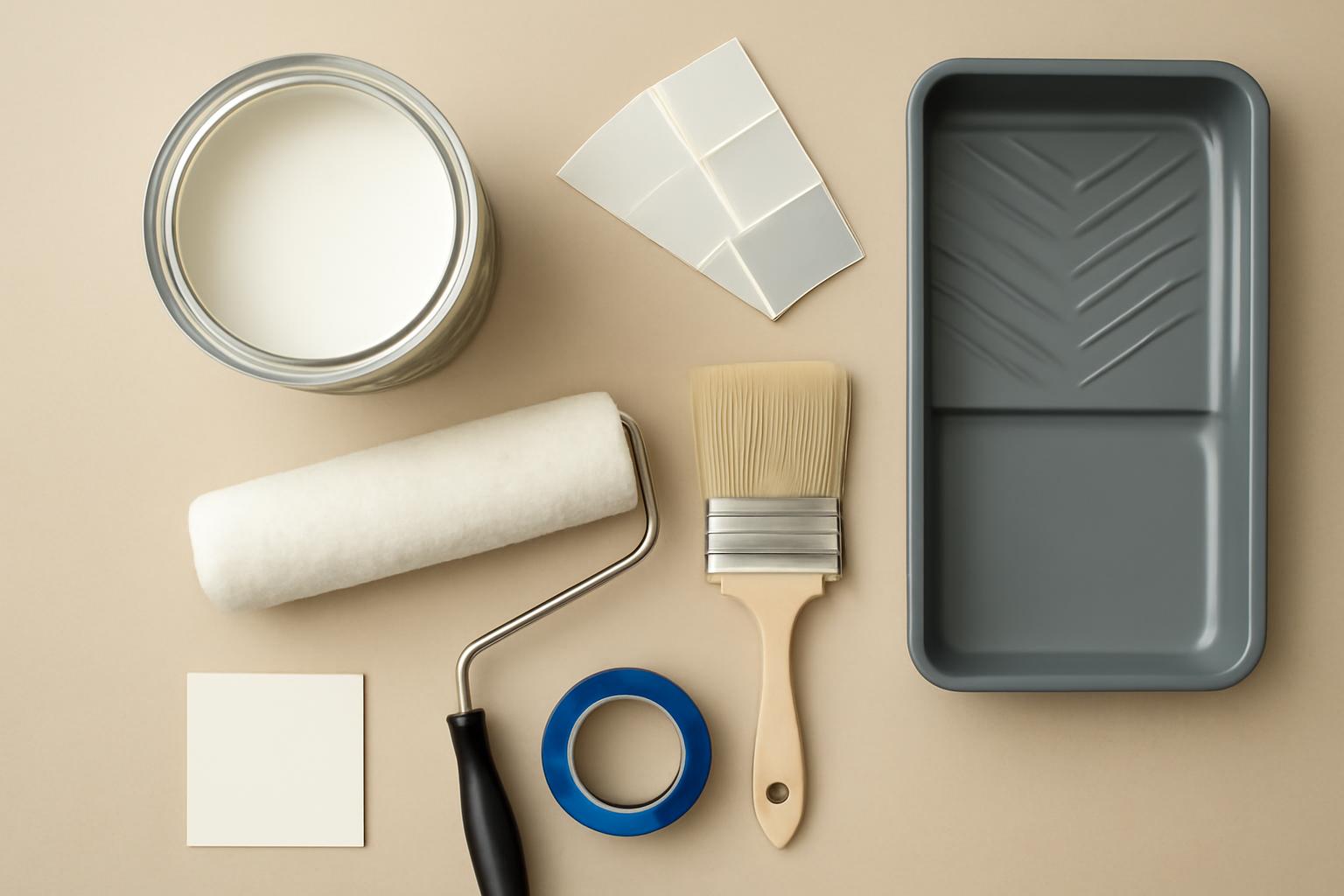
A gallon of paint is not a promise that one can will cover one fixed amount of wall. It is a per-coat spread rate under favorable conditions, and the amount you actually need depends on the finish you chose, how much hide the color provides, whether the wall is smooth or thirsty, how dramatic the color change is, and whether you are brushing, rolling, or spraying.
For most interior repainting, the best way to estimate is to start with a baseline, then adjust for sheen, coats, texture, porosity, and waste. That is the same common-sense approach you would use for other order-before-you-buy material quantities on Mortar Desk: use the published spec first, then account for real job conditions.
What Is Paint Coverage and Why Does Sheen Matter?
Paint coverage is usually expressed as square feet per gallon, per coat. That last part matters. A can may spread over a given area once, but the project is only “covered” when the wall looks even and finished.
Under good conditions, many interior wall paints fall in the broad range of about 350 to 400 square feet per gallon, but finish affects how forgiving the result looks. Lower-sheen paints generally hide minor flaws better, while shinier finishes reflect more light and make unevenness more visible (All Covered Painting).
That is why coverage has two layers:
- Spread rate: how far one coat physically goes
- Effective job coverage: how many coats it takes before the wall looks right
Those are related, but they are not identical. A flatter finish can make a patched wall look acceptably uniform sooner because it hides defects better. A glossier finish may still spread well on paper, yet show lap marks, flashing, or patch outlines that force you into more coating work. On the other hand, some manufacturer-oriented guidance notes that flat and matte paints can absorb more on porous surfaces, which lowers first-coat coverage in the real world (HIS Paint).
For that reason, sheen should be treated as an estimating clue, not a universal law. The can label or technical data sheet for the exact product in your cart is more reliable than any rule of thumb, especially if you are painting over repairs, using primer, switching brands, or moving from walls to trim, doors, or specialty coatings.
Standard Paint Coverage Rates Per Gallon
For standard interior wall paint on a smooth, prepared surface, the most useful general range is 300 to 400 square feet per gallon per coat, with 350 square feet per gallon as a practical rough estimate when you do not have the exact label rate (PaintCare).
Brand guidance often lands in the same neighborhood. Rodda Paint says a gallon of wall paint covers about 375 to 400 square feet, which is a helpful benchmark for ordinary room painting when you are dealing with standard wall paint rather than a heavy specialty coating (Rodda Paint).
Not every coating reaches that range. KILZ gives a broader estimate of roughly 250 to 350 square feet per gallon for paint or primer, which is a good reminder that primers and heavier products often cover less than standard finish paint (KILZ).
In practice, that leads to a simple hierarchy:
- If you have the can or technical data sheet, use that number.
- If you do not, 350 square feet per gallon is a reasonable conservative planning figure for standard wall paint (PaintCare).
- If the coating is a primer, floor paint, stain, epoxy, elastomeric coating, or another heavier product, expect lower spread until the manufacturer says otherwise (KILZ; HIS Paint).
The other important qualifier is that these figures are almost always per coat. One coat can work when the old color is similar and the product hides well, but consumer and manufacturer guidance commonly treats two coats as the safer expectation for major color changes, damaged or older surfaces, and better durability and uniformity (Rodda Paint; Farrow & Ball). That is why a room that looks like a “one-gallon room” on paper can turn into a two- or three-gallon purchase once you account for the second coat and normal waste.
A useful way to think about the standard range is this:
- 300–350 sq ft/gal: conservative planning for heavier or less efficient products
- 350 sq ft/gal: dependable rough estimate when the exact spread rate is unknown (PaintCare)
- 375–400 sq ft/gal: common benchmark for ordinary wall paint under good conditions (Rodda Paint)
Those are planning numbers, not guarantees. The real gallon count is decided by the wall in front of you.
How Paint Sheen Affects Coverage and Coats Needed
The cleanest way to understand sheen is to separate how far paint spreads from how easily it hides.
A flatter finish is usually more forgiving. Because it reflects less light, it tends to disguise roller texture, patched spots, hairline waviness, and minor surface defects more effectively. Guidance aimed at consumers and contractors commonly describes flat and matte paints as requiring fewer coats for an acceptable-looking finish than semi-gloss or gloss on comparable walls (All Covered Painting; PaintCare).
A shinier finish is usually less forgiving. Semi-gloss and gloss are more reflective, more durable, and easier to wipe down, but that same reflectivity reveals surface flaws and uneven film build. Consumer guidance summarized by PaintCare notes that a dark-to-light or light-to-dark change may require three or even four coats in some cases, and one estimating source simplifies the sheen effect further by saying a typical flat job often takes 2 coats while semi-gloss or glossy work may take 3 or more in harder-hide situations (PaintCare; Contractor’s Maintenance Service).
That does not mean gloss always covers less in a strict, mechanical sense. It means the finished result is harder to make look even. That distinction matters because many DIY estimates fail when they assume that a quoted spread rate equals finished appearance.
At the same time, lower sheen is not automatically the most efficient choice on every wall. HIS Paint notes that flat and matte paints may absorb more on porous surfaces. So two different statements can both be true:
- A flat finish may look covered sooner because it hides flaws better.
- That same flat finish may use more material on the first coat if the wall is porous or unprimed.
This is why sheen advice often sounds contradictory. One source is talking about visual hide; another is talking about first-coat absorption.
For most interior repainting, the practical pattern looks like this:
-
Flat or matte: often the most forgiving visually; usually planned as 2 coats for a solid result (PaintCare; Farrow & Ball)
-
Semi-gloss or gloss: often demand better prep and more exact application; some jobs may need extra coating work or additional coats to look even (PaintCare; All Covered Painting)
The tradeoff is straightforward:
- Lower sheen usually gives better flaw concealment and easier touch-up, but less scrub resistance.
- Higher sheen usually gives better washability and moisture resistance, but shows more defects and tends to be less forgiving of uneven application.
That tradeoff becomes most obvious in repaint scenarios:
Same-color repaint on a decent wall: Flat, matte, or eggshell may look finished quickly because the old color is not fighting the new one, and the lower reflectivity helps hide small inconsistencies.
Large color change: Even if the label spread rate looks generous, your coat count can rise sharply. Major shifts—from dark to light, light to dark, or into saturated colors—often need more coats regardless of sheen (PaintCare; Farrow & Ball).
Patched wall or fresh repair work: Gloss makes patch outlines, texture differences, and lap marks easier to see. Flat or matte can be more forgiving here, but unprimed patches may drink up the first coat.
Bathroom, laundry, or trim work: Semi-gloss or gloss can still be the right choice because durability and moisture resistance matter more than squeezing maximum wall area out of the can.
So when someone asks whether sheen changes coverage, the best answer is: yes, but mostly through hide, coat count, and forgiveness—not just through a single spread-rate number.
Coverage Rates by Sheen Level: Flat vs. Gloss Comparison
If you need a fast planning rule for smooth, primed surfaces, one contractor estimating guide breaks finish ranges out this way: flat/matte 350–400 sq ft/gal, eggshell/satin 350–400, semi-gloss 300–350, and gloss 300–350. That is useful as a rule of thumb, but it should not be treated as a universal cross-brand standard (Contractor’s Maintenance Service).
| Sheen level | Rule-of-thumb coverage per gallon, per coat | What to expect |
|---|---|---|
| Flat / Matte | 350–400 sq ft | Best at hiding wall flaws; usually the most forgiving visually |
| Eggshell / Satin | 350–400 sq ft | Similar planning baseline, with better washability |
| Semi-Gloss | 300–350 sq ft | More reflective; prep quality and lap marks show more |
| Gloss | 300–350 sq ft | Highly reflective and durable; least forgiving of defects |
This table works best as an estimating shortcut, not as proof that every flat paint always spreads farther than every gloss paint. The evidence across the source set is stronger on the qualitative point—flatter finishes hide better and shinier ones show more—than on a universal numeric hierarchy that holds across all brands and product lines.
That is also why manufacturer data can look very different from simplified online tables. Farrow & Ball, for example, publishes maximum per-coat coverage of 70 m² per 5 litres for Estate Emulsion, 60 m² per 5 litres for several eggshell-style finishes, and 30 m² per 2.5 litres for Full Gloss, while also recommending one coat of Primer & Undercoat followed by two coats of topcoat for best results (Farrow & Ball).
The phrase maximum per-coat matters. Surface condition, color change, film thickness, and application method still control the real purchase quantity.
So the safest way to use sheen-specific numbers is this:
- Treat 350–400 sq ft/gal as a planning band for many flatter wall paints on smooth, prepared surfaces (Contractor’s Maintenance Service).
- Treat 300–350 sq ft/gal as a cautious planning band for shinier interior finishes where reflectivity and coating quality matter more (Contractor’s Maintenance Service).
- Override both with the exact label or technical sheet whenever you have it.
If you want a fast midpoint for back-of-the-envelope math, these are reasonable planning midpoints, not guarantees:
- Flatter wall paints: around 375 sq ft/gal (derived from the 350–400 range; Rodda Paint is in the same neighborhood)
- Semi-gloss or gloss: around 325 sq ft/gal (derived from the 300–350 range; Contractor’s Maintenance Service)
Those shortcuts are useful for budgeting, but they should never overrule the specific product data.
Factors That Reduce Real-World Coverage
The number on the can is theoretical. Your wall, your tools, and your technique decide what happens in practice.
Rough walls have more actual surface area than smooth ones, and the low spots consume extra product. PaintCare says rough textures may require up to 50% more paint than smooth surfaces (PaintCare).
Porosity is another major variable. A contractor estimating guide says porous surfaces may use roughly 15% to 25% more paint, textured surfaces often need 20% to 30% more, and a general 10% to 15% waste factor is wise for overspray, spills, tray loss, and normal inefficiency. The same source estimates roughly 5% to 10% waste for brush or roller application and 10% to 25% for airless spraying (Contractor’s Maintenance Service).
Those adjustments are easier to use if you think in scenarios rather than one perfect number:
| Real-world condition | Conservative planning adjustment |
|---|---|
| Smooth, primed wall with brush/roller | Start with label rate, then add normal waste |
| Unknown standard wall paint | Use about 350 sq ft/gal as a rough baseline |
| Porous wall or unprimed patches | Add roughly 15–25% |
| Textured surface | Add roughly 20–30% |
| Rough texture | In harder cases, up to 50% more paint |
| Brush/roller waste | Add about 5–10% |
| Airless sprayer waste | Add about 10–25% |
| General project buffer | Add about 10–15% |
These are planning adjustments drawn from PaintCare and Contractor’s Maintenance Service. They help you stay conservative, but the product label still controls when it is available.
Color change is another hidden gallon-eater. Moving from a very dark wall to a light one, from light to dark, or into certain saturated colors can increase the number of coats even when the per-coat spread rate itself is normal (PaintCare; Farrow & Ball). This is one reason a room that mathematically “needs” 1.2 gallons can still turn into a 3-gallon purchase after two finish coats and a buffer.
Surface condition matters just as much:
- Fresh drywall or bare repairs absorb unevenly
- Patched plaster can flash through the finish
- Glossy old paint may need more prep for a uniform topcoat
- Smoke-stained or otherwise contaminated walls often need primer
- Budget products may not hide as well as better-hiding alternatives, depending on the specific line (All Covered Painting)
Application method changes the math too. Roller and brush application generally lose less material than spraying, but they are not waste-free. Sprayers can move fast and lay down an even coat, yet overspray, line loss, masking loss, and airborne material all increase consumption compared with what many DIYers expect (Contractor’s Maintenance Service; HIS Paint).
Environmental conditions shave away at coverage as well. HIS Paint and Contractor’s Maintenance Service both note that conditions such as temperature, humidity, drying speed, and, outdoors, wind can affect how the coating flows and builds.
A good mental model is this:
Published spread rate minus losses from surface absorption minus losses from texture minus losses from application method plus extra coats caused by hide or color change = real gallons purchased
That is why the front-of-can number is a starting line, not the answer.
How to Calculate Paint Needs: Step-by-Step Formula
A reliable estimate uses four inputs:
- Paintable area
- Coverage rate per gallon
- Number of coats
- Waste or adjustment factor
For a rectangular room, wall area is:
(2 × length × height) + (2 × width × height)
Then subtract the area of doors, windows, and any large openings that will not be painted. That is the same logic used by paint calculators that ask for room dimensions, openings, coat count, and paint efficiency (Omni Calculator).
Once you know the paintable area, use this formula:
(Total sq ft ÷ coverage rate per gallon) × number of coats × waste factor = gallons needed
That formula is simple enough to do by hand and flexible enough to handle sheen, texture, or spray adjustments.
Basic room example
Rodda Paint uses a classic example: a room that is 12 ft × 14 ft with 8 ft ceilings has about 416 square feet of wall area (Rodda Paint).
- 2 × (12 × 8) = 192
- 2 × (14 × 8) = 224
- Total = 416 sq ft
If your chosen wall paint is estimated at 375 sq ft/gal, one coat is:
416 ÷ 375 = 1.11 gallons
If you expect 2 coats:
1.11 × 2 = 2.22 gallons
Add a 10% waste factor:
2.22 × 1.10 = 2.44 gallons
In shopping terms, that usually means buying 3 gallons, unless the retailer can mix gallons and quarts in a way that suits the job (Rodda Paint; Contractor’s Maintenance Service).
Sheen-aware example
Now apply the same room to a shinier finish.
If you use a semi-gloss planning rate of 325 sq ft/gal—a midpoint taken from the 300–350 sq ft/gal rule-of-thumb band for semi-gloss and gloss—then two coats would be:
416 ÷ 325 × 2 = 2.56 gallons
Add 10% waste:
2.56 × 1.10 = 2.82 gallons
Again, that points to 3 gallons. The key difference is not huge in this room, but on larger areas it becomes noticeable. Those midpoint numbers are planning shortcuts derived from the sheen bands above, not manufacturer guarantees (Contractor’s Maintenance Service).
How to adjust the formula for real-world conditions
The main mistake DIY estimators make is plugging in area and stopping there. A better workflow is:
- Measure the wall area
- Subtract doors and windows
- Use the exact can rate if available
- Decide on realistic coat count
- Add a waste or condition factor
- Round up to buyable units
Here is a quick decision sequence:
- If the label says 390 sq ft/gal, use 390, not a generic average.
- If the label is unavailable, use 350 sq ft/gal for standard wall paint as a rough baseline (PaintCare).
- If the finish is flatter and the wall is smooth, a planning midpoint near 375 sq ft/gal can be reasonable.
- If the finish is semi-gloss or gloss, a planning midpoint near 325 sq ft/gal is more cautious.
- If the wall is porous, textured, or sprayed, increase the estimate before buying (PaintCare; Contractor’s Maintenance Service).
Why calculators are helpful but not final
Online tools are useful because they force you to think in terms of dimensions, openings, coats, and efficiency. But calculators are only as accurate as the inputs you give them. If you guess at the spread rate, ignore the second coat, or skip the texture adjustment, the result will still be wrong.
That is why paint calculators should be treated as structured worksheets, not verdicts. The more exact your purchase needs to be, the more the result should depend on:
- the spread rate on the can
- the surface you are actually painting
- the real number of coats
- a reasonable waste factor
If you are estimating for walls plus trim, or ceilings plus doors, separate them into different calculations. Wall paint, trim enamel, primer, and specialty coatings often cover at different rates, and combining them into one generic room total can make the order less accurate than it looks.
Sheen Recommendations by Room and Surface
Coverage is important, but it is not the only reason to choose a finish. In most rooms, the best sheen is the one that balances hide, durability, maintenance, and how much wall prep you are willing to do.
For bedrooms, living rooms, dining rooms, and ceilings, flatter finishes are often the easiest path to a clean-looking result. Sherwin-Williams recommends flat or matte options in lower-traffic or flaw-prone areas because they reduce visible reflection and help hide imperfections; flat is also a common ceiling choice because it keeps overhead surfaces visually quiet (Sherwin-Williams).
For general interior walls, eggshell, velvet, low-lustre, or satin often provide the middle ground. They usually clean better than flat while still avoiding the highly reflective look that calls attention to every patch or roller line. In a busy family room or hallway, that compromise can matter more than chasing the highest theoretical square-foot coverage.
For kitchens, bathrooms, mudrooms, laundry spaces, trim, and doors, higher sheen often makes sense even if it reduces estimating efficiency. Dunn-Edwards describes higher gloss levels as more durable and more resistant to scrub, stain, and moisture, while also noting that they highlight defects and imperfections more readily than flatter paints (Dunn-Edwards).
A practical room-by-room cheat sheet looks like this:
- Ceilings: flat
- Bedrooms and living rooms: flat, matte, or eggshell
- Hallways and kids’ rooms: eggshell, velvet, low-lustre, or satin if you expect cleaning
- Kitchens and bathrooms: satin or semi-gloss where moisture and wipe-downs matter
- Trim, baseboards, doors, cabinets: semi-gloss or gloss, with extra attention to prep and quantity planning
That last point is important. Estimating them separately is usually wiser than assuming the leftover wall paint math will carry over.
So the room-based decision is usually:
- choose flatter when hide and forgiveness matter most
- choose shinier when cleanability and moisture resistance matter most
And if those goals conflict, pick the performance requirement first and then budget the extra prep and paint it may require.
Tips for Accurate Estimation and Avoiding Waste
The single best habit is simple: read the label or technical data sheet for the exact product you plan to buy. Generic averages are useful, but the product itself is the authority on spread rate, recoat timing, recommended surfaces, and whether the manufacturer expects one coat or two.
Second, do not confuse published spread rate with finished-job coverage. A paint can have an impressive per-coat number and still require extra gallons because the wall is porous, the old color is strong, or the chosen sheen makes inconsistencies obvious.
Third, prime when the surface calls for it. Fresh drywall, repairs, stains, and major color changes often benefit from primer because it creates a more uniform base.
Fourth, if hide matters, do not buy on price alone. Some guidance aimed at homeowners notes that better-quality paints may provide better hide than economy lines, which can reduce the chance of needing extra finish coats in repaint situations. That is a product-dependent possibility, not a fixed percentage advantage, so judge it by the specific line and manufacturer information rather than a blanket rule (All Covered Painting).
Fifth, test a small area when the order needs to be tight. A sample patch can reveal whether the wall is soaking up the first coat, whether repairs are flashing through, or whether the chosen sheen shows more defects than expected.
Finally, keep the scope of the advice in perspective. Mortar Desk explains on its About page that it publishes general reference information rather than individual project advice. Paint estimating should be treated the same way: use guides like this to buy smarter, then verify against the exact can, the exact wall, and the exact conditions in your room.
What is the average sq ft per gallon for flat vs gloss paint?
A practical rule-of-thumb average is:
- Flat / matte: 350–400 sq ft per gallon per coat
- Gloss: 300–350 sq ft per gallon per coat
Eggshell and satin are commonly grouped with flat/matte at 350–400 sq ft/gal, while semi-gloss is commonly grouped with gloss at 300–350 sq ft/gal on smooth, primed surfaces (Contractor’s Maintenance Service).
The important caveat is that these are planning ranges, not universal manufacturer specs. Cross-brand agreement is stronger on the qualitative idea—flat hides better, gloss shows more—than on one fixed numeric gap that always holds.
How many coats does different sheens typically need?
For most interior repainting, plan on 2 coats as the default, especially for durability, color changes, or less-than-perfect walls (Rodda Paint; Farrow & Ball).
Where sheen affects the estimate is in how forgiving the finish is. Lower sheens such as flat and matte often look uniform sooner because they hide defects better. Higher sheens such as semi-gloss and gloss may require more exacting application and, in some situations, more coats or corrective work to achieve even hide (PaintCare; All Covered Painting).
So the fast takeaway is:
- Baseline expectation: 2 coats
- Higher-sheen caution: be prepared for more visible flaws and possibly more coating work
- Porous or unprimed surfaces: can upset the pattern, even with flatter finishes (HIS Paint)
Should I add extra paint for textured walls or spraying?
Yes. Those are two of the clearest reasons to build in a buffer.
PaintCare says rough textures may require up to 50% more paint than smooth walls. Contractor estimating guidance also suggests adding around 10–15% overall for waste, with brush/roller work losing roughly 5–10% and airless spraying often losing 10–25% through overspray and other inefficiencies (PaintCare; Contractor’s Maintenance Service).
If you are painting a wall that is both textured and sprayed, use a conservative estimate rather than the optimistic front-of-can number.
Where do I find the exact coverage rate for my paint?
Check the paint can label first, then the product’s technical data sheet if the label is brief. Paint calculators that ask for paint efficiency are asking for that manufacturer-stated area-per-volume figure, not a universal default (Omni Calculator; PaintCare).
If the label is missing or you are estimating early, 350 sq ft per gallon is a reasonable rough number for standard interior wall paint until you can confirm the product-specific rate (PaintCare).
Does brand matter for coverage by sheen?
For example, Farrow & Ball publishes separate maximum per-coat coverage figures by finish and still notes that surface condition, application thickness, and color change affect the result (Farrow & Ball). That means brand tables are useful for the exact product you are buying, but they are not universal proof that one sheen always spreads farther than another across the whole market.
So brand matters most when you compare like-for-like products:
- one wall paint versus another wall paint
- one trim enamel versus another trim enamel
- one published product data sheet versus another
For ordering, the exact manufacturer data for the can in your hand beats a generic sheen average every time.