 MortarDesk
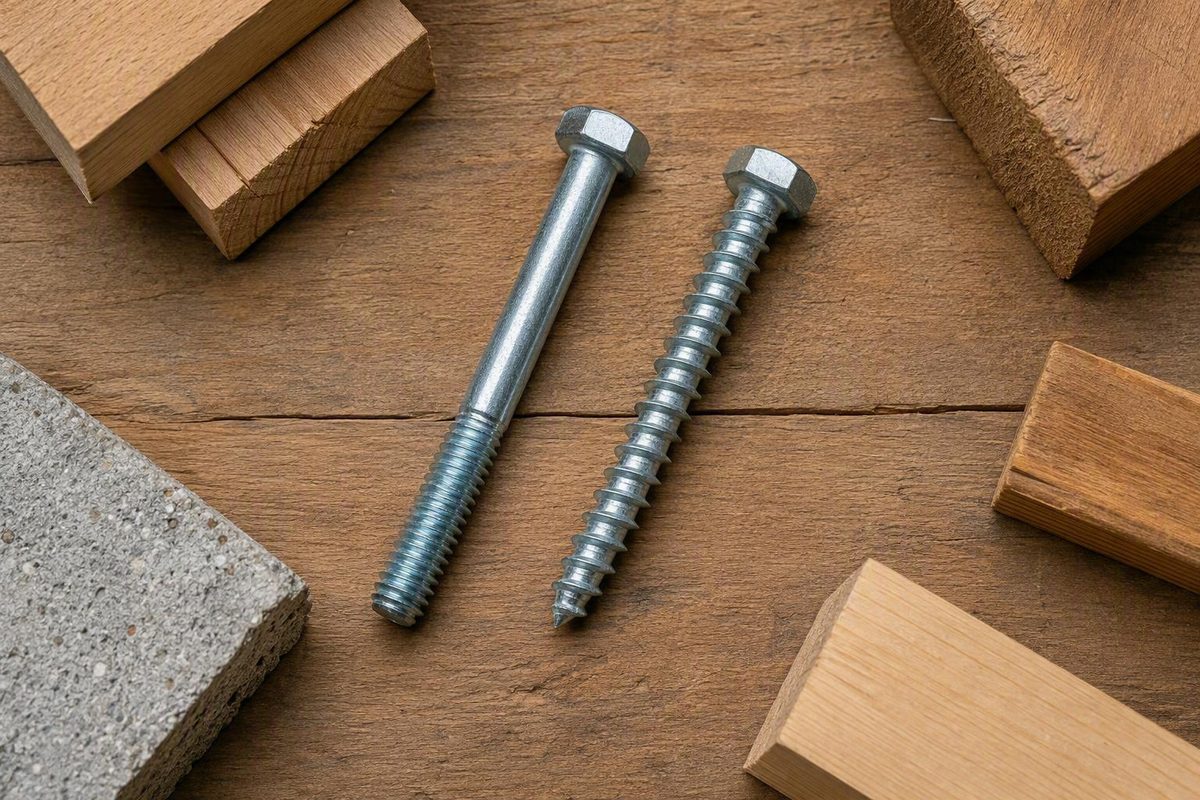
The short answer: lag screw and lag bolt usually mean the same thing
In ordinary trade, retail, and construction usage, lag screw and lag bolt usually refer to the same traditional heavy wood fastener. They are not consistently separate product categories. Fastener references commonly use the names interchangeably, although lag screw is generally considered more technically descriptive because the fastener threads directly into the receiving material rather than normally working with a nut (Fasteners Plus explains the shared terminology).
Terminology may vary by retailer, industry, or context. “Lag screw” may be more familiar in woodworking, while “lag bolt” may appear more often in construction or store labeling. That variation is a matter of usage rather than a dependable engineering distinction (Engineering Express discusses the naming variation).
The package wording does not, by itself, establish a difference in:
- Diameter
- Length
- Thread form
- Threaded length
- Shank configuration
- Material or grade
- Finish or coating
- Head geometry
- Load capacity
- Intended substrate
- Installation requirements
- Approved applications
One retailer may shelve a product under “lag bolts,” while the manufacturer or another supplier calls an equivalent item a “hex-head lag screw.” The specifications are therefore more useful than the noun printed in the largest type.
When comparing packages, read the complete product descriptions. Nominally similar fasteners can differ in threaded length, shank design, steel, coating, head dimensions, installation requirements, or supporting documentation. Conversely, products sold under different names may be functionally equivalent traditional lag fasteners.
Lag screw is the clearer technical description because the fastener is installed by turning its head while its coarse threads engage the receiving material. Lag bolt remains common and widely understood, largely because the fastener’s substantial body and hexagonal head look bolt-like.
Quick takeaway
If two packages match in diameter, length, thread form, material, finish, and applicable approvals, the words lag screw on one and lag bolt on the other do not alone make them different fasteners. That comparison does not prove complete interchangeability, however: also check threaded length, shank and head geometry, installation instructions, documentation, and the requirements of the connection.
This resolves the vocabulary question, not the selection question. Whether a particular lag is suitable depends on the complete connection—not on which familiar name appears on the package.
Why it is technically called a screw
The distinction becomes clearer when fasteners are classified by how they work rather than how they look.
A conventional machine bolt generally passes through prepared holes and is secured by a nut, or it engages a compatible tapped component. A traditional lag fastener instead has coarse threads that form or engage a threaded path in wood or another compatible receiving material. It is tightened by rotating its head and ordinarily does not rely on a nut.
That behavior makes screw the more descriptive word. An engineering trade explanation likewise distinguishes bolts assembled with nuts from screws driven by turning their heads so their threads engage the receiving material (Design World compares lag screws with conventional bolts).
The name lag bolt persists because appearance points in the other direction. A traditional lag commonly has:
- A substantial body
- A large hexagonal head
- No slotted or Phillips recess
- A wrench- or socket-driven installation
Those characteristics look bolt-like. The pointed end, coarse wood threads, and direct engagement with the receiving member look—and function—more like a screw.
Head shape alone is therefore not a reliable classification system. Not every hex-head fastener is a lag, and not every screw uses a screwdriver-style recess. Thread form, point geometry, mating components, and the way the fastener engages the assembly all matter.
| Fastener type | Typical point | Typical thread style | Normally uses a nut? | Common drive method | General role |
|---|---|---|---|---|---|
| Traditional lag screw | Pointed or tapered | Coarse threads intended to engage wood or another compatible material | No | Wrench, ratchet, or socket on the head | Direct fastening into a substantial receiving member |
| Conventional machine bolt | Commonly blunt | Machine threads | Usually, or it engages a tapped mating part | Appropriate tools control the bolt head and nut | Clamps an assembly through prepared holes |
| Ordinary wood screw | Pointed | Wood threads, with geometry varying by product | No | Screwdriver bit or another specified driver | General wood fastening where that product class is suitable |
| Engineered structural screw | Often specialized or self-starting | Product-specific engineered threads | No | Product-specific bit, often used with an approved powered driver | Documented structural fastening in specified applications |
This table describes typical mechanisms, not universal definitions or a strength ranking. A large traditional-looking fastener is not necessarily approved for a structural application, while a slimmer proprietary screw may have documented structural uses. The exact product specification and connection documentation—not appearance—settle that question.
There is also an important assembly distinction. If a fastener passes completely through the connected members and is secured with a nut, the connection is functioning as a through-bolted assembly. Calling the fastener a lag does not turn that arrangement into a typical lag-screw connection.
How to identify a traditional lag fastener
A traditional lag fastener is commonly recognizable by four features:
- A hexagonal head
- A relatively thick body
- Coarse wood threads
- A pointed or tapered tip
Some products also have a smooth, unthreaded shank between the head and the threaded portion. That feature may be conspicuous on longer traditional lags, but it is not universal. Threaded length and shank configuration vary by product (Fasteners Plus summarizes typical lag-screw anatomy).
The hex head is typical rather than definitive. Less-common square, flanged, or other head configurations may be available. Examine the fastener’s complete anatomy and product description instead of identifying it solely by the head.
Because the usual head lacks a conventional screwdriver recess, installation generally uses a wrench, ratchet, socket, or powered tool permitted by the product instructions. The tool must match the head or specified drive, and the installer should follow any product-specific limits on tool type or installation procedure.
A labeled illustration helps when comparing an unfamiliar product:
       wrench or socket engages here
                    ↓
              ┌─────────┐
              │ hex head│
              └────┬────┘
             [ optional ]  ← washer
attached member ───┼────────────────
                   │
                   │ smooth shank    ← present on some products
                   │
receiving member ──┼────────────────
/\/\/\/\/\/\/\/ ← threaded portion
/
/ ← pointed or tapered tip
                         V
The attached member is the piece being held in place, such as a bracket or the first wood member. The receiving member is the material in which the lag’s threads develop their engagement.
Appearance is only an initial screen. Before buying, verify:
- Nominal diameter
- Overall length and how that length is measured
- Thread form and threaded length
- Presence or absence of an unthreaded shank
- Head dimensions and required tool
- Fastener material
- Finish or coating
- Intended receiving material
- Installation instructions
- Applicable load data, listing, or evaluation documentation
A product sold as a “lag bolt” may be a traditional lag screw, a proprietary structural fastener marketed with familiar wording, or a component intended for use with an anchor. The name alone cannot distinguish among those possibilities.
Where traditional lag screws are commonly used
Traditional lag screws are commonly associated with substantial wood connections and hardware attachment. General examples include:
- Beams and posts
- Deck components
- Timber joints
- Brackets and heavy hardware
- Heavy furniture
- Equipment mounting
- Wall-mounted fixtures
- Other connections into substantial lumber
These examples describe common use categories, not blanket approvals. The fact that lag fasteners appear in deck construction does not mean every lag is suitable for every ledger, railing, post, or other regulated deck detail. Likewise, a label such as “for timber” does not establish capacity for every wood species, member size, or load direction.
The central feature of a traditional lag-screw connection is that its threads engage a receiving wood member or another specifically compatible material. That differs from a through-bolted connection, in which a bolt passes through the assembly and is secured with a nut.
Connection performance can depend on:
- Fastener diameter and thread geometry
- Thread engagement in the receiving member
- Wood species and moisture condition
-
Member thickness and geometry
-
Distance from edges and ends
-
Environmental exposure
-
Drilling and installation quality
-
Any washer, plate, nut, shield, or anchor required by the design
Supplier guidance likewise notes that holding capacity varies with factors including diameter, thread design, penetration, wood species, moisture, load direction, and installation quality (Intercorp’s guide discusses connection-dependent performance).
For structural or safety-critical work, do not select diameter or length solely from a generic rule of thumb. A rule based only on the attached piece’s thickness ignores receiving-member thickness, required thread engagement, edge conditions, splitting risk, and the loads the connection must resist.
Consider a heavy steel bracket being attached to timber. The useful question is not:
Should I buy the package labeled “lag bolt” or “lag screw”?
It is:
Does this exact fastener—at this diameter, length, material, finish, and installation condition—meet the documented requirements for the bracket, timber, load, and exposure?
That shift from naming to specification prevents a familiar product name from being mistaken for approval.
Pilot holes, washers, nuts, and installation tools
Pilot or lead holes are commonly recommended for traditional lag screws. Pre-drilling can ease installation and help reduce splitting, particularly with larger lags or demanding wood and connection conditions. However, general references do not describe the requirement uniformly: some recommend pilot holes as standard practice, while others suggest that the need varies with fastener size and application.
That disagreement is a reason not to adopt one universal pilot-hole diameter, depth percentage, or generic chart. Follow the instructions for the exact fastener and connection. Relevant considerations include:
- Fastener root and outside thread geometry
- Wood species and density
- Moisture condition
- Grain direction
- Fastener diameter and length
- Required thread engagement
- Proximity to ends and edges
- Attached-member thickness
- Connection geometry
- Manufacturer requirements
- Connector instructions and governing design documents
Traditional lag guidance generally recommends pre-drilling to ease driving and limit splitting, while modern engineered products may have different requirements; the product-specific instructions should control (Intercorp distinguishes traditional-lag and structural-screw installation).
The hole through the attached member may perform a different function from the lead hole in the receiving member. Do not assume that one arbitrary diameter should be drilled through every layer. Use the dimensions and sequence specified for the product or documented connection.
Does it need a nut?
A traditional lag screw normally does not need a nut. Its threads engage the receiving material directly. If the intended assembly passes completely through the members and finishes with a nut, confirm whether the design instead calls for a conventional bolt or through-bolt.
Special assemblies may use components that differ from the usual arrangement. Treat those as specifically designed connections, not as evidence that nuts are generally part of lag-screw installation.
What does a washer do?
A washer under the head can:
- Spread bearing pressure over a larger surface
- Reduce localized surface damage
- Limit how readily the head embeds into wood
- Provide the bearing surface required by a connector or design
Its effect depends on the fastener, member, connector, loading, and governing design. Hardware guidance describes washers as a way to distribute pressure and reduce material damage, but the connection documents must determine whether one is required (Old West Iron’s fastener guide explains the washer’s general role).
Which tools are suitable?
General tool categories include:
- A correctly sized wrench
- A ratchet and socket
- A powered driver permitted by the product instructions
- An impact tool where the instructions allow one
Fit the tool securely and tighten according to the product or connection instructions. Do not assume that the highest tool setting or maximum available force produces the best installation. Where torque, installation speed, seating condition, or inspection criteria matter, use the procedure provided for the exact fastener and assembly rather than a universal value.
Lag screws are not the same as engineered structural screws
The terminology issue and the product-comparison issue are different:
- Lag screw vs. lag bolt: usually two names for the same traditional fastener.
- Traditional lag vs. engineered structural screw: potentially different products with different geometries, materials, installation methods, documentation, and approved applications.
An engineered structural screw may use a specialized point, proprietary thread design, distinctive drive system, controlled material properties, application-specific coating, and its own installation instructions. Some are designed for installation with minimal or no pre-drilling in specified applications. Traditional lags commonly use pilot holes.
That does not mean every structural screw is stronger, safer, faster, or better than every traditional lag. Performance belongs to a particular product in a defined connection, not to the broad category name. Manufacturer comparisons may describe benefits for their own systems, but those claims should not be generalized to unrelated products.
A structural fastener’s documented capacity can vary with:
- Product model and diameter
- Thread and tip geometry
- Fastener length
- Thread engagement
- Wood species or engineered wood product
- Member dimensions
- Load direction
- Edge and end conditions
- Moisture and exposure
- Number and spacing of fasteners
- Installation method
Some manufacturers offer structural-screw systems for particular applications that might otherwise use traditional lags or through-bolts. Such replacements remain product- and application-specific (FastenMaster distinguishes engineered structural screws from traditional lags).
Do not replace a specified lag screw one-for-one merely because another product is marketed as a “lag replacement,” appears similar, or has a comparable outside diameter. A substitution should be supported by a governing source applicable to the project, such as:
- Approved plans
- Applicable code provisions
- Connector-manufacturer instructions
- Fastener-manufacturer documentation
- A relevant evaluation report
- Review by the responsible design professional
Diameter alone cannot establish equivalence.
An ordinary wood screw is a separate product category. It should not replace a rated fastener in a load-bearing connection merely because it fits the hole or is available in the desired length; fastener-supplier guidance expressly warns against using standard wood screws as substitutes for rated structural fasteners.
Use this decision checkpoint:
- Identify what the plans, connector, or connection documentation requires.
- Find the exact proposed product and its current documentation.
- Compare allowable loads and documented applications—not marketing names.
- Compare dimensions, engagement, member conditions, and installation procedure.
- Verify material and exposure compatibility.
- Obtain approval for a substitution when the project documents require it.
Installation speed matters only after suitability has been established. A fastener that installs without pre-drilling may save labor, but convenience does not make it an approved substitute.
Material, finish, treated wood, and masonry considerations
Fastener selection changes with the environment. A dry interior furniture connection, an exterior deck detail, a moisture-exposed structure, and a pressure-treated-lumber assembly may require different materials or protective systems.
Traditional lag fasteners are available in forms described as plain steel, zinc-coated, galvanized, stainless steel, or specialty-coated.
Check compatibility among:
- Fastener material and finish
- Preservative treatment used in the lumber
- Connector, bracket, and washer metals
- Indoor, exterior, wet, coastal, or other exposure
- Product-specific corrosion limitations
- Project and local requirements
Do not select solely on the words galvanized, coated, zinc, or stainless. Products within those broad categories can differ. Use documentation that addresses the specific fastener, connector hardware, treated wood, and exposure.
Wood, through-bolting, and masonry are different paths
Begin by classifying the substrate and assembly:
- Wood connection: A traditional lag’s threads engage a suitable receiving wood member. Follow the connection requirements for pilot holes, engagement, spacing, edge conditions, washers, and exposure.
- Through-bolted assembly: A bolt passes through prepared holes and is secured with a nut, often with specified washers or plates. Follow the bolt and connection specification rather than treating it as an ordinary lag installation.
- Masonry or concrete anchoring system: Use a compatible lag shield or another anchor system documented for the substrate and application. Follow that system’s instructions for drilling, hole preparation, embedment, spacing, edge conditions, and installation.
A traditional lag screw should not be driven into concrete or masonry as though those materials were wood. Supplier guidance that discusses lag use in masonry also identifies a lag shield or anchor as part of the assembly, underscoring that the complete anchoring system creates the connection (Amerifast discusses lag shields for masonry and concrete).
Use documentation specific to the anchor system, substrate, load, and installation conditions.
What to check before buying or substituting a fastener
The package name answers only a vocabulary question. Before purchase, work through the specifications that control the connection.
Purchase checklist
- Specified fastener type: Is the requirement a traditional lag screw, through-bolt, proprietary structural screw, masonry anchor system, or something else?
- Nominal diameter: Does it match the plans, connector instructions, or product schedule?
- Length: Is it measured in the same way as the specified product, and does it account for every intervening component?
- Thread engagement: Will the required threaded portion engage the receiving member under the documented conditions?
- Thread and shank configuration: Does the product have the required thread form, threaded length, and shank arrangement?
- Head and drive: Will the head bear correctly on the member, washer, or connector, and is the specified tool available?
- Material: Is the fastener material appropriate for the required product and environment?
- Finish or coating: Is compatibility documented for the exposure, treated wood, and adjacent hardware?
- Receiving material: Is the fastener documented for the actual wood, engineered product, masonry, concrete, or other substrate?
- Load direction: Is the connection resisting withdrawal, lateral loading, combined loading, or another documented condition?
- Edge, end, and spacing conditions: Does the actual geometry satisfy the governing connection requirements?
- Washer or connector requirement: Is a washer, plate, shield, bracket, or proprietary accessory specified?
- Installation instructions: Are the drilling, tool, tightening, and inspection requirements available and practical?
- Documentation: Is current allowable-load information, an applicable evaluation report, or another recognized approval available where rated performance is required?
If the connection depends on rated structural performance, locate documentation for the exact product, not merely its product family or general fastener category. Confirm that the supporting information covers the substrate, dimensions, loading, exposure, and installation conditions at hand.
Before making a substitution, check:
- Approved construction documents
- Connector-manufacturer instructions
- The fastener manufacturer’s current literature
- Applicable local-code requirements
- Any evaluation report referenced for the product
- The responsible designer or qualified professional where approval is required
Generic retailer advice is not enough for higher-consequence connections such as deck ledgers, engineered timber joints, or other load-bearing assemblies. These details may have prescribed fastener types, patterns, spacing, edge conditions, or inspection requirements.
Mortar Desk publishes general building-material reference information; it is not a contractor and does not provide individual engineering advice. Specifications can change, and codes vary by locality (About Mortar Desk). Structural and otherwise safety-critical work should follow approved plans, current product documentation, local requirements, and qualified review.
Are lag screws and lag bolts exactly the same thing?
In ordinary retail and trade usage, the terms usually identify the same traditional heavy wood fastener. Lag screw is more technically descriptive because the fastener is driven by its head and normally engages the receiving material without a nut.
That does not mean every product carrying either label is interchangeable. Products can differ in dimensions, thread geometry, material, finish, installation requirements, or approvals. Compare the complete specifications.
Does a lag screw need a nut or washer?
A traditional lag screw normally does not need a nut because its threads engage the receiving material. If the fastener passes through the members and is secured with a nut, the assembly may instead be a through-bolted connection.
A washer may be required or useful under the head to spread bearing pressure and reduce surface damage or embedment. Whether to use one depends on the plans, connector, product instructions, and connection conditions. It is not an automatic capacity upgrade.
Do lag screws always require a pilot hole?
Not under every product and application, but pilot holes are commonly recommended for traditional lag screws to ease driving and reduce splitting risk. General guidance differs on whether pre-drilling is universal or mainly necessary for larger fasteners and demanding materials.
Follow the instructions for the exact fastener, wood, member geometry, and connection. Do not apply a universal pilot-hole diameter or depth percentage, and do not assume the attached and receiving members necessarily require the same hole.
Can a structural screw replace a lag screw?
Only when the exact structural screw and connection documentation support the substitution. Some engineered structural screws are documented for applications that might otherwise use traditional lags, and some permit minimal or no pre-drilling under specified conditions.
That does not make all structural screws universal lag replacements. Compare approvals, allowable loads, dimensions, thread engagement, substrate, exposure, and installation requirements. If the plans specify a lag, obtain any required approval before changing it.
Can a lag screw be used in concrete or masonry?
A lag screw may form part of a concrete or masonry connection when used with a compatible lag shield or another documented anchoring system. It should not be treated as though it can form wood-style threads directly in concrete or masonry.
Select the complete anchor system for the actual substrate and load. Follow its requirements for drilling, hole preparation, embedment, spacing, edge conditions, and installation rather than inferring capacity from the lag’s diameter or package name.
The final decision rule is simple:
Treat lag screw and lag bolt as naming variants. Treat every change in dimensions, thread engagement, material, finish, substrate, installation method, documentation, or rated product as a potentially meaningful specification change.