 MortarDesk
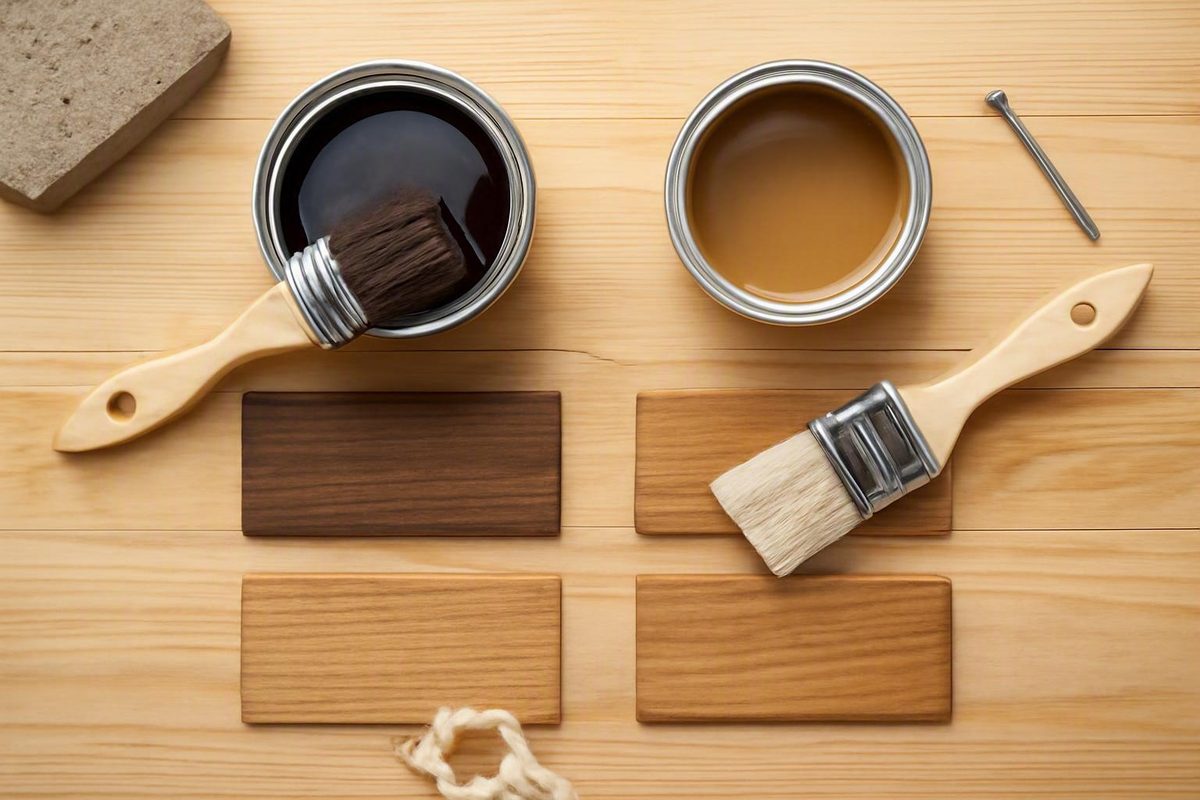
The practical answer to oil-based stain vs water-based stain is that neither chemistry always wins. Consider a water-based stain when fast drying, lower odor, and soap-and-water cleanup are priorities. Consider an oil-based stain when you want more time to blend the color or prefer a traditionally warmer, more amber-toned appearance.
Those are screening rules, not final specifications. The right stain must also be approved for the intended interior or exterior use, compatible with the existing finish, suitable for the wood and its condition, and manageable under the available temperature, humidity, ventilation, and cleanup conditions. For outdoor work, whether a product penetrates the wood or forms a film may matter more to future maintenance than whether its carrier is oil or water.
Quick comparison: when water-based or oil-based stain makes sense
A label-approved water-based stain is often a practical starting point for confined indoor or quick-turnaround work. An oil-based stain may suit a large or detailed surface where additional blending time is valuable, provided the site can accommodate its drying schedule, ventilation requirements, and specified cleanup solvent.
The table describes broad category-level tendencies. Individual formulations, wood species, preparation, application rate, and working conditions can change the result.
| Decision point | Water-based stain: general tendency | Oil-based stain: general tendency |
|---|---|---|
| Drying speed | Dries sooner and may permit earlier recoating or finishing | Dries more slowly and may delay later steps |
| Working time | Shorter open time can make broad areas harder to blend | Longer open time can make blending easier |
| Odor | Usually lower odor | Usually stronger solvent odor |
| Cleanup | Commonly soap and water | Commonly mineral spirits or another specified solvent |
| Appearance | Often less amber, although color varies by formula | Commonly warmer or more amber-toned |
| Grain raising | Water can swell exposed fibers and raise the grain | Less associated with water-induced grain raising |
| Ventilation | Follow the label and safety data sheet even when odor is low | Fresh-air circulation requires particular attention because of stronger fumes |
| Common project fit | Confined indoor or quick-turnaround work, when approved | Large or detailed surfaces where blending time is important |
| Main scheduling risk | Edges may set before adjoining sections are blended | Slow drying can delay handling, topcoating, or return to service |
| Main buying check | Intended use, cure schedule, grain behavior, and topcoat compatibility | Intended use, solvent requirements, cure schedule, ventilation, and material handling |
For a closet, trim, cabinet, or furniture project, faster drying and easier cleanup can make a water-based product attractive. “Lower odor,” however, is not a substitute for the selected product’s ventilation, protective-equipment, and first-aid instructions.
Oil-based stain can be useful on a broad tabletop, paneled door, or detailed assembly where a longer working window helps prevent hard edges. The tradeoff is a longer wait before subsequent work and, commonly, stronger fumes and solvent cleanup. U-C Coatings describes this same speed-versus-working-time distinction, although its commercial comparison does not establish that either chemistry is universally easier or more durable (U-C Coatings’ oil-versus-water comparison).
A fast-drying stain can be convenient on one job and unforgiving on another. A slow-drying stain can improve blending but create an impractical schedule. Compare products designed for the same project rather than choosing a universal winner.
Oil versus water is only one part of the product specification
A water-based stain uses water as its pigment carrier. An oil-based stain uses natural or synthetic oils as its carrier. That distinction helps predict likely working time, odor, and cleanup, but it does not by itself establish penetration, outdoor durability, UV or water resistance, or future maintenance requirements.
A complete comparison should address four separate classifications:
- Interior or exterior use: Exterior products must be formulated and labeled for weather exposure. Do not assume that an interior stain is suitable for a deck, fence, siding, or outdoor furniture.
- Penetrating or film-forming behavior: A penetrating stain is intended primarily to enter the wood. A film-forming product leaves more of a coating at the surface.
- Transparency and pigment: Transparent, semi-transparent, semi-solid, and solid-color products obscure the wood to different degrees. Opacity comes from pigment level and product design, not simply from film formation.
- System function: Some stains are colorants intended to receive a separate topcoat. Others claim combined staining and protective functions. The documentation must identify what the product includes.
Penetrating-versus-film-forming behavior can be particularly useful when planning maintenance. A penetrating product may weather through gradual color loss and permit cleaning and recoating, depending on its condition and instructions. A film that loses adhesion may require sanding, stripping, or removal. Neither maintenance outcome belongs exclusively to oil-based or water-based products.
Do not compare a transparent penetrating oil with a solid-color water-based coating and attribute every difference to the carrier. Their pigment levels, resin systems, opacity, application rates, and maintenance paths are already different. Compare products with similar intended uses and transparency levels.
For each candidate, verify:
- Interior, exterior, or dual-use approval
- Compatible wood species and surface condition
- Penetrating or film-forming behavior
- Transparency and pigment level
- Required application rate and coat count
- Any sealing or weather-protection claims
- UV, water, mildew, and abrasion claims, where relevant
- Whether a separate protective topcoat is required
- Recoating, preparation, and removal instructions
Commercial sources disagree over whether oil-based stain necessarily penetrates more deeply and whether water-based stain necessarily forms a peel-prone film. Deck-restoration guidance identifies exceptions, including penetrating water-based exterior products, and argues that penetration or film formation may be more informative for maintenance than carrier chemistry (DeckStainHelp’s practitioner comparison). This is field guidance from a commercial specialist site, not an independent standardized comparison of equivalent products.
Quality and correct application matter. A suitable water-based formulation applied at its specified rate may outperform an unsuitable or overapplied oil-based product, and the reverse is also possible. “Oil-based” and “water-based” are useful screening categories, not complete performance specifications.
Drying speed, working time, application, and cleanup
Water-based stains generally dry and become ready for later steps sooner. Oil-based stains generally remain workable longer. That creates a direct tradeoff between project speed and blending time.
Faster drying can shorten the interval before topcoating, moving, or reinstalling a piece. It can also allow an edge to set before the adjoining section is blended, particularly on a large tabletop, cabinet assembly, paneled door, or broad run of siding. Longer open time provides more opportunity to wipe, feather, and even out the color, but it delays handling and return to service.
Neither chemistry is automatically easier for a beginner. Application difficulty depends on:
- Surface size and complexity
- The wood’s absorption rate
- Product consistency and application method
- Applicator and wiping material
- Temperature and humidity
- Air movement and direct sunlight
- Preparation and sanding
- The ability to maintain a wet edge
- The formula’s wiping or removal window
Drying terms also describe different milestones:
A stain can feel dry while remaining unsuitable for a topcoat, rain, furniture, or traffic. Likewise, a stated recoat time is not the same as full cure.
Published commercial comparisons report substantially different drying figures for the two categories. Those differences may reflect formulations, coat thicknesses, environmental conditions, and inconsistent definitions of “dry.” Schedule the project from the current container label and technical data sheet rather than a universal oil-versus-water range.
Water-based products commonly call for soap-and-water cleanup. Oil-based products commonly call for mineral spirits or another specified solvent. Confirm the required cleaner before beginning and clean tools within the period allowed by the label.
Use this application-planning checklist:
- Prepare representative scrap or choose an inconspicuous test area.
- Complete every preparation step required for the wood and prior finish.
- Confirm acceptable temperature, humidity, and wood-moisture conditions.
- Plan natural stopping points before applying stain.
- Divide broad surfaces into manageable sections.
- Maintain a wet edge wherever the instructions require one.
- Work with the grain and complete whole boards or natural breaks when practical.
- Apply only the specified amount.
- Follow the stated wiping window and coat limit.
- Test the complete drying and topcoating schedule before committing the entire project.
Natural-bristle brushes are commonly recommended for oil-based stain, while synthetic-bristle brushes are commonly recommended for water-based stain. Sherwin-Williams identifies that general distinction and advises against casually mixing stain types or brands in its guide to avoiding wood-staining mistakes. The selected stain’s instructions still control because some products call for pads, rollers, sprayers, cloths, or combinations rather than a conventional brush.
Appearance, wood absorption, and raised grain
Oil-based stains are commonly associated with a warmer, richer, or more amber-toned appearance. That is a starting expectation, not a color specification. Final color depends on the formula and color selected, wood species, existing color, sanding, surface condition, absorption, application rate, wiping, coat count, and topcoat.
Keep these qualities separate:
- Warmth is the apparent color cast.
- Darkness is the value or lightness.
- Opacity is how much of the underlying wood is hidden.
- Grain enhancement is the visual contrast in the wood structure.
- Protection is resistance to the relevant exposure.
A stain can look warmer without being darker, more opaque, or more weather-resistant. A richly colored sample does not prove better exterior protection.
Water in a water-based stain can swell exposed fibers and raise the grain. This may be particularly noticeable on furniture, cabinets, and fine trim where a smooth tactile finish matters. It may be less conspicuous on rough-sawn fencing or weathered exterior boards. A manufacturer comparison also identifies raised grain as a possible water-based-stain effect, although the extent will depend on the wood and application (ZAR’s oil-versus-water overview).
Do not turn that observation into a universal sanding recipe. Instead:
- Prepare a sample from the same stock as the project, if possible.
- Apply the stain at the specified rate.
- Let it reach the relevant drying milestone.
- Inspect and feel the surface for raised fibers.
- Follow the manufacturer’s sanding directions if smoothing is permitted.
- Recheck the color before applying a topcoat.
Some systems specify a pretreatment or sanding sequence; others restrict sanding between particular layers.
Wood species and condition also affect absorption. Pine and maple can absorb stain unevenly and produce blotching or unexpected color. That does not make either carrier chemistry a universal solution. Sanding consistency, contamination, heartwood and sapwood variation, end grain, conditioners, gel formulations, and application technique can all affect the result.
Test the complete system, not just the stain. If the product specifies a conditioner, include it. Apply the intended stain color and coat count, followed by the intended topcoat.
Commercial claims about exterior color retention conflict. Some sellers favor oil-based products, while others claim modern water-based resins retain color or repel water more effectively. Without equivalent independent testing, rely on the specific product documentation and a representative sample rather than assuming that color warmth predicts outdoor longevity.
Best fit by project: interior furniture, cabinets, decks, and fences
The most useful recommendation starts with the surface and working conditions.
Closets, trim, and confined interior work: A label-approved water-based stain is commonly a practical starting point when lower odor, faster drying, and soap-and-water cleanup matter. Confirm that the room can still be ventilated as directed and that the stain is compatible with the intended topcoat.
Cabinets and furniture: Either chemistry may be appropriate. Water-based stain can support a shorter production schedule, but faster setting may require careful sectioning and wiping. Oil-based stain provides more blending time, which can help on detailed doors, carved parts, or assemblies with uneven absorption. Test the complete conditioner-stain-topcoat system.
Large tabletops and broad panels: An oil-based stain’s longer working time may make it easier to maintain an even appearance across the surface. That advantage is practical only when the project can accommodate the specified ventilation, solvent cleanup, and drying period. A water-based product may still work well when its application method is suited to the area.
Decks: Prioritize deck approval, the existing coating, wood condition, penetration or film formation, transparency, pigment, exposure, traffic, application rate, and maintenance instructions.
Fences and siding: These vertical surfaces do not receive the same direct wear as deck boards, but orientation, end grain, sprinklers, vegetation, exposure, and previous coatings still matter. Decide whether gradual fading, localized touch-up, or eventual coating removal fits the desired maintenance approach.
Outdoor furniture: Confirm approval for exterior furniture and consider abrasion, rain exposure, storage, and how people will contact the finished surface. Advice developed for deck boards does not automatically apply to chairs and tables.
Manufacturers and contractors often recommend oil-based stains for exterior wood because of working time, penetration, or preferred maintenance behavior. These commercial sources provide product or field experience, but they do not establish universal superiority through controlled comparative testing. One contractor, for example, favors transparent penetrating oils because gradual fading is preferable to film peeling in its maintenance system (Sand & Stain’s deck-maintenance discussion). That is a useful field perspective, not proof that every water-based stain forms a peeling film.
Do not extend deck recommendations automatically to wood floors, countertops, food-contact surfaces, or children’s furniture. Those uses involve different contact, abrasion, exposure, and product-approval considerations.
Before choosing, run the project through this five-factor screen:
- Intended use: Is the product approved for the precise interior or exterior surface?
- Existing finish: Is the wood bare, weathered, stained, sealed, painted, or covered by an intact film?
- Desired working time: Is rapid progress more valuable than a long blending window?
- Ventilation and cleanup: Can the site accommodate the documented airflow, protective equipment, cleanup material, and waste requirements?
- Maintenance approach: Do the expected cleaning, touch-up, recoating, sanding, stripping, or removal requirements fit the project?
Previously stained wood and compatibility between systems
Can water-based stain go over oil-based stain, or oil-based stain over water-based stain? There is no reliable universal answer. Compatibility depends on the existing product, whether it has fully cured, its condition, any sealer or topcoat, surface preparation, and the new manufacturer’s instructions.
The carrier named on the container is only part of the question. Possible warning signs include blotching, poor bonding, unusual color, or abnormal drying.
Do not mix stain types or brands within one application merely because their colors appear similar. Even products described as the same broad chemistry may use different resins, solvents, additives, and application schedules. Combine products only when the relevant manufacturers expressly approve the complete system.
Use this conservative sequence:
- Identify the existing product. Find the original container, receipt, maintenance record, or manufacturer if possible.
- Inspect the surface. Look for peeling, flaking, uneven wear, glossy areas, contamination, or an intact film.
- Define the proposed system. Include cleaners, brighteners, conditioners, stain, sealer, and topcoat.
- Consult both manufacturers. Ask whether the proposed system is approved over the identified old product and what curing and preparation requirements apply.
- Prepare exactly as directed. Do not assume ordinary washing is sufficient.
- Test adhesion and appearance. Use a representative area and wait through the specified evaluation or cure period.
- Remove the existing system if required. Unknown, incompatible, or failing coatings may need to be stripped or sanded back to a sound surface.
For exterior decks, practitioner guidance recommends stripping, brightening, and drying the wood before changing between oil- and water-based systems. Treat that as conservative deck-restoration guidance, not a universal rule for every interior project. A manufacturer may permit application over a fully cured and correctly prepared finish, while another may require bare wood.
If the existing coating is unknown and failing, removal followed by one compatible system may be more predictable than adding another stain. Avoid household tests that claim to identify an unknown stain chemistry with certainty. Even a correct guess about the carrier would not identify the resin, sealer, topcoat, or compatibility requirements.
Outdoor durability, fading, peeling, and future maintenance
The available evidence does not support declaring either chemistry universally longer-lasting outdoors. Commercial sellers of oil-based products frequently emphasize penetration and maintenance, while deck practitioners also identify penetrating water-based products that can perform comparably. Performance depends on much more than the liquid carrier.
A useful maintenance distinction is fading versus film failure:
- Some penetrating stains weather by gradually losing pigment and color.
- Film-forming products can peel, flake, crack, or blister if the system loses adhesion.
- Penetrating and film-forming products can exist within either broad chemistry.
This distinction helps anticipate future work, but it is not an inevitable oil-versus-water split. A penetrating water-based stain should not be evaluated as though it were identical to a solid film-forming coating. Nor should every oil-based stain be assumed to penetrate successfully or remain easy to recoat.
Outdoor performance can be affected by:
- Transparency and pigment level
- Resin system and formulation
- Surface preparation
- Application thickness
- Wood species, age, and condition
- Existing coatings and residues
- Climate and temperature cycling
- UV exposure and orientation
- Moisture, drainage, and drying
- Foot traffic and furniture movement
- Cleaning methods and maintenance timing
Overapplication can impair the drying, appearance, or performance of either stain type. Applying extra stain is not a dependable way to gain extra protection; use the specified spread rate, coat count, and wiping instructions.
Maintenance may involve cleaning and recoating, localized touch-up, sanding, stripping, or complete removal. The correct path depends on how the particular product weathered and whether the remaining material is sound and compatible with the next coat. A brand-specific claim that one product can be recoated after cleaning should not be generalized to its entire chemistry.
Inspect exterior wood periodically rather than relying on one universal calendar. Look for color loss, bare patches, water uptake, cracking, peeling, biological growth, damaged boards, and areas that remain wet. Then use the product’s stated criteria for preparation and recoating. Lifespan estimates published by commercial sites are field estimates, not guarantees for a particular surface, climate, or application.
Ventilation, solvents, oily materials, and the final pre-purchase check
Oil-based stains commonly produce stronger solvent fumes, so fresh-air circulation requires particular attention. Sherwin-Williams advises opening windows to circulate fresh air when oil-based stain is used indoors, but the selected product’s label and safety data sheet must determine the actual ventilation, protective-equipment, ignition, storage, and first-aid requirements.
Lower odor does not establish that a water-based stain is harmless. Formulations vary, and the current label and safety data sheet should be reviewed before purchase so the work area, protective equipment, storage, and cleanup can be planned.
Oil-contaminated rags and similar materials can present a self-heating and fire hazard. A retailer comparison specifically warns that oil-stain rags require careful disposal, but it does not provide a complete protocol (Outdoor Furniture Plus on oil- and water-based finishes). Do not improvise a universal handling method: follow the exact stain and solvent documentation and obtain an approved procedure from the relevant local fire and waste authorities.
Before purchasing, verify:
- Intended interior or exterior use
- Approved wood species and surface types
- Compatibility with the prior coating
- Penetrating or film-forming behavior
- Transparency and expected appearance
- Required cleaning, stripping, sanding, conditioning, or priming
- Acceptable application temperature and humidity
- Wood-moisture requirements, if stated
- Coverage rate and required quantity
- Coat count and application rate
- Required brush, pad, roller, cloth, or spray equipment
- Wiping and wet-edge instructions
- Dry-to-touch, recoat, handling, and full-cure milestones
- Rain-ready and traffic-ready restrictions
- Approved cleanup material
- Ventilation and protective-equipment requirements
- Flammability and ignition precautions
- Storage and disposal requirements
- Whether a separate sealer or topcoat is required
- Compatibility and timing of the planned topcoat
Do not assume that a product labeled “stain” supplies every sealing, UV, mildew, abrasion, or water-resistance function the project needs. These are product-specific claims. If the documentation does not identify a required function, determine whether the system needs a separate compatible product.
Finally, make a representative test patch. Evaluate color, absorption, grain raising, lap marks, adhesion, drying, and appearance under the intended topcoat. Retain the container label, technical data sheet, and safety data sheet through application, cleanup, and disposal.
The decision: Choose by the complete project specification, not the carrier name alone. Water-based stain is commonly practical for faster turnaround, lower odor, and simpler cleanup. Oil-based stain commonly offers more blending time and a warmer appearance. For exterior or previously finished wood, compatibility, penetration or film formation, exposure, preparation, and future maintenance may outweigh that basic distinction.
Is oil-based or water-based stain better for a deck?
Neither is universally better. Compare products specifically approved for decks, then evaluate the existing coating, wood condition, transparency, pigment, penetrating or film-forming behavior, exposure, traffic, application rate, and maintenance instructions.
Oil-based products are often recommended because many offer longer working time and a penetrating maintenance strategy. Penetrating water-based products also exist. Do not treat a transparent penetrating stain and a solid film-forming coating as equivalent simply because both are sold as deck stain.
Can water-based stain be applied over oil-based stain?
Sometimes, if the new manufacturer approves the application after the old system has fully cured and the surface has been prepared correctly. There is no universal permission.
Identify the existing product, inspect its condition, consult the manufacturers, and follow the required cleaning, sanding, or stripping procedure. Test adhesion and appearance before treating the full surface. An unknown or failing coating may require complete removal.
Which stain is easier for a beginner to apply evenly?
It depends on the project. Oil-based stain’s longer working time may make a broad panel or detailed piece easier to blend. Water-based stain’s faster drying and simpler cleanup may suit a small project, but its shorter working window can make overlaps less forgiving.
Practice on scrap, divide the work into manageable sections, and follow the product’s wiping and wet-edge instructions.
Does water-based stain raise the wood grain?
It can. Water may swell exposed wood fibers, leaving the surface rougher after drying. The extent depends on the wood, sanding, formula, and application.
Test representative wood and follow the manufacturer’s sanding instructions if smoothing is needed. Include any conditioner, additional coat, and topcoat in the test because later steps can affect both texture and color.
How long do oil-based and water-based stains take to dry and cure?
There is no dependable category-wide range. Water-based stain generally reaches later milestones sooner, while oil-based stain generally remains workable and wet longer.
Check dry-to-touch, recoat, handling, full-cure, rain-ready, and traffic-ready times separately on the current label and technical data sheet. Do not topcoat, expose the surface to rain, or return it to service merely because it feels dry.