 MortarDesk
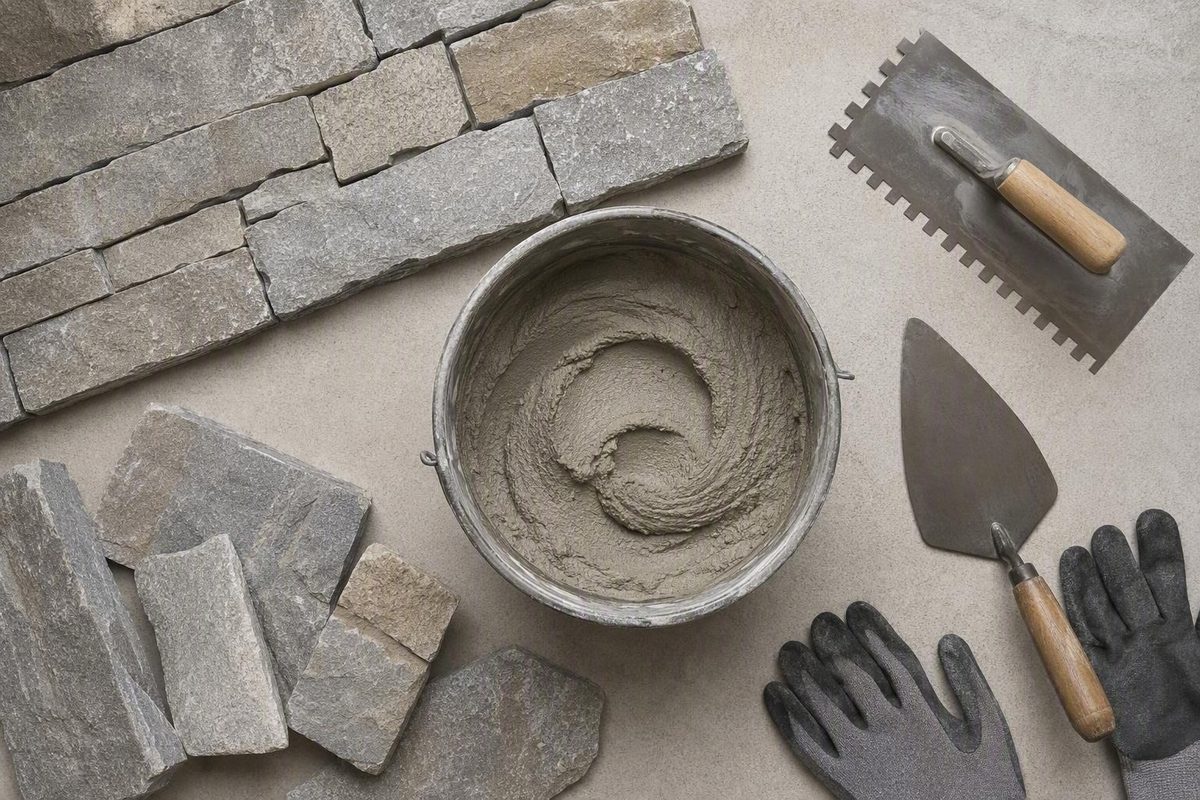
Quick answer: what Sakrete Stone Veneer Mortar is designed to do
Sakrete Stone Veneer Mortar is a preblended, polymer-modified mortar marketed primarily for installing natural or manufactured stone veneer. Its documented role has two parts:
- Setting veneer: bonding veneer units to a properly prepared, approved surface or base coat.
- Grouting veneer: filling and finishing joints when the selected veneer system calls for visible mortar joints.
Bonding mortar must still be applied over the correct substrate assembly.
Representative applications include veneer walls, feature walls, columns, exterior facades, and some fireplace surrounds. The official U.S. Sakrete product page identifies natural and artificial stone veneer, masonry, concrete, prepared OSB, and above- or below-grade veneer applications. These examples do not establish universal approval for every wall, stone, exposure, or fireplace.
One building-supply description characterizes stone veneer as non-load-bearing and gives walls, fireplaces, and columns as example projects.
Canadian manufacturer material lists additional uses, including cultured brick on vertical surfaces and horizontal bedding of granite pavers or slabs. Those uses belong to the Canadian product documentation and should not automatically be transferred to a U.S. bag.
The central purchasing issue is regional variation. The available evidence covers:
- U.S. 50 lb bags
- U.S. 80 lb bags
- Canadian 20 kg, or 44 lb, bags
The Canadian product is described as a blend of cementitious material, polymer, masonry sand, and selected components. Its package, water quantity, yield assumptions, and installation directions differ from the information available for U.S. bags. Matching branding does not prove that the formulations or instructions are interchangeable.
Treat phrases such as “exceptional bond,” “superior durability,” and “professional-grade” as manufacturer or retailer descriptions rather than independently demonstrated findings. A sound decision should be based on the exact regional package, documented use, substrate assembly, yield, and current technical literature.
Specification table: separate the U.S. and Canadian listings
The figures below must remain separated by market. Do not average the yields, scale Canadian mixing water to a U.S. package, or assume that products with similar coverage use the same formulation.
| Specification | U.S. manufacturer listing | U.S. retailer listings | Canadian manufacturer listing |
|---|---|---|---|
| Product category | Polymer-modified stone veneer mortar for setting and grouting artificial or natural veneer | Generally described as polymer-modified stone veneer mortar | Preblended grey mortar containing cementitious material, polymer, masonry sand, and selected components |
| Package size | 50 lb and 80 lb | 50 lb at Lowe’s and Home Depot; 80 lb through SiteOne and other suppliers | 20 kg, or 44 lb |
| Listed application depth | 3/8–1/2 in | Some listings repeat 3/8–1/2 in | Yield is stated at 10 mm, or 3/8 in; that is not necessarily a universal maximum-depth specification |
| Nominal yield | 8 ft² per 50 lb bag; 13 ft² per 80 lb bag | Some retailers repeat the manufacturer’s per-bag figures | Approximately 1.20 m², or 13 ft², per bag at 10 mm or 3/8 in |
| Working time | Not established in the supplied U.S. manufacturer-page text | Approximately 30–60 minutes; another retailer lists 60 minutes | Use the current Canadian product data sheet and bag instructions |
| Water quantity | Not established in the supplied U.S. manufacturer-page text | Not reliably established | Maximum 3.0 L, or 0.8 U.S. gal, of potable water per 20 kg bag |
| Mixing time | Not established in the supplied U.S. manufacturer-page text | Not reliably established | 3–5 minutes in a clean paddle mixer |
| Temperature and cure | Not established in the supplied U.S. manufacturer-page text | Not reliably established | Substrate and mortar at 5–38°C, or 40–100°F, maintained for 72 hours; allow mortar to cure for 24 hours |
| Listed strength | Greater than 1,800 psi | Retailer descriptions are not a substitute for a test report | No numerical strength is established in the supplied Canadian page text |
| Distinct regional uses | Natural or artificial veneer above or below grade | Retailer descriptions focus principally on veneer | Also lists cultured brick and horizontal bedding of granite pavers or slabs |
The U.S. bag sizes, application depth, yields, and greater-than-1,800-psi final-strength listing come from the U.S. manufacturer page. The strength value is incomplete as an engineering specification because the supplied page does not identify the test method, curing age, specimen configuration, or test conditions. It therefore does not establish structural capacity, bond strength, code compliance, or approval for a particular veneer system.
The Canadian figures—including the 20 kg package, approximate 13-square-foot yield at 3/8 inch, water limit, mixing time, temperature range, and cure period—come from the Canadian manufacturer listing. The 20 kg bag should not be treated as a lighter version of either U.S. mix without confirmation.
For U.S. planning, Home Depot reports a working time of approximately 30–60 minutes for its 50 lb listing, while Lowe’s reports 60 minutes. These are retailer-reported values, and the current regional bag and technical data sheet should control the Home Depot listing.
SiteOne identifies an 80 lb grey polymer-modified product sold in 42-bag pallets. It also reports 70 ft² per pallet without supplying the thickness, joint dimensions, or other assumptions needed to reconcile that figure with the manufacturer’s per-bag yield. The SiteOne listing is useful for identifying the package and pallet arrangement, not for calculating project coverage from the unexplained pallet number.
Do not classify the product as Type N merely because those words appear in a retailer URL or similar-item label. The visible product descriptions identify a specialized polymer-modified veneer mortar, while Canadian manufacturer material distinguishes it from conventional Type N bedding mortar.
Suitable, conditional, and unsupported applications
The safest way to evaluate a proposed use is to separate documented applications from those that depend on regional instructions, assembly details, exposure, or further written confirmation.
| Category | Proposed application | What to verify |
|---|---|---|
| Supported by the supplied product material | Setting artificial or manufactured stone veneer | Exact veneer system, regional bag, substrate assembly, thickness, and exposure |
| Supported by the supplied product material | Setting natural stone veneer | Unit dimensions or weight, back-buttering, joint method, and substrate preparation |
| Supported by the supplied product material | Grouting veneer joints | Whether the veneer system calls for grouting, plus timing and finishing instructions |
| Supported by the supplied product material | Interior veneer | The complete interior substrate assembly rather than assumed direct bonding |
| Supported by the supplied product material | Exterior veneer | Water-resistive barrier, flashing, drainage, lath, base coat, weather, and curing requirements |
| Conditional or region-specific | Below-grade veneer | Listed by the U.S. manufacturer, but persistent moisture, soil contact, saturation, and hydrostatic pressure remain unresolved |
| Conditional or region-specific | Cultured brick | Specifically listed in Canadian material; confirm before transferring that use to a U.S. bag |
| Conditional or region-specific | Horizontal bedding of granite pavers or slabs | Listed for the Canadian 20 kg product, not established as a U.S. use |
| Conditional or unresolved | Fireplace surround | Potentially within ordinary veneer work, but clearance, substrate, and temperature exposure govern |
| Conditional or unresolved | Heavy individual veneer units or attached objects | Obtain written limits and system approval; do not infer capacity from compressive strength |
| Unsupported or advised against | Foundation coating or parging substitute | Sakrete Customer Care advised against this use |
| Unsupported or advised against | Concrete stamping | Sakrete Customer Care advised against this use |
| Unsupported or unresolved | Fire pits, fireboxes, combustion chambers, or high-temperature joints | Available retailer Q&A is contradictory and does not establish approval |
| Outside documented purpose | Conventional load-bearing masonry bedding | Canadian documentation directs conventional Type N work to another Sakrete product |
| Unsupported as a design rule | Bonding a 12 lb cement address block based only on mortar | A retailer-hosted response rejected that use, but its unexplained weight statement is not a universal engineering limit |
“Above grade” and “below grade” describe location, not every possible moisture condition. The U.S. listing’s below-grade wording does not prove suitability for direct soil contact, continuously wet walls, submerged conditions, negative-side water pressure, or hydrostatic loading. Those exposures require explicit confirmation for the complete assembly.
Retailer-hosted Sakrete Customer Care responses provide useful cautions but are not complete specifications. Customer Care advised against foundation coating and concrete stamping. The same Q&A said the mortar was unsuitable for a 12 lb cement address block and referred to a 7 lb limit without defining unit area, geometry, test method, substrate, safety factor, or installation conditions. Its fire-pit answer is internally contradictory, mentioning both Stone Veneer Mortar and High Heat Mortar, so it cannot establish high-temperature approval from the Q&A wording.
Do not convert the unexplained 7 lb statement into a design limit. Suitability may depend on face area, thickness, center of gravity, back texture, substrate, mortar coverage, mechanical support, installation height, and the veneer manufacturer’s tested system.
Obtain written manufacturer confirmation for unusual moisture exposure, heavy pieces, overhead work, or applications outside the current product and veneer-system documents. Structural or code-sensitive conditions may also require review by an appropriate qualified trade or design professional.
Substrate preparation: concrete, masonry, plywood, OSB, and interior walls
Everything beyond that is substrate- and assembly-specific.
Concrete and masonry
Concrete and masonry are named substrates, but that does not mean every concrete or masonry wall is ready for direct application. Evaluate:
- Surface soundness and cleanliness
- Paint, sealers, curing compounds, release agents, efflorescence, and contamination
- Surface smoothness and mechanical profile
- Cracks, movement joints, and wall stability
- Moisture exposure and drainage
- Whether a scratch coat, base coat, lath, or bonding treatment is required
- Whether the veneer must be back-buttered
In project-specific retailer Q&A, Sakrete Customer Care said a bonding agent was not necessary for thin-brick veneer over clean exterior cinder block, while recommending a scratch coat and back-buttering. That answer should not be generalized into either “bonding agents are never needed” or “scratch coats are always required.” It addressed a short customer scenario rather than supplying a complete wall detail.
The U.S. product page recommends Sakrete Concrete Bonder & Fortifier for stronger adhesion, but the supplied text does not establish it as mandatory for every substrate. The controlling substrate and veneer-system instructions should determine whether a bonding product is used.
OSB
The U.S. manufacturer names prepared OSB, with “prepared” doing essential work. The available product-page text does not define the necessary layers and does not establish approval for direct bonding to bare OSB.
Before purchasing mortar for an OSB wall, identify the complete documented assembly. Depending on the wall and governing system, unresolved components may include:
- A water-resistive barrier
- Drainage provisions
- Corrosion-resistant lath
- Appropriate fasteners
- A scratch or base coat
- Flashing
- Movement details
Do not design that sequence from a short retailer description.
Exterior plywood
Canadian manufacturer instructions give this regional example for exterior plywood:
- Tar paper
- Metal lath
- Base coat
- Stone veneer mortar
- Masonry or veneer unit
The sequence demonstrates why “suitable over plywood” should not be read as “bond directly to plywood.” It remains subject to the current regional data sheet, veneer instructions, project specifications, and local requirements.
Interior walls
Canadian instructions describe metal lath and a base coat before veneer mortar and the masonry unit over listed interior substrates. Examples include drywall, plywood, concrete panels, and interior-rated cement board. Appearance in that list does not independently authorize direct bonding.
The same instructions generally call for moistening receiving surfaces or base coats before application, except drywall, which should not be moistened. The preparation layers and moisture directions should be followed together as part of the regional assembly described by Sakrete Canada.
Substrate checklist before mixing
- Identify the substrate. Distinguish cast concrete, concrete masonry, brick, plywood, OSB, drywall, cement board, and an existing base coat.
- Confirm that it is structurally sound. Veneer mortar cannot correct unstable framing, deteriorated masonry, significant movement, or unsuitable panels.
- Find the current regional assembly detail. Do not combine a Canadian substrate sequence with U.S. mixing instructions unless the manufacturer expressly permits it.
- Follow the veneer manufacturer. Its requirements may control mortar selection, back-buttering, coverage, unit limits, joints, flashing, and curing.
- Resolve hidden layers before mixing. Determine weather-barrier, drainage, lath, fastener, scratch-coat, and base-coat requirements first.
- Address exposure and code. Exterior moisture management, clearances, structural suitability, and wall construction may be governed by project specifications or local requirements.
Plywood, OSB, drywall, and cement board should be treated as components of an approved assembly—not as shorthand permission for direct bonding.
Coverage calculator: estimating 50 lb, 80 lb, and 20 kg bags
Use the nominal rates documented in the specification table:
- U.S. 50 lb bag: approximately 8 ft²
- U.S. 80 lb bag: approximately 13 ft²
- Canadian 20 kg bag: approximately 13 ft² at a stated 3/8-inch thickness
These are estimating rates, not guaranteed installed coverage.
Base formula
Required bags = project area ÷ listed yield per bag
Always round the result up to a whole bag.
The calculation gives only a nominal quantity. Add a separate project allowance after considering:
- Joint width and depth
- Whether joints will be grouted with the same product
- Back-buttering
- Stone profile and rear-surface texture
- Wall irregularity
- Actual mortar thickness
- Scratch or base coats, if the same material is expressly permitted and specified
- Spills and dropped mortar
- Mortar left in tools or mixing equipment
- Unusable partial batches
- Layout changes and replacement units
There is no defensible universal waste percentage for every veneer installation.
Example: 80 ft² using U.S. bags
Using the documented U.S. rates:
80 ft² ÷ 8 ft² per 50 lb bag = 10 bags nominally
For 80 lb bags:
80 ft² ÷ 13 ft² per 80 lb bag = 6.15, rounded up to 7 bags nominally
Neither result includes a project-specific allowance. If the mortar will also fill deep joints or compensate for uneven stone, the actual order may need to be higher.
Why package weight alone is misleading
A Canadian 20 kg, or approximately 44 lb, bag and a U.S. 80 lb bag may both list about 13 ft² of nominal coverage. That does not make them interchangeable or prove that the Canadian product delivers twice the coverage per pound.
The Canadian figure expressly assumes a 3/8-inch layer. Regional formulation, density, test assumptions, installation method, and intended uses may differ. Use the rate attached to the exact package rather than selecting whichever weight-to-coverage ratio appears most favorable.
Effect of application depth
The U.S. manufacturer lists an application depth of 3/8–1/2 inch. Moving toward the thicker end generally consumes more material over the same face area. The supplied U.S. product page does not provide a thickness-conversion table, however, so no adjusted yield should be presented as guaranteed.
Do not use SiteOne’s unexplained 70-ft²-per-pallet entry as a calculator input. A listing that also describes 42 bags per pallet cannot be reconciled with the manufacturer’s per-bag yield without knowing what the pallet number measures and which assumptions it uses.
Immediately before ordering, compare the physical bag with the current manufacturer data sheet or calculator. Confirm whether the stated yield covers only the setting bed or also anticipates back-buttering and joint filling.
Mixing, working time, temperature, and curing
Mixing information must be divided by evidence type. The Canadian manufacturer provides numerical directions for its 20 kg product. U.S. retailers report working times. Current U.S. water and mixing quantities remain unresolved in the supplied manufacturer-page text.
Verified Canadian 20 kg instructions
For the Canadian product only:
- Use no more than 3.0 L, or 0.8 U.S. gal, of potable water per 20 kg bag.
- Mix for 3–5 minutes in a clean paddle mixer.
- Keep the substrate and mortar between 5°C and 38°C, or 40°F and 100°F.
- Maintain that temperature range for 72 hours after application.
- Allow the mortar to cure for 24 hours.
These are package-specific manufacturer instructions for the Canadian 20 kg product. Do not scale the 3.0 L quantity proportionally for a 50 lb or 80 lb U.S. bag. Weight conversion would assume equivalent formulation and water demand, which the available evidence does not establish.
Retailer-reported U.S. working time
U.S. retailer listings report approximately 30–60 minutes of working time, with one listing stating 60 minutes. Treat those figures as planning information, not permission to use mortar automatically until a clock expires.
The controlling instructions should also define what “working time” means.
Unresolved U.S. instructions
The supplied U.S. manufacturer page does not establish:
- Water quantity for either U.S. bag size
- Required mixer type or mixing duration
- Rest or remix sequence
- Temperature limits
- Minimum protection period
- Grouting interval
- Rain-exposure timing
- Freeze-protection timing
- Service-readiness timing
Obtain these values from the current U.S. bag and technical data sheet. Do not fill the gaps with Canadian figures, retailer comments, or instructions for another mortar.
The Canadian 24-hour cure statement does not determine when a completed assembly can be grouted, exposed to rain, allowed to freeze, cleaned aggressively, or placed into service. Those events may have separate timing requirements.
Restrained mixing workflow
- Complete and inspect the substrate assembly before mixing.
- Read the exact regional bag and current technical data sheet.
- Measure water for that package rather than estimating by eye.
- Use the specified mixer, duration, and sequence.
- Apply the batch within the controlling working period.
- Protect the installation within the stated temperature and weather limits.
- Follow the veneer manufacturer’s separate requirements for adjustment, joint filling, cleaning, and exposure.
Do not assume permission to retemper stiffening mortar, introduce pigments, add bonding agents, use cold-weather accelerators, or otherwise modify the mix. The supplied evidence also does not establish shelf life, storage conditions, or additive compatibility. Those answers belong in the current technical and safety documents.
Stone veneer mortar versus Type N and Type S
No. Sakrete Stone Veneer Mortar should not be treated as conventional Type N or Type S mortar under another name.
Manufacturer material presents it as a specialized, preblended, polymer-modified veneer mortar for setting and grouting. Conventional Type N and Type S mortars have their own compositions, classifications, strengths, and masonry roles.
A Lowe’s URL uses “Type N” wording for the 50 lb Sakrete item, but the visible product name and overview do not confirm that classification. The Lowe’s listing should not override manufacturer literature merely because of its URL or merchandising label.
The Canadian manufacturer is more explicit: Stone Veneer Mortar is not intended as bedding mortar for conventional masonry work, and conventional Type N applications are directed to Sakrete Mortar Mix, Type N.
Generic third-party guidance does not resolve the product classification. One stone supplier describes polymer-modified mortar as a separate option and reports approximately 750 psi for Type N and a 1,800 psi minimum for Type S in its general comparison.
Another veneer supplier discusses Type N or Type S as possible choices depending on the stone and application in its thin-veneer mortar guide. Neither article evaluates the Sakrete veneer product, and their broad guidance cannot override the product data sheet, veneer-system requirements, project specifications, or local code.
Compressive strength alone does not resolve the choice. Sakrete’s greater-than-1,800-psi listing does not prove that the product is Type S, nor does it establish:
- Bond strength to a particular veneer
- Compatibility with a specific substrate
- Flexibility or movement accommodation
- Water-management performance
- Approval for a tested veneer system
- Structural attachment capacity
- Compliance with a specified standard or evaluation report
Before choosing between a specialized veneer mortar and conventional Type N or Type S mortar, identify:
- The natural or manufactured veneer system
- The substrate and all preparation layers
- Interior, exterior, above-grade, or below-grade exposure
- Jointed, dry-stack, or other finishing method
- The exact regional mortar package
- The veneer manufacturer’s written mortar requirement
- Project specifications and applicable local requirements
Use the product whose current documentation matches the complete installation—not one selected solely by a familiar mortar-type name or a higher compressive-strength number.
Buying checklist and unresolved specifications
A useful pre-purchase check starts with the physical bag and works outward to the complete assembly.
Identify the exact product
Check:
- Country or market
- Exact product name
- Bag weight
- Colour, where relevant
- Item, model, UPC, or manufacturer identifier
- Manufacturing or date code, if provided
- Current technical data sheet revision
- Current safety data sheet revision
Useful U.S. identifiers include Lowe’s item 293037 and Home Depot model 65306213, internet number 100669876, and store SKU 667553. These identifiers distinguish retailer listings but do not prove nationwide availability or identical regional stock.
SiteOne lists the 80 lb grey product as Sakrete item 100058444 in a 42-bag pallet. Its captured terms indicate that some order-in material may be sold only by full pallet and may be nonreturnable. Those conditions are branch- and date-dependent, as are price, inventory, pickup options, ratings, and review counts. Retailer reviews are purchasing feedback rather than technical performance evidence.
Confirm the estimating data
Check:
- Listed yield for the exact bag
- Thickness attached to the yield
- Permitted application-depth range
- Whether yield covers setting only or also grouting
- Whether back-buttering is required
- Whether a scratch or base coat uses another product
- Whether a retailer copied figures from a different bag size
If a pallet coverage figure cannot be reconciled with the per-bag yield, do not use it until the supplier explains its assumptions in writing.
Confirm the assembly
Determine:
- Veneer type and manufacturer
- Interior or exterior location
- Above-grade or below-grade exposure
- Wall substrate
- Required water-resistive barrier
- Drainage and flashing details
- Lath and fastener requirements
- Scratch- or base-coat requirements
- Direct-bond eligibility, if any
- Back-buttering and coverage requirements
- Joint design and grouting method
- Unit-size or weight limitations
- Movement-joint treatment
A retailer’s broad substrate list is not a complete assembly specification.
Confirm mixing and environmental limits
Locate the current values for:
- Water per bag
- Mixing equipment
- Mixing duration and sequence
- Working time, pot life, and open time
- Substrate and air temperatures
- Hot-, cold-, rain-, and wind-protection requirements
- Initial cure
- Grouting timing
- Rain and freezing exposure
- Cleaning timing
- Service readiness
Do not borrow these values from a different package size or country.
Review safety documentation
Find the current safety data sheet linked by the manufacturer and follow its handling, exposure-control, first-aid, and disposal directions. The manufacturer product pages link technical and safety documents, but those documents were not evaluated for this article. The current documents—not a general product overview—should govern job-site safety.
Questions that remain unresolved
The supplied product pages and retailer material do not fully answer:
- What are the current U.S. water quantities for 50 lb and 80 lb bags?
- What preparation layers apply to each U.S. substrate?
- Which test method, curing age, and conditions support the greater-than-1,800-psi figure?
- What numerical bond-strength data are available?
- Which standards, evaluation reports, or tested veneer systems apply?
- When can the installed veneer be grouted?
- When can it be exposed to rain or freezing?
- Is any firebox, fire-pit, or other high-temperature use approved?
- What limits apply to persistent moisture, saturation, soil contact, or hydrostatic pressure?
- What is the shelf life?
- Which additives, pigments, or bonding agents are compatible?
- Are there documented limits for individual veneer-unit size or weight?
Resolve these points through the current regional technical data sheet, safety data sheet, veneer-manufacturer instructions, project specifications, and applicable local requirements. Unusual moisture, high-temperature, structural, overhead, or heavy-unit conditions should be referred to the manufacturer and an appropriate qualified trade or design professional.
Mortar Desk is an independent building-material reference publisher, not Sakrete, a retailer, contractor, testing laboratory, code authority, or engineering adviser. This article compares the supplied regional manufacturer pages and retailer listings as a purchasing reference; it is not a project-specific installation design.
Frequently asked questions
Can Sakrete Stone Veneer Mortar be used for both natural and manufactured stone?
Yes. U.S. product material identifies the mortar for setting and grouting natural and artificial or manufactured stone veneer.
That does not make every veneer product automatically compatible. Confirm the veneer manufacturer’s mortar requirement, unit limitations, substrate assembly, back-buttering method, and exposure conditions before buying.
How many square feet does a bag of Sakrete Stone Veneer Mortar cover?
As summarized in the specification table, the U.S. manufacturer lists nominal yields of approximately 8 ft² per 50 lb bag and 13 ft² per 80 lb bag. The Canadian 20 kg, or 44 lb, product lists approximately 13 ft² per bag at a 3/8-inch thickness.
Divide the project area by the applicable regional yield and round up. Then add a project-specific allowance for joints, back-buttering, stone profile, wall irregularity, mortar thickness, spills, and unusable partial batches. No listed yield should be treated as guaranteed.
Can Sakrete Stone Veneer Mortar be applied directly to plywood or OSB?
Do not assume so. The U.S. manufacturer refers to prepared OSB, but the supplied product-page text does not define the preparation assembly. Retailer references to plywood likewise do not establish direct-bond approval.
For exterior plywood, Canadian documentation describes tar paper, metal lath, a base coat, veneer mortar, and then the masonry unit. Use the assembly documented for the exact market, substrate, veneer system, and exposure.
Is Sakrete Stone Veneer Mortar a Type N mortar?
The available manufacturer material does not establish it as conventional Type N mortar. It describes a specialized polymer-modified veneer mortar.
Although Type N wording appears in a retailer URL and similar-item label, Canadian manufacturer documentation expressly distinguishes Stone Veneer Mortar from conventional Type N bedding mortar. Choose by the written veneer-system and product specifications, not by a retailer category or inferred classification.
Can this mortar be used below grade or around a fire pit?
The U.S. manufacturer lists below-grade veneer use, but that wording does not establish suitability for direct soil contact, continuous saturation, hydrostatic pressure, or every below-grade assembly. Obtain confirmation for the actual moisture exposure.
Fire pits, fireboxes, combustion chambers, and other high-temperature applications remain unresolved. The available retailer-hosted Q&A is contradictory and does not provide reliable approval. Use a product and assembly expressly documented for the expected temperature and location.
Final decision framework
Confirm the exact regional bag, match it to an expressly supported veneer application and documented substrate assembly, and estimate from that package’s listed yield with room for project variables. Then follow the current bag, technical data sheet, safety data sheet, and veneer-system instructions.
Do not borrow water quantities, coverage assumptions, or installation directions from another package or country. Where substrate preparation, moisture exposure, heat, structural suitability, or code compliance remains unclear, obtain confirmation from the manufacturer, veneer-system documentation, local authority, or an appropriately qualified professional.