 MortarDesk
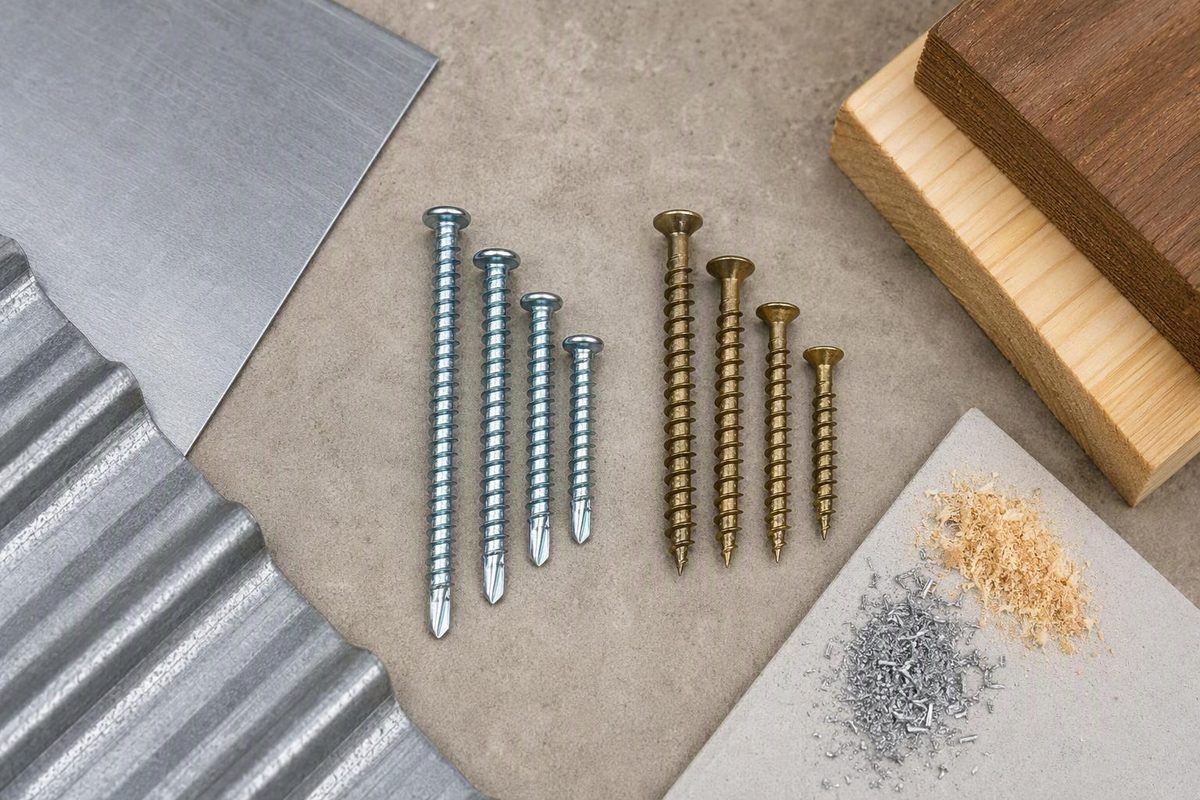
Choose by the material that holds the threads, not just the material under the head. For ordinary wood-to-wood fastening, start with a wood screw. For sheet-metal-to-sheet-metal fastening, start with a sheet metal screw specified for that metal and thickness. A metal bracket attached to timber generally needs a wood-compatible fastener—not automatically a sheet metal screw.
The familiar identification difference is an unthreaded upper shank on a traditional wood screw versus full threading on a sheet metal screw. But full threading alone is not proof: manufacturers also make fully threaded timber screws. Bolt Depot’s type chart and SPAX’s timber range show these distinctions.
Main differences
| Feature | Wood screws | Sheet metal screws |
|---|---|---|
| Intended receiving material | Wood | Sheet metal; some products also suit wood, plastic or fiberglass |
| Threading | Traditional versions have a smooth upper shank; other wood fasteners are fully threaded | Normally fully threaded |
| Point | Tapered point on traditional versions | Pointed self-tapping tip or a drill-shaped self-drilling tip |
| Hole preparation | Follow the screw’s instructions and wood-specific pilot-hole guidance | Check the required starting-hole size for a non-drilling self-tapper; a self-driller makes its own hole within its rated capacity |
| Head selection | Match a countersunk hole or surface-bearing requirement | The same principle applies; flat, pan, truss and hex-washer heads are available |
The thread, point and head descriptions follow Bolt Depot’s fastener chart and sheet metal screw guide. A pointed self-tapping tip is not the same as a drill point: SendCutSend’s tapping-versus-drilling guide explains the distinction.
When the smooth shank spans the upper wood piece, that piece can move along the screw as the threads pull the lower piece toward it. This helps close the joint; it does not mean every fully threaded screw is unsuitable for wood. Home Depot’s screw anatomy guide explains the clamping function.
Can you substitute one for the other?
Some sheet metal screws can be used in wood. Bolt Depot explicitly lists wood among the occasional uses for its sheet metal screws. That makes substitution possible for suitable general-purpose work, but it does not establish an equivalent load rating, clamping action or exterior approval.
Do not assume a wood screw will work in sheet metal. Its ability to enter wood says nothing about drilling steel or forming reliable threads in a thin metal sheet. Use a fastener documented for the receiving metal.
For structural connectors, do not substitute either generic category merely because the screw fits the hole. Simpson Strong-Tie states that its published connector loads depend on the specified fastener quantity, type, size and installation; material and finish also matter. Follow the connector fastener requirements.
Check size, pilot hole and exposure
A #8 wood screw and a #8 sheet metal screw both have a listed major thread diameter of 0.164 in. (about 4.17 mm). Equal diameter does not make them interchangeable. Also, these screw numbers are not sheet metal gauge numbers. Compare the wood screw diameter table with the sheet metal screw table.
Before buying, check:
- Length convention: Pan heads are measured beneath the head to the tip; flat countersunk heads include the head in their length. Measuring guidance
- Pilot-hole specification: Do not transfer a wood pilot size to metal. TR Fastenings’ Type AB self-tapper hole-size reference has specific application limits; its metric table varies with material strength and sheet thickness. Use guidance applicable to the selected screw and metal.
- Drilling capacity: “Self-tapping” does not mean “self-drilling.” For a self-driller, the pilot section must finish drilling through before the threads engage, or the screw can bind and break. Simpson Strong-Tie technical note
- Exposure compatibility: Neither category name guarantees suitability outdoors or in treated wood. Match the documented coating or stainless grade to the environment and hardware; Simpson distinguishes low-resistance zinc electroplates from more corrosion-resistant coatings and alloys. Materials and coatings guide
For roofing, use the panel-system specification rather than this general comparison; see metal-to-metal roof screw selection.
Worked selection example
Suppose an indoor, nonstructural wood assembly calls for a #8 flat-head wood screw, seated flush, through an actual 1/2-in. (12.7-mm) upper piece, with 3/4-in. (19.1-mm) penetration into the lower piece:
1/2 in. + 3/4 in. = 1-1/4 in. (31.8 mm) overall length.
That is a length calculation, not a load rating. Penetration to the tip is not necessarily full-thread engagement; verify the selected screw’s thread length and the lower piece’s thickness.
For a traditional #8 wood screw, Bolt Depot lists straight-bit pilots of 7/64 in. (2.78 mm) in softwood and 1/8 in. (3.18 mm) in hardwood. Use the specific screw manufacturer’s instructions where they differ. Wood pilot-hole chart
If the lower piece changes to steel, stop using the wood selection: specify a wood-to-steel fastener with the required grip length and steel-thickness capacity.