 MortarDesk
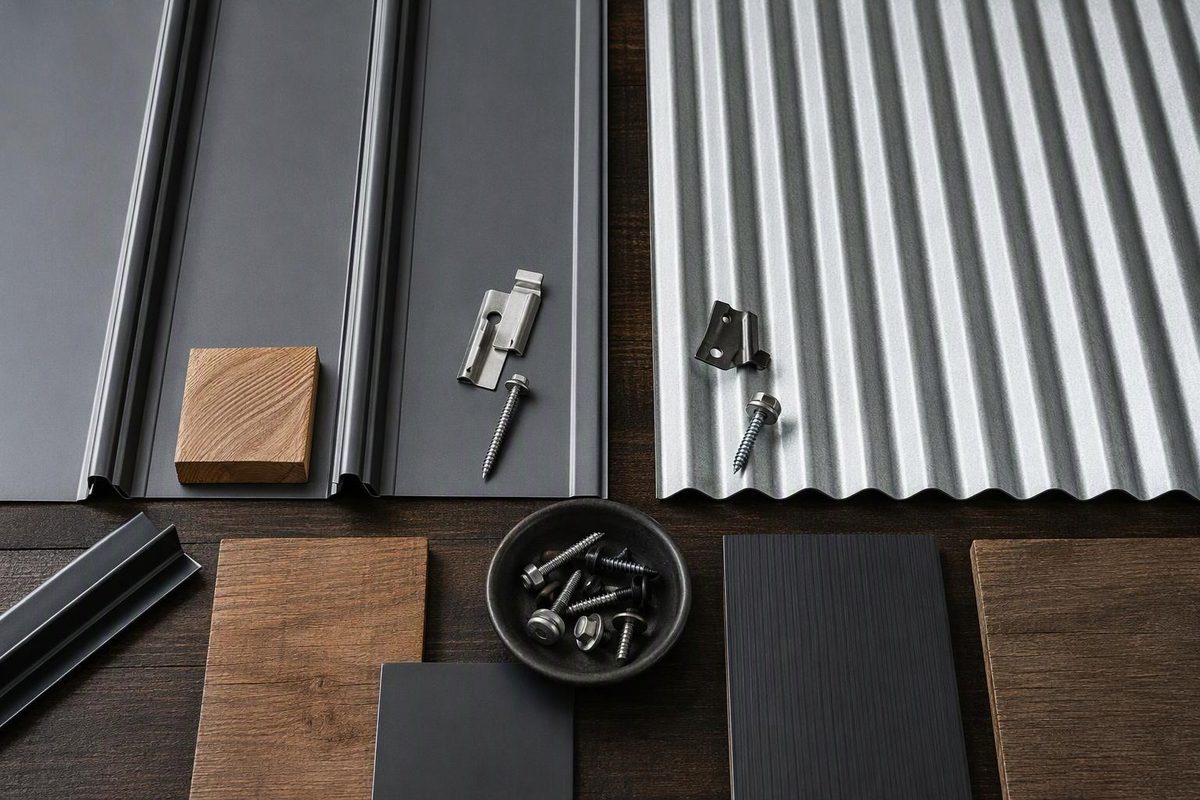
Standing seam generally suits buyers who want concealed panel fasteners and less exposed-fastener upkeep; corrugated generally suits buyers prioritizing lower initial cost. These are the main trade-offs described in S-5!’s system comparison.
Roof pitch can rule out a product before price matters. For example, Western States’ 7/8-inch corrugated lists a 3:12 minimum, while its Western Lock snap-lock data sheet recommends a 3:12 minimum and directs lower-pitch inquiries to the manufacturer. Not every standing seam panel qualifies for a low-slope roof.
A 3:12 slope rises 3 inches per 12 inches of horizontal run, equivalent to 250 mm per metre. The product examples below come from U.S. manufacturer literature; local approval and the complete roof assembly still need checking.
What is actually different?
“Corrugated” describes the rounded, repeating waves in the sheet. “Standing seam” describes raised longitudinal seams with concealed panel fastening. R-panel and other angular ribbed sheets may also use exposed fasteners, but they are not the same profile as rounded corrugated roofing. Western States’ panel description makes this distinction.
| Buying consideration | Standing seam | Corrugated, exposed-fastener roofing |
|---|---|---|
| Appearance | Raised seams separated by relatively broad pans; panel fasteners concealed | Repeating rounded waves; screw heads visible |
| Panel attachment | Clips or a concealed fastening flange, depending on the system | Screws through the panel into the specified substrate |
| Weather-sealing detail | Concealed panel attachment avoids most exposed panel-fastener penetrations | Sealing washers and correctly installed laps are important |
| Installation | Snap-lock or mechanically seamed joints; complexity varies by system | Overlapping sheets without a standing-seam operation; correct screw driving remains essential |
| Maintenance emphasis | Inspect seams, flashings, penetrations, coating and drainage | Inspect those items plus exposed fasteners, washers and laps |
| Initial cost | Generally higher | Generally lower |
These are system-level tendencies, not guarantees. S-5!’s comparison explains the attachment, labor and maintenance differences. Western States’ corrugated installation guide specifies sealing washers and proper screw driving. Corrugated roofing is not inherently leaky, and standing seam is not maintenance-free.
Thermal movement is another specification check. Through-fastening restrains the sheet at its attachment points. Many standing seam clip systems permit movement between panel and structure, but not all concealed-fastener designs work alike. Panel length, clip design and the specified fixed point matter. The Metal Construction Association’s panel-attachment paper explains these mechanisms.
Compare actual panel specifications
The following published examples, checked October 11, 2026, show why “standing seam” or “corrugated” is not a complete purchase specification.
| Product example | Rib/seam height | Effective roof coverage width | Published steel gauges | Published slope guidance |
|---|---|---|---|---|
| Western States 7/8-inch corrugated | 7/8 in. | Typically 34.67 in. for PVDF finishes; 32 in. for SMP finishes | 20, 22, 24, 26 | 3:12 minimum |
| Western Lock snap-lock standing seam, standard PVDF sheet | 1.75 in. | 18 in. standard; alternate widths listed | 22, 24 | 3:12 recommended minimum; lower pitches require inquiry |
| McElroy Maxima 1.5 mechanically seamed standing seam | 1.5 in. | 12, 16 or 18 in. | 24 standard; inquire about 22 | 1:12 minimum |
Specifications are subject to change. Use the current technical sheet for the exact finish, panel width and assembly being quoted.
Two purchasing traps follow:
- Overall sheet width is not roof coverage. Side laps consume width. The corrugated product also lists different wall and roof coverage—use the roofing figure.
- Gauge alone does not establish suitability. Request the metal type and specified thickness, plus the load tables or approval for the chosen profile and support arrangement. Gauge options overlap between these systems.
For slope thresholds across other profiles, see minimum pitch for metal roofing.
Worked selection example
Assume a simple gable roof has two rectangular slopes, each 24 ft wide along the eave, with 12-ft eave-to-ridge runs measured along the roof surface, at 4:12 pitch.
Both Western States examples above clear their listed 3:12 slope guidance. For a preliminary width calculation:
- Corrugated at 34.67-inch effective coverage: 288 ÷ 34.67 = 8.31, rounded up to 9 panels per slope.
- Standing seam at 18-inch coverage: 288 ÷ 18 = 16 panels per slope.
That gives preliminary totals of 18 corrugated panels or 32 standing seam panels. These are layout counts, not a final order: starter and terminal details, rake cuts, eave hems, ridge allowances and actual measured lengths still need resolving. Fewer sheets also do not prove a lower installed price.
If the same roof were 2:12, it would fall below the corrugated panel’s listed minimum and Western Lock’s recommended minimum. Western Lock directs lower-pitch inquiries to the manufacturer; do not treat that invitation as approval. A qualifying mechanically seamed system could be considered instead. Passing the slope check alone does not approve the assembly.
What to request in matched quotes
Ask both suppliers or installers to identify:
- Exact panel name, seam type, metal thickness, protective coating and paint system.
- Effective coverage, panel lengths, required substrate and underlayment.
- Fasteners or clips, spacing and applicable wind-uplift and load documentation.
- Complete trim, closures, sealants and penetration details—not panels alone.
- Installation scope, maintenance requirements and warranty exclusions; distinguish finish coverage from any weathertightness coverage.
Wind resistance belongs to the assembly, not just the panel name or gauge. The MCA attachment paper identifies panel geometry, width, material properties, clips and attachment frequency as variables affecting performance. Have the applicable assembly checked against local wind, snow and code requirements rather than choosing from a generic “high-wind” label.
Compare bids only after those specifications match. Otherwise, the apparent standing-seam premium may also include different steel thickness, coating, deck work or flashing scope.