 MortarDesk
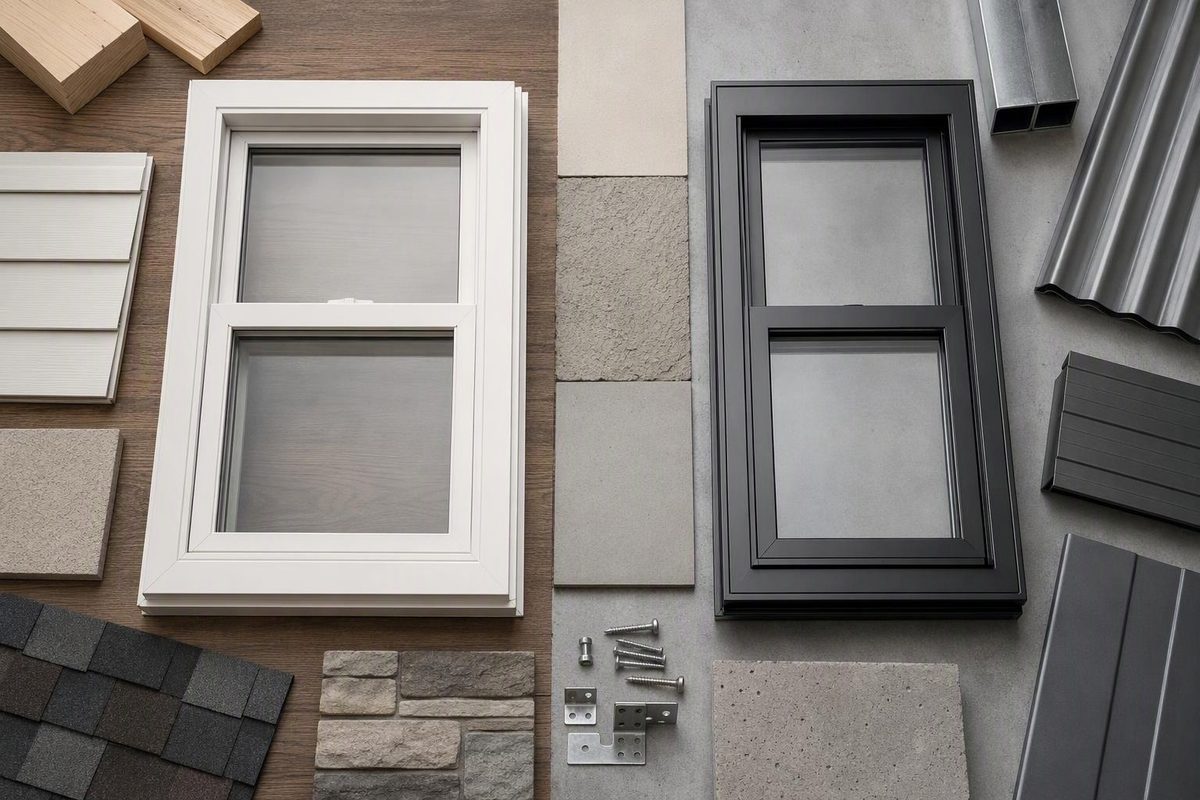
Start with vinyl for an insulation-focused residential replacement; consider thermally broken aluminum when narrow frames and larger views are priorities. Neither material name establishes the window’s energy performance, allowable size or wind resistance. Buy by the exact product configuration and its documented ratings.
The key distinction is vinyl versus aluminum with or without a thermal break, not simply plastic versus metal. Aluminum conducts heat readily; a thermal break interrupts that conductive path between interior and exterior frame sections. Both materials can be used in efficient windows, but the NFRC whole-window rating is the useful comparison. Here, aluminum means an aluminum-framed window, not an aluminum-clad wood window.
Enter the whole-window U-factors from your quotes to compare insulation; the starting values are hypothetical.
Compare Whole-Window U-Factors
Use U-factors in Btu/(h·ft²·°F), not glass-only values.
Enter positive values in matching units. The defaults are hypothetical, not product ratings.
Vinyl: 20% Lower U-Factor
0.28 versus 0.35. Vinyl has the better insulation rating in this comparison.
For equal area and temperature difference, the percentage also describes the reduction in simplified conductive heat transfer—not utility-bill savings. It does not compare solar gains, air leakage, sightlines or structural suitability.
Source: the article’s hypothetical worked example; NFRC whole-window ratings and ENERGY STAR rating definitions.
Material Differences That Affect the Purchase
| Buying Question | Vinyl Windows | Aluminum Windows |
|---|---|---|
| Insulation | An insulation-first starting point; verify whole-window U-factor. | Verify thermal-break construction, then compare U-factor. |
| Frame Width And View | Compare actual frame-and-sash dimensions. | Some series offer narrow sightlines and larger glass areas. |
| Maintenance | Clean frames, tracks and drainage openings; inspect weatherstripping. | Follow finish-care instructions and remove salt deposits. |
| Purchase Price | Quote the exact glass, operating style and installation scope. | Quote the specified thermal-break system with the same scope. |
| Size And Exposure | Request allowed sizes and air, water and structural ratings. | Request the same; material strength does not establish a window rating. |
NFRC’s frame guide describes aluminum as light, strong and durable. Aluminum’s strength supports slim profiles, but compare the actual frame-and-sash dimensions: not every vinyl profile is bulky, and not every aluminum window has narrow sightlines. As a product example, Milgard’s aluminum range uses narrow sightlines and a polyurethane thermal-break channel. Those features describe that range, not every aluminum window.
Both materials are low maintenance, not maintenance-free. Follow the exact product’s care instructions. The 2026 MITER Brands care guide calls for routine cleaning, weatherstrip inspection and clear drainage openings. It also warns that construction chemicals and trapped salt deposits can corrode aluminum frames. For coastal purchases, request the finish specification, cleaning schedule and applicable warranty exclusions.
The draft provides no price figures or material-wide price premium. Obtain matched installed quotes rather than assigning a cost advantage from the frame material alone.
Whole-Window Ratings Matter More Than Frame Labels
Use ratings for the quoted operating style and glass package—not a series brochure’s best available number. NFRC’s U-factor includes both frame and glazing. Its frame guide notes that the frame and sash can occupy 10–30% of the window’s total area, so a glass-only value does not establish whole-window performance.
| Rating | Units | What It Tells You |
|---|---|---|
| U-Factor | Btu/(h·ft²·°F) on U.S. ratings | Lower means better insulation. |
| Solar Heat Gain Coefficient (SHGC) | Dimensionless, 0–1 | Lower means less solar heat enters. |
| Visible Transmittance (VT) | Dimensionless, 0–1 | Higher means more visible light passes through. |
| Air Leakage | cfm/ft² | Lower means less air passes through window joints under test conditions. |
These definitions and units come from ENERGY STAR’s performance-rating guide. Choose SHGC for the climate, orientation and shading rather than automatically selecting the lowest number.
Air leakage and condensation resistance are optional entries on the NFRC label. Ask for separate documentation if they are important to the comparison; a missing entry does not establish equivalent performance.
Interior condensation occurs when a surface falls below the room air’s dew point. A thermal break can help keep the interior frame warmer, but it cannot guarantee dry windows regardless of humidity. NFRC explains that, where available, a higher condensation-resistance rating indicates better resistance under rated conditions.
Energy Ratings Do Not Establish Wind Or Water Performance
FGIA distinguishes thermal certification from certification for basic air, water and structural performance. Request the applicable performance class, performance grade (PG), design pressure and size documentation for either material.
PG covers the applicable design-pressure test and other standard requirements, not pressure alone. Aluminum’s material strength does not replace documentation for the window you are ordering. See FGIA’s certification programs and performance-class overview.
Worked Comparison: A 36 × 60-Inch Window
Suppose two hypothetical fixed windows have the same 36 × 60 in. outside unit dimensions—approximately 914 × 1,524 mm—and the same SHGC:
| Quoted Specification | Vinyl | Thermally Broken Aluminum |
|---|---|---|
| Whole-Window U-Factor, Btu/(h·ft²·°F) | 0.28 | 0.35 |
| SHGC | 0.25 | 0.25 |
| Gross Unit Area | 15 ft² | 15 ft² |
At an illustrative indoor–outdoor temperature difference of 40°F, simplified steady-state heat transfer is U-factor × gross unit area × temperature difference.
| Option | Calculation | Estimated Heat Transfer |
|---|---|---|
| Vinyl | 0.28 × 15 × 40 | 168 Btu/h |
| Aluminum | 0.35 × 15 × 40 | 210 Btu/h |
Here, the vinyl option has 20% less calculated heat transfer through the window. That is not a 20% utility-bill saving: the calculation excludes solar gains, air leakage and the rest of the building, and rated U-factors do not predict every field condition.
The aluminum option might still be preferred for narrower sightlines, provided its other specifications satisfy the project requirements. Reverse the U-factors and the thermal result reverses too. The example compares two hypothetical ratings, not typical performance for either material.
Request Matched Quotes Before Choosing A Frame
Specify actual unit width and height, required rough opening, installation method, operating style, frame material, thermal-break construction where applicable, finish and exact glazing package. Request visible glass dimensions if view area matters; outside unit dimensions alone do not tell you how much glass remains.
Compare installed prices with identical removal, flashing, air-sealing, trim, disposal and repair scope. Verify local energy requirements, wind or impact requirements, safety glazing and any required emergency escape opening before ordering. NFRC’s buying guide stresses both local energy-code compliance and proper installation.
If pane count is also unsettled, compare that separately in the single-pane versus double-pane window guide. Frame material and glazing are separate specification choices.