 MortarDesk
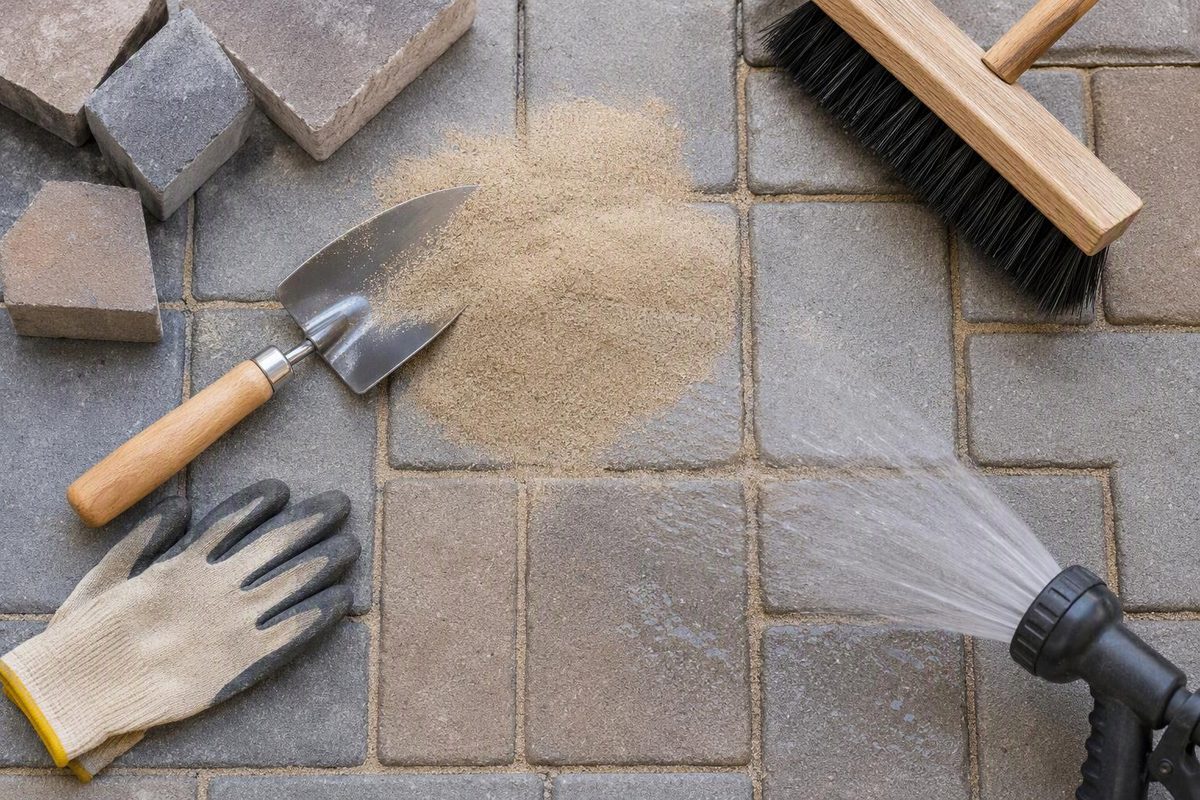
Polymeric sand is graded jointing sand mixed with polymer binders. It is swept and compacted into the joints between compatible pavers, brick, slabs or natural stone, then activated with a controlled application of water. The cured joint becomes firm while retaining some flexibility; it is not a rigid mortar joint.
Compared with ordinary loose joint sand, a compatible polymeric product can better resist erosion and insect disturbance and help inhibit weed growth. It does not replace the bedding layer, stabilize a failed base or correct settlement and drainage problems.
Enter the paved area and published joint-width range to estimate 50 lb bags for the cited product.
50 lb Bag Coverage Calculator
For 2-3/8 in. (60 mm) pavers using the cited Supersand Bond coverage table.
Compatibility Starts With the Joint and Base
Joint width, joint depth, pavement construction and exposure determine whether a particular bag is suitable. “For paver joints” is not a complete specification.
| Buying Check | What to Verify |
|---|---|
| Joint width | The product’s minimum and maximum permitted width |
| Joint depth | Required filled depth, not just the visible opening |
| Surface material | Approval for concrete, clay, wet-cast or natural stone |
| Base system | Aggregate base, open-graded base or concrete overlay |
| Exposure | Traffic, slopes, pool areas and wet-area restrictions |
| Weather | Minimum temperature and required dry periods |
| Coverage | Yield for the paver size, pattern, width and depth |
Published limits vary considerably. A 2020 Techniseal EZ Sand sheet specifies 1/16–1/2 in. (1.5–13 mm) joints, while Alliance’s 2025 Supersand Bond sheet specifies 1/8–1 in. (3–25 mm) joints. Both require at least 1-1/2 in. (38 mm) of joint depth, but their base, weather and installation requirements differ (Techniseal EZ Sand technical sheet; Alliance Supersand Bond technical sheet).
Those limits are product examples, not a universal specification. Check the current bag and technical data sheet for the exact product being purchased. A width accepted by one formula may be outside another formula’s range, even when both are sold as polymeric sand.
Polymeric Sand Is Not Mortar or Bedding Sand
These materials occupy different parts of a pavement assembly and are not interchangeable.
| Material | Behavior | Typical Role |
|---|---|---|
| Ordinary joint sand | Remains loose unless separately stabilized | Joints designed for loose sand |
| Polymeric sand | Binder firms after controlled watering | Compatible paver and approved overlay systems |
| Mortar | Forms a rigid cementitious joint | Masonry designed for mortared joints |
Do not substitute polymeric sand for mortar solely because both materials harden. Alliance, for example, requires mortar in pool-coping joints even where its Gator Maxx G2 polymeric sand is permitted in the adjoining paver field (Gator Maxx G2 technical sheet).
Polymeric sand is also not automatically suitable for submerged or constantly wet work. The cited EZ Sand sheet excludes both conditions. Product approval for a patio or driveway therefore does not establish approval for a pool detail, drainage channel or other persistently wet location.
The material also cannot compensate for poor construction below the joint. Rocking pavers, settlement, inadequate edge restraint and drainage failures must be corrected as assembly problems rather than covered with new jointing material.
Installation Depends on Complete, Dry Joints
The bag instructions control the watering method, equipment and waiting periods. The usual sequence is:
- Verify the complete assembly. Confirm that the product permits the paver material, base or concrete overlay, traffic, joint dimensions and exposure.
- Start dry. The paving surface and joints normally must be completely dry. Moisture can activate binder on the face before the sand reaches the joint.
- Fill and compact. Sweep material into the full joint depth, compact with equipment permitted for the paver and product, then refill and compact again. Narrow joints require particular care to avoid hidden voids.
- Set the final level. The cited products require the sand to finish 1/8 in. (3 mm) below the paver surface or below the chamfer—not flush with the top.
- Clean the face. Remove residue as the instructions specify before watering. Binder and fines left on the surface can produce haze.
- Activate as directed. Too little water can leave material lower in the joint unactivated. Excessive flow can wash material from the joint.
- Observe separate rain and traffic limits. Rain-safe time, curing time and pedestrian or vehicle downtime are not interchangeable. They vary by formula and pavement system.
A shallow top-up on an existing patio may not provide the required filled depth. The Alliance sheet directs installers to remove existing joint material without disturbing the bedding and refill at least 1-1/2 in. (38 mm) deep. Sakrete likewise advises removing old sand to the bottom of the paver before refilling (Sakrete retrofit guidance).
Loose, rocking or badly settled pavers should be reset before joint material is replaced. New polymeric sand may firm the visible joint, but it will not rebuild a displaced bedding layer.
Coverage Changes Sharply With Joint Width
Assume a 300 sq. ft. (27.9 m²) patio has 2-3/8 in. (60 mm)-high pavers and 1/8–3/8 in. (3–9 mm) joints. Alliance’s 2025 Supersand Bond table gives a yield range of 65–85 sq. ft. (6–7.9 m²) per 50 lb (22.7 kg) bag for that paver height and joint-width range. The manufacturer notes that actual quantity also depends on paver shape and size.
Use the low end of the published coverage range for a conservative preliminary quantity. The calculation is 300 sq. ft. divided by 65 sq. ft. per bag, which equals 4.62 bags. Because partial bags cannot cover the remaining area, round up to 5 bags.
That rate should not be reused for wider joints or a different paver layout. The same table gives only 22–42 sq. ft. (2–3.88 m²) per bag for 3/4–1 in. (19–25 mm) joints (Alliance coverage table). No coverage figure from the draft establishes a rate for widths between those two published ranges.
Coverage tables are planning figures rather than guarantees. Joint depth, paver dimensions, pattern and actual joint profile affect consumption. Use the table for the exact product and assembly instead of transferring a bags-per-square-foot figure from another installation.
Dry Sand and Masonry Dust Require Controls
Read the product safety data sheet before handling polymeric sand and control dust as directed. Sand and masonry products can contain crystalline silica. OSHA identifies inhalation of respirable crystalline-silica particles as a risk for silicosis, lung cancer, COPD and kidney disease (OSHA crystalline-silica overview).