 MortarDesk
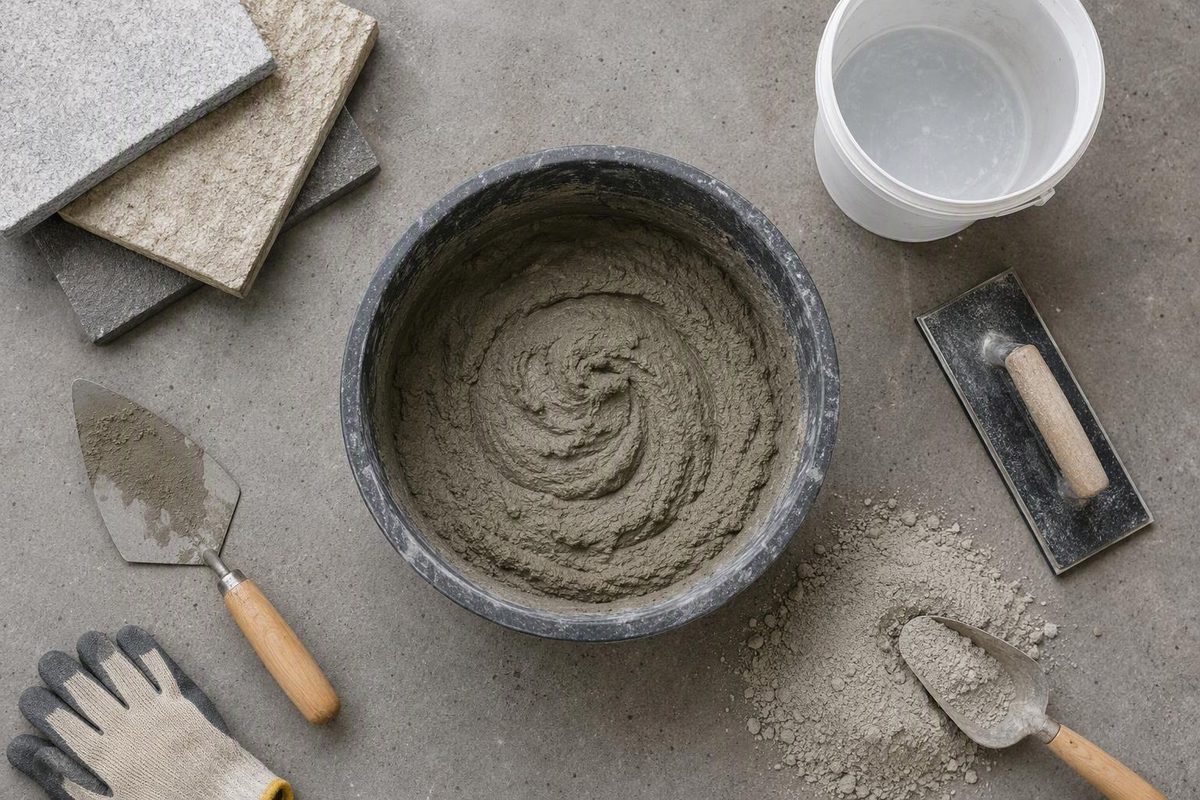
Rapid Set Mortar Mix is a branded, fast-setting concrete repair mortar—not a Type N or S masonry mortar and not tile-setting thinset. The CTS data sheet specifies a 1/2–6 in. (12–152 mm) placement depth, a 15-minute initial set and approximately 0.5 ft³ per 55-lb (25-kg) bag. That yield converts to about 14 L. The product is intended for concrete and pavement work, stucco and plaster repairs, underlayments, formed repairs, and vertical or overhead applications.
Specification table
| Property | Manufacturer’s specification |
|---|---|
| Application thickness | 1/2–6 in. (12–152 mm) |
| Initial set | 15 minutes |
| Final set | 35 minutes |
| Typical mix time | 1–3 minutes |
| Water, DOT and other critical work | 3–3.75 qt (2.8–3.5 L) per 55-lb bag |
| Water, general-purpose maximum | 5 qt (4.7 L) per 55-lb bag |
| Application temperature | 45–90°F (7–32°C) |
| Yield, 55-lb bag | About 0.5 ft³ (about 14 L by conversion) |
| Yield, 25-lb box | About 0.2 ft³ (about 5.7 L by conversion) |
| Minimum water cure | 1 hour |
| Shelf life | 12 months when properly stored |
These are product-specific figures from the current CTS Mortar Mix data sheet. Check the bag and current sheet before use. CTS says the product contains an air-entraining admixture in some geographic production areas.
Typical compressive strength
CTS reports these laboratory results at 70°F (21°C) and an ASTM C1437 flow consistency of 100:
| Age | Typical compressive strength |
|---|---|
| 1 hour after final set | 2,500 psi (17.2 MPa) |
| 3 hours | 4,000 psi (27.6 MPa) |
| 24 hours | 5,000 psi (34.5 MPa) |
| 7 days | 5,500 psi (37.9 MPa) |
| 28 days | 6,500 psi (44.8 MPa) |
The manufacturer identifies conformance to ASTM C928 R3 and ASTM C387. ASTM C928/C928M covers packaged cementitious mortar and concrete materials for rapid repairs to hardened concrete; it does not supply the design, reinforcement or load approval for a particular repair. Follow the project documents for engineered or load-bearing work. See the broader concrete repair mortar selection guide if there is movement, corrosion, deep deterioration or structural distress.
Coverage per 55-lb bag
A 0.5-ft³ yield gives this theoretical coverage before waste:
| Uniform depth | Coverage per 55-lb bag |
|---|---|
| 1/2 in. | 12 ft² |
| 1 in. | 6 ft² |
| 2 in. | 3 ft² |
| 3 in. | 2 ft² |
| 6 in. | 1 ft² |
For measurements in feet and inches:
Bags = area (ft²) × depth (in.) ÷ 6
Round up and allow for an irregular cavity, spillage and material left in the mixer.
Worked selection example
For a repair measuring 12 in. × 36 in. × 1.5 in.:
- Area: 1 ft × 3 ft = 3 ft²
- Bags before waste: 3 ft² × 1.5 in. ÷ 6 = 0.75 bag
- With 10% allowance: 0.75 × 1.10 = 0.825 bag
One 55-lb bag is enough by the stated yield. If the cavity averages 2 in. rather than 1.5 in., however, it consumes the full theoretical bag before waste. Measure several depths instead of using the shallowest point.
Choose it by depth and function
Use this product where the specified repair is at least 1/2 in. and no more than 6 in. deep. For a featheredge, CTS specifies Cement All from featheredge to 4 in. For thicker placements, the manufacturer specifies Concrete Mix from 2–24 in. (Cement All data sheet; Concrete Mix data sheet). Where the ranges overlap, select according to the substrate, aggregate size, placement orientation and project specification.
Do not select this bag merely because a project calls for “mortar.” Bricklaying and repointing normally require a specified masonry mortar type and compatibility assessment; compare the mortar mix types and uses. Tile requires a tile-setting mortar carrying the applicable tile standard. CTS All Tile Mortar, for example, is identified to ANSI A118.4 or A118.11, unlike this repair material (CTS All Tile Mortar data sheet).
Mixing and placing
- Complete preparation first. Remove unsound material and bond-inhibiting oil, asphalt, curing compound, acid, dirt and debris. Roughen the substrate, saturate it thoroughly and remove standing water.
- Stage the job. Have the measured water, mechanical mixer, tools, forms and curing materials ready before opening the bag. A 15-minute initial set does not provide 15 minutes of leisurely placement time.
- Put water in the container first. For a 55-lb bag, use 3–3.75 qt for DOT and other critical work. General-purpose work must not exceed 5 qt. The manufacturer says lower water content produces higher strength.
- Mechanically mix for 1–3 minutes, stopping once the material is uniform and lump-free. Do not retemper stiffening mortar with water. For additional flow or set delay, use only the manufacturer’s specified admixture rather than adding extra water or blending another cement product.
- Place and consolidate immediately. Fill flatwork to full depth instead of building it in layers. Strike and finish promptly; CTS says not to wait for bleed water.
- Water-cure for at least one hour. Begin after the material starts to harden and before the surface loses its moist sheen. Cold conditions or a retarding admixture can require a longer cure.
The manufacturer’s instructions say temperatures above 70°F (21°C) accelerate setting, while lower temperatures delay set and strength gain. Installation is permitted from 45°F to 90°F (7–32°C); chilled mixing water can extend working time in warm weather, and the material must not be installed on frozen surfaces.
Finally, control dust and protect eyes and skin. The Rapid Set Mortar Mix safety data sheet identifies crystalline silica and classifies the mix as causing skin irritation and serious eye damage, with inhalation hazards. Use adequate ventilation, suitable gloves and clothing, eye protection, and approved respiratory protection when engineering controls cannot keep airborne exposure within applicable limits.