 MortarDesk
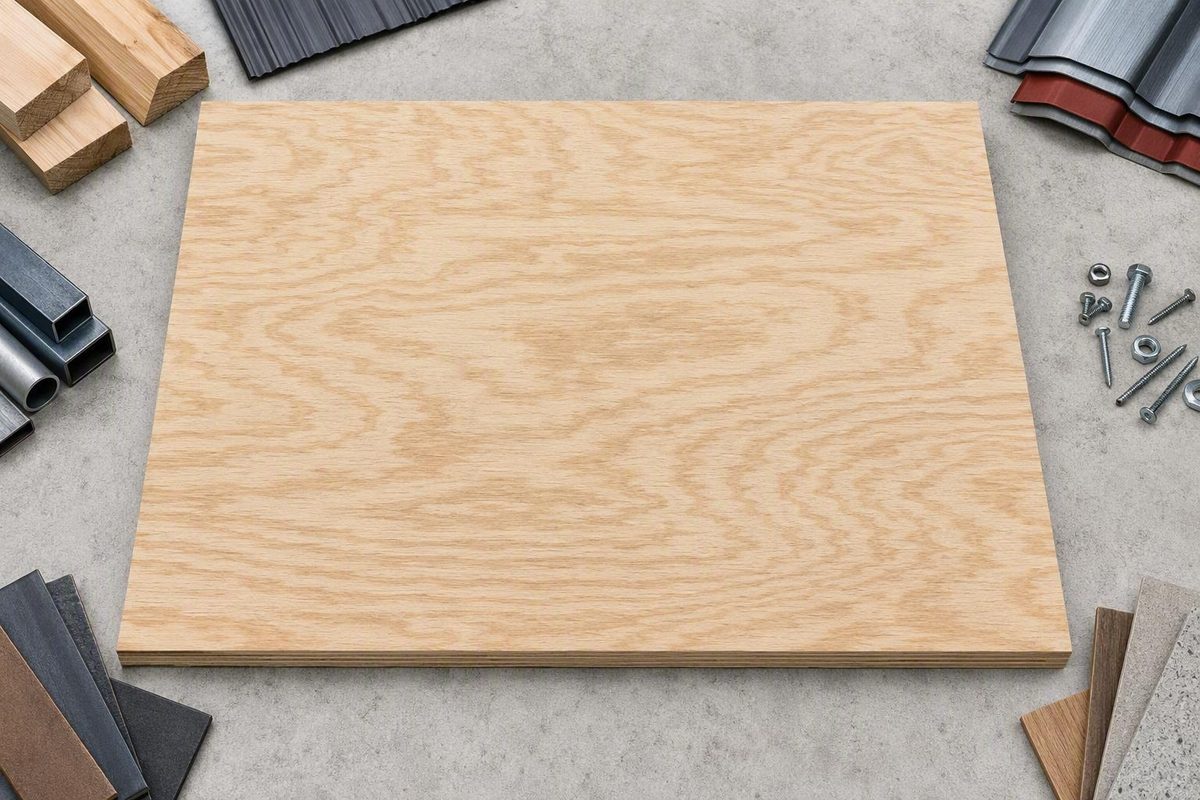
Many retail listings for 3/4 marine grade plywood describe a nominal 3/4-inch, 4-by-8-foot sheet. At 32 square feet of face area, that is a familiar format—but not a uniform product (Plywood Company’s Douglas-fir listing).
Actual thickness, species, veneer grade, core construction, ply count, treatment, weight, certification, inventory, and delivery terms can all differ. Even two panels advertised as “AB marine” may not be interchangeable.
The safest rule is to verify the sheet, not merely the label. Compare products on three separate axes:
- Marine construction quality: veneer arrangement, face and back grades, core gaps, repairs, species, and adhesive bond.
- Preservative treatment: whether the wood has been treated for biological deterioration under specified conditions.
- Structural rating: whether documented engineering properties support the intended span, load, fastening pattern, or assembly.
A panel may have one attribute without the other two. This guide therefore compares retailer-reported listings—not independently verified manufacturer specifications—and marks missing information as unknown.
What the 3/4-Inch Marine Plywood Label Does—and Does Not—Tell You
Several captured listings use the familiar nominal dimensions of 3/4 inch by 4 feet by 8 feet, which provides 32 square feet of face area before cuts and waste.
Sellers commonly describe marine plywood as cross-laminated veneers bonded under heat and pressure with exterior or waterproof adhesive. Forest Plywood also notes that marine products come in multiple grades, sizes, and thicknesses rather than one universal specification (Forest Plywood’s marine-plywood overview).
The crucial distinction is between a waterproof adhesive bond and waterproof wood. An unfinished panel can still absorb moisture through faces, edges, cuts, drilled holes, damaged coatings, joints, and fixing points.
The words “marine grade” alone therefore do not prove:
- Compliance with a particular grading or certification system
- A structural panel rating
- Preservative treatment
- A specific species or ply count
- A defined maximum core-void size
- Suitability for continuous or permanent immersion
- Approval for a hull, pontoon, dock span, or other engineered assembly
- Compatibility with a particular coating, adhesive, covering, or fastener
A seller may describe nearly gap-free veneers and waterproof glue while also stating that the panel is untreated and requires protection from direct moisture. Those claims address different attributes and are not contradictory (Capitol City Lumber’s marine-plywood guide).
Most evidence available for the products below is retailer-authored. Treat grade labels, standard references, warranties, and performance statements as seller claims unless the supplier provides a matching manufacturer data sheet, grade stamp, certificate, treatment record, or technical declaration.
Nominal 3/4 Inch Versus Actual Panel Thickness
“3/4 inch” may be a product name rather than the measured thickness of the delivered sheet. This matters whenever the panel must fit another component instead of simply covering an open surface.
For example, Discount Builders Supply lists an AB marine panel as nominally 3/4 inch but gives its actual thickness as 23/32 inch. That is 0.71875 inch—1/32 inch less than 0.75 inch (Discount Builders Supply’s AB marine listing).
By contrast, Plywood Company describes its Douglas-fir AB panel as a full 3/4 inch. Buyers therefore should not assume that every nominal 3/4-inch panel measures either 23/32 inch or exactly 0.75 inch.
Other captured listings give only a nominal thickness, without an actual measurement or manufacturing tolerance. Those fields must remain unknown.
A 1/32-inch difference can affect:
- Dadoes, grooves, and rabbets
- Replacement decking fitted into existing trim
- Aluminum or vinyl edge profiles
- Flush joints with adjoining panels
- Hardware with a limited grip range
- Stacked laminations, where differences accumulate
- Fasteners selected to avoid penetrating the opposite face
- Repairs that must mate with an existing floor, cabinet, deck, or bulkhead
Before ordering, request the manufacturer’s actual finished thickness and tolerance for the exact product number. After delivery, measure representative points with calipers before cutting grooves, setting trim, or fabricating dependent parts. Include any factory coating, overlay, or treatment when checking the finished dimension.
Captured Product and Price Comparison
Freshness notice: The supplied research does not identify when each commercial listing was captured. The figures below must therefore be treated as undated retailer-reported snapshots, not current offers. Prices, stock, pickup timing, delivery terms, and return policies should be revalidated immediately before publication and again before purchase.
Price per square foot is calculated from a 32-square-foot, 4-by-8 sheet. It excludes taxes, freight, coatings, fasteners, waste, and handling charges.
| Seller and product | Captured base price | Base price per sq. ft. | Listed grade | Nominal and actual dimensions | Species, plies, and weight | Adhesive or standard claim | Treatment | Captured availability and fulfillment | Important conditions or unknowns |
|---|---|---|---|---|---|---|---|---|---|
| Plywood Company: Douglas-fir AB | $149.17 | About $4.66 | A face/B back; B-grade-or-better veneers claimed | Full 3/4 in. × 4 ft. × 8 ft. | Douglas fir throughout; seven plies; 72 lb | Seller says adhesive meets ASTM D2559; core gaps limited to 1/8 in. or less | Not listed as treated | 300 shown available | SKU 75MAR; construction and standard claims lack independent verification |
| Discount Builders Supply: AB marine | $138.98 | About $4.34 | AB | Nominal 3/4 in.; actual 23/32 in. × 4 ft. × 8 ft. | Not disclosed | Moisture-resistant core and cross-lamination claimed; no certification identified | Not disclosed | Shown in stock, with pickup and delivery determined at checkout | Manufacturer, species, plies, weight, adhesive, tolerance, and marine standard not disclosed |
| Imeca: TECH B/BB | $117.53 | About $3.67 | B/BB; “TECH” appears in title | Nominal 3/4 in. × 4 ft. × 8 ft.; actual thickness not disclosed | Not disclosed | Not disclosed | Not disclosed | 436 online units shown; regional inventory, delivery, and pickup stated | “B/BB” and “TECH” are undefined; detailed return conditions apply |
| Boat Carpet Central: treated pontoon panel | $105 per sheet | About $3.28 | B-C | 3/4 in. × 4 ft. × 8 ft.; longer format also offered | Seven plies; species and weight not disclosed | General specification claims, but no product-specific marine certificate supplied | Seller-reported CCA treatment | Freight order; quantities begin at four sheets | Four-sheet minimum makes the initial panel total $420 before freight; liftgate charges may apply and an adult signature is required |
| Capitol City Lumber: Okoume or Aquatek Meranti offering | $179 example | About $5.59 | Two-sided A/B stated | 3/4 in. × 4 ft. × 8 ft. | Species associated with price is ambiguous; plies and weight not given | Waterproof-bond claims discussed, but no product-specific certification established for the priced example | Generally described as untreated | Quote and purchase options described; inventory not documented | Confirm the exact product and species associated with the price |
| Home Depot: unbranded AB marine panel | Not exposed | Not calculable | AB marine grade | Nominal 3/4 in. × 4 ft. × 8 ft.; actual thickness not disclosed | Not disclosed | Retailer references APA certification, but supporting documentation was not exposed | Not disclosed | Captured as unavailable | Internet no. 202084532; model and store SKU 726540; missing specifications should not be inferred |
The captured base prices span approximately $105 to $179 per sheet, or about $3.28 to $5.59 per square foot, based on the linked retailer listings. This is not a controlled comparison: species, treatment, grading terminology, technical documentation, minimum quantities, and freight conditions differ.
A low sheet price can therefore produce a higher project cost. Conversely, a more thoroughly described panel can still be unsuitable if its documentation does not address the intended application.
How to Read Grades, Plies, Faces, and Core Claims
A grade label is useful only if the supplier identifies the grading system that defines it.
The captured listings use AA, AB, B/BB, and B-C, but the available evidence does not place all four labels within one directly comparable framework. A letter may describe face appearance in one system, while another listing may combine face and back designations or use terminology associated with another product category.
Do not treat “A face” as shorthand for every desirable property. A smooth or repair-limited face does not independently establish:
- A low-void core
- A particular species
- A qualified waterproof adhesive bond
- Preservative treatment
- Structural capacity
- Compliance with a marine standard
The most detailed captured example shows what a useful retail specification can include. Plywood Company describes its panel as seven-ply Douglas fir throughout, with an A face, B back, B-grade-or-better veneers, and core gaps limited to 1/8 inch or less. Those seller-reported details apply only to that product.
For the exact sheet under consideration, request documentation defining:
- Face, back, and core grades
- Permitted knots and knotholes
- Patches, plugs, putty repairs, and overlaps
- Veneer species and minimum quality
- Core composition and permitted gaps
- Whether scarf joints or other veneer joints are allowed
- Number and arrangement of plies
- Sanding and thickness tolerances
Ply count is frequently undisclosed. Two listings describe seven-ply panels, but that does not make seven plies a universal requirement for nominal 3/4-inch marine plywood.
References to APA, ASTM D2559, BS 1088, emissions declarations, or environmental declarations also require careful reading. Ask whether the claim applies to the finished panel, its adhesive, its emissions, its treatment, or another characteristic. An adhesive claim is not automatically a certification of the complete panel.
Plain-language purchasing terms—not formal standard definitions
- Nominal thickness: The size used to name or market the panel.
- Actual thickness: The measured finished thickness, subject to manufacturing tolerance.
- Face grade: The stated quality or appearance category of the front veneer.
- Back grade: The stated category of the reverse veneer.
- Core gap: An opening between internal veneer sections, whether visible at an edge or concealed.
- Cross-lamination: An arrangement in which adjacent veneers generally alternate grain direction.
- Adhesive-bond claim: A statement about the glue line; it does not necessarily classify the complete panel.
- Preservative treatment: A purchasing field identifying whether the wood has received a stated chemical treatment for specified exposure conditions.
- Structural rating: Product documentation used to assess loads, spans, supports, orientation, and fastening.
Keep cosmetic grade, species, adhesive bond, core integrity, preservative treatment, and structural documentation in separate comparison fields.
Marine Construction, CCA Treatment, and Structural Rating Are Different
Every buyer should ask three independent questions.
How is the panel constructed? Look for species, veneer grades, ply schedule, core composition, permitted gaps and repairs, and adhesive documentation.
Has the wood received preservative treatment? Treatment is a separate attribute intended for specified exposure conditions. An untreated low-void panel and a treated decking panel may address different risks.
Is the panel structurally documented for the project? Thickness and a marine label do not establish allowable loads or spans. A structural decision may require design values, support spacing, panel orientation, fastener schedules, and approval within the complete assembly.
Boat Carpet Central describes its pontoon panel as seven-ply, B-C grade, kiln-dried, and CCA-treated. The seller also states a treatment “rating of .40 or better,” but supplies no unit, retention basis, use category, or supporting treatment certificate in the captured material. That bare number should not be treated as a complete treatment specification (Boat Carpet Central’s treated plywood listing).
CCA treatment does not by itself establish low-void construction, BS 1088-style veneer quality, structural capacity, or recognized marine certification. Conversely, a waterproof-bond, low-void panel is not necessarily preservative-treated or naturally decay-resistant.
Match the verification path to the project:
- Wet-room cabinetry: Confirm dimensional fit, face finish, stable core construction, coating compatibility, and protection of visible and concealed surfaces.
- Outdoor furniture: Verify that the panel and finish are approved for exterior weather and UV exposure; avoid details that trap water.
- Docks and pontoon decks: Obtain treatment records, structural data, compatible-fastener requirements, covering or finishing instructions, and written system approval.
- Boat interiors and removable components: Verify moisture exposure, weight, finish quality, coating compatibility, and attachment details.
- Demanding boat or hull construction: Require a clearly identified product standard, manufacturer documentation, design acceptance, and qualified project guidance.
The supplied evidence is insufficient to recommend any compared sheet for a hull, below-waterline service, permanent immersion, a specified structural span, or a particular pontoon assembly.
For treated material, obtain the current treatment documentation before machining or installing it. Follow that document and applicable safety requirements for cutting, dust control, use restrictions, compatible fasteners, cleanup, and disposal. The captured retail listing does not provide enough information to improvise these precautions safely.
Is Marine Plywood Waterproof, and Does It Need to Be Sealed?
No unfinished wood panel should be assumed impervious merely because its adhesive is described as waterproof. The available seller information supports calling certain glue bonds waterproof or moisture-resistant, but it does not establish that the complete panel is decay-proof, maintenance-free, or suitable for unlimited immersion.
The apparent contradiction comes from using “waterproof” for two different things:
- Waterproof glue describes the adhesive bond.
- Waterproof plywood would imply that the entire sheet cannot absorb water.
Those are not equivalent. Moisture can enter through unfinished faces, backs, edges, cuts, holes, fastener penetrations, joints, damaged finishes, and concealed undersides.
Harlow Bros’ supplier-authored guidance recommends protecting faces, backs, edges, cutouts, holes, joints, undersides, hidden surfaces, and fixing points. It also recommends flat supported storage under cover, protected joints, exposure-appropriate corrosion-resistant fasteners, and ongoing inspection (Harlow Bros’ preparation and installation guidance).
Edges and newly exposed veneers need particular attention because cutting or drilling bypasses protection applied to the original surface.
Indoor humidity and occasional splashes
For bathroom components, cabinetry, laundry areas, and similar interiors, choose a finish compatible with the panel species, desired appearance, cleaning products, and expected moisture. Protect backs, edges, cutouts, and concealed contact surfaces—not only the decorative face.
Exterior weather and ultraviolet exposure
Exterior components need a coating system approved for weather and UV exposure. Pay close attention to horizontal surfaces, edges, joints, end grain, and details where water can remain trapped. Follow the coating manufacturer’s current preparation, film-build, recoat, and curing instructions.
Demanding near-water use
Repeated wetting, spray, abrasion, standing water, and concealed surfaces require a system intended for those conditions. Epoxy sealers, exterior primers or coatings, marine varnishes, and UV-resistant topcoats appear in supplier guidance as possible categories, not universal prescriptions.
Do not derive the coat count from the panel’s ply count. Supplier recommendations vary, and the selected coating system—not the veneer count—should determine preparation, coverage, film build, and curing. Plymasters likewise states that coating choice depends on exposure and that sealing cannot make an unsuitable plywood grade appropriate for full exterior use (Plymasters’ plywood-sealing guide).
Before finishing:
- Confirm the plywood is approved for the intended exposure.
- Confirm the coating is compatible with the species, treatment, adhesive, and existing surface.
- Follow preparation and moisture-condition requirements.
- Observe application temperatures, recoat windows, and curing times.
- Protect every surface and penetration required by the manufacturers.
- Reseal new cuts, holes, and damaged areas.
- Do not expose or install the assembly before the finish has cured as specified.
Sealing can slow moisture ingress. It cannot convert unsuitable interior plywood into exterior- or marine-rated material.
Ordering, Delivery, Handling, and Installation Details That Change the Real Cost
Base sheet price is only the first line of the estimate:
Delivered-and-finished cost = sheets + taxes + minimum quantities + freight + handling or liftgate fees + coatings + fasteners + waste + special-order charges
The $105 treated pontoon panel illustrates the effect of order conditions. A four-sheet minimum produces a starting panel total of $420 before freight; the seller also states that an adult signature is required and that residential liftgate service may generate a charge.
Return terms can also overturn an attractive headline. Imeca’s detailed policy requires authorization within 30 days, unused and resalable goods, a 10% restocking fee, and customer-paid return shipping (Imeca’s product and return-policy page).
Availability is regional and time-sensitive. One captured national-retailer page showed its panel unavailable, while other sellers displayed substantial inventory or pickup options. A stock count does not establish availability at the nearest branch or eligibility for a particular delivery method.
The documented Douglas-fir example lists a 72-pound sheet. Depending on the route, wind, stairs, unloading conditions, and the handlers’ capabilities, buyers should assess whether assistance or mechanical handling is appropriate. Do not apply that weight to another species or panel construction.
Delivery inspection checklist
Before accepting or cutting a shipment, conduct a preliminary visible-condition check:
- Match the product identifier and description to the order.
- Photograph available grade stamps, labels, treatment tags, and batch markings.
- Verify quantity, length, width, and actual thickness.
- Compare the grade, species, and treatment labels with the invoice.
- Note visible bowing, twisting, corner damage, crushed edges, wet packaging, open edge gaps, loose veneers, or apparent delamination.
- Photograph suspected freight damage before unpacking further.
- Follow the seller’s damage-reporting procedure.
- Do not cut a disputed panel until return or claim eligibility is confirmed.
These prompts are not universal grading or rejection criteria. Formal acceptance depends on the purchase agreement, freight policy, applicable grade rules, and product documentation.
Storage and installation planning
Supplier-authored guidance recommends keeping sheets flat, evenly supported, dry, and under cover. It also recommends pre-drilling where the panel or fastening detail requires it, using corrosion-resistant fasteners appropriate to the panel and exposure, protecting joints, observing manufacturer-specified movement gaps, and resealing cuts and holes.
During planning:
- Check fastener compatibility with the wood, treatment, connected metals, and exposure.
- Avoid details that hold water against an edge.
- Follow the complete assembly manufacturer’s fastening and finishing schedule where one exists.
- Inspect exposed coatings, joints, edges, and fixings periodically, then repair damage before it creates an open moisture path.
No fixed inspection interval or service life can be promised without product-specific evidence and defined exposure conditions.
The Pre-Purchase Verification Checklist
Use this checklist to turn a vague request for “3/4 marine grade plywood” into a documented order specification.
Product identity and dimensions
- [ ] Manufacturer name
- [ ] Exact product name
- [ ] Manufacturer product number and retailer SKU
- [ ] Nominal thickness
- [ ] Actual finished thickness
- [ ] Manufacturing tolerance
- [ ] Sheet length and width
- [ ] Oversize, partial-sheet, or cut-sheet options
- [ ] Listed sheet weight
Veneers and core
- [ ] Face species
- [ ] Back species
- [ ] Core species or composition
- [ ] Number and arrangement of plies
- [ ] Face grade
- [ ] Back grade
- [ ] Core veneer grade
- [ ] Grading system defining AA, AB, B/BB, B-C, or another label
- [ ] Permitted knots and knotholes
- [ ] Permitted plugs, patches, putty repairs, and overlaps
- [ ] Maximum permitted core gaps or voids
- [ ] Sanded or unsanded condition
Standards and declarations
- [ ] Photograph or copy of the grade stamp
- [ ] Current manufacturer technical data sheet
- [ ] Certificate or declaration supporting any APA claim
- [ ] Document supporting any ASTM adhesive claim
- [ ] Product-specific certificate supporting any BS 1088 claim
- [ ] Applicable emissions declaration
- [ ] Applicable environmental declaration
- [ ] Certificate number, issuing body, scope, and current status
A general standards logo on a category page does not prove that a precise SKU complies. Where relevant, confirm that the document identifies the manufacturer, product, production scope, thickness, and applicable standard.
Adhesive, treatment, and exposure
- [ ] Adhesive type or bond classification
- [ ] Test or standard claimed for the adhesive
- [ ] Whether the panel is preservative-treated
- [ ] Treatment type, retention unit and basis, use category, and supporting certificate
- [ ] Intended exposure limits
- [ ] Restrictions on interior, exterior, direct-water, or immersion use
- [ ] Machining, cleanup, and disposal instructions for treated material
- [ ] Compatible metals and fasteners
- [ ] Compatible coatings, adhesives, coverings, and fiberglass systems
Structural and system requirements
- [ ] Structural panel rating, if applicable
- [ ] Design values or engineering data
- [ ] Span and support tables
- [ ] Fastening schedule and edge distances
- [ ] Required panel orientation
- [ ] Written approval for the specific dock, pontoon, boat, hull, or other assembly
- [ ] Applicable local-code and project-designer requirements
Do not substitute a retailer’s application list for engineering data. “Ideal for docks” does not define allowable span, support spacing, load, orientation, or fastening.
Finishing and installation
- [ ] Must both faces be sealed?
- [ ] Must factory edges be sealed?
- [ ] How should cuts, notches, and drilled holes be treated?
- [ ] What surface preparation is required?
- [ ] Which coating systems are compatible?
- [ ] What coverage, film build, recoat, and cure schedule applies?
- [ ] Are movement gaps required?
- [ ] How should joints and fixing points be protected?
- [ ] What inspection and maintenance guidance applies?
Price, stock, delivery, and returns
- [ ] Current price for the exact product
- [ ] Date the price and availability were checked
- [ ] Quantity breaks and minimum order
- [ ] Stock quantity and physical location
- [ ] Pickup date and holding period
- [ ] Shipping method and freight amount
- [ ] Residential, appointment, liftgate, or handling fees
- [ ] Taxes and special-order charges
- [ ] Damage inspection and claim procedure
- [ ] Return-authorization period
- [ ] Restocking fee
- [ ] Return-shipping responsibility
- [ ] Eligibility of cut, coated, or special-order sheets
- [ ] Total delivered-and-finished project cost
Supplier-request template
I am considering [manufacturer and product number] for [project and exposure]. Please send the current manufacturer technical data sheet, grade-stamp information, actual thickness and tolerance, species and ply schedule, face/back/core grade definitions, permitted core gaps and repairs, adhesive documentation, treatment documentation, structural or fastening tables, and any product-specific certificate supporting the listed APA, ASTM, BS 1088, emissions, or environmental claims.
Please also confirm whether both faces, all edges, cuts, and drilled holes require sealing; identify compatible coatings and fasteners; and provide the current price, date checked, stock location, minimum order, freight and liftgate charges, damage procedure, and return eligibility for full, cut, or special-order sheets.
The decision rule is simple: do not substitute marketing adjectives for blank specification fields. If species, tolerance, treatment, core limits, certification, or structural data are missing, mark them unknown. Do not rank panels by base price when treatment, species, documentation, minimum quantities, and freight differ.
Mortar Desk publishes general building-material reference information and does not provide individual engineering advice.
Frequently Asked Questions
Is 3/4-inch marine plywood actually 23/32 inch thick?
Sometimes, but not always. Discount Builders Supply lists one nominal 3/4-inch AB panel at an actual 23/32 inch, while Plywood Company describes its Douglas-fir panel as a full 3/4 inch.
Request the exact product’s actual dimension and tolerance, then measure the delivered panel before cutting grooves, trim, or mating components. Do not use 23/32 inch as a universal dimension.
Is marine-grade plywood waterproof, or does it still need sealing?
A panel may use waterproof or moisture-resistant adhesive without being impervious. Unfinished faces, backs, edges, cuts, holes, joints, and damaged areas can still admit moisture.
Use a finish approved for the panel and actual exposure, protect all surfaces and penetrations required by the manufacturers, and follow current preparation and curing instructions. Sealing does not make an unsuitable interior sheet marine-rated.
How much does a 4-by-8-foot sheet of 3/4-inch marine plywood weigh?
Plywood Company lists 72 pounds for its full 3/4-inch, seven-ply Douglas-fir sheet.
Ask for the listed weight of the exact product and assess the pickup, unloading, and carrying route before deciding how it should be handled.
Are AB, AA, B/BB, and B-C marine plywood grades equivalent?
No equivalence can be assumed from the supplied listings. They do not identify one common grading framework under which all four labels can be ranked.
Ask which standard or grading system defines the label and request its rules for the face, back, core, knots, knotholes, patches, repairs, and voids. A cosmetic grade alone does not establish adhesive qualification, treatment, core integrity, or structural capacity.
How much does 3/4-inch marine-grade plywood cost per sheet?
The captured retailer examples range from approximately $105 to $179 per 4-by-8 sheet, or about $3.28 to $5.59 per square foot before taxes, freight, finishing, and other costs. The listings are undated snapshots and must be rechecked before publication or purchase.
The products are not directly equivalent. Compare the delivered-and-finished cost for the exact quantity and specification required.
The final buying rule is to verify the sheet, not merely the label. A useful order specification identifies actual thickness, dimensions, species, veneer and core quality, adhesive documentation, treatment, structural data, intended exposure, finishing requirements, and delivered cost. If a supplier cannot document an attribute that matters, leave it unknown rather than assuming “marine grade” resolves it.