 MortarDesk
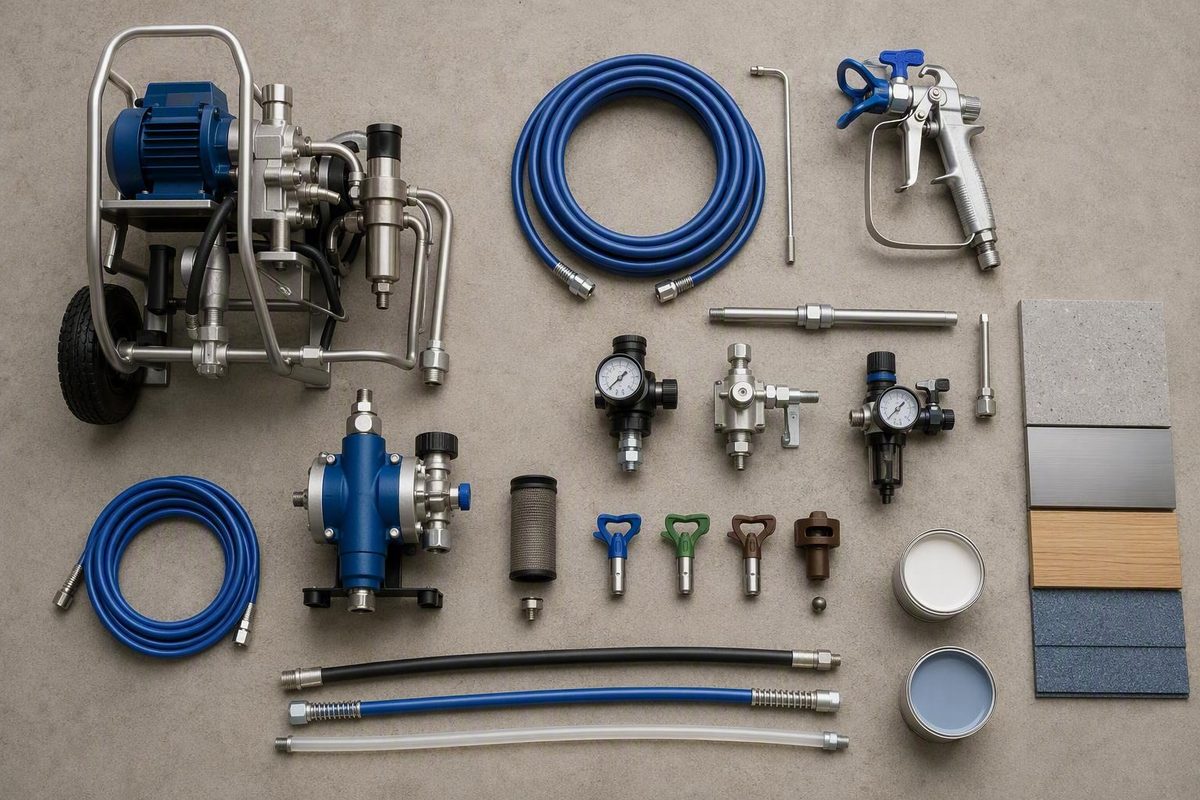
An air assisted airless paint sprayer uses pressurized coating through an airless-style tip to form the fan and begin atomization, then adds compressed air at the gun’s air cap to refine the droplets and pattern. Before buying or renting, confirm whether the listing is a complete system or only a gun. Then verify the pump, compressor, regulators, tip, fluid path, coating compatibility, ventilation, grounding and protective-equipment requirements for the exact model. Treat every maximum pressure as a safety ceiling, not a spray setting.
What an air-assisted airless paint sprayer is
Atomization means breaking a bulk liquid into droplets. In an air-assisted airless system, fluid pressure supplies much of the energy: coating exits a small airless-style tip at speed, forming the fan and beginning droplet breakup. Compressed air delivered through the surrounding air cap then completes or refines atomization.
The system has two separate circuits:
FLUID CIRCUIT
Pressurized coating source
→ fluid filter
→ pressure-rated fluid hose
→ gun
→ fluid tip

AIR CIRCUIT
Regulated compressed-air source
→ air treatment
→ air hose
→ gun air cap
The two paths meet at the gun but perform different jobs. The fluid circuit supplies coating and the initial atomization energy. The regulated air circuit modifies the final breakup and shape of the spray.
That added cap air distinguishes the method from standard airless spraying. It also differs from conventional air spray, where high-speed air acts on relatively low-speed fluid. General atomization relationships—including the effects of pressure, orifice size, viscosity, surface tension and density—are explained in Graco’s Atomization Concept and Theory guide.
These mechanical differences do not prove that one category is universally faster, cleaner, more efficient or capable of a better finish. Results depend on the coating, tip, pump, gun, adjustments, operator, workpiece and spray environment.
Is the listing a complete sprayer or only a gun?
“Air-assisted airless spray gun” may describe one component rather than an operational system. A gun-only purchase can still require a compatible fluid pump, compressor, regulators, hoses, filtration, fittings, mounting equipment and safety provisions.
Commercial listings illustrate the range. The category includes electric sprayers, pneumatic pump packages, guns and separately sold hose assemblies in cart, wall, stand and pail-cover configurations—not one standardized package format (examples of air-assisted airless configurations).
Because tables with too many columns become difficult to use, the component comparison is divided into three parts. “Variable” means the listing must be checked; it does not mean the component is excluded.
| Listing type | Pump or fluid source | Compressed-air source | Regulators |
|---|---|---|---|
| Complete electric sprayer | Usually included; verify flow and pressure | Built in or separate; verify listing | Variable |
| Pneumatic pump package | Air-powered pump may be included | Required for pump and gun | Variable; separate controls may be needed |
| Gun only | Separate | Separate | Separate |
| Hose set | Not included | Not included | Not included |
| Accessory | Not applicable unless stated | Not applicable unless stated | Only if the accessory is a regulator |
| Listing type | Fluid and air hoses | Filtration | Fittings |
|---|---|---|---|
| Complete electric sprayer | Variable | Variable | Variable |
| Pneumatic pump package | Variable | Pump or gun filtration may be included | Variable |
| Gun only | Usually separate | Gun filter may be included | Connections still require verification |
| Hose set | Included as identified | Not normally included | End connections may be included |
| Accessory | Only if identified | Only if identified | Only if identified |
| Listing type | Gun | Tip | Mounting hardware |
|---|---|---|---|
| Complete electric sprayer | Often included | Variable | Cart or stand may be included |
| Pneumatic pump package | Variable | Variable | Wall, cart, stand or pail-cover hardware may be included |
| Gun only | Included | May be included | Usually separate or not applicable |
| Hose set | Not included | Not included | Not included |
| Accessory | Only if identified | Only if identified | Only if identified |
Before treating a product as ready to operate, verify:
- a compatible pump or other pressurized fluid source;
- a compressor or other regulated compressed-air source;
- the exact gun and approved tip;
- fluid-pressure and air-pressure regulators;
- correctly rated fluid and air hoses;
- compatible fittings and adapters;
- upstream filtration and any final gun filter;
- required mounting hardware;
- grounding provisions for applicable components; and
- a suitable, controlled spray environment.
A retailer’s Graco G40 page is a useful example. It identifies the product type as “spray gun” while listing gun-specific details such as pressure limits, a 1/4-inch NPSM air inlet, an integrated 100-mesh filter and an included tip. Those specifications do not make it a complete sprayer; the listing does not establish that a pump, compressor, regulators or hose set is included (Graco G40 retailer listing).
Package prices are not comparable until their contents are normalized. A lower gun price can sit inside a more expensive final system once the fluid source, compressed-air equipment, controls, filtration, hoses, fittings, mounting parts and safety infrastructure are added.
Specification decoder: ceilings, settings, and compatibility
Warning: Maximum working pressure is a component safety ceiling—not a target spray setting. The complete system must remain within the pressure and temperature rating of its lowest-rated component.
A useful specification sheet separates equipment limits from operating variables:
- Maximum fluid pressure: The highest fluid pressure for which the identified component is rated.
- Maximum air pressure: The component’s air-pressure ceiling, not necessarily the pressure required at the air cap.
- Actual fluid setting: The pressure selected for a particular coating, approved tip, required flow and spray pattern.
-
Assist-air setting: The regulated air used to refine atomization or modify the pattern on the identified gun.
-
Approved tip range: The tip types and orifice sizes permitted by the gun, pump and coating documentation.
- Air demand: The airflow required by the gun and, where applicable, a pneumatic fluid pump.
- Filtration: The upstream and final-stage filter or screen arrangement.
- Wetted materials: The metals, polymers, seals and other materials that contact the coating or cleaning solvent.
- Hose ratings: Pressure, temperature, fluid compatibility, dimensions, electrical characteristics and fitting type.
- Fittings: Thread standard, size, sealing method, material and pressure rating.
- Maximum fluid temperature: The highest fluid temperature allowed for the identified component.
The following figures are model limits, not operating recommendations:
| Documented model | Maximum fluid pressure | Maximum air pressure | Meaning |
|---|---|---|---|
| Graco G15 models | 1,500 psi | 100 psi | Component limit |
| Graco G40 models | 4,000 psi | 100 psi | Component limit |
The same manufacturer document specifies an air hose with an inside diameter of 3/16 inch (5 mm) or larger to reduce pressure drop and describes a built-in 100-mesh final gun filter. These details apply to the documented G15/G40 guns and are not category-wide requirements. Confirm that Graco manual 3A0149J remains the applicable revision for the exact gun being considered (G15/G40 instructions and specifications).
Compatibility must cover the entire fluid path:
Coating and cleanup solvent
→ pump and seals
→ filter elements
→ hoses and fittings
→ gun and internal seals
→ approved tip
A seller’s list of materials that can pass through a gun does not establish compatibility with the pump, hose liner, seals, filters, fittings or cleaning system. Before purchase or setup, check the applicable gun and pump manuals, approved tip chart, coating technical data sheet, and coating and solvent safety data sheets.
How tip, viscosity, pressure, and assist air interact
There is no universal tip or pressure setting because several variables work together:
- Tip orifice and geometry influence flow, fan formation and droplet behavior.
- Coating viscosity affects how readily the liquid breaks apart.
- Required flow affects pump and tip selection.
- Fluid pressure controls fluid velocity and contributes to initial atomization.
- Assist air refines atomization and can alter the pattern.
- Surface tension and density also affect droplet formation.
As a general relationship, raising fluid pressure tends to increase fluid velocity and decrease average droplet size. A larger orifice tends to produce larger average droplets when other factors remain equal. Higher viscosity, surface tension or density tends to increase average droplet size. These are tendencies, not settings for a particular coating and machine.
The practical setup principle documented for the G15/G40 is to begin with low fluid pressure and increase it only while additional pressure meaningfully improves atomization. On those guns, increasing pattern air reduces pattern width; a wider pattern calls for less pattern air or a larger approved tip. Both instructions are model-specific rather than universal rules (Graco G15/G40 manual).
Small tip orifices introduce another tradeoff. Commercial supplier guidance identifies clogging as a possible limitation, particularly with pigmented coatings, and discusses orifices from 0.007 to 0.011 inch. That range is not a universal recommendation; use only tips approved for the exact gun, pump and coating (Finish Systems’ air-assisted airless explainer).
When a pattern is poor, do not assume that maximum pressure is the cure. Check tip wear and suitability, coating viscosity and preparation, filtration, pump output, fluid pressure, air regulation, hose restrictions and the gun’s model-specific controls.
When the system may fit—and when to keep comparing
Commercial sources commonly position air-assisted airless equipment for cabinets, furniture, trim, wood finishing and industrial coatings. These are market signals, not proof that every unit suits every coating, finish requirement or production target (commercially listed applications and systems).
| Job characteristic | Reason to consider the system | Item to verify |
|---|---|---|
| Finish-detail work | Separate fluid and air controls may suit controlled finishing | Coating, tip range, filtration, pattern control and spray environment |
| Repeat production | A configured system may support repeatable delivery | Pump flow, duty cycle, compressor capacity, maintenance and training |
| Recesses or shaped parts | Adjustable atomization and pattern may help with complex work | Access, gun geometry, coating behavior and test-panel results |
| Occasional DIY use | May be considered for demanding finish work | Professional-use labeling, training, air supply, controls and safe spray area |
| Large architectural areas | Fluid delivery may be relevant, though another sprayer type may be simpler | Required output, finish target, hose length, tip range and setup time |
| Hazardous or specialty coatings | Compatible industrial configurations may be available | Full fluid-path compatibility, ventilation, grounding and PPE |
For occasional DIY use, the equipment complexity may outweigh its potential benefit. The documented G15/G40 guns are labeled for professional use, and the gun is only one part of the installation. Spray-space controls, compressed-air capacity, regulation, grounding, ventilation, cleaning arrangements and operator training all affect practicality.
Continue comparing if a seller cannot provide an exact model number, applicable manual, approved tip range, pump output, air demand, hose ratings or complete package list. Do not assume superior transfer efficiency, reduced overspray, less bounce-back or a finer finish without comparative testing under the same coating, tip, output, workpiece and operating conditions.
Safety checks before setup, cleaning, or troubleshooting
High-pressure spray, a pinhole leak or a ruptured component can force coating through the skin. A suspected fluid-injection injury requires immediate emergency medical evaluation, even when the puncture appears small or initially painless. Tell medical personnel what fluid may have been injected and provide the coating information if doing so will not delay care (high-pressure sprayer safety guidance).
Before changing or cleaning a tip, clearing a clog, investigating a leak or servicing the equipment, follow the pressure-relief procedure in the applicable manual. Do not replace it with a generic sequence: pumps, valves, air controls, drain points and trapped-pressure hazards differ by system.
Recurring controls include:
- keeping the tip guard installed and intact;
- confirming that the trigger lock works;
- using properly rated, undamaged fluid and air hoses;
- inspecting pumps, guns, filters, fittings and connections;
- routing hoses away from traffic, sharp edges, heat and tight bends;
- grounding equipment and conductive objects as required;
- operating suitable ventilation;
- controlling flames, sparks, hot surfaces and other ignition sources; and
- securing the work area against untrained users.
Never place a hand near the tip, grab a pressurized leaking hose or try to stop a leak with a glove, rag or body part. Relieve pressure using the exact manufacturer procedure before approaching a suspected leak.
Spray painting can generate airborne mists and vapors. The hazard depends on the coating’s complete formulation, not simply whether it is called waterborne or solventborne. Check the product label and SDS for ventilation, protective clothing, gloves, eye protection and respiratory requirements. Some polyurethane paints contain isocyanates, and some coatings may require specialized ventilation, respirators or supplied breathing air.
Verify the installation against the applicable equipment manuals and the workplace, fire, electrical, environmental and local requirements governing the site. A category name or seller compatibility list does not establish compliance.
A before-you-buy worksheet
Complete this worksheet for each system under consideration. Leave unsupported fields blank and request manufacturer documentation rather than filling gaps with category averages or seller copy.
Equipment identity and package
- [ ] Manufacturer, exact model and variant:
- [ ] Applicable gun manual number and revision:
- [ ] Pump or complete-system manual:
- [ ] Complete package or gun only:
- [ ] Electric, pneumatic or other pump type:
- [ ] Pump ratio and rated flow:
- [ ] Flow test conditions:
- [ ] Mounting style:
- [ ] Included gun, tip and tip guard:
- [ ] Included pump or fluid source:
- [ ] Included compressor or assist-air source:
- [ ] Included fluid and air regulators:
- [ ] Included filters:
- [ ] Included hoses, fittings and mounting hardware:
Pressure, air and fluid-path specifications
- [ ] Maximum fluid pressure:
- [ ] Maximum gun air pressure:
- [ ] Lowest-rated component:
- [ ] Maximum fluid temperature:
- [ ] Approved tip types and orifice range:
- [ ] Compressor airflow requirement:
- [ ] Required air pressure and pressure stability:
- [ ] Air filtration, moisture control and quality requirements:
- [ ] Fluid and air regulator specifications:
- [ ] Fluid-hose pressure, temperature and compatibility ratings:
- [ ] Air-hose size and pressure rating:
- [ ] Fitting sizes, thread standards and materials:
- [ ] Upstream filtration requirement:
- [ ] Final gun-filter specification:
- [ ] Wetted materials in pump, hoses, fittings, gun and seals:
Coating, location and safety
- [ ] Exact coating and product code:
- [ ] Coating-approved application method:
- [ ] Viscosity or reduction instructions:
- [ ] Coating-approved tip and filtration:
- [ ] Cleanup solvent:
- [ ] Compatibility across the complete fluid path:
- [ ] Ventilation requirements:
- [ ] Grounding and ignition-source controls:
- [ ] Required gloves and protective clothing:
- [ ] Required eye and face protection:
- [ ] Required respiratory protection:
- [ ] Model-specific pressure-relief procedure located:
- [ ] Operator training requirements:
- [ ] Applicable facility and local requirements checked:
Review the documents in this order:
- Applicable manuals for the complete system, pump and gun, followed by the approved tip chart.
- The coating manufacturer’s technical data sheet.
- The coating and cleanup-solvent safety data sheets.
- Applicable facility, workplace, fire, electrical, environmental and local requirements.
An air-assisted airless label identifies an atomization method, not a complete specification. If package contents, ratings, compatibility information or applicable documents are missing, the system is not ready for a meaningful comparison. Compare prices only after accounting for the same required components in every package.
Frequently asked questions
What should I do if an air-assisted airless spray or leak punctures the skin?
Stop work and obtain immediate emergency medical evaluation, even if the wound resembles a small pinprick. Do not treat it as an ordinary cut. Tell medical personnel that it may be a high-pressure injection injury, identify the coating or solvent involved, and provide its label or SDS if available without delaying treatment. Manufacturer documentation describes these injuries as extremely serious (Graco injection-hazard warning in a model-specific manual).
Does an air-assisted airless spray gun need a compressor?
It needs a regulated source of compressed air for the air cap. That source may be a separate compressor or part of an integrated system. A pneumatic fluid pump may also consume compressed air independently of the gun, so verify total airflow, pressure stability, filtration, moisture control and regulator requirements. A gun-only listing does not establish that an air source is included.
Is maximum working pressure the pressure I should spray at?
No. Maximum working pressure is the component’s safety limit, not a recommended operating pressure. Actual fluid and assist-air settings depend on the coating, approved tip, required flow, gun design and pump. Follow the applicable equipment and coating instructions, and keep the complete system within the rating of its lowest-rated component (manufacturer example of maximum working pressure ratings).