 MortarDesk
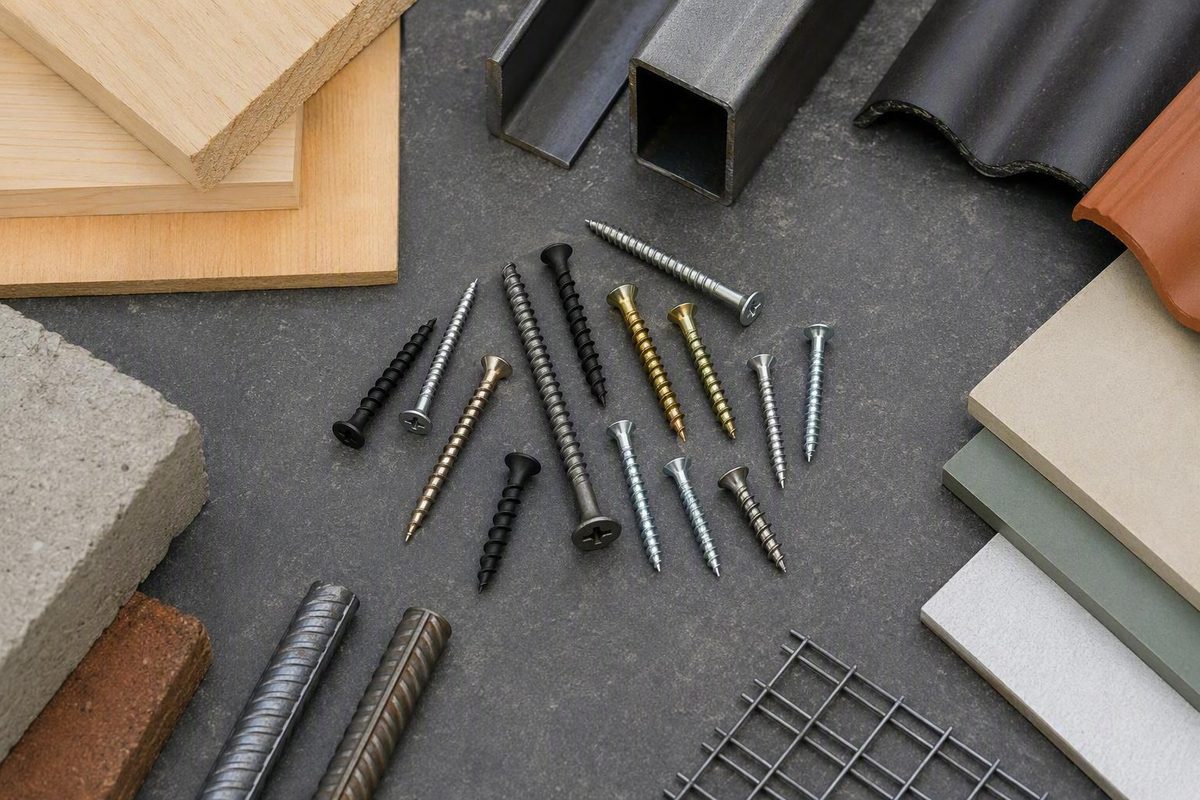
A bugle head screw is identified by its curved countersunk head—not by one universal thread, point, drive, material, or coating. Although the profile is closely associated with drywall screws, it also appears on products intended for wood, decking, plywood, OSB, plasterboard, and panel-to-steel fastening.
That distinction matters when buying fasteners. A box labeled “bugle head” might contain a coarse-thread sharp-point drywall screw, a fine-thread screw for compatible steel framing, or a self-drilling panel screw. The drive could be Phillips, square, Torx, or another style. The finish might be suitable only for a dry interior, or the product could have a coating intended for a specifically documented exposure.
The head shape is therefore only the beginning of the specification. Start with the materials being joined, then verify the thread, point, diameter, length, drive, material, coating, exposure limits, and any approval required by the assembly.
What is a bugle head screw?
A bugle head is commonly described as having:
- A flat or nearly flat top
- A countersunk overall form
- A curved or concave underside
- A gradual transition from the head toward the shank
Viewed in cross-section, the underside flares outward rather than meeting the shank through the straight bevel typical of a conventional flat-head screw.
Because it is countersunk, the head is intended to finish flush with the work or enter its surface. In drywall, the normal objective is a shallow, fillable recess rather than a deeply buried screw. The paper face surrounding the fastener should remain intact.
Commercial descriptions attribute several benefits to the curved transition. Fastener SuperStore, for example, describes it as a smoothly curved countersinking profile intended to reduce material tearing. Other sellers say the shape spreads bearing pressure over a wider area. These statements explain the profile’s intended behavior, but the supplied evidence does not include independent comparative testing that quantifies tear reduction, pressure distribution, or superiority over another head design. See Fastener SuperStore’s product description.
The gradual profile is commonly paired with paper-faced gypsum board because it is intended to form a broad, shallow dimple suitable for finishing. That is design intent rather than a guarantee: an incorrectly selected or overdriven screw can still tear the paper or crush the gypsum.
Most importantly, bugle head describes the head geometry only. It does not establish:
- The drive recess or required bit
- Whether the thread is coarse, fine, tapping, serrated, or another pattern
- Whether the point is sharp or drill-shaped
- Whether the screw is self-drilling
- The diameter or length
- The base metal or heat treatment
- The coating or environmental suitability
- The drilling capacity in steel
- Structural capacity or assembly approval
Drywall is the profile’s dominant association, but not its exclusive use. Commercial classifications also identify bugle-head products for wood decking, plasterboard, and other panel applications. Fasteners Plus categorizes the bugle head as countersunk and lists several of these uses.
Practical definition: A bugle head screw is a screw with a curved countersunk head profile. Every other part of its specification must be identified separately.
Bugle head vs. flat, pan, and round heads
The easiest way to distinguish a bugle head is to compare its cross-section with other common screw-head profiles.
Bugle head
A bugle head has a flat top and a concave underside that curves gradually toward the shank. Depending on the material and installation instructions, it may finish flush or slightly recessed.
Its association with drywall comes from the intended interaction between that gradual transition and soft, paper-faced board. Correct seating should produce a shallow depression without cutting through the facing.
Flat head
A conventional flat head is also countersunk, but its underside normally uses a straight, angled bevel rather than a bugle-shaped curve. Both profiles can finish flush, yet they transition into the work differently.
McFeely’s describes a typical flat-head countersink as approximately 80–82 degrees, while noting that other angles, including 90- and 100-degree variants, are also used. The same guide describes the bugle head as a tapered profile commonly found on drywall screws. See McFeely’s comparison of bugle and flat heads.
Neither profile is universally stronger or better. A conventional flat head may be appropriate where a material or prepared countersink matches its bevel. A bugle profile is commonly selected for soft board because its transition is more gradual. Suitability still depends on the complete fastener and fastening system.
Pan head
A pan head generally has a broad top and a relatively flat bearing surface beneath it. Instead of entering the work, it normally remains above the surface.
That may be desirable where countersinking could damage a thin sheet, where a connected component has a clearance hole, or where the specified assembly depends on an above-surface bearing head. It does not make a pan head an automatic substitute for a bugle head: changing the head can affect seating, finishing, clearance, bearing area, and compliance with the assembly instructions.
Round head
A round head also remains visibly above the work. Its domed form is unsuitable where a flush, finishable recess is required, but it may be appropriate for a product designed around an exposed head.
As with a pan head, selection should follow documented application requirements rather than appearance alone.
Illustration brief — labeled cross-section: Show three screws entering the same material. Label the bugle head’s curved, concave transition; the flat head’s straight beveled countersink; and the pan head’s above-surface bearing profile. Add a surface line showing that the bugle and flat heads can finish flush while the pan head remains proud.
| Head profile | Underside shape | Typical finished position | Main selection question |
|---|---|---|---|
| Bugle | Curved or concave transition | Flush or shallowly recessed | Is this profile specified for the board or panel system? |
| Flat | Straight beveled countersink | Usually flush | Does the material or prepared hole match the countersink? |
| Pan | Broad bearing underside | Above the surface | Is an exposed, non-countersunk head required? |
| Round | Domed, non-countersunk form | Above the surface | Is an exposed head compatible with the assembly and finish? |
The head is only one part of the screw
A product can have the right head shape and still be wrong for the connection. Treat every screw as a set of separate attributes.
Head profile
This is the exterior form beneath and around the drive recess: bugle, flat, pan, round, wafer, trim, or another profile. “Bugle” belongs in this category only.
Drive recess
The drive is the feature engaged by the installation bit. Phillips is common on drywall screws, but it is not inherent to a bugle head. Cataloged alternatives include:
- Square
- Torx
- Star
- Lox
- Slot
- Combination drives
The bit must match both the drive style and specified size. A label that says only “bugle head” does not tell you whether a Phillips bit—or any particular Phillips bit—will fit.
Nominal diameter or gauge
It is often expressed as a screw number such as #6, #8, or #10, although other naming systems can appear.
Retail listings illustrate how broad the category is. Bugle-head assortments include approximately #6 through #10 diameters, multiple threads and finishes, and lengths beginning around 1/2 inch. These ranges demonstrate commercial variety, not technical interchangeability. Home Depot’s bugle-head category shows the range of listed attributes.
Length
Length must account for the board or panel, additional layers or components, and the engagement required in the framing. Choose it from the applicable system instructions rather than from the head description.
Thread pattern
Cataloged bugle-head products include coarse, fine, Hi-Lo, serrated, dual-thread, tapping, and other configurations. The correct pattern depends on the material receiving the threads.
A thread intended for wood is not automatically suitable for steel. Similarly, a product designed for one range of steel thicknesses should not be assumed suitable for every metal stud or flange.
Point style
A sharp point, drill point, and other specialized points perform different jobs:
- Sharp point: A pointed tip intended to start in compatible materials.
- Drill point: A drill-shaped tip intended to pass through a documented range of metal thicknesses.
- Self-drilling: A product designed to form its initial hole within stated capacity and installation limits.
- Non-self-drilling: A screw that does not carry the manufacturer’s self-drilling classification.
A bugle head is not automatically self-drilling. Pro-Twist’s bugle-head catalog includes both self-drilling and non-self-drilling products, along with sharp-point and drill-point versions. Its listed options include diameters from #6 through #10 and lengths extending to 6 inches. Compare the configurations in Pro-Twist’s bugle-head catalog.
A screw may combine a drill point with tapping threads, but the functions remain distinct.
Shank
The shank is the portion between the head and point. Its geometry is part of the individual product design and cannot be inferred from the head.
Material
Cataloged bugle-head screws include carbon steel, high-carbon steel, and several stainless grades. Material can influence hardness, drilling ability, brittleness, and corrosion behavior, but an alloy name alone does not establish suitability for a connection.
Coating or finish
Phosphate, zinc, ceramic, polymeric, and other finish descriptions appear in catalogs. A generic finish label is not a complete corrosion rating. Exposure, connected materials, coating system, testing, and product limitations all matter.
Retailer filters are useful for locating candidates, not approving them. Category metadata can be inconsistent, and an “exterior,” “deck,” or “metal” filter does not prove that every displayed screw is suitable for those conditions.
Where bugle-head screws are used
The most familiar use is fastening gypsum drywall to framing. The head enters the board face enough to create a shallow recess for finishing, while the thread and point engage the wood or compatible metal support behind it.
Three representative configurations show why the remaining specifications matter:
- Drywall to wood framing: A coarse-thread, sharp-point bugle-head screw is commonly offered.
- Drywall to compatible light steel: A fine-thread, sharp-point version is commonly offered, subject to the product’s documented steel capacity.
- Wood or panel to steel: A self-drilling bugle-head screw may combine tapping threads with a drill point selected for the steel.
These are common commercial configurations, not universal specifications.
Bugle-head classifications also appear on products sold for:
- Wood-to-wood fastening
- Decking
- Trim and construction work
- Sheet metal
- Cement board
- Drywall-to-drywall lamination
- Plywood-to-metal fastening
- OSB or other wood-panel attachment to steel
A useful bounded example comes from Simpson Strong-Tie. The manufacturer describes one self-drilling bugle-head product for fastening wood, plywood, and OSB panels to steel studs. That product uses a #2 square drive, tapping threads, and a #3 drill point and is offered in specified diameters and lengths. Those attributes belong to that product family; they do not define every bugle-head screw. Review Simpson Strong-Tie’s product details.
The head shape by itself cannot establish suitability for:
- Exterior decking
- Cement board
- Treated lumber
- A particular steel thickness
- A corrosive or continuously damp location
- A structural connection
- A fire-rated or tested wall assembly
Begin with the connection. Identify both materials, their thicknesses, the environment, and any approval the assembly requires. Use “bugle head” only after those conditions are understood.
Choosing the thread and point for wood or metal framing
Thread and point must be considered together. The thread determines how the screw engages its receiving material; the point determines how the screw starts or drills into that material.
Common configuration, not universal specification
| Materials being joined | Commonly offered thread | Commonly offered point | What must still be verified |
|---|---|---|---|
| Drywall to wood framing | Coarse | Sharp point | Board system, wood product, diameter, length, engagement, and approvals |
| Drywall to compatible light-gauge steel | Fine | Sharp point | Steel material and actual thickness, screw capacity, board system, and installation limits |
| Wood, plywood, OSB, or another documented panel to steel | Tapping or product-specific metal thread | Drill point or documented self-drilling point | Drilling capacity, total grip, drive speed, drive style, corrosion compatibility, and approval |
For drywall over wood, coarse threads are widely offered because they are intended to engage compatible timber framing. This is a starting point, not a rule making every coarse-thread bugle-head screw appropriate for every species, engineered wood product, panel combination, or load.
For drywall over compatible light steel, fine-thread sharp-point screws are commonly offered. The limiting word is compatible. Commercial guides provide overlapping or conflicting gauge ranges for sharp- and drill-point products. Gauge can also be incomplete unless the metal and actual thickness are known.
Where the screw must drill steel, select a product with a documented drill point and drilling capacity. Do not assume that a sharp point will penetrate merely because the framing is called “light gauge.” Likewise, do not assume that every self-drilling screw can pass through any steel flange.
Fong Prean’s commercial buyer guide pairs coarse-thread sharp-point screws with typical wood framing, fine-thread sharp-point screws with some light steel, and drill-point products with heavier steel. The guide also advises matching the head, thread, tip, size, and coating to the framing and environment. Its gauge ranges are general commercial guidance, not a universal specification. Read Fong Prean’s drywall-screw selection overview.
Several variables can alter the correct choice:
- Steel thickness: The point must be documented for the metal it must drill.
- Substrate density: Dense wood or specialty panels may change starting or pilot-hole requirements.
- Total grip: The screw must pass through the attached materials before properly engaging the base.
- Thread engagement: The thread must suit the receiving material.
- Installation speed: Some drill-point products have stated speed limits or recommendations.
- Layer count: Additional board or panel layers change the required length and grip.
- Assembly requirements: A tested or specified system may name an exact fastener.
A self-drilling point does not promise pilot-hole-free installation in every material. It means the product has a drilling function within its documented limits. A sharp point may start readily in drywall and wood while remaining unsuitable for drilling a different assembly’s steel.
The Simpson product above provides a useful example: it has a #3 drill point, but users must still obtain the applicable drilling-thickness capacities and installation conditions from the manufacturer’s current technical documentation. Identifying the point is not the same as verifying what it can drill.
Selecting diameter, length, drive, material, and coating
After choosing a possible head, thread, and point, complete the specification systematically.
Diameter
Use the diameter named by the product instructions, board system, tested assembly, or project specification. A larger number is not automatically better.
Length
Length must account for:
- The thickness of the board or panel
- The number of layers
- Any intervening component
- The required engagement in wood or passage through steel
- The point and grip geometry
- The governing assembly instructions
Commercial drywall guidance commonly lists 1-1/4-inch screws for some single-layer 1/2-inch board applications and 1-5/8-inch screws for some single-layer 5/8-inch applications. These are representative shopping references, not universal prescriptions; framing and assembly details can change the required length. See Albany County Fasteners’ representative sizing examples.
The supplied commercial sources do not agree on one framing-penetration figure for every drywall assembly. Do not resolve that disagreement by selecting the largest number. Follow the board manufacturer, tested system, project specification, and selected fastener documentation.
Longer screws are not automatically stronger or safer. Unnecessary penetration can increase the chance of reaching concealed wiring, plumbing, or other services, so length should be based on board thickness, layer count, framing, and system requirements. Screwbee likewise cautions that added length does not automatically improve a drywall connection.
Drive and bit
Match the bit to both the drive style and its stated size. A common drywall screw may use a #2 Phillips drive, while a self-drilling panel-to-steel screw may use a #2 square drive. The number alone is not enough: #2 Phillips and #2 square are different interfaces.
Use equipment that holds the bit securely and allows controlled depth.
Base material
Bugle-head screws are available in carbon steel, high-carbon steel, and stainless grades. Those labels identify the screw material, not the environmental performance of the complete connection.
A hard screw may be useful for drilling or fast installation, but hardness does not make it an approved structural fastener. Stainless steel can improve corrosion performance in some environments, yet stainless grades differ. Compatibility with framing, panels, preservatives, and adjacent metals must be documented.
Coating and exposure
Phosphate-coated drywall screws are commonly positioned for dry interior work. They should not be treated as a default for bathrooms, exterior assemblies, continuously damp areas, or locations exposed to recurring condensation. Fong Prean describes phosphate coatings as offering minimal corrosion resistance and recommends selecting a documented corrosion-resistant alternative for damp or exterior conditions. See the manufacturer’s coating guidance.
Generic descriptions such as “zinc,” “ceramic coated,” or “stainless” do not by themselves establish suitability for:
- Exterior exposure
- Treated lumber
- Marine or salt exposure
- Continuously wet conditions
- Cementitious or chemically aggressive materials
- Contact between dissimilar metals
Product-specific limitations can be especially important with hardened stainless fasteners. Simpson Strong-Tie states that its Type 410 stainless screw has less corrosion resistance than Types 305 and 316. It also warns against using its hardened stainless fasteners with steel framing where high humidity, condensation, or other moisture will occur at the dissimilar-metal interface. See Simpson Strong-Tie’s material and moisture limitations.
That warning illustrates why “stainless” is not a complete specification. A grade chosen partly because it can be hardened to drill steel may have different corrosion limitations from another stainless grade.
Purchasing checklist
Before ordering, confirm:
- Materials joined: Drywall, plywood, OSB, wood, steel, cement board, or another panel
- Total thickness: Every layer and intermediate component
- Framing: Wood species or product, or steel material and actual thickness
- Thread: Coarse, fine, tapping, Hi-Lo, or another documented pattern
- Point: Sharp, drill point, or another specified design
- Length: Sufficient for the assembly without unnecessary penetration
- Diameter: Required screw number or measured specification
- Drive: Phillips, square, Torx, Star, Lox, slot, or combination
- Bit: Correct style and size
- Material: Carbon steel, high-carbon steel, or identified stainless grade
- Coating: Product-specific finish with documented exposure suitability
- Environment: Dry interior, damp, exterior, treated-lumber, or corrosive exposure
- Approval: Product data, tested assembly, project specification, or local requirement
- Finish condition: Flush, shallowly recessed, or above the surface as specified
How to seat a bugle head in drywall
In paper-faced gypsum board, the target condition is a shallow, fillable dimple. The top of the head sits slightly below the board face while the surrounding paper remains intact.
This allows joint compound to cover the fastener without leaving a prominent bump. It also avoids tearing the facing or crushing a deep pocket in the gypsum.
Proud
A proud screw head remains at or above the board face.
It can catch a finishing tool, remain visible through the completed surface, or require excessive compound to conceal. Before driving it farther, confirm that the screw is aligned with and engaging the intended framing.
Correctly recessed
A correctly seated head forms a shallow, smooth depression. The edge of the bugle profile has entered far enough for finishing, but the paper remains continuous around the head.
This differs from a general product description that says a bugle head “drives flush.” In paper-faced drywall, commercial installation guidance generally describes a slight recess rather than a head exactly level with the outer paper.
Overdriven
An overdriven head has broken through the paper, crushed the gypsum around it, or formed a deep crater. Overdriving can damage the facing and reduce the attachment’s holding performance at that location. Albany County Fasteners advises adding or relocating a screw when the paper tears, the threads strip, or the framing is missed.
Do not assume that filling the crater restores an equivalent attachment. Follow the applicable board-system instructions for replacement or relocation.
Illustration brief — drywall seating sequence: Show side and face views of three screws. Label the first “proud—head above surface,” the second “correct—shallow dimple, paper intact,” and the third “overdriven—paper torn or gypsum crushed.”
For more consistent seating:
- Drive perpendicular to the board face.
- Keep the bit centered in the recess.
- Use controlled pressure rather than forcing the head rapidly through the paper.
- Confirm that the screw engages the intended framing.
- Stop when the shallow dimple is formed.
- Inspect the paper instead of judging depth only by the sound of the driver.
A depth-limiting drywall screw gun can help on larger installations. Drywall dimpler bits are another practical depth-control option for smaller jobs, although neither tool replaces correct adjustment and visual inspection. Newport Fasteners identifies both screw guns and dimpler bits as depth-control options.
If the paper tears, the screw spins without tightening, or the point misses the framing, use the board-system instructions for replacement or relocation. Avoid adopting a universal repair distance from a general buying guide; the correct response can depend on edge location, framing, wall or ceiling orientation, layer count, and whether the assembly is rated.
The same caution applies to screw spacing, edge distance, torque, and exact recess depth. Those requirements should come from the applicable system rather than being generalized from one product or wall type.
Limits, approvals, and final verification
“Bugle head” cannot tell you whether a screw is approved for the work. Head geometry alone establishes none of the following:
- Structural capacity
- Code acceptance
- Fire-rated assembly compliance
- Steel drilling capacity
- Corrosion resistance
- Compatibility with treated lumber
- Suitability for dissimilar-metal contact
- Approved spacing or edge distances
- Required framing penetration
- Suitability for a wall, ceiling, or multilayer system
A hardened drywall screw must not automatically replace a construction screw, wood screw, connector fastener, or another rated structural fastener. Drywall screws may be designed to drive quickly and attach gypsum board to framing, but that purpose does not establish capacity for framing joints, joist hangers, ledgers, guards, or other structural connections. Screwbee likewise warns that drywall screws should not automatically be treated as structural fasteners.
Retail inventory is not technical evidence. Product counts, filters, package quantities, prices, availability, and user reviews may assist shopping, but they do not establish compatibility. Even categories labeled “exterior,” “construction,” or “metal” must be narrowed to the individual product documentation.
Final selection should be controlled by the most specific applicable documents:
- The fastener manufacturer’s current technical data
- The gypsum-board or panel-system instructions
- Tested assembly requirements
- Project drawings and specifications
- Applicable local requirements
- Product evaluation reports or approvals where required
General buying guidance is especially inadequate for:
- Fire-rated assemblies
- Multilayer board systems
- Ceilings
- Engineered or structural connections
- Steel framing
- Damp or exterior conditions
- Treated lumber
- Corrosive industrial or coastal exposure
The supplied commercial sources do not provide a consensus standard defining one universal bugle-head geometry. Nor do they provide independent comparative tests quantifying paper-tear reduction, stress distribution, holding power, or superiority over a flat head across all materials. Seller and manufacturer descriptions can explain intended behavior, but they should not be converted into universal performance claims.
A practical final-selection sequence is:
- Identify the materials being joined.
- Measure their total thickness.
- Identify the framing material and actual thickness.
- Select a documented thread and point.
- Verify diameter, length, drive, material, and coating.
- Confirm environmental compatibility.
- Check the applicable assembly and approval requirements.
- For drywall, drive to a shallow recess without breaking the paper.
Mortar Desk publishes general building-material reference information rather than individual contracting or engineering advice. It also notes that specifications change and codes vary by locality. Read Mortar Desk’s scope and verification guidance. For steel, rated, structural, or unusual exposure conditions, the selected product documentation and governing project requirements take precedence over the head label.
Frequently asked questions
Is every bugle head screw a drywall screw?
No. Drywall is the application most closely associated with the profile, but bugle-head products are also cataloged for wood, decking, trim, construction, cement board, plywood, OSB, sheet metal, and panel-to-steel work.
The label identifies the head shape. Read the complete product specification to determine what the screw is designed to fasten.
Are bugle-head screws always self-drilling?
No. Catalogs include both self-drilling and non-self-drilling bugle-head screws. Some use sharp points, while others use numbered drill points.
Confirm the point style and documented drilling capacity. Do not infer self-drilling capability from the curved head.
Does a bugle head need a separate countersink?
Often not in soft materials for which the product is designed. The head is commonly intended to form its own shallow countersunk seat, and drywall installation normally relies on a controlled dimple rather than a machined countersink.
That does not mean every bugle-head screw can enter every material cleanly without preparation. Dense wood, brittle panels, specialty finishes, and other substrates may require a pilot hole or another preparation method specified by the product or material manufacturer.
Can bugle-head drywall screws be used for structural framing?
Not unless the specific fastener has documented structural ratings or approval for the connection. A drywall screw should not automatically replace a rated construction screw, wood screw, connector nail, or proprietary structural fastener.
For structural work, use the fastener named by the connection design, hardware manufacturer, evaluation report, or applicable project requirements.
Are phosphate-coated bugle-head screws suitable for bathrooms or exterior work?
Phosphate-coated drywall screws are generally marketed for dry interior use, not as a default for damp rooms or exterior exposure.
For damp, exterior, treated-lumber, corrosive, or dissimilar-metal conditions, choose a product with documentation specific to that environment. Do not rely solely on generic labels such as zinc coated, ceramic coated, or stainless steel.