 MortarDesk
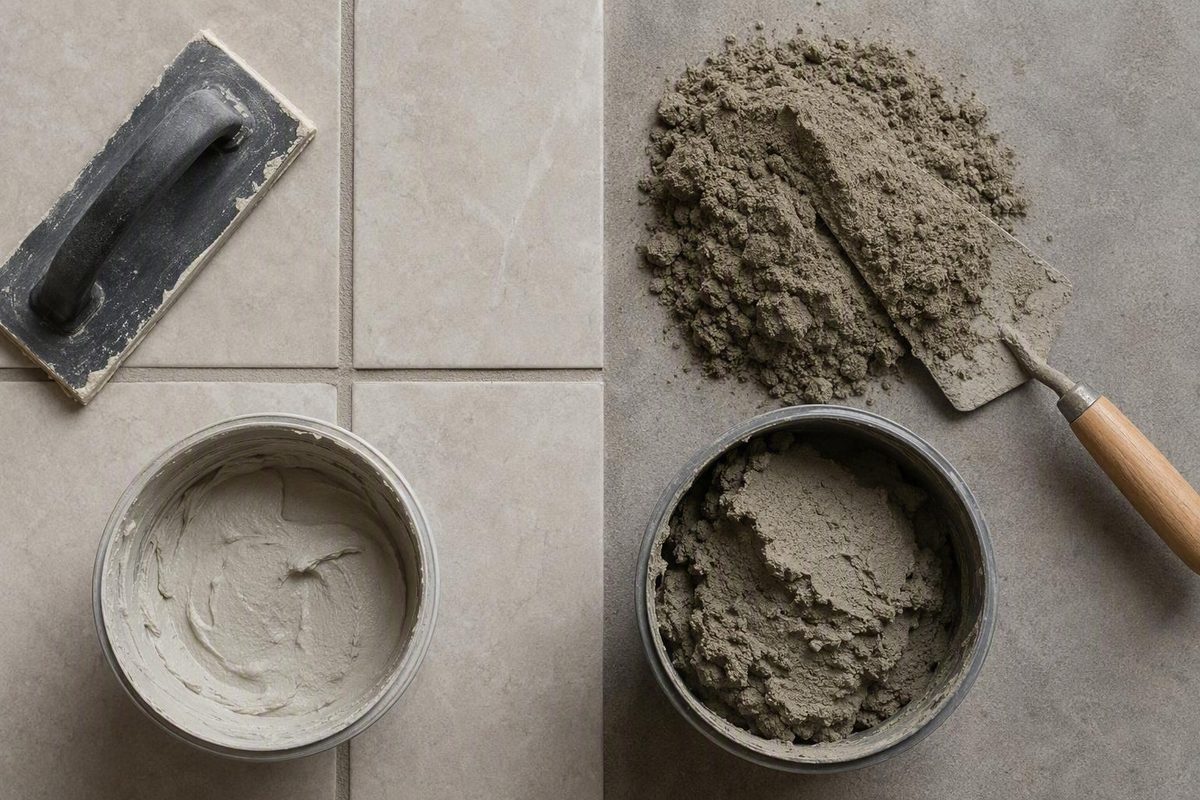
The short answer: mortar bonds, grout fills
The simplest grout vs mortar distinction is based on function:
- Mortar primarily bonds or beds materials.
- Grout primarily fills joints, gaps, cores, or voids.
That rule covers most buying decisions, but grout does not refer only to the colored material between tiles. Masonry grout can fill concrete-masonry-unit cores, including cells containing reinforcement when the design requires it. Purpose-designed structural grout can fill spaces beneath base plates, around anchors, between precast components, or in concrete voids. Likewise, mortar can mean either traditional masonry mortar or a tile-setting product.
Mortar is generally thicker and more shape-retaining, making it suitable for trowel placement. Grout is generally more workable or flowable so it can be worked into joints, placed with a grout bag, or poured or pumped into confined spaces. Exact consistency depends on the formulation and application; the product name alone does not determine how much water to use or how the material should behave.
| Comparison | Mortar | Grout |
|---|---|---|
| Primary function | Bonding or bedding materials | Filling joints, gaps, cores, or voids |
| Typical location | Beneath tile or between masonry units | Between tiles, inside masonry cores, or within specified structural spaces |
| General consistency | Usually thicker and more shape-retaining | Usually more workable or flowable, depending on the product |
| Placement method | Spread, combed, buttered, pointed, or troweled | Worked with a float, bagged, poured, or pumped |
| Common tools | Margin trowel, notched trowel, brick trowel, or pointing tool | Grout float, grout bag, hose, pump, or pouring equipment |
| Installation timing | Placed as masonry units or tiles are installed | Tile grout follows tile setting; masonry and structural grout follow the specified construction sequence |
| Representative uses | Laying brick or block, bedding stone, bonding compatible tile | Finishing tile joints, filling specified block cells, grouting anchors or base plates |
| Substitution risk | May not flow into or finish a space as required | May not provide the specified bonding bed or support |
Brick and concrete block are commonly bedded in masonry mortar. Tile is bonded to a compatible substrate with an appropriate setting mortar or adhesive, after which tile grout fills the joints. Concrete-masonry-unit cores may instead require masonry grout, depending on the plans and specifications. These basic differences in function and consistency are summarized in Archtoolbox’s comparison of mortar and grout.
Ingredients alone do not provide a reliable definition. Cementitious mortars and grouts can contain overlapping ingredients, including cement, aggregate, water, polymers, pigments, and other additives. Resin-based products add further variation. The meaningful distinctions are the complete formulation, intended function, documented properties, and installation requirements—not merely the presence of sand or the amount of water.
One pair of names, several different product families
The words grout and mortar cover several product families. A statement that is accurate for cementitious tile grout may be wrong for structural grout, just as a recommendation for masonry mortar may be unsuitable for setting porcelain tile.
| Product family | Principal role | Typical context |
|---|---|---|
| Traditional masonry mortar | Beds and bonds masonry units | Brick, concrete block, and stone |
| Tile-setting mortar or thin-set | Bonds compatible tile to a compatible substrate | Tile floors, walls, and other approved assemblies |
| Large-and-heavy-tile mortar | Provides a setting bed for qualifying tile applications | Installations within the selected product’s stated limits |
| Epoxy setting mortar | Bonds tile where the specific resin-based system is approved | Specialized tile work |
| Mastic or premixed tile adhesive | Provides non-cementitious adhesive bonding where approved | Selected indoor tile applications |
| Tile grout | Fills and finishes joints between installed tiles | Floors, walls, mosaics, and similar tiled surfaces |
| Masonry grout | Fills masonry cores and other spaces defined by the design | Grouted or reinforced concrete masonry |
| Structural or non-shrink grout | Fills specified construction voids or confined spaces | Base plates, anchors, precast joints, equipment, and concrete voids |
Traditional masonry mortar beds and bonds brick, concrete block, or stone. It is placed as the units are laid, forming joints that support, align, and connect the masonry.
Tile-setting mortar, often called thin-set, is generally a cement-based setting product used to bond compatible tile to an approved substrate. Thin-set is therefore a kind of mortar in tile work, but it is not a synonym for every mortar. Brick mortar and tile thin-set are not interchangeable simply because both packages use the word mortar.
Large-and-heavy-tile mortar is another tile-setting category. It is intended to support qualifying tile within the product’s documented application and thickness limits. Tile dimensions alone should not be used to invent a universal cutoff; check the tile, substrate, installation method, and current product literature.
Mastic is a premixed, non-cementitious adhesive rather than another name for mortar. Its suitability depends on the tile, substrate, location, exposure, and restrictions listed for the specific product.
On the filling side, tile grout finishes joints between installed tiles. Cementitious, epoxy, furan, and single-component products can differ in mixing, cleanup, stain or chemical resistance, maintenance needs, and permitted exposures.
Masonry grout is not decorative tile-joint filler. It may be specified for filling block cores and spaces containing reinforcement. Structural or non-shrink grout is a separate category for defined construction applications, such as spaces beneath base plates or around anchors. Ordinary tile grout should not be assumed to have the placement or performance characteristics of either category.
There is also an important terminology distinction: cement is commonly a binding ingredient, not the finished material. Cement, mortar, grout, and concrete are not synonyms. Shared ingredients do not make finished products interchangeable.
How mortar and grout work together in a tile installation
A typical tile installation uses mortar and grout in different locations and at different stages.
Simplified cross-section—not to scale:
Top / exposed surface
┌──────────────┐     grout joint     ┌──────────────┐
│     TILE     │◄──── fills gap ────►│     TILE     │
└──────────────┘                     └──────────────┘
████████████████ setting mortar / thin-set ██████████
──────────────── compatible substrate ────────────────
Bottom / supporting assembly
The setting product goes beneath the tile. A compatible tile-setting mortar is spread over a prepared, approved substrate, commonly with a notched trowel, before the tile is placed. The exact trowel, allowable bed thickness, and installation method depend on the tile, substrate, location, and selected product.
Grout goes between the tiles. It is applied after the tiles have been set and the setting material has cured for the period stated in its instructions.
The components perform complementary jobs:
- The substrate supports the assembly.
- The setting mortar or approved adhesive bonds the tile to the substrate.
- The tile forms the visible surface.
- Grout fills and finishes the planned joints.
Common setting-product categories include thin-set mortar, large-and-heavy-tile mortar, epoxy setting mortar, and certain premixed adhesives. These should not be treated as equally suitable alternatives. Approval for one indoor wall application does not establish that a premixed adhesive is appropriate for a floor, wet area, exterior location, or heavier tile.
Common tile-grout categories include:
- Cementitious sanded grout
- Cementitious unsanded grout
- Epoxy grout
- Furan grout
- Specialized premixed or single-component grout
Joint width is one selection factor, but it should not be converted into a universal sanded-versus-unsanded rule. Permitted joint ranges vary by product. Surface sensitivity also matters: aggregate in some sanded products may scratch polished stone, glass, or another delicate finish. Confirm compatibility with the tile supplier and grout manufacturer before installation.
Moisture, staining risk, cleaning methods, and chemical exposure can also affect grout selection. A kitchen backsplash, residential shower, entry floor, and industrial setting do not necessarily need the same material.
The central distinction remains straightforward: tile-setting mortar is selected to bond and support tile on a compatible substrate, while tile grout is selected to fill and finish the joints. Neither is the default substitute for the other.
Masonry mortar: bedding and bonding brick, block, and stone
Outside tile work, mortar most commonly refers to material used to bed and bond masonry units. A mason places mortar on the supporting course, positions the next brick, block, or stone, and finishes the exposed joint as required. The mortar must remain workable during placement while supporting the units and forming the specified joint.
Representative uses include:
- Bricklaying
- Concrete-block work
- Stone masonry
- Walls and chimneys
- Foundations and retaining walls
- Repointing
- Masonry repair
These are broad use categories, not universal approvals. A mortar suitable for one assembly may be unsuitable for another because the location, loads, weather exposure, masonry units, or existing construction differ. General applications and trowel placement are outlined by Duke Concrete Products; repointing and masonry repair likewise require a mortar selected for the particular work.
Types M, S, N, and O are distinct masonry-mortar categories with different performance and application profiles. They are not a simple “good, better, best” ranking. Higher compressive strength alone does not establish suitability.
Selection can depend on:
- Above-grade or below-grade location
- Structural role and anticipated loads
- Weather, moisture, and freeze-thaw exposure
- Masonry-unit type, strength, absorption, and condition
- Required bond and workability
- Existing material characteristics in repair work
- Project specifications and locally applicable requirements
For older, weak, weathered, or historic masonry, do not select a replacement mortar solely by choosing the highest-strength category. Compatibility should be evaluated for the specific assembly. Likewise, a lower-strength mortar should not be selected casually for a demanding structural location.
Keep masonry mortar separate from tile-setting mortar. A product intended for laying block is not automatically a tile adhesive, and thin-set intended to bond tile is not automatically suitable for brickwork, repointing, chimneys, foundations, or retaining walls. Read the intended-use statement rather than relying on the shared family name.
Historic masonry, foundations, retaining walls, load-bearing work, and other consequential applications require particular care. Use current plans and specifications where available, and have structural or specialized conservation work reviewed by an appropriately qualified professional rather than relying on a generalized mortar-type chart.
Masonry and structural grout: filling cores and confined voids
Grout extends beyond tile joints. In concrete masonry, masonry grout may be specified to fill hollow block cores, including cells containing reinforcement. The material and placement method must follow the current plans, specifications, applicable requirements, and product documentation.
The shape of the space matters. Material intended for a confined core must be suitable for filling that geometry and, where applicable, moving around reinforcement. A thick mortar intended for trowel work should not be assumed to perform the same placement role.
Structural grout may be used in specified spaces:
- Beneath machine or equipment base plates
- Around anchor bolts
- Between precast components
- Within concrete voids
- In certain repair details
These applications may require a purpose-designed structural or non-shrink grout. Non-shrink is a documented product characteristic, not a property of every material called grout. The selected product’s permitted uses, consistency, dimensional behavior, and placement limits must come from its current technical data and the project requirements. A construction-material supplier identifies base plates, anchors, precast joints, and concrete voids as structural-grout applications, but those examples should not be generalized to tile grout or every masonry grout.
The shared name can therefore be misleading:
- Tile grout fills joints in tiled finishes.
- Masonry grout fills specified spaces in masonry construction.
- Structural or non-shrink grout fills designated construction voids.
These products are not interchangeable merely because all are called grout.
For reinforced masonry and load-transfer applications, current design documents, manufacturer literature, applicable standards, and locally adopted codes control. Observing mortar packed into block cells on another job does not establish that the same substitution is suitable or compliant.
Practitioner discussion supports the broad functional distinction between flowable masonry grout and trowel-applied mortar. However, the available forum discussion does not provide controlled comparative evidence that every mortar-for-grout substitution causes structural failure. Its useful lesson is narrower: the specified function and current project requirements must be verified rather than inferred from job-site custom.
Why grout and mortar generally cannot substitute for each other
Interchangeability should be judged by the required function, not by whether two products look similar after mixing.
| Task | Required function | Appropriate product family | Typical placement method | Unsuitable default substitute |
|---|---|---|---|---|
| Install tile | Bond and support tile on a compatible substrate | Specified tile-setting mortar or approved adhesive | Spread with the required trowel; set tile | Ordinary tile grout |
| Lay brick or block | Bed and bond masonry units | Specified masonry mortar | Trowel into bed and head joints | Ordinary tile or structural grout |
| Fill tile joints | Fill and finish planned joints | Compatible tile grout | Work into joints with a grout float or approved tool | Masonry mortar or thin-set |
| Fill reinforced block cells | Fill specified cores and surround reinforcement | Specified masonry grout | Place as required by project documents | Trowel mortar used without approval |
| Grout a base plate or anchor | Fill a specified confined space | Specified structural or non-shrink grout | Pour, pump, or place as documented | Tile grout or general masonry mortar |
| Repoint masonry | Replace joint material compatibly | Project-appropriate repair or masonry mortar | Place and finish as specified | Tile grout |
For bonding: Ordinary tile grout is not a substitute for a specified tile-setting mortar or masonry bonding bed. It is not selected or installed to provide the same adhesion, support, bed thickness, working properties, or substrate compatibility. Hardening in place does not prove that it performs the required bonding role.
For bedding: Brick, block, and stone require mortar suited to the masonry, location, and project requirements. Ordinary grout should not be used to lay masonry unless a specifically designed and approved system permits it.
For tile-joint filling: Mortar is not a suitable default replacement for tile grout. It may not provide the flow, joint workability, finished appearance, color range, or joint-specific properties expected from the selected grout.
For structural or masonry void filling: Trowel mortar should not automatically be packed into reinforced masonry cells, beneath base plates, or around anchors. These locations may require grout selected for the specified geometry and function. The design documents and current product data—not a general comparison—determine the requirement.
A mismatch may contribute to poor adhesion, inadequate support, incomplete filling, an unsuitable finish, or shrinkage inconsistent with the intended application. These are conditional risks, not guaranteed outcomes in every case. Results depend on the materials, geometry, workmanship, exposure, and system design.
Observed job-site practice does not by itself establish suitability. A substitution can appear to harden successfully while still failing to meet the named material category or project requirements. Obtain approval before changing a material specified in the plans or product instructions.
Properties that vary by formulation—not just by name
The quickest way to misunderstand grout and mortar is to assign one product’s properties to every material bearing the same family name.
Myth: Grout is always runny, and mortar is always stiff. Fact: Mortar is usually thicker and more shape-retaining, while grout is generally formulated to move into a joint or void. Tile grout, masonry grout, structural grout, epoxy grout, thin-set, and repair mortar can nevertheless have very different working consistencies. Follow the documented mixing and placement range.
Myth: Adding water turns mortar into grout. Fact: Water content alone does not define the product. Adding extra water can move a material outside its stated mixing ratio and alter its handling or cured properties. Do not add water merely to make one product imitate another.
Myth: Mortar always contains lime, and grout never does. Fact: Formulations vary. Cement, aggregate, water, lime, polymers, resins, pigments, fillers, and other additives may occur in different products. The selected product’s documentation controls.
Myth: Grout is always stronger than mortar. Fact: Strength depends on the exact formulation and test method. Tile grout, masonry grout, structural grout, masonry mortar, and tile-setting mortar are intended for different systems. Their reported values are not automatically comparable, and the highest number does not establish suitability.
Myth: All grout is non-shrink. Fact: Non-shrink grout is a specific product category or documented characteristic. Tile grout and masonry grout should not inherit that label unless their current product information states it.
Myth: Epoxy and specialty grout are simply better versions of cementitious grout. Fact: Specialty products may provide greater resistance to staining, moisture, chemicals, or particular service conditions, but those benefits are formulation-specific. They can also require exact component mixing, offer limited working time, demand prompt cleanup, or impose temperature and exposure restrictions.
Myth: Grout makes a shower waterproof. Fact: Grout fills tile joints; it should not be assumed to waterproof the entire shower. Wet-area performance depends on the complete compatible assembly specified for the installation, not on grout alone.
Myth: One joint-width rule always determines whether grout should be sanded or unsanded. Fact: Joint width matters, but permitted ranges vary by product. Surface sensitivity matters too because aggregate in some sanded grouts may scratch polished stone, glass, or other delicate finishes. Verify both the joint range and tile compatibility before installation.
Broad product descriptions are only a starting point. Current technical documentation for the exact product should determine mixing, installation, exposure limits, maintenance, and suitability.
A project-based checklist before you buy
Start with the task. Determine whether the material must:
- Bond a finish to a substrate
- Create a supporting bedding layer
- Bed and bond masonry units
- Fill and finish a visible joint
- Fill a masonry core
- Fill a confined structural void
Once the function is clear, choose within the correct product family.
For tile, check:
- Tile material, finish, dimensions, weight, and surface sensitivity
- Substrate type, condition, preparation, and compatibility
- Wall, floor, interior, exterior, wet, or other location
- Planned joint width and depth
- Moisture, staining, cleaning, and chemical exposure
- Required mortar application and permitted bed thickness
- Compatibility among the selected installation products
- Whether the tile or grout could be scratched or discolored
- Whether the system documentation calls for materials other than grout in particular joints
For wet areas, verify the complete specified installation system. Water-resistant grout does not replace the required waterproofing or water-management components.
For brick, block, or stone, check:
- Masonry-unit type and condition
- New construction, repointing, or repair
- Above-grade or below-grade location
- Structural or nonstructural role
- Moisture, weather, and freeze-thaw exposure
- Existing material characteristics where compatibility matters
- Joint dimensions and finish
- Specified mortar category and current project requirements
Do not assume the highest-strength-looking product is the correct choice. Mortar selection also depends on function, compatibility, location, and the needs of the masonry assembly.
For reinforced block cells, anchors, base plates, precast joints, or concrete voids, follow the design rather than a generic shelf comparison. Identify the exact grout category and verify the current product and project requirements before work begins.
For every packaged product, verify:
- Mixing-water quantity or component ratio
- Mixing sequence
- Permitted application or bed thickness
- Working time or pot life
- Placement method
- Temperature and environmental restrictions
- Cure time before grouting, loading, exposure, or service
- Sealing or maintenance requirements
- Approved substrates and service exposures
- Cleanup instructions
- Package condition and storage information
Do not buy solely by package color, the generic word mortar or grout, or an assumed strength ranking. Read the intended-use statement and current technical data for the exact product. If the application is not listed—or the label conflicts with the project documents—seek clarification before installation.
The task-first rule is simple: choose mortar when the specified job is bonding or bedding, and choose the appropriate grout family when the job is filling a tile joint, masonry core, or structural void. Then verify the exact product against the tile or masonry, substrate, dimensions, exposure, installation instructions, project specification, and locally applicable requirements.
Mortar Desk publishes general building-material reference information. It is not a contractor and does not provide engineering advice; specifications change and codes vary locally, as explained on the About Mortar Desk page. Reinforced masonry, load-transfer applications, historic structural masonry, and other consequential work should be checked against current design documents and handled or reviewed by appropriately qualified trades and professionals.
Frequently asked questions
Can I use grout instead of mortar to install tile?
Generally, no. Tile grout is designed to fill and finish joints after tile has been bonded. It is not the default substitute for tile-setting mortar or an approved adhesive because it may not provide the required bonding bed, support, working properties, or substrate compatibility.
Use a setting product approved for the tile, substrate, location, and exposure. Apply compatible grout only after the setting product has cured for the period stated in its instructions.
Can mortar be used in place of grout between tiles?
Mortar should not be used as the default joint filler. It may not provide the workability, finish, color, or joint-specific properties expected from tile grout.
Choose a grout whose documented joint-width range, exposure rating, and surface compatibility fit the installation. For polished stone, glass, or another delicate finish, verify that the grout will not scratch the surface.
Is thin-set the same as mortar?
Thin-set is a type of tile-setting mortar, generally cement-based, used to bond compatible tile to a compatible substrate. It is not the same as traditional masonry mortar used for brick, block, or stone, and it is not interchangeable with every product labeled mortar.
The selected thin-set must still suit the tile, substrate, location, exposure, and permitted application thickness. Mastic is a non-cementitious premixed adhesive rather than thin-set mortar.
Does grout make a shower waterproof?
No grout should be assumed to waterproof a shower by itself. Some grout formulations may resist water better than others, but wet-area performance depends on the complete compatible system specified for the installation.
Select mortar and grout approved for the wet-area system, but do not use either as a substitute for its required waterproofing or water-management components.
Can mortar be used instead of grout in reinforced block cells?
Not as an unapproved default substitution. Reinforced block cells are generally filled with the masonry grout specified for the design. Trowel mortar serves a different placement role and should not be assumed to satisfy a grout requirement merely because it can be packed into a cell.
Current plans, specifications, product documentation, applicable requirements, and locally adopted codes govern the work. Have any proposed substitution reviewed and approved by the responsible authorized party before placement.