 MortarDesk
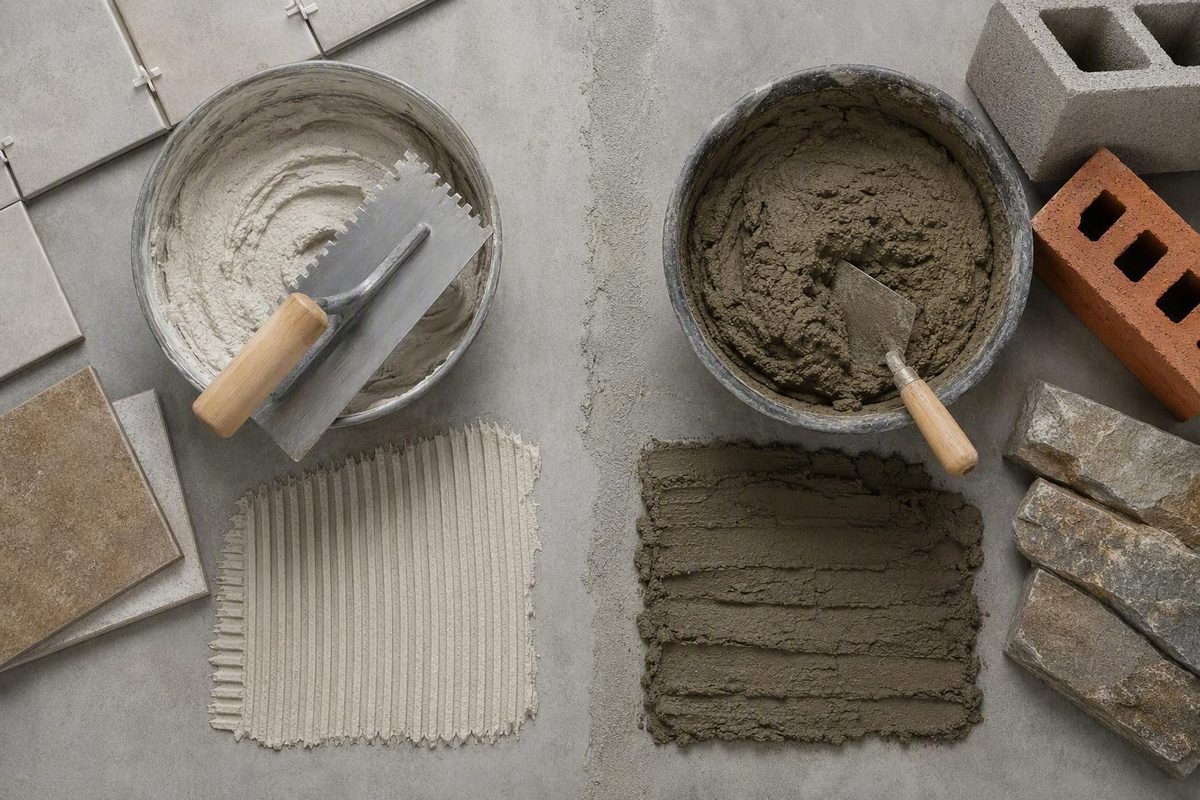
Thinset is a type of mortar made to bond tile in a thin layer. “Mortar” is the broader term and, on a building-material aisle, often means masonry mortar for laying brick, block or stone. They are not interchangeable.
If the job is setting tile, shop for a tile-setting mortar that matches the tile, substrate and exposure. If the job is laying or repointing masonry units, choose the specified masonry mortar type instead.
Thinset and masonry mortar compared
| Check | Thinset mortar | Masonry mortar |
|---|---|---|
| Main job | Bonds tile or stone to an approved substrate | Beds and joins brick, concrete block or stone |
| Typical identification | “Dry-set,” “modified dry-set,” “thin-set” or “large-and-heavy-tile mortar” | Type N, S, M or O masonry mortar |
| Standards commonly shown on the bag | ANSI A118.1, A118.4, A118.11 or A118.15, depending on performance | ASTM C270 and a mortar type |
| Working thickness | Thin bond coat; product-specific | Masonry joint or bedding application; product-specific |
| Applied with | Notched trowel selected for required coverage | Mason’s trowel and jointing tools |
| Do not substitute it for | A leveling layer, mortar bed or masonry mortar | Tile-setting mortar |
The Tile Council of North America describes thinset as cement, finely graded sand and a water-retention compound. It says thinset, dryset and drybond mortar are synonymous terms and that a conventional thinset layer is typically no more than 3/16 in. thick after the tile is pressed in (TCNA). That limit describes the installed bond coat, not the notch height printed on a trowel.
By contrast, one representative packaged Type N masonry product is described as masonry cement and graded sand for brick, block and stone construction or repair—not tile setting (Quikrete). For a fuller masonry-type comparison, see Types of Mortar: M, S, N, O and K Compared.
Read the ANSI designation, not just “thinset”
“Thinset” alone does not identify the performance class. TCNA’s current standards list distinguishes:
- ANSI A118.1: dry-set cement mortar
- ANSI A118.4: modified dry-set cement mortar
- ANSI A118.11: EGP plywood modified dry-set mortar
- ANSI A118.15: improved modified dry-set cement mortar
These are separate material specifications, so the correct bag depends on the whole tile assembly—not an assumption that “modified” is always better (TCNA standards list). Check the installation instructions for the tile, backer board or membrane and mortar together. Confirm that the exact mortar lists the substrate, tile type, interior or exterior location, wet or submerged exposure, and required ANSI designation.
For example, a current modified thinset data sheet lists porcelain tile and cement backerboard among its supported materials, but excludes pools and water features. It also limits the mortar to 1/4 in. (6 mm) after beat-in and requires at least 80% coverage in dry areas and 95% in wet or exterior areas (Custom Building Products). Those are product instructions, not universal numbers for every bag.
Thinset is not a floor leveler or universal thick bed
Ordinary thinset should not be built up to flatten an uneven floor. TCNA says the tile follows the substrate plane and that thinset is not appropriate for correcting level or flatness (TCNA). Prepare the substrate to the assembly’s flatness requirement before setting tile.
A bag labeled large-and-heavy-tile mortar may permit a thicker bond coat, but only within its stated range. One MAPEI product, for example, permits 3/32 to 1/2 in. (2.5 to 12 mm) and still says it is not designed to correct uneven floors (MAPEI technical data). Do not transfer that 1/2-in. allowance to a different thinset.
A mortar bed is another distinct tile component: a formed cementitious base that may be allowed to cure before tile is bonded to it with thinset. It is not the same material choice as the thin bond coat. Shower floors commonly use a separate dry-pack bed; see Dry Pack Mortar for a Shower Pan.
Worked buying example: 12 × 24 in. porcelain shower-wall tile
Do not start by choosing between a bag marked “mortar” and one marked “thinset.” Use this sequence:
- Identify the assembly: porcelain tile, the exact backer or waterproofing membrane, and a wet-area wall.
- Read the system instructions: determine whether the backer or membrane calls for unmodified, modified or another specified setting material.
- Match the mortar data sheet: it must approve porcelain, the named substrate or membrane, vertical use and wet-area exposure.
- Check thickness and coverage: choose a trowel that can achieve the product’s required contact without exceeding its cured-thickness limit. Lift tiles periodically to verify coverage rather than relying only on notch size.
- Reject a Type N masonry bag: an ASTM C270 masonry-mortar label does not establish suitability for bonding porcelain tile.
If the tile is large or heavy, evaluate a mortar explicitly labeled for that use rather than exceeding an ordinary thinset’s thickness limit. Product directions also control water quantity, slake time, pot life, open time and cure time. For more detail on those choices, see Thin Set Mortar: How to Choose, Mix and Apply It.
The shortest buying rule is: specify the job first, then the standard and approved assembly. “Mortar” is not a sufficiently precise order description.