 MortarDesk
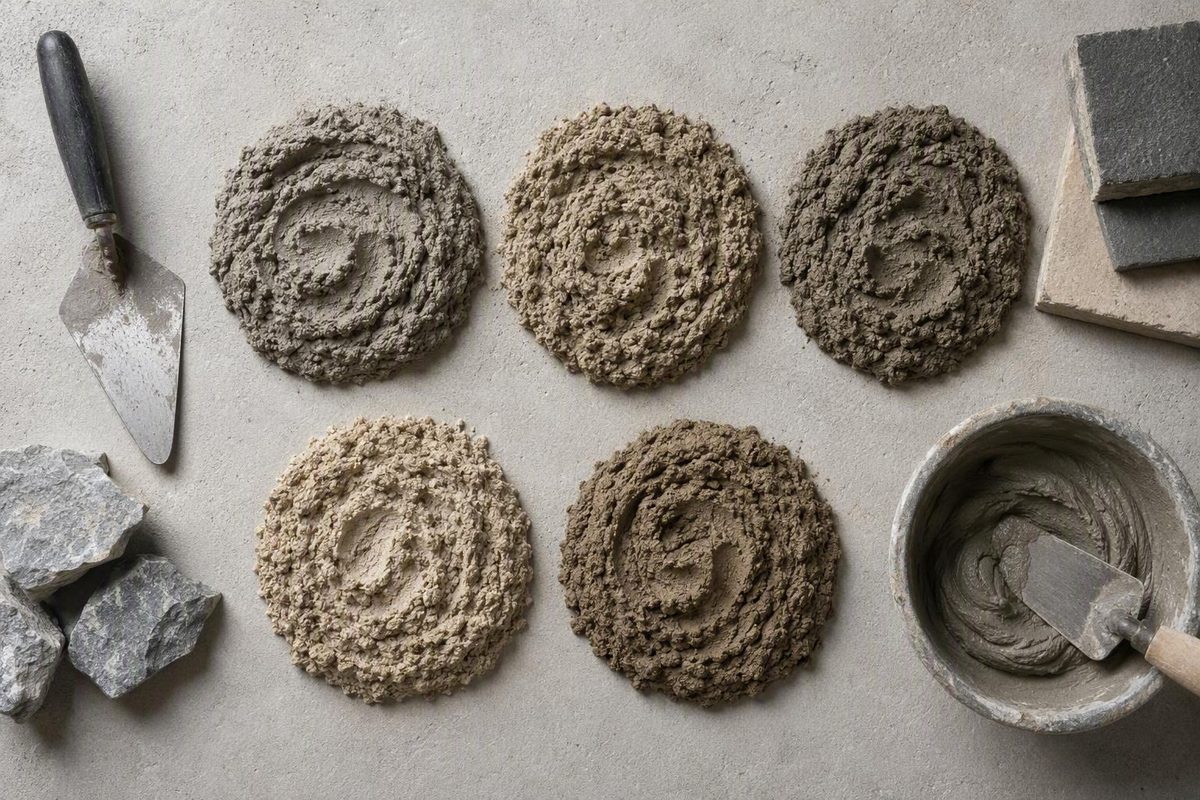
Choosing among the different types of mortar is not simply a matter of buying the bag with the highest compressive-strength number. Mortar must carry the required loads, bond to the masonry, tolerate expected exposure and movement, and remain compatible with the brick, block, or stone around it.
In U.S.-focused guidance, Types M, S, N, O, and K form a broadly descending strength sequence. That sequence is useful, but it is not a quality ranking. Type M is not inherently better than Type N, and a softer mortar is not necessarily inferior. The right mortar is the compatible mortar specified for the assembly, location, loading, moisture conditions, and service environment.
This article is a secondary-source overview for purchasing and specification discussions—not a standards table or project-specific engineering determination. Structural plans, current product data, preservation requirements, adopted local codes, and qualified professional direction should control the actual project.
Start With the Right Mortar Taxonomy
Mortar is a workable mixture that hardens between masonry units. It bonds brick, concrete masonry units, or stone; fills and seals irregular joints; and helps distribute loads through the assembly. Typical masonry mortar contains fine aggregate—usually sand—a binder, and water. Portland cement and hydrated lime are common binder components in modern cement-lime mortar.
The phrase types of mortar can refer to three different classification systems:
- Letter-designated masonry mortars: Types M, S, N, O, and K.
- Binder-based mortar families: Portland-cement, lime, gypsum, pozzolanic, and polymer-modified mortars.
- Specialty setting or service products: refractory mortar, thinset, epoxy setting mortar, and other application-specific materials.
These categories overlap, but they are not interchangeable. Type N describes a masonry-mortar category. “Lime mortar” identifies a broader family based on its binder. “Refractory mortar” identifies a product intended for a particular service condition. A general technical overview of masonry mortar describes both the lettered classes and these broader binder-based families within the wider mortar taxonomy.
This article concentrates on the U.S.-focused M-to-K classification because that is usually what buyers and builders mean when comparing masonry mortar types. Even so, the product category must be established before the letters are compared. A tile-setting mortar and a bricklaying mortar may both carry the word mortar on the package while serving fundamentally different purposes.
It also helps to separate three related terms:
- Cement is a binding ingredient used in mortar and concrete. It is not, by itself, a substitute for a properly formulated mortar.
- Mortar is the workable mixture placed between masonry units to create joints and bond the assembly.
- Concrete combines cementitious binder, water, and aggregate in a material commonly placed into forms to make slabs, walls, footings, and other elements. Its aggregate and intended role differ from those of masonry mortar.
Tile terminology introduces another layer of potential confusion:
- Thinset is a cementitious or modified setting material used to bond tile under specified substrate and service conditions.
- Epoxy setting mortar is a resin-based tile-setting product.
- Mastic is a premixed adhesive, not conventional masonry mortar.
Retail tile guidance likewise treats thinset, epoxy mortar, and mastic as distinct setting choices rather than equivalents to brick-and-block mortar in its comparison of masonry and tile products.
Before selecting a lettered type, ask the first and most basic question: Is this masonry work, tile setting, high-temperature construction, or a specialized repair?
Types M, S, N, O and K at a Glance
The figures below are commonly reported by secondary guides as approximate minimum 28-day compressive strengths under controlled preparation, curing, and testing. They are not guaranteed field strengths, and this table is not a substitute for the governing standard or project specification. Actual performance depends on the product, materials, water content, curing, weather, and workmanship. The values and broad application categories are summarized in a retailer’s standards-oriented comparison of Types M, S, N, O, and K as reference values rather than guaranteed jobsite outcomes.
| Type | Approximate minimum 28-day compressive strength | Relative position | Common starting-point applications | Principal cautions |
|---|---|---|---|---|
| M | 2,500 psi | Highest of the five | Heavy-load foundations, retaining walls, manholes, pavements, and demanding below-grade masonry | Greater strength does not make it suitable for every wall, stone, or repair; it may be incompatible with softer units |
| S | 1,800 psi | High | Structural work, lateral-pressure conditions, severe exposure, soil contact, and some at- or below-grade assemblies | Applications overlap with Type M; loads, reinforcement, units, and exposure must determine the specification |
| N | 750 psi | Medium | Ordinary above-grade walls, veneers, partitions, and general masonry where permitted | Not universally suitable for every structural wall, chimney, foundation, or exposure |
| O | 350 psi | Low | Non-load-bearing interiors and selected compatible repair or repointing work | Exterior suitability must be evaluated for the actual exposure and assembly |
| K | 75 psi | Exceptionally low | Specialized restoration involving very soft or fragile historic masonry | Not a routine new-construction mortar; compatibility and preservation evaluation are essential |
The broad strength order is:
M → S → N → O → K
That sequence says only that commonly cited compressive strength decreases from left to right. It does not mean that bond, flexibility, permeability, workability, weather resistance, or compatibility follow the same pattern. A lower-strength mortar may be deliberately selected to accommodate movement or protect weaker masonry units.
The application lists also overlap. Foundations and retaining walls appear in guidance for both Types M and S. Some sources place chimneys or exterior structural walls under Type N, while others direct more demanding versions of those assemblies toward Type S. Type O is sometimes discussed for selected exterior historic repairs but elsewhere limited to protected interior work.
These differences cannot be resolved by choosing whichever chart names the strongest mortar. They demonstrate why an application label is only a starting point. Unit strength and porosity, reinforcement, loads, wall design, moisture, climate, product formulation, and governing documents can all change the answer.
The same retailer guide describes M, S, N, and O as the four principal ASTM C270 types and discusses Type K differently in an appendix. That is the retailer’s summary, not independent verification of the current standard. Standards are revised, and locally adopted editions can vary, so check the governing edition named in the project documents or used by the relevant authority.
What Each Lettered Mortar Type Is Commonly Used For
Each lettered type occupies a general performance range, but none guarantees suitability merely because a project appears on a common-use list.
Type M mortar
Type M is the highest-compressive-strength category in the M-to-K sequence. It is commonly associated with:
- Heavily loaded foundations
- Retaining walls
- Manholes and sewers
- Pavements and similar hard-service work
- Demanding below-grade masonry
- Assemblies designed for substantial compressive loads
Its strength can be valuable where the design requires it. That does not make Type M the default for ordinary above-grade walls or repair work. A very hard mortar can be a poor match for soft brick, porous stone, or masonry expected to accommodate movement through its joints.
Type M should not be prescribed universally for natural stone. Stone varies considerably in density, compressive strength, absorption, bedding structure, moisture sensitivity, and structural role. A dense structural stone and a soft porous stone may require different mortar characteristics even though both are described simply as “natural stone.”
Use Type M where it is identified by the plans or specification and where its characteristics are compatible with the units. Do not substitute it for a lower-strength specified mortar merely because the bag displays a higher number.
Type S mortar
Type S occupies the next position in the strength sequence. It is commonly considered where masonry must address:
- Structural loads
- Lateral pressure from soil or other forces
- At- or below-grade placement
- Retaining-wall or foundation conditions
- Demanding exterior exposure
- Higher bond requirements
Its practical role is not defined by compressive strength alone. Type S may provide a useful balance of strength, bond performance, and workability for demanding masonry, but that balance depends on the mortar system and product rather than the letter alone.
A retaining wall’s height, drainage, soil conditions, reinforcement, surcharge, unit type, and foundation design matter more than the label “retaining wall.” Type S may be specified for one wall while Type M or a proprietary engineered system is required for another.
Type N mortar
Type N is commonly treated as the general-purpose category for ordinary above-grade masonry. Typical starting-point applications include:
- Above-grade brick and block walls
- Brick veneer
- Interior partitions
- General residential masonry
- Moderate-duty repairs where the existing materials are compatible
- Some stonework, depending on the stone and design
Its medium position in the strength range can offer an appropriate balance for many ordinary walls. That does not make it universally suitable for every above-grade or exterior project.
A structural wall may have a specific mortar requirement. A wall in severe exposure may need different performance. A chimney can involve weather, condensation, temperature, and code details that cannot be settled by a generic Type N recommendation.
“General purpose” should therefore be read as a common role, not blanket permission. Check the wall-system instructions, structural documents, veneer details, product data, and local requirements before purchasing.
Type O mortar
Type O is a low-compressive-strength mortar commonly associated with:
- Interior, non-load-bearing masonry
- Protected partitions
- Selected repointing or repair work
- Softer masonry that would be poorly matched to a harder mortar
Its relatively low strength may be an advantage where a soft, replaceable joint is intended. It is not suitable for substantial structural demand merely because it is workable or compatible with some older brick.
Exterior suitability is especially dependent on conditions. Some general guides restrict Type O to interior work, while restoration sources discuss it for selected exterior historic masonry. An exposed parapet in a wet, freezing climate presents a different problem from a sheltered wall built from soft masonry. Existing materials, rain exposure, drying potential, joint profile, and preservation requirements must be assessed before exterior use is approved.
Type K mortar
Type K is exceptionally soft and lies at the bottom of the commonly cited strength range. It is primarily associated with specialized preservation work involving fragile or very soft masonry.
It is not a routine choice for new construction, nor is it automatically correct whenever a building is old. Some historic assemblies may need Type K; others may need Type O, a custom lime mortar, or another formulation based on investigation. The objective is compatibility with the original materials and moisture behavior—not selection by age alone.
For all five types, common-use lists remain subordinate to:
- Structural drawings and project specifications
- Current manufacturer technical data and installation instructions
- Historic-preservation requirements
- The locally adopted building code
- Direction from the architect, engineer, preservation specialist, or other responsible professional
Choose by Load, Location, Exposure and Masonry Compatibility
A practical selection process begins with the assembly rather than the mortar aisle.
1. Determine whether the work is structural
Establish whether the masonry:
- Carries gravity loads
- Resists lateral forces
- Supports another building element
- Functions only as a non-load-bearing veneer or partition
If structural performance is involved, determine whether the mortar type is already stated on the plans. Reinforcement, grout, anchors, wall geometry, unit strength, openings, and foundations work together as a system. A mortar substitution cannot be evaluated safely in isolation.
2. Establish the grade level
Identify whether the work is:
- Above grade
- At grade
- Partly buried
- Fully below grade
- In direct contact with soil
Then identify lateral earth pressure, surcharge, groundwater conditions, and drainage limitations. Below-grade placement often moves the discussion toward Types S or M, but grade level alone does not decide between them.
A decorative garden wall that partly touches soil is not structurally equivalent to a retaining wall supporting a driveway. Likewise, a foundation veneer does not necessarily perform the same role as a load-bearing masonry foundation.
3. Assess environmental exposure
Consider the complete service environment:
- Wind-driven rain
- Persistent dampness or saturation
- Freeze-thaw cycling
- Large temperature changes
- Deicing salts or salt-laden air
- Splashback from paving
- Poor drainage
- Soil contact
- Sheltered versus fully exposed elevations
Do not translate one condition into a universal mortar choice. Exposure must be considered alongside the masonry units, joint detailing, flashing, drainage, workmanship, and structural requirements. Mortar cannot compensate for missing flashing, defective drainage, or an incorrectly designed wall.
4. Examine the masonry units
Compare the proposed mortar with the brick, block, or stone in terms of:
- Compressive strength and surface hardness
- Porosity and absorption
- Moisture sensitivity
- Expected dimensional movement
- Surface texture
- Existing deterioration
- Structural or decorative role
Compatibility matters because mortar and masonry units respond together. Mortar that is excessively hard relative to soft masonry can shift movement and stress into the units, contributing to cracking, damaged faces, or spalling. Conversely, mortar that is too weak for the loads or exposure may erode, crack, or lose integrity prematurely. Contractor-supply guidance similarly recommends balancing loads, exposure, movement, and unit properties instead of selecting mortar by strength alone in its compatibility-based selection framework.
5. Consider bond, movement, and moisture—not just compression
Compressive strength is easy to compare because it produces a single number. Masonry performance is more complicated. The selected mortar must also provide suitable bond, workability, water retention, movement capacity, and moisture behavior.
The strongest mortar may not produce the best assembly. A hard, rigid joint can be incompatible with weak units or a wall expected to move. At the other extreme, a mortar chosen solely because it is soft may lack the necessary performance for a structural or severely exposed application.
The letter designation also does not establish one universal lime content or permeability. Mortars can be produced through different binder systems and specifications. Evaluate the actual product or approved mix, not assumptions based only on its letter.
6. Treat heat as a separate service condition
Fireboxes, ovens, fire pits, flues, and other high-temperature assemblies require product-specific evaluation. Ordinary masonry mortar should not be presumed suitable merely because it is strong or because it is used elsewhere in a chimney. Supplier guidance identifies refractory mortar as a separate specialty formulation for heat-exposed construction rather than treating standard lettered mortar as interchangeable.
The correct material depends on the appliance or assembly design, the joint’s location, unit type, expected temperature, and applicable installation instructions.
7. Verify the selection
Before ordering, compare the proposed mortar with:
- The project drawings and specifications
- The bag label and current technical data sheet
- The masonry-unit or wall-system instructions
- The locally adopted code and referenced standards
- Applicable preservation requirements
- Direction from the responsible designer or specialist
Escalate the decision instead of relying on a general chart when the work involves structural walls, foundations, retaining walls, below-grade construction, chimneys, fireplaces, persistent wetting, unusual stone, or historic masonry.
Type N vs. Type S—and Type S vs. Type M
Two comparisons create much of the purchasing confusion: Type N versus Type S, and Type S versus Type M.
Type N versus Type S
The useful question is not “Which is better?” It is “What does the assembly require?”
Type N is commonly associated with ordinary above-grade work where moderate strength and general workability are appropriate. An above-grade brick veneer may specify Type N, provided the wall design, unit manufacturer, product instructions, and local requirements permit it.
Type S enters the discussion as structural demand, lateral pressure, soil contact, bond demand, or exposure becomes more severe. It is frequently listed for foundations, retaining walls, below-grade work, and structural walls.
This does not create a universal dividing line at grade. Some above-grade structural work may specify Type S, while an above-grade veneer may use Type N. Loads, wind or seismic design, ties, reinforcement, substrate, exposure, and masonry-unit properties determine the specification.
The following examples are illustrative, not prescriptive:
| Project condition | Common starting point | What must still be checked |
|---|---|---|
| Ordinary above-grade veneer | Type N may be specified | Veneer system, ties, unit data, exposure, plans, and code |
| Above-grade wall with greater structural or bond demand | Type S may be considered | Structural design, reinforcement, movement, and unit compatibility |
| Wall exposed to soil pressure | Type S or M may be specified | Engineering, drainage, wall height, surcharge, reinforcement, and foundation |
| Soft-masonry repair | Type N may already be too hard | Existing mortar, unit strength, moisture, and preservation criteria |
The word exterior does not settle the N-versus-S choice. Exterior walls range from sheltered veneers to heavily exposed structural assemblies. “Exterior” describes location; it does not fully describe demand.
Type S versus Type M
Type S and Type M overlap in common application lists. Both are associated with foundations and retaining walls, so seeing either project name on a chart does not decide the specification.
Type M supplies the higher commonly cited compressive strength. Type S may provide a different balance of compressive strength, bond, and workability. Exact composition and performance depend on the specified mortar system, product, and governing requirements; the letter alone does not establish a universal lime content or flexibility level.
Conditional examples include:
- A wall subject to moderate structural demand and lateral soil pressure may specify Type S.
- A heavily loaded below-grade masonry assembly may specify Type M.
- A retaining wall may use Type S, Type M, or a proprietary engineered system, depending on its design.
- A hard Type M mortar may be inappropriate if the selected masonry units cannot tolerate it.
When loads, reinforcement, lateral pressure, seismic forces, or foundation performance are involved, structural documents or qualified design input should control. A retailer’s application chart cannot determine a wall’s structural adequacy.
Historic Brick, Lime Mortar and the Sacrificial Joint
In compatible traditional masonry, the joint is often intended to be the more readily repairable part of the assembly. It can accommodate some movement and weathering so that mortar deteriorates before the more valuable brick or stone. This is the principle of the sacrificial joint.
That principle reverses the instinct to make every repair as hard as possible. If repointing mortar is significantly harder or less moisture-permeable than soft masonry, stress and moisture may be redirected into the units. Instead of the joint weathering gradually, brick faces or stone edges may crack, flake, or spall.
Lime mortar is generally softer, more flexible, and more vapor-permeable than Portland-cement-rich mortar. Those characteristics can make it more compatible with some traditional masonry, but “lime mortar” covers multiple formulations. It is not a single standardized recipe suitable for every historic building.
Types O and K are commonly discussed as possibilities for soft historic masonry because they occupy the lower end of the strength range. They are not automatic choices. Building age alone does not reveal:
- The composition of the original mortar
- The strength and absorption of the masonry units
- Whether earlier repairs introduced Portland cement
- The wall’s moisture sources and drying paths
- Its structural condition
- Its weather exposure
- Applicable preservation requirements
Some historic assemblies may need a non-Portland lime mortar rather than a generic Type O or K cement-lime mix. Others may appropriately use a carefully specified lettered mortar. The decision should follow investigation rather than a rule based on construction date.
A compatibility-first process includes:
- Inspect the wall. Identify cracking, open joints, spalling, dampness, failed flashings, leaks, and previous repairs.
- Investigate the existing materials. Evaluate the original mortar and the brick or stone rather than matching only the visible color.
- Assess moisture and exposure. Determine where water enters and how the wall dries.
- Define performance requirements. Establish suitable strength, permeability, bond, and movement characteristics.
- Check applicable preservation controls. Confirm any project or jurisdictional requirements before work begins.
- Prepare cured samples. Approve color, texture, aggregate, tooling, and joint profile after the sample has developed a representative appearance.
- Control installation and curing. Even a compatible formulation can perform poorly if joints are inadequately prepared or the new mortar dries too quickly.
Appearance is not governed by the M, S, N, O, or K designation alone. Sand composition, particle size, aggregate color, pigment, binder color, joint depth, tooling, and curing can all change the finished result. Restoration guidance therefore treats strength, sand, color, and joint profile as connected but distinct parts of repointing rather than relying on nominal mortar type alone.
Fragile, significant, or visibly deteriorated historic masonry warrants evaluation by a preservation specialist or restoration mason experienced with the relevant construction. Repointing an old wall without addressing active water entry can conceal rather than solve the underlying problem.
Mix Proportions, Property Specifications and Real-World Performance
Online mortar charts often present cement-lime-sand ratios as universal recipes. They are better treated as reference proportions that illustrate how commonly reported cement-lime mixes differ.
A retailer guide reports the following common field proportions and distinguishes proportion-specified mortar, based on prescribed constituent quantities, from property-specified mortar, evaluated through characteristics such as compressive strength, water retention, and air content. These are the retailer’s summaries of the specification framework, not a substitute for consulting the governing document or the approved project specification.
| Type | Cement | Lime | Sand |
|---|---|---|---|
| M | 1 | 1/4 | 3 3/4 |
| S | 1 | 1/2 | 4 1/2 |
| N | 1 | 1 | 6 |
| O | 1 | 2 | 9 |
| K | 1 | 3 | 10 |
These figures are not universal jobsite formulas. They do not authorize a contractor or DIY builder to replace a specified product or approved mix.
Confusion arises because other online references express Type M as 3:1:12 and Type S as 2:1:9. For Type S, dividing every number by two produces 1:1/2:4 1/2, so the two forms express the same relative proportions. For Type M, dividing 3:1:12 by three produces 1:1/3:4, which is close to—but not identical with—1:1/4:3 3/4. A masonry contractor’s chart illustrates the 3:1:12 and 2:1:9 convention without establishing it as a universal project recipe.
Do not resolve it by casually converting or combining online recipes. Follow the governing specification, approved submittal, or current product instructions.
Even when nominal proportions are correct, real-world performance can vary with:
- Sand grading, shape, cleanliness, and moisture
- Accuracy of volumetric measurement
- Variation between batches
- The amount of added water
- Mixing sequence and duration
- Mortar and ambient temperature
- Heat, cold, wind, and humidity
- Absorption by the masonry units
- Admixtures and pigments
- Joint preparation and placement
- Protection and curing
Excess mixing water can reduce mortar strength, so adding water by eye to every batch can undermine consistency even when the dry proportions remain unchanged according to contractor guidance on mortar-strength variables.
Preblended mortar
It may simplify purchasing and reduce variation in aggregate and pigment between batches.
That convenience does not mean any bag marked with the same letter can replace a specified mortar. Products may differ in binder system, aggregate, color, admixtures, required water, installation limits, and tested properties. Verify the complete product designation and technical data rather than relying only on the large letter printed on the package.
Jobsite-mixed mortar
Jobsite mixing allows control over local sand, color, and formulation. That can be valuable in restoration or work requiring a particular appearance, but it places a greater quality-control burden on the crew.
Materials must remain consistent, batching methods must be controlled, and sand moisture must be considered. Mixing and use must follow the governing specification rather than an improvised recipe assembled from several online charts. Supplier guidance likewise contrasts the consistency of preblended products with the flexibility—and greater control burden—of jobsite mixing when discussing mortar selection and batching.
The safest purchasing rule is straightforward: use the specified product or approved mix, review the current technical data, and complete any required testing. Do not reverse-engineer a structural or preservation mortar from a strength table alone.
Specialty Mortars and Products That Should Not Be Confused
The M-to-K comparison addresses masonry mortar, but many other materials are described as mortar in product names or everyday conversation.
Portland-cement mortar
Portland-cement mortar uses Portland cement as a principal hydraulic binder. Modern masonry mortars may combine it with lime or use formulated masonry cement or mortar cement. The binder system can affect workability, strength, water retention, and other properties.
Lime mortar
Lime mortar relies primarily on lime as its binder. Depending on the formulation, it may set through carbonation, hydraulic reaction, or a combination of mechanisms. Its generally softer and more moisture-permeable character can make it important in compatible traditional masonry repair.
A lime-rich mortar should not be selected solely because a wall is old. Original materials, unit characteristics, exposure, structural role, and preservation requirements still govern.
Gypsum mortar
Gypsum-based mortar belongs to a binder family rather than the M-to-K sequence. Available evidence describes it as faster-setting than lime mortar but less durable in damp conditions, so the product and intended service environment must be checked.
Pozzolanic mortar
Pozzolanic materials react with lime in the presence of water and can alter setting and durability characteristics. Historic and modern formulations vary, so the term alone does not define a complete specification.
Polymer-modified mortar
Polymer additives can alter adhesion, flexibility, water behavior, and other properties, often at additional cost. Those changes may be beneficial in a product engineered for a particular substrate or repair.
Low permeability can be problematic in some traditional masonry repairs because it may contribute to unwanted moisture retention. “Polymer-modified” is therefore not an automatic upgrade for every wall.
Refractory mortar
Refractory mortar is formulated for high-temperature service. It may be required in fireboxes, ovens, fire pits, or other heat-exposed assemblies, depending on the design and product instructions.
Do not presume that ordinary Type M or Type S masonry mortar is suitable simply because it has high compressive strength. Compressive strength under ordinary test conditions does not establish suitability for high-temperature service. Refractory mortar is identified separately for heat-exposed construction in supplier guidance on specialty mortar applications.
Thinset
Thinset is a tile-setting material applied in a comparatively thin layer. Its selection depends on the tile, substrate, installation location, expected movement, moisture, heat, and product requirements.
A product approved for a dry interior installation should not be presumed suitable for a wet area, exterior installation, fireplace surround, or heat-exposed assembly.
Epoxy setting mortar
Epoxy setting mortar is a resin-based specialty material. Depending on its formulation, it may provide water or chemical resistance. It can also have demanding mixing, working-time, substrate-preparation, and cleanup requirements.
Its properties are product-specific. The word epoxy does not establish suitability for every wet, chemical, industrial, or tile application.
Mastic
Mastic is a premixed tile adhesive, not conventional masonry mortar. It is generally discussed for limited tile-setting applications and is not a structural product for laying brick, block, or stone.
Before buying, use this checklist:
- Identify whether the work is masonry, tile setting, high-temperature construction, or repair.
- Confirm the required mortar type, binder system, or product standard.
- Check the masonry unit, tile, stone, and substrate limitations.
- Verify above-grade, below-grade, interior, exterior, wet-area, and heat-exposure restrictions.
- Read the mixing, application, working-time, protection, and curing instructions.
- Confirm compatibility with adjacent materials.
- Do not substitute products solely because both packages use the word mortar.
Frequently Asked Questions
What is the strongest type of masonry mortar?
Type M has the highest commonly cited compressive strength in the M, S, N, O, K sequence, at approximately 2,500 psi as a minimum 28-day reference value. Type S follows at approximately 1,800 psi in commonly reported secondary-source comparisons.
That does not make Type M the best mortar for every job. It is commonly associated with heavily loaded and demanding below-grade masonry, but it may be unnecessarily hard or incompatible with ordinary walls, soft brick, or some stone. The plans, units, exposure, and project specification should determine whether its higher strength is appropriate.
Should I use Type N or Type S for an exterior wall?
“Exterior wall” does not provide enough information to choose safely.
Type N is commonly associated with ordinary above-grade masonry and veneer. Type S is commonly considered where structural loads, higher bond demand, severe exposure, soil contact, or lateral forces make the service conditions more demanding.
Check whether the wall is structural or veneer, its grade level, unit properties, wind or seismic design, moisture exposure, reinforcement, and specified wall system. If structural performance is involved, follow the plans and qualified design input rather than selecting from a general-purpose chart.
Why can high-strength mortar damage old brick?
A mortar joint that is much harder or less moisture-permeable than soft brick can redirect movement, stress, and moisture into the brick. Instead of the replaceable joint weathering, the masonry unit may crack, lose its face, or spall. Restoration guidance warns against selecting repointing mortar solely for high strength when working with soft historic masonry and recommends evaluating compatibility first.
A softer compatible mortar can serve as the sacrificial and more readily repairable part of the wall. That does not mean every old building automatically needs Type O or K. Original mortar, brick properties, moisture, exposure, and preservation requirements should be investigated first.
Are the published cement, lime and sand ratios universal recipes?
No. They are reference proportions, and different sources may normalize or report them differently. A ratio also does not describe sand grading, sand moisture, measurement method, admixtures, mixing water, curing, or the tested properties required by the project.
Use the specified mortar or an approved product that meets the governing requirements. Do not replace a bagged or property-specified mortar with a field recipe based only on an online ratio.
Are thinset, epoxy mortar and mastic the same as masonry mortar?
No.
Thinset is a tile-setting material. Epoxy setting mortar is a resin-based specialty setting product whose resistance and application limits depend on its formulation. Mastic is a premixed adhesive used for limited tile applications.
Conventional masonry mortar is formulated to form joints and bond brick, block, or stone. Products from these categories are not interchangeable merely because their labels use related terms.
A Compact Mortar Selection Sequence
Use this sequence before purchasing:
- Identify the product category. Determine whether the work requires masonry mortar, tile-setting material, refractory mortar, or another specialty product.
- Define the service conditions. Establish structural load, grade level, soil contact, moisture, heat, weather exposure, and expected movement.
- Evaluate compatibility. Compare the proposed mortar with the hardness, strength, porosity, absorption, and condition of the masonry.
- Verify the choice. Check the plans, current product data, applicable preservation requirements, adopted local code, and responsible professional’s direction.
M-to-K is a broad strength hierarchy, not a best-to-worst ranking. The correct mortar is the compatible, specified mortar—not automatically the strongest bag on the shelf.