 MortarDesk
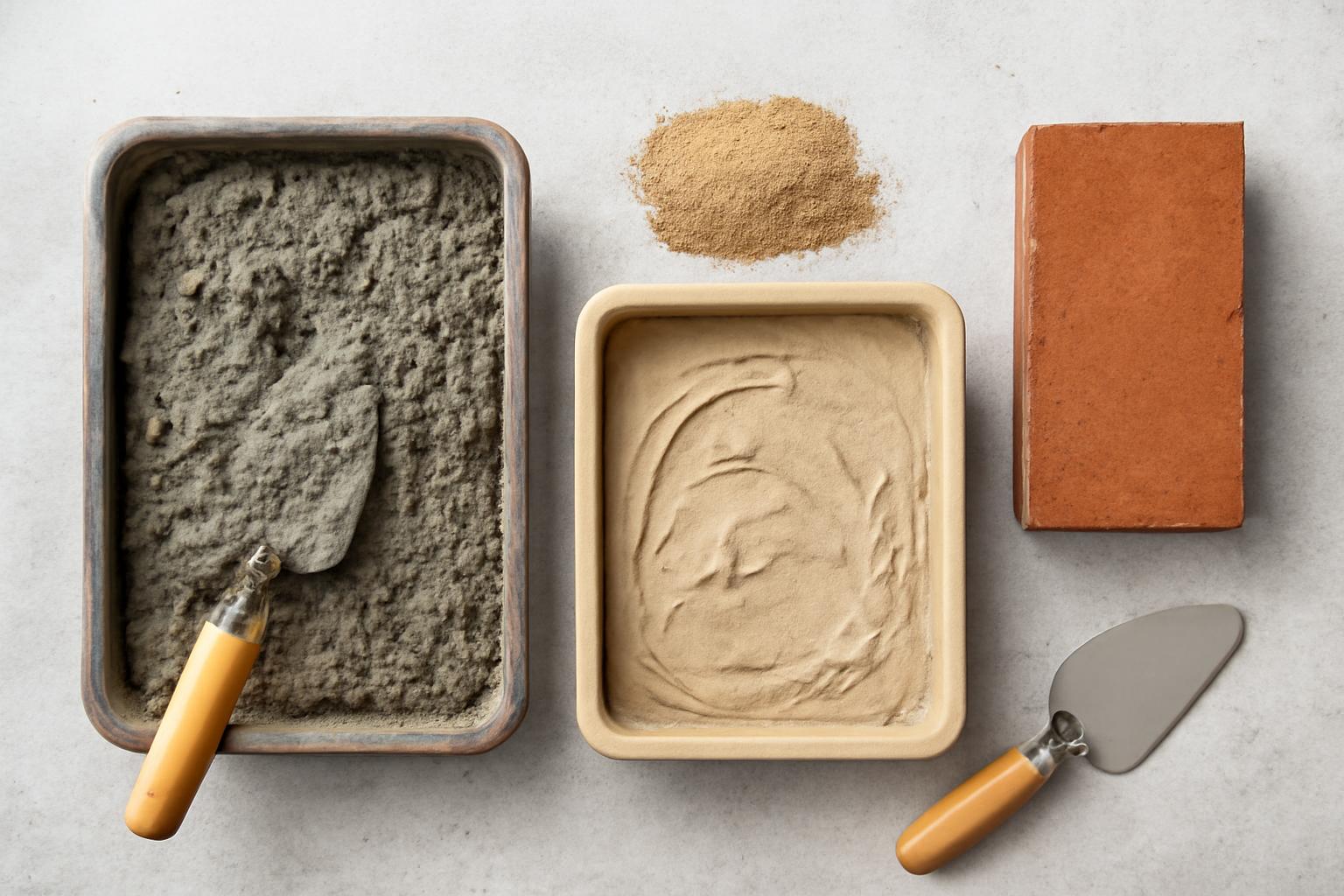
“Concrete mix ratio vs mortar type” sounds like a simple shelf comparison. It is not. Concrete and mortar share cement, but they are formulated for different jobs, behave differently in the fresh state, and are selected by different systems.
Concrete is a structural composite. It is meant to harden into the load-bearing body of a footing, slab, pad, step, or sidewalk. Mortar is a masonry bonding material. It is meant to join brick, block, or stone, stay workable on the trowel, retain water long enough to develop bond, and in many cases remain softer than the masonry units it connects.
That distinction matters more than any single “recipe.” The right comparison is not just ratio against ratio. It is ingredients, compressive strength, workability, application, and compatibility.
There is also an important asymmetry in the way the two materials are labeled. Mortar is commonly organized by named types—M, S, N, O, and K. Concrete, at least in the approved evidence here, is not presented through one equally universal homeowner type ladder. Instead, it is discussed by its ingredients, target compressive strength, workability window, and intended use. So if you came looking for one neat “concrete ratio ladder” that mirrors the mortar letters, the more useful answer is this: concrete is usually chosen by placement and strength class; mortar is usually chosen by type and compatibility.
Core Differences Between Concrete Mixes and Mortar Types
At the ingredient level, the separation happens fast. Concrete combines portland cement, sand, water, and coarse aggregate such as gravel or stone. Mortar typically combines cement, fine sand, water, and often lime or masonry cement to improve bond and workability. Concrete is used for structural placements such as foundations, walls, sidewalks, and slabs, while mortar is used to bond masonry units and fill their joints (Amerimix).
That coarse aggregate is not a small detail. It is the feature that makes concrete a structural composite rather than a bonding paste. Stone aggregate helps concrete carry compressive loads and behave like the bulk material of the structure. Mortar leaves out that coarse stone so it can be smoother, creamier, easier to spread, and better able to form bond in relatively thin joints.
Fresh-state behavior follows the same logic. Concrete is mixed so the paste can coat sand and stone, then be placed and consolidated into a monolithic mass. Mortar is mixed so it will cling to the trowel, wet the masonry surface, retain enough moisture for bond, and tool cleanly in joints. Even when both products come in bags from the same aisle, they are not trying to do the same job.
A practical way to think about the difference is this:
- Concrete becomes the thing itself: the slab, footing, sidewalk, or pad.
- Mortar connects the parts of a masonry assembly: bed joints, head joints, repointing, and repairs.
The most important rule is the simplest one: they are not interchangeable. Mortar is not a substitute for structural concrete, and concrete is not a substitute for proper masonry mortar. Sakrete’s guidance is blunt that using them interchangeably “will lead to disaster” because the formulations are intentionally different (Sakrete).
That warning also explains why the keyword comparison can be misleading. A “concrete mix ratio” does not compete with a “mortar type” in the same way two mortar types compete with each other. One system describes a structural pour material with aggregate; the other describes a family of masonry joint materials whose strength, bond, and compatibility are tuned to the wall.
Understanding Concrete Mix Ratios and Properties
A concrete mix ratio is the balance of cementitious paste, fine aggregate, coarse aggregate, and water that produces the placing and strength characteristics needed for the job.
In the approved sources, typical residential concrete is commonly described in the 2,500 to 5,000 psi range, with fresh concrete staying workable for roughly 60 to 90 minutes after water is added.
That is why aggregate matters so much in this comparison. Concrete gets its structural character from the stone locked into the hardened cement paste. Without coarse aggregate, you no longer have the same load-carrying composite. You have moved toward another cement-based material family.
Water management is the other big divider. Concrete needs enough water to place and consolidate properly, but its performance goal is still strength. Mortar also cannot be overwatered, yet it is intentionally formulated for greater spreadability and workability because it has to bond masonry in thin joints rather than fill a form or trench. In short, concrete tolerates neither guesswork nor the “just add water until it feels easy” approach.
For buyers, this creates a selection difference that is easy to miss:
- Concrete products are usually chosen by intended placement and target strength.
- Mortar products are usually chosen by type.
That is the closest thing to a true side-by-side framework supported by the evidence. If you are comparing a slab mix with a Type S mortar, the real question is not which number is larger. It is which material family the project belongs to.
A useful concrete-side decision framework looks like this:
- If the material itself must become a monolithic structural or ground-supported element, start in the concrete category.
- If the material must join masonry units in thin joints, start in the mortar category.
- Once you are in the concrete category, compare products by use case, strength range, aggregate content, and workable time, not by trying to force them into the M/S/N/O/K language used for mortar.
That matters because the approved evidence does not support one universal residential concrete recipe that covers every footing, slab, sidewalk, and post base. So the honest answer to “concrete mix ratio vs mortar type” is not to invent a ratio ladder. It is to compare concrete by structural class and application against mortar by type and bond function.
Mortar Types: M, S, N, O, K Defined by ASTM C270
When builders refer to mortar “types,” they are usually talking about the familiar M/S/N/O/K ladder. In the approved evidence, direct ASTM C270 property tables are clearly supported for Types M, S, and N. SPEC MIX lists minimum 28-day compressive strengths of 2,500 psi for Type M, 1,800 psi for Type S, and 750 psi for Type N, along with water retention of at least 75% and maximum air contents of 18% for M and S and 20% for N under its ASTM C270 property specifications (SPEC MIX).
Those numbers help explain why mortar is not judged by strength alone. Water retention matters because mortar must stay usable long enough to develop bond with the masonry unit. Air content matters because mortar is expected to remain workable and, in common field guidance, higher air content is part of the reason it performs differently from concrete in exposure conditions. Mortar is a joint material first and a compressive material second.
For the lower-strength end of the ladder, the approved field guides place Type O at about 350 psi and Type K at about 75 psi. Marshalltown describes Type O as a softer mortar suited to above-grade interior, non-load-bearing work and some repair situations, while Type K is mainly a restoration mortar for historic masonry that needs a very soft, compatible joint material (Marshalltown).
Put together, the common lineup looks like this:
- Type M — highest common strength; used where heavy loads or below-grade conditions justify it
- Type S — strong masonry mortar with good bond; common for structural and exterior exposure
- Type N — the common above-grade general-use mortar
- Type O — lower-strength mortar for gentle repair or interior non-load work
- Type K — very soft mortar mainly for historic restoration
What matters most is not memorizing the letters. It is understanding the design logic behind them. Mortar often needs to be weaker than the masonry units so the joint remains the serviceable, repairable part of the assembly. A masonry wall is not always better when every component is as hard as possible.
That is also why mortar types are not simply a “more cement equals better wall” ladder. The right mortar must spread well, bond well, retain water, and match the strength and absorption characteristics of the masonry units. Compressive strength is part of the choice, but only part.
Mortar Mix Ratios by Type
For traditional portland-cement/lime/sand mortars, the commonly published proportion guides in the approved evidence are:
- Type O = 1 : 2 : 9
- Type N = 1 : 1 : 6
- Type S = 2 : 1 : 8–9
- Type M = 3 : 1 : 12
Those figures are proportions by volume of cement : lime : sand (Marshalltown).
Those ratios are useful, but they need context. Second, slight published variation does not necessarily mean a different mortar family. For example, Type S may appear as 2:1:8-9 in one guide and as 2:1:9 in another summary. The point is the class of mortar, not false precision in the last shovel of sand.
For a field-batched Type S example, Rosie on the House gives one traditional mix as 1 bag (94 lb) portland cement + 1/2 bag (50 lb) hydrated Type S lime + 28 shovels of masonry sand + 7 to 8 gallons of water. The same source gives a masonry-cement alternative as 1 bag (70 or 78 lb) masonry cement + 18 to 20 shovels of masonry sand + about 5 gallons of water. For premixed mortar, it gives an example of 5 to 6 quarts of water per 80 lb bag, followed by mixing, a short 2 to 3 minute slake, and remixing before use (Rosie on the House).
That gives DIY readers three distinct layers of guidance:
- Mortar type tells you the target performance class.
- Traditional proportion recipes tell you one way to produce that class.
- Premixed bag instructions tell you how the manufacturer wants that specific product mixed.
Keeping those layers separate prevents a common mistake: throwing together cement and sand, then calling the result “Type S” just because it feels strong. If the formulation does not match the intended class, the label is wishful thinking.
It also helps explain why premixed mortar is often a better small-project choice. The factory has already controlled the cement, lime or masonry-cement content, and sand grading. Your job is reduced to choosing the correct type, then following the water and mixing directions exactly.
One more caution matters here. The evidence supports traditional mortar ratios far better than it supports any universal concrete ratio. So if you can quote a Type N recipe but not a slab recipe, that is not a gap in understanding. It reflects the way the two material families are actually specified in the approved sources.
Strength Comparison: Concrete vs Mortar Types
If you compare them by compressive strength alone, concrete generally comes out well ahead. Sakrete says most general concrete is around 4,000 psi and notes that special applications can go to about 8,000 psi. The same source gives the familiar common mortar strengths of Type M at 2,500 psi, Type S at 1,800 psi, and Type N at 750 psi at 28 days (Sakrete).
Adding the lower-strength repair and restoration mortars extends the ladder further downward. The approved sources commonly place Type O around 350 psi and Type K around 75 psi, again as 28-day comparison figures.
A practical comparison looks like this:
- Concrete — commonly about 2,500 to 5,000 psi in residential discussion, with general concrete often around 4,000 psi and higher-strength specialty mixes above that
- Type M mortar — about 2,500 psi
- Type S mortar — about 1,800 psi
- Type N mortar — about 750 psi
- Type O mortar — about 350 psi
- Type K mortar — about 75 psi
That ranking is useful, but it can also mislead. Mortar is often weaker on purpose. Sakrete explicitly frames mortar as the lower-strength, more workable material, and the evidence also supports the core masonry principle that the mortar joint should usually remain the sacrificial, repairable element instead of forcing stress into the brick or stone.
So “more psi” is not the right decision rule for masonry. A very hard mortar next to a soft historic brick can create the wrong failure mode. Instead of the joint taking wear and being repointed later, the brick face may crack, spall, or otherwise deteriorate first.
The familiar mnemonic “MASON WORKS” remains a handy memory aid for the main descending order of common mortar strengths: M > S > N. It is not a design method, but it is a useful reminder when you are staring at bags in a yard and trying to remember which type is stronger.
The bigger lesson is this: concrete and mortar are optimized for different ideas of success. Concrete is trying to become a strong mass. Mortar is trying to become a durable bond line that works with the masonry around it. That is why even the strongest common mortar type does not turn mortar into a replacement for concrete.
Applications: When to Use Concrete Mixes vs Mortar Types
Use concrete when the material itself is supposed to become the structural or ground-supported body of the project: slabs, sidewalks, footings, pads, steps, and similar monolithic placements. Use mortar when the job is to lay, bond, or repair masonry units and their joints (Amerimix).
Within the mortar family, type selection depends on the wall, not just the bag:
- Type M is associated with heavy-duty or below-grade masonry and retaining conditions.
- Type S is commonly used for exterior masonry, load-bearing work, chimneys, fireplaces, and other more demanding exposure conditions.
- Type N is the common above-grade residential and general-use mortar.
- Type O is suited to interior, non-load-bearing, or gentler repair work.
- Type K is mainly for historic restoration where the goal is compatibility with very soft original masonry rather than maximum strength (Building Restoration Corporation).
That type map becomes much more important once you understand compatibility. Building Restoration Corporation stresses that mortar that is too hard can damage softer brick or stone, while mortar that is too soft for the exposure and load can fail too early. In other words, both overbuilding and underbuilding the joint can be mistakes.
A few common project examples show how the selection logic changes:
- A sidewalk slab is a concrete job, not a mortar-type choice.
- A new above-grade brick garden wall often starts in Type N territory unless higher exposure or load pushes the choice upward.
- A below-grade masonry wall may use stronger mortar, but the footing beneath it is still a concrete decision.
- Repointing old soft brick is often a compatibility question before it is a strength question.
- A historic facade may need a much softer mortar than a new retaining wall built from modern units.
That is why “pick the strongest one” is such a poor field rule. The right material is the one that fits the assembly. Concrete must match the needs of the pour. Mortar must match the needs of the masonry unit, the exposure, and the repair strategy.
If you remember only one application rule, let it be this: concrete for pours, mortar for joints, and among mortars choose the type that matches both the load and the masonry units.
Mixing Procedures and Common Pitfalls
Concrete and mortar are mixed differently because they are aiming for different fresh-state behavior. Concrete mixing is about evenly wetting and coating sand and stone so the aggregate can be placed and consolidated into a uniform mass. Mortar mixing is about creating a smooth, cohesive, spreadable paste with enough water retention and body to bond masonry units well.
On the mortar side, the common mistakes are remarkably predictable: using the wrong type, using bad proportions, and mismanaging water. Consolidated Aggregates recommends dry blending thoroughly, adding water gradually, and mixing for about 3 to 5 minutes to get a uniform mortar. The same guidance warns that wrong type selection, poor proportions, and incorrect water content can lead to weak bonds, cracking, and durability problems (Consolidated Aggregates).
Premixed products narrow the room for error, but they still have to be mixed correctly. Rosie on the House’s example for premixed mortar calls for 5 to 6 quarts of water per 80 lb bag, then mixing, a 2 to 3 minute slake, and remixing before use. SPEC MIX’s preblended masonry mortar instructions call for mechanical mixing for about 4 to 5 minutes and using the mortar within 2.5 hours of initial mixing, which is a good reminder that product instructions are still product-specific (Rosie on the House).
For most DIY work, that turns into a simple but important checklist:
- Dry blend before you flood the mix.
- Add water in stages, not all at once.
- Stop at workable consistency instead of chasing a looser feel.
- Use the right mortar type for the job instead of “making it stronger.”
- Protect fresh work from weather and premature drying.
Those principles matter because the most expensive mortar mistake is often not mixing technique by itself. It is selecting the wrong material family or wrong mortar type, then trying to compensate by improvising with water or extra cement.
The same caution applies on the concrete side. A mix that does not place well is not necessarily asking for more water; it may be asking for the correct product, correct batch size, or better placement planning. Concrete performance depends on the intended balance of paste, sand, stone, and water, just as mortar performance depends on the intended balance of bond, workability, and strength.
For small repairs and typical homeowner jobs, preblended products are often the safest path because they eliminate proportioning error. The tradeoff is that you still have to choose the right family—concrete or mortar—and then the right class within that family.
Selecting the Right Mix: Project Factors and Standards
On the mortar side, SPEC MIX specifically notes that selection should consider factors such as masonry unit absorption rate, while also emphasizing workability, bond, and consistency rather than compressive strength alone (SPEC MIX).
That gives you a practical project-selection framework:
- Choose concrete when the material itself must form the structural or ground-supported body of the work.
- Choose mortar when the material’s job is to bond, cushion, and service masonry joints.
- Move upward from N to S to M only when load and exposure actually justify it.
- Move downward toward O or K when soft masonry or restoration compatibility matters more than raw strength.
- Prefer preblended products when batch-to-batch consistency matters more than site experimentation.
Here is the side-by-side comparison most buyers actually need:
| Project condition | Concrete track | Mortar track |
|---|---|---|
| Slab, pad, footing, sidewalk, step | Choose a concrete product by intended use, strength range, aggregate profile, and placement needs | Not a mortar application |
| New brick/block wall above grade | Concrete may still be used for footings or fills, but not for the joints | Type N is the common starting point; increase only if load/exposure demand it |
| Exterior or higher-load masonry | Concrete still belongs to monolithic elements, not bed joints | Type S is often the common step up; M is for heavier-duty situations |
| Historic or very soft masonry | Concrete is not the repointing material | O or K may be appropriate where compatibility outweighs strength |
| “Can I just use the stronger bag?” | Wrong question if the project needs a joint material | Wrong question if the project needs a pour material |
That table is the clearest way to reconcile the two systems without pretending they are labeled the same way. Concrete selection is about the body of the structure. Mortar selection is about the behavior of the joint.
Standards matter too. ASTM-backed property tables are directly supported in the approved evidence for Types M, S, and N mortar. But standards are only part of the decision. Local code, project specifications, and the actual masonry units on the wall still control the final choice, especially for structural, below-grade, and restoration work. As Mortar Desk explains, it is a reference site rather than a contractor or engineering service, and specifications and codes can vary by locality and edition.
Can I use concrete mix instead of mortar or vice versa?
No. Concrete and mortar may share cement, but they are designed to do different jobs. Concrete contains coarse aggregate and is meant for structural or ground-supported placements. Mortar is smoother, more workable, and meant to bond masonry in relatively thin joints. Sakrete’s guidance warns directly against using them interchangeably because the formulations are intentionally different.
A good field rule is simple: if you are pouring a footing, slab, pad, or step, think concrete. If you are laying or repointing brick, block, or stone, think mortar. Even if the bags look similar on the pallet, the successful choice is driven by the job, not by the fact that both products contain cement.
Which mortar type for a typical garden wall or patio?
For a typical above-grade garden wall, Type N is often the starting point because it is the common general-use mortar for above-grade masonry. If the wall is retaining soil, exposed more severely, or carrying more load, the choice often moves upward toward Type S, with heavier-duty situations sometimes justifying Type M depending on the assembly (Building Restoration Corporation).
If by “patio” you mean the actual slab or paving base, that is usually a concrete question rather than a mortar-type question. Mortar may be part of certain masonry joint or repair details, but the slab itself belongs in the concrete category, not the mortar category.
What if I add too much water to mortar or concrete?
Too much water usually makes a mix feel easier in the moment and perform worse later. On the mortar side, Consolidated Aggregates warns that incorrect water content can reduce adhesion, weaken the mortar, and contribute to cracking or durability problems.
The practical fix is to add water gradually and stop as soon as the mix becomes workable. For both mortar and concrete, disciplined water control is part of getting the material you thought you bought.
Are pre-mixed mortar bags reliable for DIY?
Usually, yes. For small and typical jobs, premixed bags are often the most reliable DIY option because the manufacturer has already controlled the ingredient proportions. Rosie on the House is explicit that, unless you are on a major jobsite with many masons, it is often not worth mixing from scratch, and it gives measured water additions plus a slake-and-remix procedure for premixed mortar.
The catch is that “premixed” does not mean “one bag fits all.” You still need the right type—M, S, N, and so on—and you still have to follow the label for water quantity, mixing time, and use window.
Does mortar strength match concrete for below-grade use?
No. Even where a higher-strength mortar is appropriate below grade, it is still serving as a masonry joint, not replacing structural concrete. In the approved evidence, residential concrete is commonly discussed around 2,500 to 5,000 psi, while Type M mortar is about 2,500 psi and is used for heavy-duty masonry joints rather than for monolithic pours (MudMixer).
So a below-grade masonry wall may call for stronger mortar between the units, but the footing, pad, or poured structural element beneath or beside it is still a concrete decision. Equal-looking numbers do not make the materials interchangeable, because the function of the hardened material is different.
Concrete mix ratios and mortar types are not rival versions of the same label. Concrete is the aggregate-based structural material used for pours. Mortar is the bond-focused masonry material used in joints. Concrete is usually selected by intended application, strength range, aggregate content, and workable time. Mortar is selected by type, strength class, water-retention/workability behavior, and compatibility with the masonry units. If you choose by that logic instead of by “stronger must be better,” you will make far better material decisions.