 MortarDesk
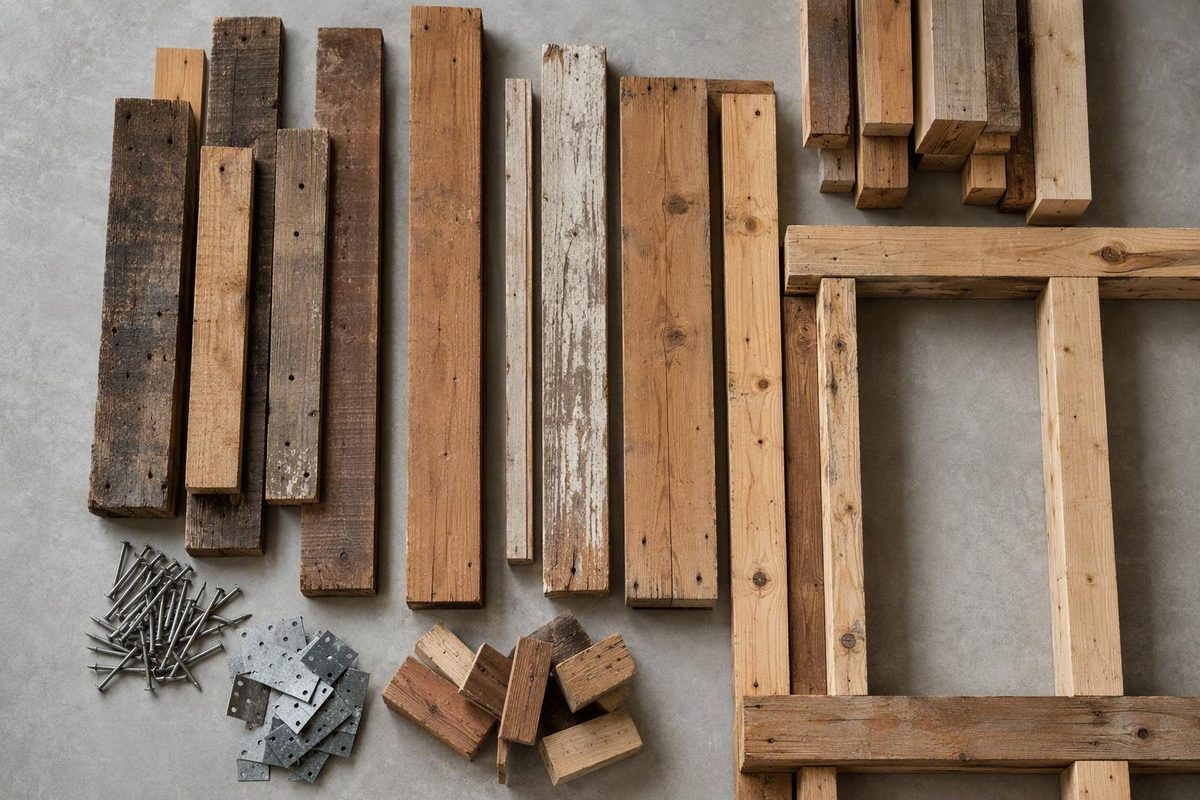
Yes, reclaimed lumber can potentially be used for structural framing, but appearance alone is not enough. Its structural capacity must be documented through the grading or inspection route accepted for the project, and the local authority having jurisdiction should confirm that route before the lumber is purchased, processed, or installed.
Related: 3 Nail Sizes for 2x4 Framing and What Changes the Choice.
The short answer: reclaimed lumber is conditionally usable for framing
Reclaimed lumber is not automatically disqualified because it came from another building. It is also not automatically suitable because it looks straight, dense, dry, or undamaged. Structural acceptance depends on the particular lumber, its documented species and grade, its present condition and dimensions, the intended framing component, and the rules applied to the project.
NAHB reports that the finalized 2027 I-Codes permit salvaged lumber to be reused structurally when it is evaluated by a certified lumber grader. That is a model-code development, not blanket approval for every salvaged board or every current permit. The controlling condition is the professional evaluation—not the lumber’s age or appearance. See NAHB’s report on the finalized 2027 I-Code changes.
The published 2024 IRC wall-framing provisions use a documentation-based approach. Within the scope of Chapter 6, Section R602.1.1 requires sawn lumber to have a grade mark from an accredited lumber grading or inspection agency, while allowing a qualifying certificate of inspection instead of a grade mark. Section R602.2 generally sets No. 3, standard, or stud grade as the minimum for studs, subject to the section’s conditions and exceptions. Review IRC Sections R602.1.1 and R602.2 in the 2024 wall-construction chapter.
A clean-looking old 2x4 is therefore not necessarily a code-recognized stud in its current condition.
| Material status | Practical outcome | Next action |
|---|---|---|
| Capacity is documented and locally accepted | May be used as specified | Install only in the approved component and configuration |
| Undocumented, irregular, or materially altered | Requires the locally accepted evaluation | Obtain grading, inspection, and any required design review |
| Unsound, contaminated, or unable to qualify | Should not be used structurally | Redirect suitable pieces to approved nonstructural uses or reject them |
The usable rule is: reclaimed lumber may be acceptable when the particular stock, documentation, component, and project satisfy the requirements enforced for that permit.
A finalized model code is not automatically your local law
The International Code Council develops and publishes model codes, but finalizing a model-code provision is not the same as making it enforceable for a particular project.
ICC’s development timeline states that Final Action Results for the 2024–2026 Group A and B cycle were posted on July 13, 2026. That date marks completion of a code-development step; it does not by itself demonstrate adoption in any state or municipality. ICC lists the cycle milestones on its code-development page.
NAHB and Green Home Builder report that the resulting 2027 I-Codes allow structural reuse of salvaged lumber after evaluation by a certified lumber grader. Green Home Builder reports publication scheduled for September 2026 for the 2027 IBC and IFC and February 2027 for the 2027 IRC. The report does not establish that any particular jurisdiction has adopted those editions. See Green Home Builder’s report on the provision and publication schedule.
Before relying on the reported 2027 provision, ask the permit authority:
- Which IRC, IBC, or other code edition applies?
- Has that edition been amended locally?
- Does the jurisdiction recognize the proposed grader or inspection agency?
- What documentation must accompany the permit or remain with the lumber?
- Does the proposed component fall within prescriptive framing rules?
- Will calculations, revised details, or engineered design be required?
Publication of a newer model code does not answer those project-specific questions.
Confirm the approval path before buying the lumber
Buying first and seeking approval later can create avoidable grading, processing, storage, and replacement costs. Use this five-step workflow before committing to reclaimed framing stock:
- Identify the locally adopted code edition. Ask which residential or building code applies to the planned permit.
- Check local amendments. Confirm whether state or municipal amendments change the applicable material, design, inspection, or documentation rules.
- Describe the component and material source. State whether the lumber is intended for bearing studs, partitions, joists, rafters, posts, beams, deck framing, or another use. Explain whether it comes from one structure or a mixed salvage lot.
- Ask what evidence will be accepted. Confirm the required grade identification, inspection certificate, grader credentials, plans, calculations, or other records.
- Obtain the required evaluation before installation. Coordinate grading or inspection with any processing and complete any required component-specific design review.
For wall framing within its scope, IRC Section R602.1.1 allows a qualifying certificate of inspection in place of an individual grade mark. It does not provide a universal procedure for every structural member or jurisdiction. Ask who may issue the certificate, how accepted pieces must be identified, and whether evaluation should occur before or after de-nailing, trimming, or milling.
Actual dimensions matter as much as nominal descriptions. If the proposed dimensions, spans, loads, bearing details, or connections fall outside the method accepted by the jurisdiction, ask whether project-specific engineering is required.
Mortar Desk provides general building-material reference information. It cannot approve lumber or replace the building official, a qualified lumber grader, a structural engineer, or a licensed trade working to local code.
Screen each piece before paying for professional grading
Preliminary screening can identify stock that is likely to be impractical or unsuitable. It cannot assign a structural grade or establish code-compliant capacity.
Start with lot-level due diligence:
- Source and prior use: Determine where the lumber came from and whether its service history is documented.
- Species: Establish whether the species is known and whether the lot is consistent or mixed.
- Actual dimensions: Measure thickness, width, and usable length.
- Available quantity: Allow for pieces lost during trimming, processing, grading, or rejection.
- Treatment history: Ask whether preservatives, pesticides, coatings, or other chemical treatments are documented.
- Storage and moisture history: Identify recently wet or unevenly conditioned stock without applying an unsupported universal moisture threshold.
Then inspect individual pieces for:
- bow, crook, cup, twist, or other distortion;
- softness, crumbling fibers, or suspected decay;
- insect holes, galleries, frass, or suspected active infestation;
- splits and checking, particularly near ends and connection areas;
- notches, mortises, drilled holes, bolt holes, and damaged edges;
- missing cross-section caused by trimming or fastener removal;
- visible nails, screws, straps, or other embedded metal; and
- coatings, stains, residue, mold, or other conditions requiring specialist assessment.
Commercial reclaimed-material guidance recommends checking provenance, dimensions, moisture condition, rot, insects, splits, prior chemical treatment, and embedded metal, while reserving questionable boards for nonstructural use or rejecting them. Treat that as preliminary screening guidance rather than structural approval.
Previously nailed, cut, or otherwise altered lumber may need inspection and regrading instead of continued reliance on an old stamp. Reporting involving Forest Products Laboratory researcher Robert Falk also identified inconsistent dimensions, variable quality, limited quantities, and grading expense as barriers to structural reuse. Great Lakes Echo describes the need to re-evaluate altered structural lumber.
Preparation may include de-nailing, cleaning, drying, sorting, metal detection, trimming, milling, and rejection of unsound pieces.
Mold, suspected pests, hidden fasteners, and unknown treatments call for appropriate professional assessment or rejection—not improvised structural approval. Even visually attractive lumber may be unsuitable for structural work or a particular occupied-space application.
Treat studs, beams, joists, and deck framing as different decisions
“Framing lumber” includes components with different loads, exposure conditions, connections, and governing provisions. Acceptance for one use should not be transferred automatically to another.
| Component | Main issue | Approval focus |
|---|---|---|
| Load-bearing wall studs | Axial loads, spacing, grade, and cuts | R602 grade identification or inspection documentation and applicable stud-grade rules |
| Nonbearing partitions | Regulated assembly despite lower demand | Condition, fastening, fire, and partition requirements |
| Beams and posts | Concentrated loads, bearing, and connections | Grading and separate design review where prescriptive rules do not apply |
| Joists and rafters | Bending, spans, holes, notches, and restraint | Species, grade, actual dimensions, span basis, and connections |
| Exterior deck framing | Structural loads plus weather and decay exposure | Exterior-use suitability, design, fasteners, and local acceptance |
| Finish or decorative work | Not relied on for structural capacity | Condition, contamination, attachment, and fire requirements |
For load-supporting wall framing covered by the cited 2024 IRC provisions, use the documentation route in Section R602.1.1 and the applicable stud-grade rules in Section R602.2. Those sections do not establish the complete requirements for beams, posts, joists, rafters, trusses, sheathing, decks, or timber frames. See the 2024 IRC wall-framing provisions for their precise scope.
Conventional framing made from reclaimed dimensional lumber is also different from an engineered reclaimed heavy-timber frame.
For decks, one commercial guide recommends new pressure-treated lumber for structural joists and framing while using reclaimed wood only in suitable applications. That is cautious, application-specific guidance—not a universal code rule.
Nonbearing partitions, trim, paneling, and decorative work can be practical fallback uses for sound pieces that do not qualify structurally.
Compare installed cost and environmental impact separately
A low purchase or salvage price does not necessarily produce a low installed cost. Compare the complete preparation and approval process with the cost of uniform, newly graded stock.
| Cost category | What to include |
|---|---|
| Material | Purchase price, salvage fee, or deconstruction cost |
| Transport | Loading, hauling, unloading, and extra trips |
| Preparation | Sorting, de-nailing, metal detection, cleaning, drying, trimming, and milling |
| Grading | Grader or inspection-agency fees and documentation |
| Design review | Engineering, revised details, or connection design |
| Storage | Covered space, stacking, handling, and protection |
| Installation labor | Additional selection, measuring, fitting, and drilling |
| Unusable-material allowance | Pieces lost to defects, processing, contamination, or inadequate dimensions |
A 2017 Michigan-centered report found that inspection and regrading expense could make larger stockpiles more economical than small quantities, while inconsistent dimensions, quality, and supply created practical barriers. That evidence supports careful budgeting, not a universal conclusion that reclaimed lumber is always more or less expensive than new stock.
Environmental performance is a separate calculation. In a 2010 Forest Products Laboratory proceedings study, virgin framing lumber used about 11 times as much cumulative energy and had about three times the global-warming potential of reclaimed framing lumber within the system studied. The analysis followed surveyed reclamation processes through storage, so those figures should not be treated as universal for every supplier, processing method, or transport route. Read the U.S. Forest Service summary of the life-cycle study.
That environmental comparison does not establish code compliance, identify contaminants, or prove the structural fitness of an individual board. The environmental case and the structural case require different evidence.
Use this reuse hierarchy:
- Use documented and locally accepted members structurally, only in the approved location and configuration.
- Redirect sound but structurally unapproved pieces to suitable nonstructural, finish, or decorative applications.
- Reject unsound or potentially contaminated material.
Do not buy reclaimed lumber for structural framing until the local authority confirms an acceptable approval path. Screen the stock for obvious risks, obtain the required grading or inspection, secure component-specific design review where necessary, and install only the pieces accepted for that use.