 MortarDesk
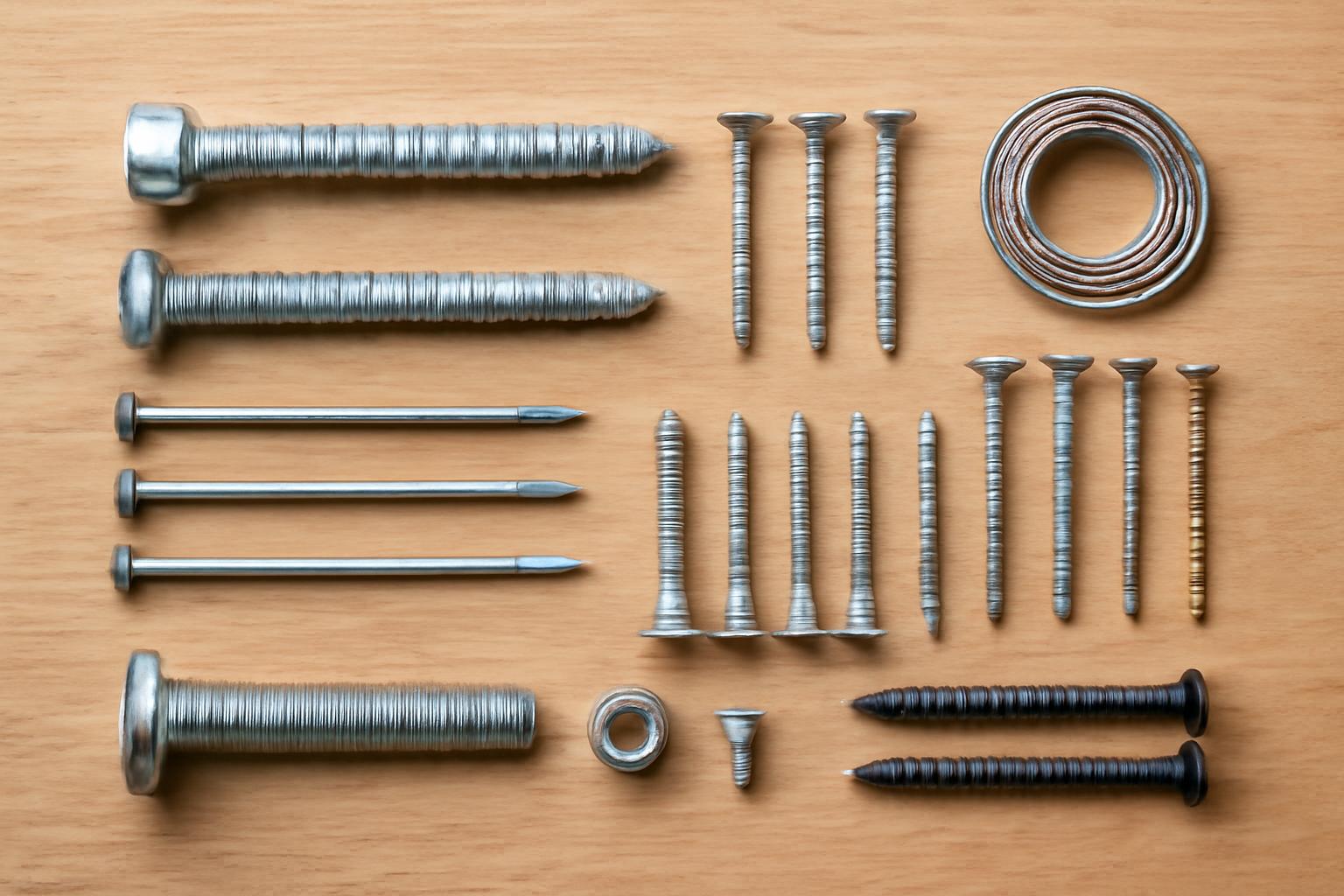
If you are buying fasteners for pressure-treated lumber, the first question is not screw length or head style. It is chemistry. Modern treated wood is often far harder on metal than ordinary interior framing lumber, so a fastener that behaves perfectly well in a dry partition wall can be the wrong choice in a deck, fence, pergola, raised bed, playset, stair, or ground-contact assembly.
The real decision is not whether corrosion matters. It is how much corrosion resistance your specific exposure demands, how that choice affects connectors and bolts elsewhere in the assembly, and whether the package in your hand actually says anything meaningful about treated-wood compatibility.
That last point is where many buying mistakes happen. Boxes are full of vague words like “galvanized,” “exterior,” “weather resistant,” and “deck screw,” but pressure-treated wood does not care about marketing language. It cares about preservative chemistry, moisture, coating thickness, and whether the metals in the whole connection system belong together.
Why Pressure-Treated Lumber Needs Special Fasteners
Pressure-treated lumber is not one uniform material. Since the residential treatment transition in 2004, common preservatives such as copper azole and alkaline copper quaternary have been used in place of older arsenic-based residential systems, and those copper-based treatments are more corrosive to many metals than ordinary untreated interior lumber. That is why reputable guidance keeps returning to the same warning: use corrosion-resistant fasteners when treated wood is exposed outdoors (Marsh Fasteners on the post-2004 treatment change and copper-based corrosivity).
The chemistry alone is not the whole story. Corrosion becomes a real field problem when moisture is present, and treated wood is usually chosen for exactly the kinds of conditions where moisture shows up repeatedly: weather exposure, splash zones, damp soil, shaded exterior framing, pool areas, and locations where boards stay wet after rain. In other words, the wood preservative and the service environment work together. The preservative raises the corrosion risk; the moisture helps the reaction keep going.
That is why ordinary fasteners are such a poor gamble in pressure-treated lumber. Plain carbon steel has no sacrificial protection at all. Very thin zinc coatings can look reassuring on the shelf and still disappear much faster than buyers expect in service. Even when failure is not immediate, the hardware can begin losing the corrosion margin that the structure needs long before the wood itself is ready to be replaced.
For a non-structural garden box, that may mean ugly rust streaks, seized heads, and stripped replacements. In a structural assembly, it is more serious. Joist connections, post bases, bolts, hangers, and deck-board fasteners all rely on the metal retaining enough section and enough grip to keep the connection performing over time. That is why corrosion resistance in treated wood is not just a cosmetic upgrade. It is part of the durability of the connection itself.
A good mental model is simple: pressure treatment helps the wood survive wet service, but that same wet service can punish the wrong metal. If the wood is being specified for a harsh environment, the hardware has to be specified for that environment too.
Code-Approved Fastener Options for Treated Wood
For code-facing work, the safest starting point is not a screw brand but the recognized material classes. A Southern Pine Council guidance summary published by Extreme How-To states that the 2006 IRC requires fasteners for pressure-preservative- and fire-retardant-treated wood to be hot-dipped zinc-coated galvanized steel, stainless steel, silicon bronze, or copper, with zinc coating weights in accordance with ASTM A153; it also notes limited exceptions, including mechanically deposited zinc coatings meeting ASTM B695 Class 55 for certain fasteners other than nails and timber rivets (Extreme How-To summary of Southern Pine Council guidance and 2006 IRC language).
For most residential buyers, that long list quickly narrows to two realistic choices: hot-dipped galvanized and stainless steel. Silicon bronze and copper are legitimate corrosion-resistant materials, but they are specialty picks in this context.
The limited mechanically deposited zinc exception matters because it prevents overstatement. It means you should not say that every acceptable zinc-coated fastener must be hot-dipped galvanized. But it does not mean that every zinc-coated screw on a retail shelf is equivalent. The exception is narrow, technical, and product-specific. For most buyers, the practical zinc-coated baseline is still verified hot-dipped galvanized hardware, not an unspecified plated finish.
In-store, that translates into a short label checklist:
- Look for “hot-dipped galvanized” on the packaging, not just “galvanized.”
- On nails, screws, bolts, nuts, and washers, look for the fastener standard the manufacturer claims to meet, especially ASTM A153 when that information is provided.
- On hangers, straps, and similar connectors, expect connector-specific finish language rather than screw language; the coating system for connectors is often heavier than for loose fasteners.
- Treat labels such as “exterior” or “deck screw” as incomplete unless the packaging or technical sheet also says the product is suitable for the relevant treated-wood preservative and exposure.
Local enforcement still controls the jobsite. Your inspector may be working from a different code edition than the one quoted in a trade article, and connector manufacturers often impose listing requirements that go beyond the wording on a generic screw box. So use published model-code summaries as a baseline, not as permission to stop checking.
Hot-Dipped Galvanized Fasteners: The Baseline Choice
Hot-dipped galvanized hardware is the baseline corrosion-resistant choice because coating thickness matters. Treated-wood hardware guidance specifically recommends hot-dipped galvanized fasteners for exterior treated wood, conforming to ASTM A153, and warns buyers away from electro-galvanized products and lighter coatings identified as G-90 or G-60 for ACQ- or CA-treated wood; it also points out that connectors are a separate category and often call for ASTM A653 G185 coatings (Treated Wood hardware guidance on ASTM A153 fasteners, G185 connectors, and avoids for ACQ/CA).
That is the important distinction: “galvanized” is not a single performance level. Electroplated or electro-galvanized coatings are thin. Hot-dipped galvanizing adds substantially more sacrificial zinc. And lighter sheet-metal coating designations that once circulated around older residential CCA discussions are not the same as buying hardware explicitly intended for modern copper-based preservatives.
For many inland, above-ground exterior projects, hot-dipped galvanized remains a sensible answer. If the project is outdoors but not constantly wet, not coastal, not salt-exposed, and not especially difficult to repair later, HDG is often the value choice.
What you should not do is treat it as a universal best choice. Hot-dipped galvanized is the minimum dependable answer for many copper-based treated-wood applications, not the automatic top-tier answer for every exposure. Once you move into constant wetting, splash zones, permanent foundations, aggressive retention levels, or salt-heavy air, stainless steel becomes easier to justify.
A useful field check is surface appearance over time. Technical corrosion guidance notes that zinc-coated hardware can show white corrosion products as part of the sacrificial behavior of the coating, while red rust is the more serious indicator that the protective system has been exhausted and the steel underneath is now being attacked (WoodWorks Insider technical note on white, black, and red rust indicators in wood fastener service).
So yes, hot-dipped galvanized screws, nails, bolts, and anchors can be enough for many pressure-treated lumber projects. But they are enough because the exposure allows them to be enough. If the exposure gets harsher, the recommendation changes with it.
Stainless Steel Fasteners: Maximum Corrosion Resistance
Compatibility guides for outdoor fasteners commonly position 304/305 stainless for general outdoor, humid, or wet climates and 316 stainless for coastal, marine, or saltwater exposure; the same guidance also treats stainless as broadly compatible with treated lumber and preferred over galvanized in cedar and redwood when staining is a concern (Fastener Depot compatibility guide for 304/305, 316, treated lumber, and cedar/redwood use).
That makes stainless the natural fit when any of the following are true:
- the project stays wet for long periods,
- the lumber is ground-contact or otherwise high-exposure,
- the location is coastal or salt-spray prone,
Think of stainless as buying corrosion margin instead of consuming it. With galvanized hardware, the zinc coating is supposed to sacrifice itself to protect the steel below. With stainless, you are starting with a base metal chosen because it resists corrosion in the first place. That does not mean stainless is magically immune to every environment or that grade no longer matters. It means you are relying less on a coating system being preserved perfectly through installation and years of service.
For everyday residential work, the usual shelf decision is 304 or 305 for inland and general wet service, then 316 when chloride exposure enters the picture. The additional cost is easy to dismiss in the aisle and much harder to dismiss after replacement work begins.
There is also a practical finishing reason to use stainless in some projects even when the wood is not treated lumber. Cedar and redwood can react badly with some metal finishes, leaving dark discoloration or staining around the heads. If your project combines treated framing with cedar or redwood trim or decking, stainless can solve more than one compatibility problem at once.
The budget tradeoff is real, of course. Outfitting an entire deck with stainless fasteners and stainless-compatible hardware costs more upfront than building the same assembly in hot-dipped galvanized steel. But the cost comparison only makes sense after you decide whether the assembly is easy to inspect, easy to repair, and mild enough in exposure to justify the lower starting point.
Coated Screws and Alternatives for Treated Lumber
Coated screws can absolutely have a place in pressure-treated wood projects, but only when the coating system is clearly rated for the preservative and the exposure. This is where buyers need to stop thinking in categories like “coated screw” and start thinking in systems with stated limits.
SPAX is one example of the right kind of specificity. Its treated-lumber guidance distinguishes among coating systems, describing HCR for ground-contact treated lumber and exterior freshwater use, HCR-X for treated lumber and freshwater environments, and 304 stainless for code-compliant use in pressure-treated and fire-retardant-treated lumber, including coastal projects (SPAX treated-lumber guidance for HCR, HCR-X, and stainless options).
That kind of language is what you want to see: not a generic promise that the screw is “exterior grade,” but a statement tying the product to treated wood, to a type of exposure, and ideally to an industry framework or approval path. A legitimate coated fastener usually comes with at least one of these signs:
- the packaging names treated-lumber compatibility directly,
- the technical sheet names preservative types or exposure limits,
- the manufacturer references AWPA-oriented compatibility language, an ICC-ES report, or other formal documentation,
- the coated option is placed in a larger system that also includes stainless when the environment becomes harsher.
The wrong way to buy coated screws is to assume all coatings are interchangeable. A dual-barrier or ceramic/polymer system specifically marketed and documented for treated lumber is not the same thing as a bargain-box exterior screw whose only claim is that it resists weather. Those are different products aimed at different corrosion problems.
Even when a coated screw is approved for treated wood, it is still a coated steel fastener. That does not make it bad. It just means you should not confuse it with stainless steel in severe conditions. A manufacturer-rated coated screw may be perfectly reasonable for inland deck boards or deck framing. That same product may be the wrong answer for a salt-exposed boardwalk, a dock, or a permanently wet assembly where inspection and replacement will be difficult.
A good buying rule is this: if you cannot identify the treated-wood compatibility, the service environment, and the supporting documentation, treat the screw as unverified rather than hoping the box color implies a standard.
Matching Fasteners, Connectors, and Avoiding Galvanic Corrosion
Fasteners for pressure-treated lumber do not live alone. A real assembly also includes joist hangers, post bases, straps, hold-downs, bolts, nuts, washers, anchors, flashing, and sometimes aluminum trim or railing parts. If you choose only the deck-board screws carefully and then cheap out on everything buried behind them, you have not really chosen a corrosion system. You have chosen one component.
Treated-wood installation guidance is explicit here: use stainless-steel fasteners with stainless-steel connectors, use galvanized fasteners with galvanized connectors, and pay attention to the different standards involved, including ASTM A153 for fasteners and ASTM A653/G185 for connectors. The same guidance also warns that aluminum contact rules vary by treatment type: some formulations are approved for direct contact with aluminum, while others are not (Treated Wood guidance on matching metals, G185 connectors, and treatment-specific aluminum compatibility).
The reason is galvanic corrosion. When dissimilar metals are in electrical contact in the presence of moisture, one can corrode faster than it would on its own. In practice, that means a premium fastener can still be the wrong fastener if it is installed into the wrong hanger, washer stack, or plate material. Mixing metals sometimes becomes unavoidable in specialty work, but then you need an engineered or manufacturer-documented path, not guesswork.
This is also where many DIY buying errors come from. People often understand that deck screws in treated wood need corrosion resistance, but they do not automatically extend that logic to joist hangers, post caps, bolts, structural straps, or masonry anchors.
Aluminum deserves its own warning. “Pressure-treated wood” is too broad a label to answer the aluminum question by itself. Some modern formulations and branded systems are approved for direct aluminum contact, while others specifically are not. If the treatment manufacturer or connector maker does not clearly allow the combination, the safe move is to isolate the metals or change the material pairing rather than assume all treated lumber behaves the same way.
A simple habit prevents a lot of future trouble: once you choose a metal system for the project, keep following it. If you started stainless, keep checking boxes until the hangers, bolts, washers, and anchors all make sense with stainless. If you started hot-dipped galvanized, make sure the supporting hardware is actually galvanized to the required level and not merely zinc-plated.
Selecting by Exposure Conditions and Treatment Type
The best fastener for pressure-treated lumber depends on two labels: the wood tag and the exposure. Simpson Strong-Tie’s corrosion-selection guidance organizes treated-wood decisions around AWPA Use Categories and ICC-ES AC257 exposure conditions, separating service into dry, wet, elevated, uncertain, and ocean-type environments rather than pretending every exterior project has the same corrosion risk (Simpson Strong-Tie corrosion guidance using AWPA/AC257 exposure categories).
You do not need to memorize every AWPA code to use that logic well. You just need to make a few disciplined distinctions before you buy.
First, identify the treatment
Read the stamp or tag on the lumber. “Pressure treated” only tells you that a preservative was forced into the wood. It does not tell you whether the preservative is copper-based, borate-based, high-retention, or meant for ground contact. Those details control the corrosion risk.
- Copper-based preservatives such as ACQ, CA, and MCA are the ones that drive the usual hot-dipped-galvanized-or-stainless conversation.
- Borate-treated wood used above ground and kept dry is a different case; it does not create the same corrosion problem as exterior copper-based PT.
- Ground-contact tags are a red flag that the exposure and preservative retention may be more demanding than ordinary above-ground lumber.
Second, classify the exposure honestly
Many hardware failures start with optimistic exposure assumptions. A project is not “mostly dry” just because it is not sitting in a pond. Ask instead:
- Is it outdoors year-round?
- Will water collect around the hardware?
- Is it poolside, lakeside, or coastal?
- Is it in shade, heavy humidity, or irrigation spray?
- Will the hardware be difficult to inspect or replace later?
If the answer to several of those is yes, choose like a pessimist. Corrosion design rewards pessimism.
Third, match the hardware category, not just the screw box
Different parts of the project may deserve different levels of scrutiny:
| Hardware category | What to look for | Typical conservative choice |
|---|---|---|
| Deck-board screws | PT-lumber compatibility named on box or tech sheet | Stainless for harsh/wet/coastal; manufacturer-rated coated screw or HDG where exposure is milder |
| Framing nails/screws | Verified corrosion resistance, not generic “galvanized” | Hot-dipped galvanized minimum for many exterior PT jobs; stainless when exposure escalates |
| Bolts, nuts, washers | Same metal family as the rest of the structural hardware | Match stainless-to-stainless or galvanized-to-galvanized |
| Joist hangers, straps, bases | Connector-specific finish language; heavier coating may be required | G185-type galvanized connector systems or stainless where exposure demands it |
| Flashing/aluminum interfaces | Treatment-specific compatibility | Use approved combinations only, or isolate the materials |
Fourth, let exposure drive the upgrade
A practical decision path looks like this:
- Dry interior borate-treated wood: standard code-compliant hardware may be acceptable.
- Typical inland exterior above-ground copper-based PT: hot-dipped galvanized is often the floor; stainless is the upgrade.
- Ground contact, high-retention, hard-to-repair assemblies: stainless becomes the stronger long-term choice.
This is why a single online answer to “what fasteners should I use in treated wood?” is incomplete. A raised bed, an inland deck, a dock stair, and a coastal boardwalk can all contain pressure-treated lumber, but they are not the same corrosion problem.
Installation Practices to Maximize Fastener Performance
Even the right material can be installed badly. Canadian Wood Council guidance notes that hot-dipped galvanized fasteners are a minimum for copper-based treated wood exposed to weather, that stainless is preferred for maximum service life in harsher conditions, and that installation method matters enough that hot-dipped galvanized nails should not be driven with high-pressure nail guns because the coating can be damaged (Canadian Wood Council guidance on treated-wood fasteners, stainless upgrades, and avoiding HDG coating damage during installation).
That is the practical installation lesson: corrosion protection is not only about what you buy, but also about what you do to it on the way into the wood. Overdriving can damage coatings, bury heads where water sits, and crush fibers around the fastener. Aggressive installation methods can scar finishes that were supposed to protect the steel for years.
Wet pressure-treated lumber adds another wrinkle. Fresh PT stock often arrives wetter than the service condition it will eventually see. If boards are saturated when installed, later shrinkage can open gaps, change board spacing, and alter the stress around the fastener shank. When practical, especially with decking, letting very wet material stabilize before final fastening makes layout and long-term appearance easier to control.
Predrilling can also help in the right places, particularly near board ends or in brittle trim combinations, because splitting at the end of a board creates a path for movement and moisture that the fastener then has to live with. The right answer depends on the product, so this is one place where the screw manufacturer’s instructions are worth following rather than assuming all wood screws behave the same.
Nails still belong in framing and in connector installations where listed nails are specifically required, but deck surfaces are one of the clearest cases where screws usually make the better homeowner-grade maintenance decision.
The broader rule is simple: keep the coating or alloy intact, drive the fastener cleanly, and do not ignore the installation notes just because the box says the screw is rated for exterior use. Corrosion-resistant hardware gives you a bigger margin, not a license to abuse it.
Is hot-dipped galvanized or stainless steel required for all pressure-treated lumber?
Not for all treated wood in every condition. For copper-based pressure-treated wood exposed outdoors, corrosion-resistant hardware is the standard answer, and hot-dipped galvanized is the usual minimum while stainless is the upgrade. But borate-treated wood used above ground and kept dry is a different case; for borate-treated wood inside buildings, the same connectors and fasteners used for untreated wood can be acceptable (Canadian Wood Council guidance distinguishing copper-based treated wood from borate-treated wood in dry interior service).
304 or 316 stainless steel for inland decks versus coastal areas?
For most inland decks and general wet-service outdoor work, 304 stainless is the common residential choice. For coastal sites, salt spray, or direct salt exposure, 316 is the safer upgrade. (Eagle Claw summary of stainless grades commonly cited for pressure-treated lumber).
Can I mix galvanized screws with stainless steel joist hangers?
As a default, no. SFS’s treated-lumber guidance warns against mixing hot-dipped galvanized and stainless steel in moist conditions because galvanic corrosion can accelerate when dissimilar metals are paired and moisture is present as the electrolyte (SFS guidance on avoiding mixed galvanized/stainless assemblies in pressure-treated wood).
Are coated deck screws okay for ACQ-treated lumber?
They can be, but only when the manufacturer explicitly rates them for treated lumber and for the expected exposure. Fastener compatibility guidance for pressure-treated lumber lists ceramic-coated and polymer-coated screws among acceptable options for ACQ, MCA, and CA-C treated wood, while still distinguishing those coated steel products from stainless steel and cautioning that harsher environments can demand more corrosion resistance (Fastener Depot guide to coated-screw compatibility with ACQ/MCA/CA-C lumber).
What about borate-treated versus copper-based PT wood?
This is one of the biggest distinctions buyers miss. The copper-based systems are the ones that push you toward hot-dipped galvanized or stainless hardware for exterior use. The Southern Pine Council guidance summarized by Extreme How-To specifically distinguishes borate-treated material used above ground and kept dry from copper-based preservatives, noting that borate-treated products do not demand the same special fastener approach when they remain in dry interior service (Extreme How-To summary distinguishing borate-treated wood from copper-based treated wood).
For most buyers, the selection process is straightforward:
- Read the lumber tag and identify the preservative.
- Classify the exposure honestly: dry interior, wet exterior, ground contact, or salt/coastal.
- Choose one metal system and carry it through the screws, nails, bolts, washers, and connectors.
- Verify the packaging language instead of trusting vague labels like “exterior” or “galvanized.”
For copper-based exterior PT, that usually means verified hot-dipped galvanized hardware meeting the relevant standard or stainless steel suited to the environment. For structural work, remember that Mortar Desk is general reference only, not engineering advice; specifications and codes are local and should be checked against the edition your inspector uses.