 MortarDesk
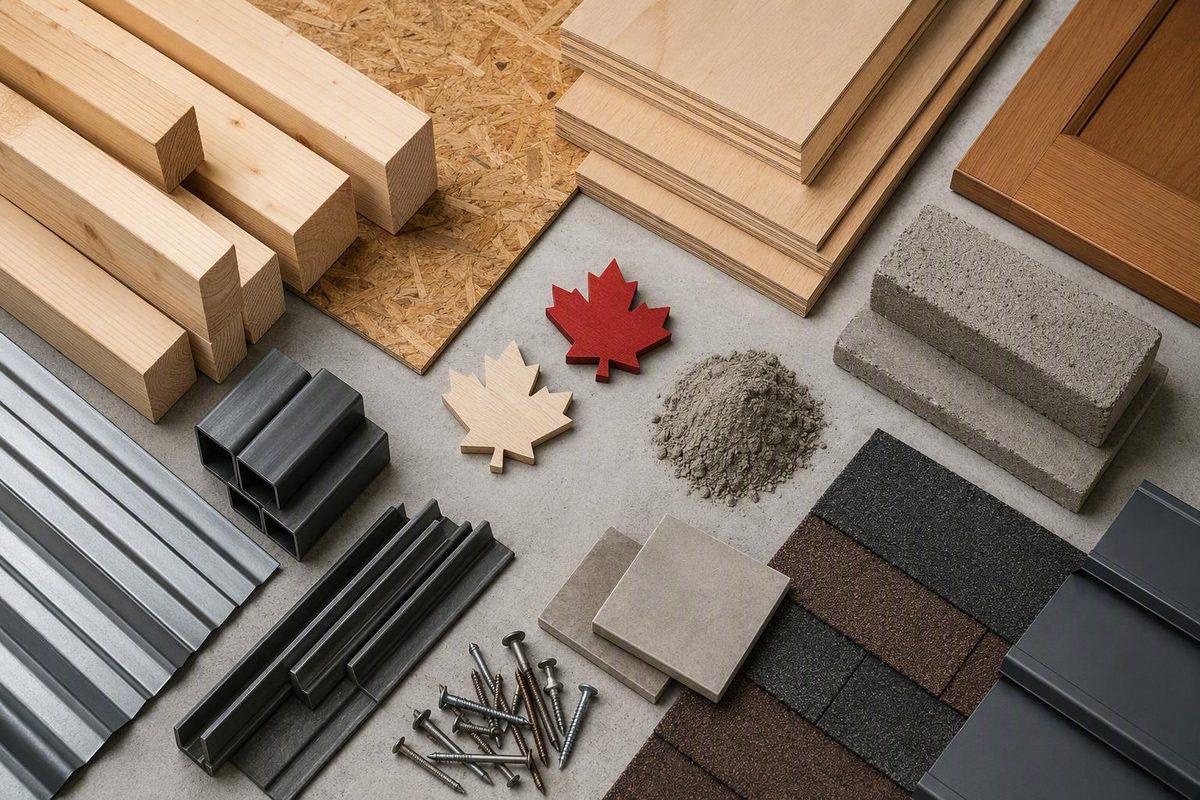
No—the 50% Canada tariff does not generally include Canadian softwood framing lumber already covered by Section 232. A Canadian 2x4 may instead carry the separate 10% Section 232 timber-and-lumber duty plus any applicable antidumping and countervailing duties. Plywood, OSB, MDF, wood doors and Portland cement are among the building materials listed for the additional 50% Section 338 duty.
The distinction depends on customs classification, not the department or aisle where a product is sold. The Section 338 annex includes specified lines for plywood under 4412.x, panels under 4410.19, MDF under 4411, wood doors under 4418.21 and 4418.29, and Portland cement under 2523.29. Section 232 timber and lumber, including designated 9903.76 wood lines, are carved out of that additional duty.
Choose a material and enter its pre-tariff value to see the indicated tariff stack and a simple uplift estimate.
Select a product, then change the example customs value and any other verified duty rate. The result models percentage arithmetic on the same entered value; it does not predict retail pricing or determine landed cost.
HTSUS starting point: 4412.x
Section 338: 50% listed
Section 232: Not identified for this product here
AD/CVD: Check product-specific orders
Confirm panel construction, origin and the complete 4412 provision.
| Material | HTSUS Starting Point | Section 338 | Section 232 | AD/CVD / Other Check |
|---|---|---|---|---|
| 2x4 SPF framing lumber | 4407 family; exact line — | Generally excluded where Section 232 applies | 10% timber-and-lumber duty | Possible AD/CVD; verify producer, exporter and scope |
| CDX plywood | 4412.x | 50% listed | Not identified here | Check exact construction and complete provision |
| OSB | 4410.19 | 50% listed | Not identified here | Check panel type and exclusions |
| MDF | 4411 | 50% listed | Not identified here | Check density, thickness and complete provision |
| Wood door | 4418.21 / 4418.29 | 50% listed | Not identified here | Check construction and complete provision |
| Type IL Portland cement | 2523.29 | 50% listed | Not identified here | Confirm classification and Canadian origin |
| Rebar | — | No result established by this dataset | — | Check steel classification and sectoral measures separately |
Source: White House Annex II covered-product and exclusion provisions, plus the government tariff guidance cited in the article. “—” means the supplied evidence does not establish a value.
Framing Lumber Is Outside the Additional 50% Duty
The additional 50% duty is a Section 338 measure covering specified Canadian goods. It is not a blanket tariff on every Canadian import or every product sold as lumber. Official guidance says the measure does not apply to products already subject to Section 232 tariffs, including timber and lumber (White House fact sheet).
For ordinary Canadian softwood framing lumber, the practical result is:
- The additional 50% Section 338 duty generally does not apply where the product falls within the Section 232 timber-and-lumber treatment.
- A separate 10% Section 232 duty may apply.
- Antidumping or countervailing duties may also apply, depending on the merchandise, producer, exporter, order scope and entry date.
- Ordinary duties, fees and other applicable Chapter 99 measures are separate questions.
Government of Canada guidance identifies a 10% U.S. Section 232 tariff on softwood timber and lumber. It also states that CUSMA-compliant softwood timber and lumber are not exempt from that tariff (Canadian Trade Commissioner guidance). CUSMA is the Canadian name for USMCA.
That 10% figure is not a universal landed-duty rate. The total for a particular shipment cannot be determined without its full HTSUS classification, origin, entry date and any applicable trade-remedy instructions.
The carve-out is reflected in the annex provisions for designated wood products entered under headings 9903.76.01 through 9903.76.03 and 9903.76.20 through 9903.76.24. The annex also preserves ordinary duties and applicable antidumping, countervailing and other charges (White House Annex II provisions).
Plywood, Panels, Doors And Cement Are Listed Separately
Plywood is not treated as dimensional softwood lumber merely because both are wood building materials. The covered schedule includes provisions beginning with 4408, 4409, 4410, 4411, 4412, 4414, 4418, 4420 and 4421, as well as the specific provision 4407.99.02 (White House Annex II covered-product list).
For the common building-material examples in the supplied annex data, the starting analysis is:
| Material | HTSUS Starting Point | Section 338 Treatment | Other Treatment To Check |
|---|---|---|---|
| 2x4 SPF framing lumber | 4407 family; exact line required | Generally excluded where Section 232 applies | 10% Section 232 plus possible AD/CVD |
| CDX plywood | 4412.x | Additional 50% duty listed | Ordinary duties and any product-specific measures |
| OSB | 4410.19 | Additional 50% duty listed | Exact panel classification and exclusions |
| MDF | 4411 | Additional 50% duty listed | Exact density, thickness and complete provision |
| Wood door | 4418.21 or 4418.29 | Additional 50% duty listed | Door construction and complete provision |
| Type IL Portland cement | 2523.29 | Additional 50% duty listed | Complete classification and origin |
| Rebar | — in the supplied annex data | No Section 338 result established here | Steel measures and exact classification must be checked separately |
These are classification starting points, not substitutes for an entry determination. A code expressed as a heading or partial provision does not classify every product sold under the corresponding retail name.
The listing of 4407.99.02 illustrates the problem. It places that provision in the covered schedule, but it does not place the whole of heading 4407 under the additional tariff. A species, processing step or product characteristic that changes the complete provision can change the result.
The same caution applies within the panel categories. OSB, particleboard, fiberboard, plywood and veneered panels are not one customs category. Their construction, materials, thickness and processing determine the applicable line.
A Store’s Lumber Department Can Contain Both Tariff Results
A building supplier may group dimensional lumber, plywood, OSB, MDF, siding, mouldings and doors under “lumber and building materials.” Customs law does not use that merchandising category.
This explains why a broad statement that the tariff includes “lumber and plywood” can be misleading. Plywood and several other Chapter 44 products are listed. Section 232-covered softwood framing lumber is generally carved out. Both products may sit in the same yard while carrying different tariff stacks.
Retail price changes do not establish which duty was assessed on each item. A merchant may adjust prices because of expected replacement cost, freight, exchange rates, inventory mix or uncertainty. Material already in stock can also be repriced before a newly tariffed shipment arrives.
The reverse is also possible: a tariff assessed at import does not establish a fixed retail-price increase. The importer, distributor and retailer may absorb or pass through different amounts. No general pass-through percentage is established in the supplied evidence.
The lookup calculator therefore performs simple rate arithmetic on the value entered by the user. It is not a prediction of a store price or a complete landed-cost calculation.
The Product’s Complete HTSUS Line Controls
A shipment described only as “Canadian lumber” cannot be assigned a reliable tariff treatment. The importer needs the complete HTSUS provision and the product facts supporting it.
For wood products, relevant facts can include:
- Species and whether the wood is softwood or hardwood
- Sawn, veneered, assembled or finished condition
- Dimensions and thickness
- Surface, edge and end processing
- Panel layers, binders and constituent materials
- Whether the shipment contains components or complete articles
Start with the ordinary HTSUS classification. Compare that complete provision—not merely Chapter 44 or a four-digit heading—with the covered Section 338 list.
If the line appears in the list, test the exclusions. A product apparently covered under its ordinary provision may still be outside the additional duty because it is already subject to Section 232 or enters under one of the designated 9903.76 wood headings.
Origin must then be confirmed. The measure concerns products of Canada, not every shipment dispatched from a Canadian address. The seller’s location or shipping point does not by itself establish customs origin.
Finally, identify the remaining tariff layers. Depending on the entry, those can include the ordinary duty, Section 232, antidumping duties, countervailing duties, another Chapter 99 measure, fees or taxes. Exclusion from Section 338 does not remove those separate charges.
The Effective Date Depends On The Operative Entry Rules
The initial annex specified an effective time of 12:01 a.m. Eastern on August 19, 2026 for covered goods entered for consumption or withdrawn from warehouse for consumption. The measure was then subject to a three-day temporary suspension, with implementation reported during the week of August 22 (Federal Register suspension notice).
An entry near that transition cannot be resolved from a news date alone. The importer must check the consolidated HTSUS revision, applicable U.S. note, Chapter 99 heading and implementation instructions in force when the goods were entered or withdrawn.
The supplied materials refer to both 9903.03.12 and 9903.03.14 in connection with the additional treatment and do not conclusively reconcile those references. The current HTSUS text should control selection of the Chapter 99 heading.
The first Section 338 proclamation was issued July 23, 2026 (Federal Register proclamation). Because implementation documents can delay, amend or supersede an original annex, the initial proclamation should not be used by itself to calculate a later commercial entry.
Buyers Should Separate Framing Lumber From Sheet Goods
Do not add 50% to every quotation containing Canadian wood. Ask the seller, importer or broker for two pieces of information:
- The complete HTSUS classification used for the product.
- The tariff programs and charges included in the quoted price.
A useful quotation should distinguish the ordinary classification from any Chapter 99 heading and identify whether its tariff component reflects Section 232, Section 338, antidumping or countervailing duties, or another measure.
Keep dimensional softwood lumber separate from plywood, OSB, MDF, veneer, mouldings and wood doors when comparing quotes. For the products specified in the annex, the material name and tariff treatment do not follow the same broad retail category.
For project budgeting, a Canadian 2x4 should not automatically receive a 50% allowance. Its tariff stack starts with the separate Section 232 treatment and possible AD/CVD. A qualifying Canadian plywood sheet, listed panel, MDF product, wood door or Type IL Portland cement entry starts with the 50% Section 338 question, subject to its exact classification and any controlling exclusion.
Does USMCA Exempt Canadian Softwood Lumber?
No. The supplied government guidance says CUSMA-compliant softwood timber and lumber are not exempt from the separate 10% Section 232 measure. USMCA qualification is not a universal exemption from U.S. sectoral tariffs.
Can Section 232 And AD/CVD Apply Together?
They may. Applicable antidumping and countervailing duties can remain in addition to the Section 232 lumber duty. The actual combination depends on order scope, producer, exporter, merchandise, entry date and current agency instructions.
Is Every Plywood Sheet Subject To The 50% Duty?
The annex lists plywood provisions under 4412.x, but “plywood” alone is not a complete classification. Construction, materials, thickness, origin and the full HTSUS line must match a covered provision, and any applicable exclusion must still be tested.
Is Rebar Covered By This Canada Tariff?
The supplied building-material lines do not establish a Section 338 result for rebar. Rebar requires its own complete steel classification and analysis of any applicable sectoral measures. The wood-product carve-out does not answer that question.