 MortarDesk
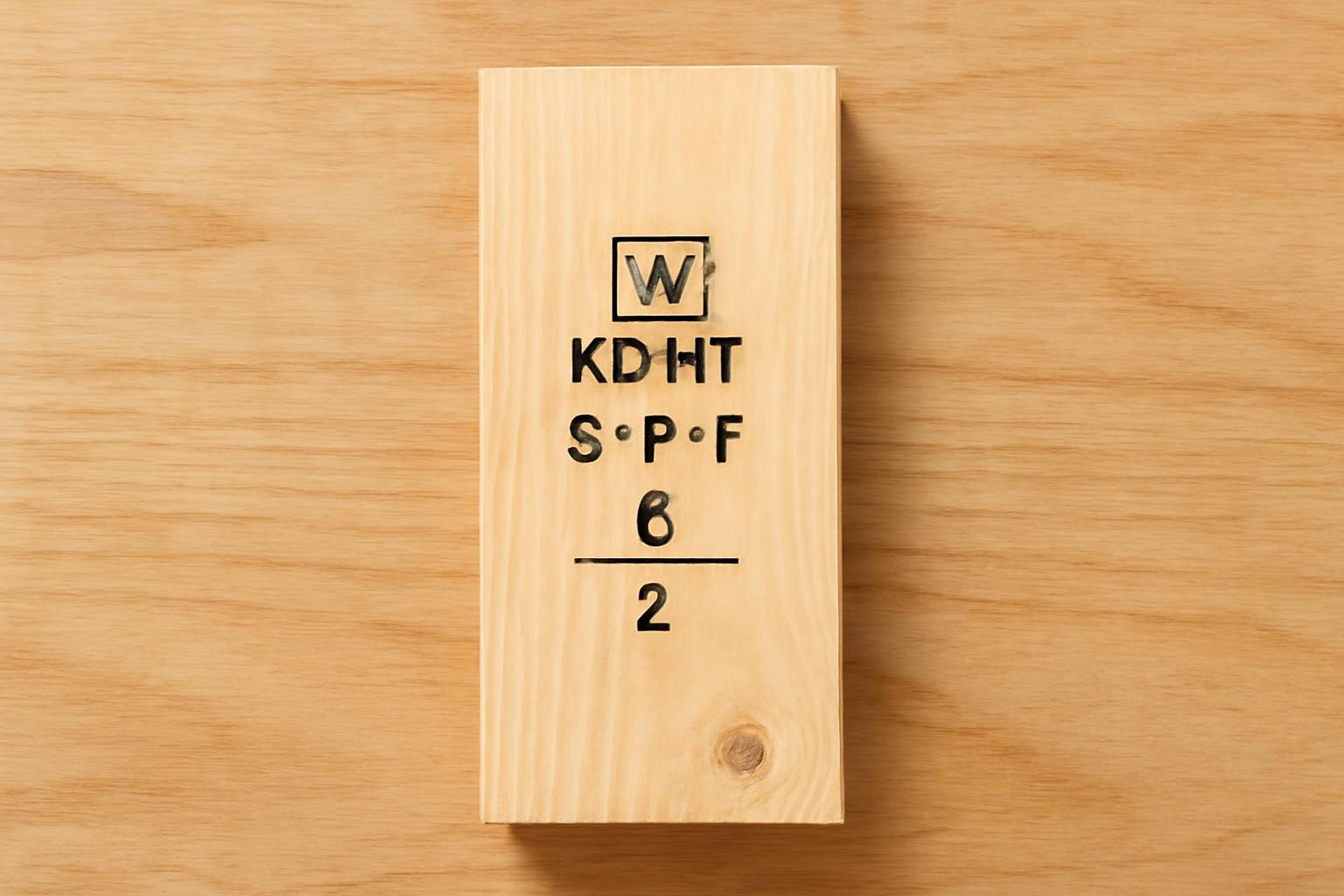
If you’ve ever stood in the lumber aisle staring at a blurry black stamp near the end of a 2x4, you were already looking at the fastest technical check most buyers skip.
That stamp is not random mill ink. On ordinary North American softwood framing lumber, it is the compact code that tells you who supervised the grading, which mill produced the piece, what species or species group it belongs to, what grade it met, and how dry it was when it was surfaced.
Learning how to read a lumber grade stamp matters because two boards that look similar can behave very differently. One may be straighter, drier, and better suited to an interior remodel. Another may be structurally acceptable but more likely to shrink or twist. For framing, that difference is not just cosmetic. It can affect whether the wood matches the job, the span tables, and the expectations of the code or inspector.
The good news is that most stamps follow the same logic. Once you understand that logic, you can read unfamiliar marks without memorizing every abbreviation in the lumber yard.
What Is a Lumber Grade Stamp and Why Does It Matter?
A lumber grade stamp is the official identification mark used on most North American softwood framing lumber. It indicates that the board was inspected visually, mechanically, or under a supervised grading system and assigned a grade based on defects that affect structural performance, such as knots, splits, wane, and slope of grain. Builders, inspectors, and designers rely on those grades because framing lumber used under commonly adopted U.S. and Canadian codes is typically expected to be graded and stamped rather than chosen by appearance alone (InterNACHI).
For U.S. softwood lumber used in structural building components, the stamp connects the board to grading rules approved by the American Lumber Standard Committee’s Board of Review and certified for conformance with the American Softwood Lumber Standard PS 20. SBCA also notes that each piece is stamped before it leaves the mill, although later cross-cutting can remove that mark from shorter pieces (SBCA).
That traceability is a big part of why the stamp matters. A stamp tells you more than “this board looks decent.” It identifies the supervising agency and the producing mill, which gives inspectors, suppliers, and buyers a way to trace the piece back to its source if questions arise later. For a DIYer, that means the stamp is the quickest way to separate real structural information from guesswork.
It also helps you avoid one of the most common buying mistakes: confusing an official grade with a sales description. Appearance labels such as “Premium” or “Select” may be useful for sorting cleaner-looking boards, but they do not replace the formal structural stamp with the agency mark and mill designation (Dunn Lumber).
In short, the grade stamp answers five practical questions at once: who checked this board, where it came from, what wood it is, how it graded out, and how dry it was. If you are buying for framing, repair work, or anything span-sensitive, that is the information that matters first.
The Five Core Elements of Every Grade Stamp
Most softwood framing-grade stamps follow the same basic pattern even if the layout changes. WWPA says that, except for categories such as rough lumber or heavy timbers, most grade stamps contain five basic elements: the certification mark, mill identification, grade designation, species identification, and condition of seasoning (WWPA).
Read in plain English, those five parts are:
-
Grading agency trademark This is the mark of the organization supervising grading under approved rules. It is the “who checked it” part.
-
Mill ID Usually a number, name, brand, or letter code. It identifies the producing mill for traceability.
-
Species or species group This tells you what wood family the piece belongs to, such as SPF, DF-L, Hem-Fir, or SYP.
-
Grade designation This is the structural grade itself, such as Select Structural, No. 1, No. 2, No. 3, Stud, or a machine-rated designation.
-
Moisture or seasoning condition This tells you how dry the lumber was when surfaced and graded, using marks such as S-GRN, S-DRY, KD19, MC15, or KD15.
That five-part model is worth memorizing because it gives you a repeatable reading order. Instead of treating the stamp as a cluster of abbreviations, read it like a sentence:
agency → mill → species → grade → moisture
Once that pattern clicks, a stamp becomes much easier to decode in a few seconds at the rack.
A second useful point: the five-element model is a framing-lumber model, not a universal rule for every wood product in every condition. WWPA and SBCA both note exceptions, especially for rough lumber, heavy timbers, or pieces that have been shortened after leaving the mill. So if a board is missing a visible stamp, that is not automatic proof that the wood is defective. It does mean you should not assume its grade from appearance alone.
Decoding Species and Group Abbreviations
Species marks are where many buyers stop too soon. They notice the “No. 2” and assume that tells the whole story. It does not. The species or species-group mark matters because boards of the same size and visual grade can still have different structural properties depending on the wood group.
SBCA’s guidance makes that point directly: a Douglas Fir-Larch joist can have greater structural capacity than an Eastern Hemlock joist of the same size and grade. In other words, the grade number does not erase species differences.
Common abbreviations you will see include:
- DF-L = Douglas Fir-Larch
- SYP = Southern Yellow Pine
- HF or Hem-Fir / H-F = Hemlock-Fir group
- SPF or S-P-F = Spruce-Pine-Fir
For consumer-friendly buying guidance, This Old House summarizes a common rule of thumb for framing stock as Doug Fir / D Fir-L, then SYP, then Hem/Hem-Fir/H-F, then S-P-F, from stronger to weaker at the same size and grade. That is a broad heuristic, not a substitute for actual design tables, but it is a useful way to understand why species marks matter (This Old House).
Here is the practical takeaway:
- A No. 2 DF-L 2x10 and a No. 2 SPF 2x10 may look similar at a glance.
- They are not automatically interchangeable for every structural use.
- If span, stiffness, or load matters, match both the grade and the species group called for by the plan, span table, or local code.
For ordinary DIY buying, think of the species mark as the board’s structural context label. It helps explain why one pile feels denser, why one species is preferred for certain framing applications, and why equal-looking boards can carry different published design values.
That does not mean SPF is “bad” lumber. It means only that species and grade work together. A mid-grade board in a stronger species group may not be equivalent to the same grade in a lighter group when the application is sensitive to span or load.
If you are matching existing joists, repairing a header area, or buying for anything load-bearing, the species mark deserves your full attention.
Understanding Lumber Grades: From Select Structural to No. 3
The grade portion of the stamp is the part most people notice first, and it does matter. It summarizes the board’s allowed defect level under the applicable grading rules.
For visual softwood framing lumber, SBCA lists common grades such as Select Structural, No. 1 & Better, No. 1, No. 2, and No. 3. It separately notes machine-rated marks such as 1650f-1.5E, 1800f-1.6E, 2100f-1.8E, and 2400f-2.0E (SBCA).
The key nuance is that Stud should not be treated as just another step in a simple top-to-bottom ladder. It is better understood as a use-specific framing grade intended mainly for wall-stud applications, where endwise compression is the main load condition.
In plain language, the common visual grades work like this:
-
Select Structural A high visual framing grade with fewer and smaller defects. It is often chosen where cleaner appearance and stronger structural sorting both matter.
-
No. 1 A strong framing grade with tighter defect limits than No. 2.
-
No. 2 The workhorse grade in residential framing. It commonly allows moderate defects, including sound knots and some wane, and it is the grade many DIYers will see most often in house-framing stock.
-
No. 3 A lower structural grade with more permitted defects than No. 2.
-
Stud A separate framing grade intended primarily for stud use rather than a general stand-in for joists, rafters, or beams.
That “No. 2 is common” point is not just retailer talk. InterNACHI describes #2 structural grade as common in houses, and homeowner-focused guidance from This Old House likewise treats No. 2 kiln-dried framing lumber as the normal buying target for many general framing tasks.
One clarification matters here because beginner articles often oversimplify it: lumber grades are not best thought of as a guaranteed percentage of clear wood. InterNACHI explains that structural grading is based on factors such as the size, type, and location of defects and the slope of grain, all of which help predict load-bearing capacity (InterNACHI). That is a better way to think about grades than any simple “X percent clear” shortcut.
So what does that mean in the yard?
It means a board stamped No. 2 may still be a smart buy even if it is not pretty. If the board is going inside a wall, floor, or roof system, paying more just for cleaner appearance can be wasted money. But the stamp is only the starting point. Within the same grade, you should still sort the pile for obvious usability problems:
- bow
- twist
- crook
- split or damaged ends
- crushed corners
- severe edge damage from handling
The stamp gives you the grade floor. Your own eyes still help you pick the best board inside that grade category.
Machine-rated lumber deserves a quick note because its stamp looks different. When you see a mark like 1650f-1.5E or 2100f-1.8E, do not try to squeeze it into the usual visual-grade ladder. Those marks indicate a machine-rated performance class tied to published design values rather than a simple visual label like No. 1 or No. 2. For a DIY buyer, the practical rule is simple: treat those numeric marks as their own grading language, not as a prettier or uglier version of No. 2.
Moisture Content Codes: S-GRN, S-DRY, KD15 Explained
Moisture codes are the part of the stamp most likely to affect how the board behaves after you bring it home. A board that looks straight at the store can shrink, twist, cup, or check as it dries further. That is why the moisture mark deserves nearly as much attention as the grade.
For common framing-lumber marks, WWPA, SBCA, and retailer guidance line up on the main thresholds: S-GRN means the lumber was surfaced green at more than 19% moisture content; S-DRY and KD/KD19 indicate lumber dried to 19% or less; and MC15/KD15 indicate lumber dried to 15% or less (Truitt & White).
Here is the practical decoder:
-
S-GRN “Surfaced green.” The board was surfaced before being dried below the standard dry threshold. Expect it to be heavier and more likely to move as it dries.
-
S-DRY “Surfaced dry.” The lumber was dried to 19% moisture content or less before surfacing.
-
KD or KD19 Kiln-dried to 19% or less.
-
MC15 / KD15 Dried to 15% moisture content or less, which generally means better dimensional stability for interior use.
-
HT Heat-treated. In a combined mark such as KD19 HT, the piece was kiln-dried to 19% or less and also heat-treated.
For buyers, the moisture code answers a practical question: How much is this board likely to move later?
That matters most when the new lumber is going into dry, conditioned space. If you are framing inside an existing house, patching a wall in a finished room, building closet shelving, or making a built-in, drier stock is usually the safer choice because there is less remaining shrinkage to show up after installation. If you are framing a detached shed or working on a budget-first outdoor structure where some movement is expected, greener stock may still be acceptable if the application allows it.
A sensible rule of thumb is:
- For interior framing, repairs, and remodels, prefer KD19, S-DRY, or MC15/KD15 when available.
- For the least movement, seek MC15 or KD15.
- For jobs where later drying is acceptable, green lumber can still be usable, but you should expect more movement.
This is also why buying by appearance alone is risky. A nearly knot-free board that is still relatively wet can cause more frustration than an uglier but drier board. When stability matters, the moisture mark often tells you more than the cosmetics.
Grading Agencies and Mill Identification
The agency mark and mill designation are the proof-of-origin side of the stamp. They tell you which rules system the piece was graded under and which mill produced it.
SBCA identifies six grading agencies with jurisdiction over establishing softwood lumber design values for acceptance in the U.S.: NLGA, NeLMA, RIS, SPIB, PLIB/WCLIB, and WWPA. Canadian lumber commonly uses NLGA-related marks or rules, but the logic of the stamp is the same: agency, mill, species, grade, and moisture.
If you buy western lumber often, one regional detail is worth knowing. WWPA says it supervises lumber grading for mills in 12 western states and Alaska, and that its grading rules conform to the American Softwood Lumber Standard PS 20. WWPA also notes that the originating mill can be identified by an assigned mill number or the firm’s name or brand, and that mill identities can be checked through the association’s directory (WWPA).
That is the practical answer to the common “what do I do with the mill number?” question:
- Read the agency mark first. A mill number is only meaningful in the context of the agency supervising that stamp.
- Write down the mill ID exactly as shown. It may be a number, letters, a name, or a brand.
- Check the supervising agency’s directory or ask the supplier. Agencies such as WWPA expressly tie those identifiers to the producing mill.
- Use that information for traceability, not for judging strength. The mill ID tells you origin, not performance by itself.
For example, if you saw a stamp beginning with WWPA 115, the sensible next step would be to check the WWPA directory or ask the yard to identify mill 115 under WWPA supervision. That is a documentation tool, not a quality shortcut.
This is also where U.S. and Canadian stamps can look a little different in practice. The agency initials may differ, and some product lines will present the information in a different arrangement, but the core reading method stays the same. If you can identify the agency, mill, species, grade, and moisture condition, you are still reading the stamp correctly.
What the mill ID does not do is tell you whether the board is “better” than one from another mill just because the number looks familiar. Strength comes from the full combination of species, grade, size, and moisture condition, not from the source number alone.
Real-World Examples and Common Pitfalls
Let’s decode a very typical example:
WWPA 115 DF-L No. 2 KD19
Read it as:
- WWPA = grading supervised by Western Wood Products Association
- 115 = mill identification
- DF-L = Douglas Fir-Larch species group
- No. 2 = structural grade
- KD19 = kiln-dried to 19% moisture content or less
Dunn Lumber uses essentially this style of example and notes that WWPA mill 115 identifies Interfor in Port Angeles, Washington, which is a good illustration of how the mill number works as a traceability tool rather than a strength claim (Dunn Lumber).
Two more quick reads:
-
SPIB SYP STUD S-DRY Southern Pine agency mark, Southern Yellow Pine species group, Stud grade, surfaced dry at 19% moisture content or less (SBCA; Truitt & White).
-
NLGA SPF No. 2 KD19 HT Canadian agency mark, Spruce-Pine-Fir species group, No. 2 grade, kiln-dried to 19% or less, heat-treated (SBCA; Truitt & White).
Those examples show why stamps are more useful than board-shopping by feel. A casual glance may tell you that a board looks straight. The stamp tells you whether it is dry, what species group it belongs to, and whether the grade is suited to the use you have in mind.
The most common buying mistakes are predictable:
1. Judging by looks alone Appearance matters for ease of use, but appearance is not the official grade. First read the stamp, then sort by straightness and damage within that stamped category.
2. Confusing appearance labels with structural grades Words like “Select” or “Premium” may describe appearance sorting, not structural grading. If the mark lacks the formal agency-and-mill structure, do not assume it upgrades the board structurally.
3. Ignoring species A No. 2 board is not just a No. 2 board. If the application is structural, species can change the published design values.
4. Ignoring moisture Buying wetter lumber for a dry interior space is a common way to invite shrinkage and movement later.
5. Treating Stud as interchangeable with joist-grade lumber Stud grade is for a different load case. It can be appropriate in wall framing and still be the wrong choice for a joist or rafter.
6. Guessing when the stamp is incomplete or missing If a board has been cross-cut, the original stamp may be gone. That does happen. But once the mark is missing, you lose the easiest proof of species, grade, agency, and moisture condition, so it is better to pause than improvise.
A good buying sequence in the yard looks like this:
- Find the official grade stamp.
- Confirm the agency mark and mill ID.
- Read the species mark.
- Read the grade.
- Read the moisture mark.
- Then check the board’s actual dimensions, because nominal names are not measurements.
- Finally, sort for straightness, end damage, and local code fit.
That order keeps you from overpaying for clean-looking but wrong material and from assuming that an unstamped or vaguely labeled board is equivalent to clearly graded stock beside it.
If there is no visible stamp on ordinary framing lumber, the safest move is to ask the yard whether the piece was cut down from stamped stock or to choose a clearly marked replacement. For nonstructural garden work you may accept more uncertainty. For framing, repairs, or anything load-bearing, missing grade information is a reason to slow down.
FAQ
What does S-GRN on a lumber stamp mean?
S-GRN means surfaced green: the lumber was surfaced before being dried below the standard “dry” threshold, and in common framing guidance that means more than 19% moisture content (WWPA; SBCA; Truitt & White). In practical terms, it is wetter lumber and is generally more likely to shrink or move as it continues drying.
Is ‘Select’ a structural lumber grade?
Not by itself. In retail settings, “Select” is often an appearance label rather than the official structural grade. The structural information is the formal grade stamp that includes the agency mark, mill ID, species, grade, and moisture code (Dunn Lumber). If “Select” appears separately from that system, do not assume it changes the structural rating.
How strong is #2 grade lumber compared to others?
No. 2 is the common middle-ground framing grade. It sits below Select Structural and No. 1, above No. 3, and is widely used in residential framing (SBCA; InterNACHI). Its real performance still depends on the species group and the application, so a No. 2 DF-L member and a No. 2 SPF member are not automatically equivalent for every span-sensitive use.
What if the grade stamp is missing or cut off?
Do not guess. SBCA notes that cross-cutting can remove stamps from shorter pieces, but once the mark is gone you lose the easiest proof of species, grade, agency, and moisture condition. For structural work, choose a clearly stamped piece or get confirmation from the supplier rather than relying on appearance alone.
Which species group is strongest at the same grade?
As a broad framing-lumber rule of thumb, consumer guidance commonly ranks Douglas Fir-Larch and Southern Yellow Pine above Hem-Fir, with SPF often lower at the same size and grade (This Old House). But that is still only a shortcut. If load or span matters, match the exact species group and grade required by the plan, span table, or local code.
Once you know how to read a lumber grade stamp, buying lumber gets much less mysterious. You stop shopping by vibe and start shopping by verified information: agency, mill, species, grade, and moisture. After that, do the common-sense checks that stamps do not replace—actual size, straightness, handling damage, and fit for local code.
For structural work, especially repairs or changes to load-bearing framing, use stamped material that matches the design and treat this guide as general reference information rather than engineering advice.