 MortarDesk
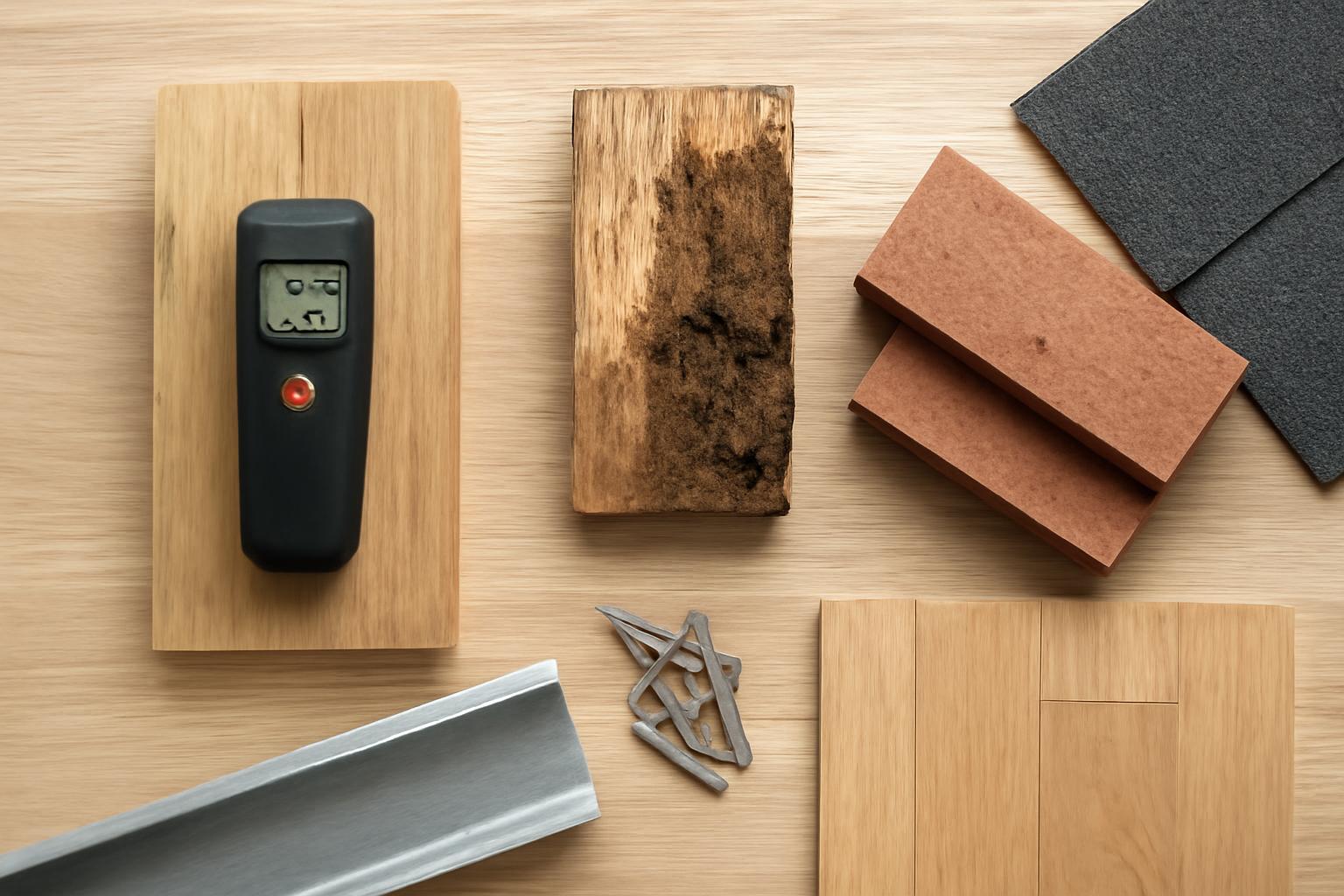
If you’re trying to find the wood moisture content rot threshold, the most useful answer is not a single number. In practice, three ranges matter most:
- a safe management zone below about 20% MC (U.S. Forest Service)
- a caution zone from about 20% to 30% MC (U.S. Forest Service)
- a decay-favorable zone once wood stays around the fiber saturation range, typically near 28% to 30% MC and above
That distinction matters because wood movement, mold, fastener corrosion, and structural decay do not all begin at the same moisture level. A board can be wet enough to swell, wet enough to mold, or wet enough to threaten connections before it is wet enough for sustained rot. For builders and buyers, the practical takeaway is simple: keep wood comfortably below decay-favorable levels, and match the lumber to the environment where it will actually live.
Understanding Wood Moisture Content Basics
Wood moisture content, usually written as MC, is the weight of water in the wood divided by the oven-dry weight of the wood, multiplied by 100. Because the denominator is the dry wood weight, freshly cut material can easily exceed 100% MC. Oregon State University Extension notes that freshly cut logs and undried lumber commonly range from about 45% to more than 200% MC (Oregon State University Extension).
That number matters because wood is hygroscopic: it gains or loses moisture as surrounding conditions change. As it wets up, it swells; as it dries, it shrinks. Those moisture-driven dimensional changes sit behind many of the failures people notice first on site—cupped flooring, opened trim joints, sticking doors, twisted framing, paint failure, and misfit replacements. If you are also checking stock sizes before you buy, Mortar Desk’s guide to nominal vs. actual lumber sizes is a useful companion, because drying and surfacing help explain why stamped dimensions and real dimensions diverge.
Moisture content is also not just a warehouse concern. It is a performance number that follows wood from milling to transport, from acclimation to installation, and then through the life of the building. Below critical biological ranges, the main risk is usually movement and finish failure. As moisture stays higher for longer, biological risk increases.
That last point is important: a high reading by itself does not guarantee active decay. The strongest evidence in this pack consistently ties rot risk to sustained moisture in a favorable range, not to a brief spike. In other words, a rain-wet board that dries back down is not the same problem as a rim board, roof edge, sill, or porch detail that stays damp for months.
A practical mental model is this: MC tells you both how much the wood may move and how biologically risky the condition may become. Those are related, but they are not the same thing.
Fiber Saturation Point: Gateway to Decay Risk
The fiber saturation point, or FSP, is the moisture level at which the cell walls are saturated with bound water while free water has not yet meaningfully changed the wood’s condition further. In ordinary building guidance, FSP is treated as roughly 30% MC for many species, with species variation of roughly ±3 percentage points (The Wood Database).
Why does that matter? Because wood behaves differently on either side of FSP. Below FSP, changes in bound water drive most of the shrinking and swelling that cause fit-and-finish problems. Above FSP, added water is more likely to exist as free water, so dimensional change slows, but biological susceptibility rises.
That is why FSP is often treated as the gateway to serious decay risk rather than as a magic rot line. Oregon State University explains the free-water and bound-water distinction, and a standards-based summary referencing the USDA Wood Handbook places the FSP for most North American species at about 28% to 30% MC while describing structural decay fungi as activating above about 28% MC.
The key nuance is duration. Wood does not instantly rot when it touches 28% or 30%. What changes near FSP is that conditions become much more favorable for decay fungi if moisture remains elevated. Below that range, the bigger concerns are often movement, staining, and finish failure. Near and above it, the conversation shifts toward durability and loss of structural performance.
There is also a measurement wrinkle here. The Wood Database notes that moisture gradients can exist through the thickness of lumber, and the evidence pack also notes that pin-type meter readings become less certain above FSP because resistance curves flatten. In practical terms, the wettest wood is often the hardest wood to measure with precision. That is one more reason field practice should aim for a comfortable dry margin, not a flirtation with the threshold.
Established Rot Thresholds from Standards and Labs
The clearest threshold language in the evidence comes from the U.S. Forest Service research summary on limiting conditions for decay in wood systems. Its abstract says wood will generally decay above 30% MC, will not decay below 20% MC, and that 20% to 30% MC is a grey area.
Those statements are sometimes quoted as if they conflict, but they actually describe different decision levels. Below 20% MC is the practical safety margin. Between 20% and 30% MC is the caution band where outcome depends on time and conditions. Around 28% to 30% MC and above is the region where wood approaches or exceeds fiber saturation and decay becomes much more plausible if moisture is sustained.
The full USDA/Forintek paper gives the grey area real texture. In the lab work summarized there, brown-rot decay progressed quickly at a steady 32% MC, progressed slowly at 29% MC, and did not initiate in a short test where samples moved from 26% down to 22% MC. The same paper also reported decay initiation in oriented strand board around 27% MC only after about 8.5 months at 20°C and 99.9% relative humidity (USDA / Forintek paper).
That evidence is why the best answer to “what is the wood moisture content rot threshold?” is not “exactly one reading.” It is better understood as a time-and-moisture relationship. A board that gets wet and dries is one situation. A concealed assembly trapped for months in the upper 20s or low 30s is another.
The same evidence also supports a stronger caution around the upper 20s than many people assume. The Forest Service paper describes decay fungi as growing effectively when MC is above the fiber saturation point, around 28% to 30%, and describes 20% MC as a margin of safety rather than a biological cliff. That wording matters. It means “below 20%” is best read as a management target, not an excuse to ignore all lower-level moisture problems.
For field decisions, that leads to a sensible hierarchy: if wood is under 20%, you generally have a good decay margin; if it is between 20% and 30%, do not enclose it casually; if it is near or above 28% to 30% and not drying, treat that as an urgent durability issue.
Mold and Corrosion Thresholds vs. Rot
Rot is not the first moisture-related problem wood usually sees. According to the Building Enclosure summary tied to ASHRAE 160 and related research, the minimum water activity for most fungi corresponds to roughly 16% MC in wood, some fungi can grow at around 15% MC, corrosion of metal fasteners can begin around 15% MC, wood above 20% MC has been associated with nail shank loss and joint-strength reduction over time, and notable wood decay generally requires about 28% to 30% MC (The Building Enclosure).
That difference matters on real jobs. Mold on wood does not automatically mean structural rot. Mold can establish on the surface at moisture levels well below the classic decay range. It is still a serious warning sign—especially in concealed assemblies—but it is not the same thing as decay fungi reducing structural capacity.
Fasteners complicate the picture further. A wall, deck, porch, or roof detail can begin losing durability through corrosion before the wood itself shows visible rot. That is one reason moisture management is about more than keeping the wood “not rotten.” The goal is to preserve the whole assembly.
Crawl spaces are a good example of overlapping thresholds. ATMOX, summarizing Weyerhaeuser guidance, says crawl-space wood is ideally kept in about the 10% to 16% MC range and warns that wood above 19% MC is sufficient to support mold growth and is also where decay-producing organisms may appear (ATMOX).
Put simply, some moisture risks begin in the mid-teens, concern rises sharply around 19% to 20%, and serious decay susceptibility rises as wood remains near 28% to 30%. That is why the field rule “keep wood below 20%” remains useful even though the classic decay range is higher: it gives you buffer against mold, connection problems, and prolonged drift toward the true decay zone.
One nuance worth keeping in view is that the Building Enclosure source also notes brown-rot fungi may continue sustaining decay at about 20% MC once colonization has already begun at higher moisture (The Building Enclosure). So the lower numbers are not only about preventing first-time activation; they also matter for stopping an existing problem from continuing.
Safe MC Levels by Wood Application
The safest moisture target is not “as dry as possible.” It is dry enough for the service environment, with margin from mold and decay thresholds. That is why install targets vary by product and location.
For interior finish work, the target range is much lower than any rot threshold. A standards-based summary citing NWFA and the USDA Wood Handbook gives 6% to 9% MC for hardwood flooring in a conditioned interior, 6% to 8% for furniture and cabinetry, and 7% to 10% as a normal in-service range in climate-controlled homes (standards-based summary).
For framing, it helps to separate best-practice targets from upper allowable limits. The same summary gives 15% MC or lower as an optimal target before enclosure and 19% MC as an acceptable maximum for structural framing under IRC-based guidance. In plain English, 19% is more of a ceiling than a goal.
Exterior and envelope wood usually runs higher than conditioned interior finish stock, but still well below decay-favorable levels in normal service. Wagner’s guidance places exterior or building-envelope wood at about 9% to 14% MC in service, while the Building Enclosure summary uses the same 9% to 14% range as “dry” for exterior wood or envelope components within assemblies (Wagner Meters).
Crawl-space framing and subflooring generally operate a bit higher because the environment is less controlled. In the evidence pack, a reasonable operating band is about 10% to 16% MC, with growing concern as readings approach 19% and above.
Mass timber deserves separate attention because the risk is often not just wetting, but trapping that moisture. WoodWorks says fabricated mass timber is typically around 12% to 14% MC, often runs 15% to 20% on site under ordinary exposure, can exceed 30% if wet, and should be below 16% MC before low-permeance membranes, acoustic mats, or concrete toppings are installed (WoodWorks).
The important distinction across all of these numbers is the type of number you are looking at. Some are ideal install targets. Some are typical in-service ranges. Some are upper acceptable limits. And some are biological warning thresholds.
Equilibrium Moisture Content and Site Factors
The reason safe targets vary is that wood tends toward equilibrium moisture content, or EMC: the moisture level that matches the surrounding air’s temperature and relative humidity. Wagner’s examples show that at about 70°F, wood tends to settle near 6% MC at about 26% to 32% RH, near 9% MC at about 47% to 52% RH, and around 12% MC at about 65% RH (Wagner Meters).
That is why the same species can behave differently in different buildings. Flooring that is stable in a heated, dry interior may swell in a humid addition. Trim that sits quietly in an air-conditioned home may gap or move after installation in a damp basement or workshop. The rot threshold has not changed, but the wood’s likely in-service MC has.
For most buyers and installers, the process matters more than the formula:
- Measure the actual air conditions where the wood will live.
- Estimate the local EMC for that condition.
- Acclimate the wood until its MC is close to that target.
- Recheck at the site right before installation.
That last step is easy to skip and costly to miss. The standards-based summary in the evidence puts it bluntly: the reading that matters is the one taken the morning of installation, because wood keeps adjusting after delivery.
This is also why “kiln dried” is not the end of the conversation. Kiln drying tells you how the material left the mill. The relevant number is the wood’s MC when the building is close to its actual service condition.
How to Measure Wood Moisture Content Accurately
To know whether wood is safely below the rot-risk range, you need both a meter and a method.
The two common meter types are pinless and pin-type. A practical meter guide explains that pinless meters read from the surface without leaving holes and usually require species calibration, while pin-type meters read electrical resistance between inserted pins and are often better suited to thicker stock such as framing lumber.
Whichever meter you use, setup matters. Use the correct species setting when the meter requires it. Stay within the thickness range the manufacturer specifies.
Also be wary of surface-only readings. Thick lumber, beams, and built-up members can have moisture gradients from face to core. Near and above FSP, those gradients become more likely, and the evidence pack notes that readings are less certain in the high-moisture range where pin-type resistance curves flatten. A single number on a single face is therefore not a full moisture diagnosis.
For installation work, a useful field rule is to dry wood to within about 2 percentage points of its expected in-use EMC, a guideline Wagner attributes to Dr. Eugene Wengert.
That rule is more useful than chasing a generic “safe” reading. If the room conditions suggest the wood wants to live near 8% MC, then installing flooring at 12% is asking for shrinkage. If a crawl-space assembly is normally equilibrating around 15%, then a surprise 21% reading deserves investigation even though it is still below fiber saturation.
Preventing Rot: Practical Strategies for Builders
The simplest rot-prevention strategy is not chemical. It is moisture management.
Start with acclimation. Do not rely on mill stamps, “kiln dried” labels, or yard assumptions. Protect wood from rain, ground moisture, splash-back, and trapped condensation during storage. Use airflow where needed. If stock arrives too wet for its application, let it dry before installation.
The Forest Service threshold language is the reason many builders use below 20% MC as a practical go/no-go limit before enclosure, even though the strongest decay activity occurs higher. It is a buffer, not a claim of perfection.
Also avoid moisture traps. WoodWorks warns that low-permeance membranes, roofing and waterproofing layers, acoustic mats, and concrete toppings can hold moisture where it cannot readily dry, especially in mass-timber assemblies and concealed interfaces. The same logic applies to many conventional details too: roofs, balconies, porches, sill zones, and transitions where water gets in but drying gets blocked.
Temporary wetting is often manageable. Trapped wetting is where routine moisture becomes hidden decay.
As part of Mortar Desk’s broader building material specifications coverage, this article is general reference rather than engineering advice. Mortar Desk explains that it is not a contractor and does not provide engineering advice; work involving structural elements belongs with licensed trades working to local code.
What is the wood moisture content rot threshold?
For field practice, keeping wood below 20% MC provides a practical safety margin against decay. Biologically, decay becomes much more likely when wood stays around the fiber saturation range of roughly 28% to 30% MC, and the U.S. Forest Service summary says wood generally decays above 30% MC, with 20% to 30% MC as the grey area.
Is 20% MC safe for wood or does it risk rot?
As a rule of thumb, 20% MC is a management limit, not an absolute guarantee. Forest Service research treats wood below 20% MC as outside the normal decay-initiation range, but the same evidence describes 20% to 30% MC as a grey area and shows that decay near the upper 20s can be slow rather than immediate. Time in the wet range matters as much as the reading itself.
What MC causes mold growth on wood?
For exposed wood, mold risk is commonly cited around 16% MC, with some fungi able to grow at about 15% MC under favorable conditions. That is lower than the usual structural decay range, which is why you can see mold before you have true rot. The same evidence also notes that notable wood decay generally requires about 28% to 30% MC.
How do I calculate safe EMC for my location?
Start with the building’s actual indoor temperature and relative humidity, then compare those conditions to an EMC chart. At about 70°F, wood EMC is roughly 6% at 26% to 32% RH, about 9% at 47% to 52% RH, and around 12% at 65% RH. Once you know that target, acclimate the wood until its measured MC is close to expected in-service EMC for that season and space.
What MC for framing lumber before installation?
For framing, the practical targets are well below the classic decay range. A standards-based summary citing IRC-based guidance gives 15% MC or lower as an optimal target before enclosure and 19% MC as an acceptable maximum for structural framing.