 MortarDesk
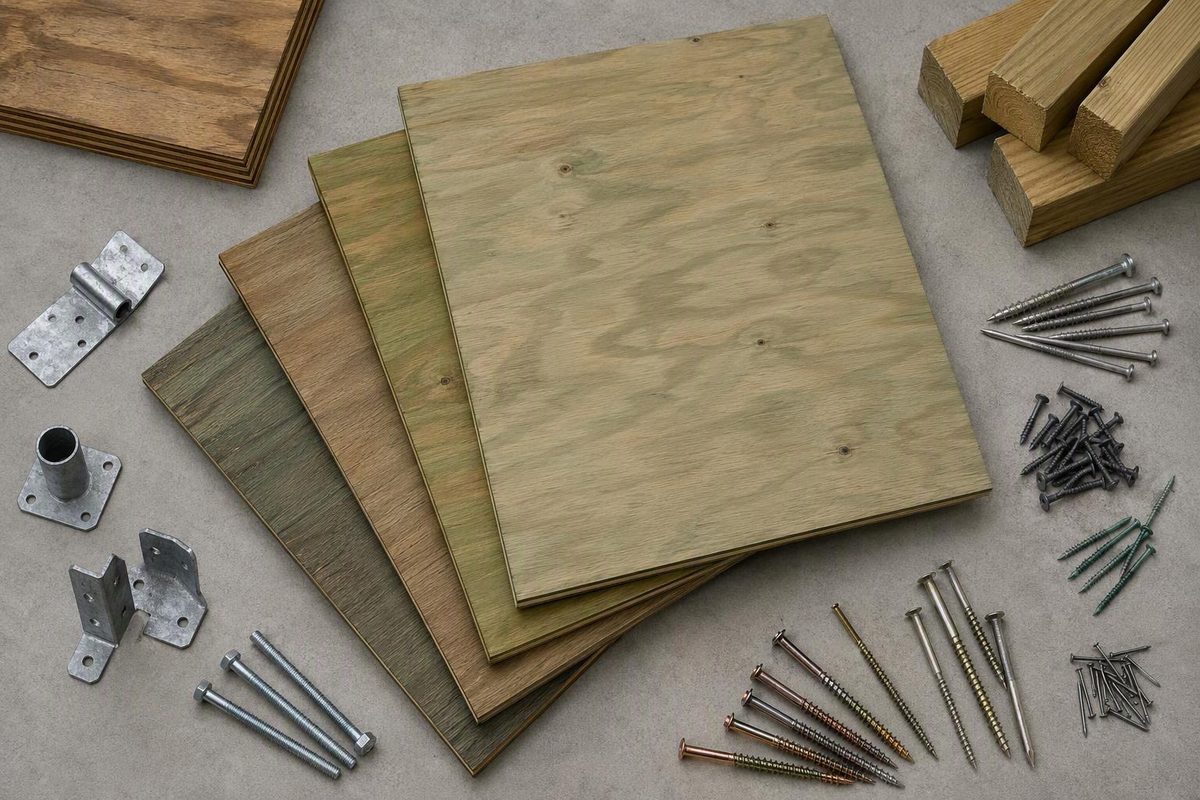
Pressure-treated plywood is plywood treated with a preservative to resist decay and wood-destroying insects. Treatment alone does not establish the sheet’s thickness, structural rating, span, surface grade or suitability for ground contact.
Before buying, match two separate sets of information:
- Plywood stamp: panel grade, Performance Category or thickness, span rating where applicable, product standard and bond classification.
- Treatment mark or certificate: preservative, retention, applicable standard and exposure/use category.
An exterior glue bond does not mean a panel is preservative-treated. A treated sheet still needs the correct panel rating for its structural job.
Pressure-treated plywood selection table
| Intended condition | Treatment designation to check | Other buying checks |
|---|---|---|
| Interior location subject to dampness | UC2 | Confirm the treatment is permitted indoors; match panel grade and thickness to the assembly |
| Coated exterior component with rapid drainage, or one continuously protected from precipitation | UC3A | Verify coating, maintenance and drainage assumptions; check bond classification and edge details |
| Exposed exterior, above ground | UC3B | Check panel stamp, fastener compatibility and instructions for treating cuts |
| Ground or fresh-water contact, or a comparable severe decay exposure | UC4A or higher, as specified | Do not substitute an above-ground panel; verify the precise end use and local requirements |
| Salt or brackish water exposure | Applicable UC5 subcategory and project specification | Neither “marine plywood” nor “treated” establishes suitability; obtain product documentation |
These are American Wood Protection Association Use Categories. AWPA defines UC3A as protected above-ground exterior exposure, UC3B as exposed above-ground use and UC4A as general ground contact. UC4B and UC4C cover more severe ground-contact conditions, while UC5 is divided by marine exposure region. The 2024 excerpt of AWPA Standard U1 says an order should identify the commodity, Use Category, commodity specification, wood species, preservative and special requirements such as conditioning or drying.
A Use Category describes exposure; it does not promise that every plywood product is manufactured for that category. Confirm that documentation applies to the actual panels, not merely to treated lumber in the same rack.
Read the panel stamp
Look for:
- Panel grade: for example, Rated Sheathing, siding or a veneer grade.
- Performance Category and declared thickness: a nominal product name may not equal the marked or measured thickness. A sheet sold in the 3/4-inch class may, for example, be marked 23/32 inch; see the 3/4-inch treated plywood reference.
- Span rating: for Rated Sheathing, the first number is the recommended roof-support spacing and the second is the subfloor-support spacing, under the stated installation conditions.
- Bond classification: commonly Exterior or Exposure 1 on construction panels, but read the actual stamp.
- Product standard: commonly PS 1 or PS 2 where applicable.
APA explains that bond classification concerns the severity and duration of moisture exposure the panel’s wood materials and adhesive are designed to withstand. It also distinguishes Performance Category from decimal thickness and explains how span ratings are read in its APA trademark guide.
“Exposure 1” does not mean pressure-treated and is not a designation for permanent weather exposure. Likewise, the “X” in a retail name such as CDX does not settle the treatment or end-use question; see what CDX does and does not identify.
Read the treatment mark or certificate
AWPA advises buyers to check for AWPA U1, the Use Category, preservative name or abbreviation and nominal retention. Where building codes apply, its homeowner guidance also calls for the quality mark of an accredited inspection agency. The AWPA label guidance identifies Use Category—not green or brown coloring—as the guide to proper usage.
Color becomes still less useful as wood ages. EPA notes that treated and untreated wood can both weather to silver, so color alone cannot reliably distinguish them in demolition debris (EPA CCA-treated wood fact sheet).
What treatment does not prove
A pressure-treatment label does not establish that a panel is:
- waterproof or suitable for continuous immersion;
- marine-grade plywood;
- rated for a particular roof, floor or wall span;
- fire-retardant-treated;
- suitable for direct food contact or every interior application;
- dry enough to paint, glue or cover with a moisture-sensitive finish.
Preservative treatment addresses biological durability under a stated exposure. The panel stamp and assembly specification address structural and bond requirements. Fire-retardant treatment is a separate classification, discussed in fire-rated plywood labels and assembly ratings.
Worked example: exposed equipment-box floor
Assume a 24 × 48 in. equipment box will stand outdoors above grade. Its plywood floor will be shaded, uncoated underneath and occasionally wetted by wind-driven rain. Supports are 16 in. on center.
- Classify exposure: because the underside is exposed and not protected by a maintained coating or enclosure, begin with UC3B, not UC3A.
- Specify the panel separately: choose the panel grade, Performance Category and span rating required by the box design. “1/2-inch treated plywood” is not a complete specification.
- Match the markings: connect the panel stamp to treatment documentation for those sheets rather than relying on a shelf card.
- Resolve fastening: preservative chemistry affects metal compatibility. Follow the treatment manufacturer’s instructions and locally adopted code; see fasteners for treated wood.
- Plan cuts and coating: follow the treater’s directions for field treatment of cuts and for the required surface condition before finishing.
If the floor will sit on soil, trap leaf litter, lack airflow or remain frequently wet, do not assume UC3B. AWPA U1 identifies several nominally above-ground conditions that can require UC4A treatment; verify the category and whether a suitable plywood product is available.
Handling and installation checks
- Store sheets flat and supported, protected from standing water but ventilated.
- Wear eye protection and control sawdust; follow the safety data for the preservative used.
- Never burn treated-wood scraps. EPA’s CCA guidance calls for outdoor cutting with dust, eye and skin protection and says CCA-treated wood should not be open-burned (EPA handling guidance). Follow local disposal rules for older or unidentified material.
- Use fasteners and connectors compatible with the treatment. The 2024 IRC addresses preservative-treated-wood fasteners in Section R317.3, but another edition or local amendments may govern the project; check the 2024 IRC Chapter 3 text against the locally adopted code.
- Retain labels, invoices and treatment certificates through inspection and completion.
A useful order description is not simply “pressure-treated plywood.” Specify the panel grade, Performance Category, required span rating, bond classification, AWPA U1 Use Category, preservative treatment, compatible fasteners and required post-treatment drying condition.