 MortarDesk
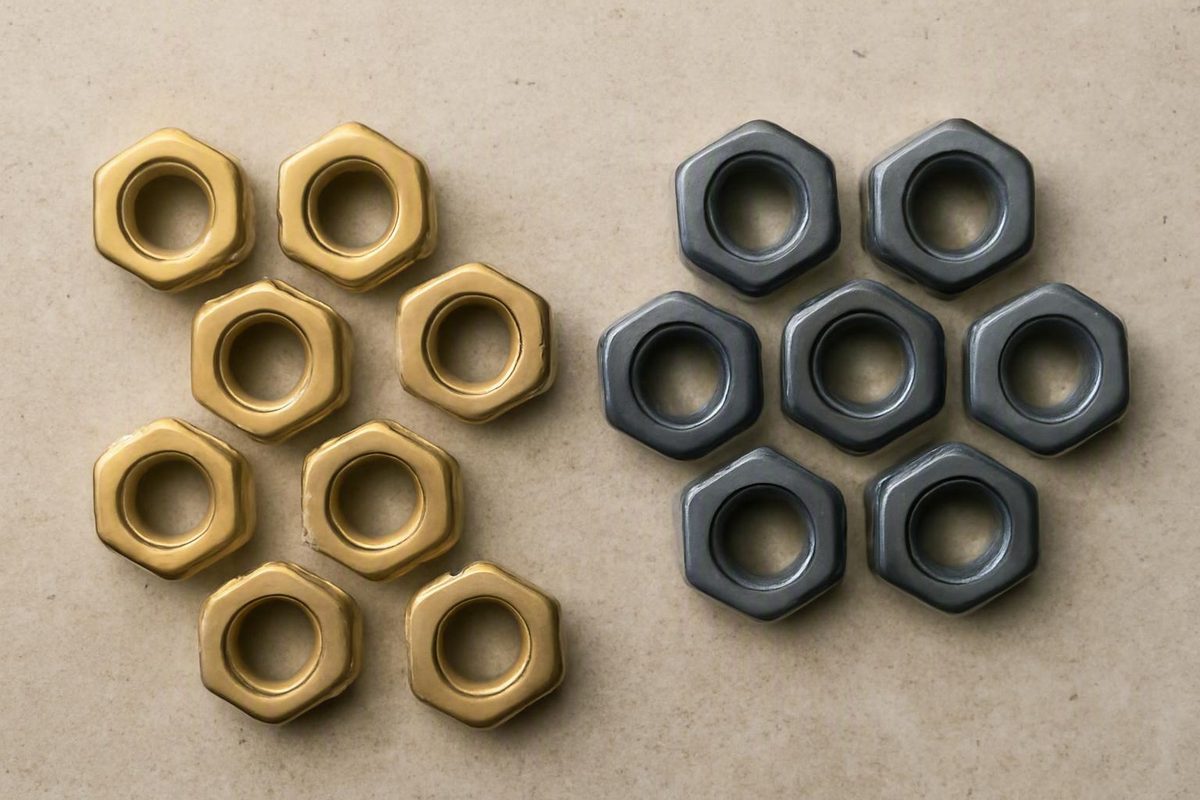
Steel is generally the better nut material when strength, high preload, hard-wearing threads, impact resistance, or structural duty controls the decision. Brass is usually the specialty choice when moderate strength is sufficient and conductivity, machinability, non-magnetic behavior, appearance, ordinary-moisture resistance, or controlled preferential wear matters more. Commercial fastener guidance consistently positions appropriately specified steel for heavy mechanical loads and brass for moderate-load specialty uses (Hindustan Brass’s qualitative nut comparison).
That verdict needs one major qualification: “steel” is not a single fastener material. Bare carbon steel, plated or galvanized carbon steel, heat-treated alloy steel, and stainless steel can differ substantially in strength, corrosion behavior, magnetism, cost, and temperature performance. Brass is likewise a family of copper-zinc alloys whose properties vary with composition and material condition.
This article is therefore a qualitative procurement screen, not a source of proof loads, tightening torques, corrosion-life predictions, or engineering approval. A defensible comparison is:
- A named brass alloy and condition;
- Versus a named steel grade or property class;
- In a specified nut geometry;
- On a compatible bolt or screw;
- Under a defined load, environment, temperature, and maintenance regime.
Quick comparison: where brass and steel nuts each lead
For initial screening, steel generally leads in strength, hardness, load-bearing potential, wear resistance, and thread durability. Brass generally leads in electrical and thermal conductivity, machinability, non-magnetic behavior, and decorative appearance. Brass also normally resists ordinary moisture better than unprotected carbon steel, although that does not mean it will outperform every coating or stainless grade.
Brass is primarily an alloy of copper and zinc. Changing the proportions, adding other elements, or changing the material condition can alter its strength, machinability, corrosion behavior, and suitability for a particular use. Steel fasteners are similarly divided into grades, hardening conditions, coatings, and stainless families rather than treated as one specification (Bolt Depot’s fastener-material overview).
The following table is a general screening comparison only. It is not a nut proof-load, tightening-torque, stripping-strength, corrosion-life, or service-life specification.
| Property or decision factor | Brass nuts | Bare carbon-steel nuts | Coated or plated carbon-steel nuts | Heat-treated alloy-steel nuts | Stainless-steel nuts |
|---|---|---|---|---|---|
| Strength and load potential | Moderate; alloy- and geometry-dependent | Generally higher than brass; grade-dependent | Base-steel potential remains grade-dependent and may be affected by processing | Often the leading starting option for demanding mechanical loads | Grade- and class-dependent; not automatically as strong as hardened alloy steel |
| Hardness | Usually lower | Usually higher | Controlled mainly by base steel and heat treatment | Often high | Varies by family, grade, and condition |
| Thread durability | Suitable for moderate duty; softer threads can deform or wear | Generally better under high load | Generally good if the threads and finish remain serviceable | Strong candidate for high preload and hard-wearing threads | Generally durable, but mating material and installation practice matter |
| Ordinary-moisture corrosion resistance | Commonly better than bare carbon steel | Poor without protection | Can be good, depending on finish, thickness, damage, and exposure | Depends on its protective system | Commonly good, depending on grade |
| Severe chloride exposure | Generic brass cannot be assumed suitable | Usually unsuitable without qualified protection | Coating-dependent and vulnerable where damaged | Requires a qualified protection system | Certain grades may be preferable, but selection remains environment-specific |
| Electrical conductivity | High relative to common steels | Low relative to brass | Low relative to brass | Low relative to brass | Low relative to brass |
| Thermal conductivity | High relative to common steels | Lower than brass | Lower than brass | Lower than brass | Lower than brass |
| Magnetism | Generally non-magnetic | Usually magnetic | Usually magnetic because the base steel is magnetic | Usually magnetic | Depends on family, grade, and processing |
| Machinability | Generally favorable | Varies | Base-metal machining plus finishing operations | Often more difficult, especially when hardened | Grade-dependent and often more demanding than brass |
| Weight at equal nut size | Normally heavier | Normally lighter | Normally lighter | Normally lighter | Normally lighter |
| Relative cost | Commonly above standard carbon steel | Commonly the lowest-cost starting point | Adds finishing cost | Varies with grade and processing | Can narrow or reverse the comparison with brass |
| Appearance | Warm, gold-colored decorative finish | Industrial gray; often finished for protection | Finish determines appearance | Usually selected for function | Bright or muted metallic appearance |
| Typical uses | Electrical components, inserts, instruments, moderate-duty plumbing components, exposed hardware, selected motion systems | General indoor fastening and lower-cost assemblies | Outdoor or damp-service assemblies where the finish is qualified | Machinery, vehicles, construction, heavy equipment, high-load joints | Corrosive environments where the selected grade is suitable |
Brass is normally a moderate-load specialty material. Its value lies less in competing with high-strength steel than in solving a different problem: carrying current, machining an intricate insert, avoiding magnetic response, providing a decorative finish, or serving as a replaceable threaded component.
Strength, hardness, and load capacity
The available comparisons consistently place steel above brass in strength and hardness, but they do not support a universal statement such as “steel nuts are twice as strong.” Generic ranges overlap because both labels cover multiple compositions and conditions. Supplier comparisons also tend to report bulk-material properties rather than controlled tests on equivalent finished nuts.
Harder or heat-treated steel can support greater mechanical demands and resist thread deformation or wear. Hardness is not an unconditional benefit, however. Some harder grades and heat-treatment conditions can be more brittle. Replacing an engineered fastener with a nominally “stronger” or harder part can therefore be unsafe when the original assembly depends on a particular deformation or failure behavior (Bolt Depot’s guidance on grade, hardening, and brittleness).
Why bulk strength is not nut capacity
A material’s tensile strength does not by itself establish:
- The nut’s proof load;
- Whether its internal threads will strip;
- The allowable bolt preload;
- The correct tightening torque;
- The necessary thread engagement;
- Preload retention under vibration or thermal cycling;
- Fatigue life;
- Whether the nut can be reused.
A finished nut is a threaded component, not a simple tensile specimen.
The principal variables include:
- Nut material: Exact brass alloy and condition, or steel family, grade, property class, and heat treatment.
- Nut geometry: Style, height, width across flats, wall thickness, flange, locking feature, and available thread engagement.
- Thread specification: Diameter, pitch, form, tolerance or class, and production method.
- Mating fastener: Bolt or screw grade, material, coating, hardness, and dimensional compatibility.
- Surface condition: Lubrication, contamination, plating, galvanizing, conversion coating, or other finish.
- Installation: Applied torque, torque-control method, prevailing torque, tool accuracy, and assembly sequence.
- Service loading: Static tension, shear, impact, vibration, fatigue, temperature cycling, or combinations of these.
- Product standard and quality control: Applicable standard, test method, lot traceability, inspection, and proof-load documentation.
Brass can be used in a load-bearing assembly when the demand is moderate and the finished nut has documented capacity for the application. It should not be treated as the default for structural, high-preload, heavy-impact, or safety-critical service.
A brass nut must not replace a specified high-strength or structural steel nut merely because its diameter and thread pitch match. Supplier material guidance likewise distinguishes moderate-strength brass from steel used for heavy loads, construction, vehicles, and machinery (Hindustan Brass’s application comparison).
Before selecting a nut for a load-bearing joint, obtain:
- The marked property class or grade, where applicable;
- The relevant product and mechanical-property standard;
- Nut proof-load or other required test data;
- Exact dimensions and thread tolerance;
- A compatible bolt specification;
- Coating and lubrication information;
- Manufacturer installation instructions;
- Any approval required for substitution.
If these details are absent, treat the part as an unidentified nut rather than a verified structural or high-strength component.
Corrosion resistance: brass, bare steel, coated steel, and stainless steel
There is no universal corrosion winner.
Brass generally performs better in ordinary moisture than unprotected carbon steel. Bare carbon steel is prone to iron-oxide rust, while brass does not form iron rust. Brass can nevertheless tarnish or undergo damaging corrosion of its own, so “does not rust” must not be interpreted as “cannot corrode.”
Steel finishes also change the comparison. Zinc plating, galvanizing, black oxide, nickel plating, phosphate treatments, and other systems have different purposes and limitations. They are not interchangeable. Damage can expose the underlying steel, and a finish suitable for mild indoor moisture may not be suitable for prolonged marine exposure (Components for Industry’s overview of steel finishes and untreated-steel corrosion).
Brass corrosion is environment-specific
Brass may be a suitable candidate in indoor humidity, freshwater, and ordinary atmospheric exposure, but performance depends on alloy, stress, and chemistry. Reported concerns include:
- Dezincification: Selective loss of zinc from susceptible brass, potentially leaving a weakened, porous copper-rich structure.
- Stress-corrosion damage: Cracking associated with tensile stress, a susceptible alloy, and a damaging chemical environment.
- Tarnishing or discoloration: A surface change that may be cosmetic but should be distinguished from structural corrosion.
- Chemical attack: Possible deterioration in unsuitable ammonia, strong-acid, strong-alkali, salt-spray, or chloride-rich environments.
Commercial brass-nut guidance specifically identifies high salt spray, chlorides, ammonia, strong acids, and strong alkalis as environments requiring caution rather than generic approval (Weldo’s brass-and-steel nut comparison).
Where stainless steel changes the answer
Stainless steel is not merely carbon steel with a surface coating. Its corrosion behavior comes from the selected alloy, although it remains vulnerable in unsuitable environments.
For preliminary screening, 304 stainless is commonly associated with ordinary atmospheric or freshwater exposure, while 316 is generally presented as more resistant in chloride environments. These labels are not project guarantees; actual suitability still depends on the grade, product condition, geometry, crevices, joined materials, and exposure (Weldo’s stainless-grade screening guidance).
In severe marine or chloride-rich service, an appropriate stainless grade may be preferable to generic brass. Conversely, suitable brass may outperform bare carbon steel in a damp indoor installation. The decision requires named materials and a defined exposure—not a generic corrosion hierarchy.
Environment matrix
| Environment | Reasonable materials to investigate | Questions to ask before selecting |
|---|---|---|
| Dry indoor use | Carbon steel, coated steel, brass, stainless steel | What proof load is required? Do appearance, conductivity, or magnetism matter? Is condensation possible? |
| Indoor humidity | Brass, suitably coated steel, stainless steel | Is moisture intermittent or trapped? Can installation scratch the finish? Are cleaning chemicals present? |
| Freshwater exposure | Suitable brass, qualified coated steel, stainless steel | Is the part immersed or only splashed? Is the water treated? What brass alloy or stainless grade is specified? |
| Outdoor weather | Coated steel, stainless steel, suitable brass | Will water drain and dry? Is road or coastal salt present? Can the coating be damaged? What maintenance is possible? |
| Marine or chloride exposure | Qualified stainless grade, specifically qualified brass alloy, or engineered coating system | What is the chloride exposure? Is the part atmospheric, in a splash zone, or immersed? Is dezincification resistance required? |
| Aggressive chemicals | Materials qualified for the exact chemical and conditions | Are ammonia, acids, alkalis, cleaners, or process chemicals present? What are the concentration, temperature, duration, and sustained stress? |
Corrosion selection must account for the entire assembly:
- Bolt or screw material;
- Washers and locking components;
- Joined metals;
- Coating type, continuity, and damage;
- Crevices that trap water;
- Condensation and drainage;
- Conductive electrolytes;
- Cleaning and maintenance chemicals;
- Temperature and residual stress.
Changing only the nut can create a dissimilar-metal combination and introduce galvanic-corrosion concerns. The available evidence does not support a universal compatibility chart or service-life prediction.
Conductivity, magnetism, machinability, weight, and appearance
Brass may be the better nut even when it is mechanically weaker because a fastener can perform electrical, manufacturing, maintenance, or visual functions as well as carry load.
Electrical and thermal conductivity
Brass generally conducts electricity and heat substantially better than common carbon and stainless steels. This can justify investigating it for selected:
- Terminals;
- Connectors;
- Switch components;
- Circuit or enclosure hardware;
- Grounding components;
- Heat-transfer or instrumentation assemblies.
Conductivity alone does not approve a component for electrical service. The specified component, contact design, clamping force, surface condition, corrosion behavior, and applicable electrical requirements still control. Main-electrical-supply work should use the specified approved components and be handled under the applicable local requirements.
Magnetism
Brass is generally non-magnetic. That can be useful near instruments, sensors, electronic assemblies, or equipment where magnetic response would interfere with operation.
Carbon and alloy steels are usually magnetic. Stainless behavior varies by metallurgical family, grade, and processing history. “Stainless” should not be used as a synonym for “non-magnetic,” and a handheld magnet is not a substitute for material identification.
Machinability and precision
Brass is widely described as easier to machine because it is softer, presents lower cutting resistance, and can allow efficient production of detailed threads, knurls, inserts, and custom shapes with comparatively low tool wear. This is one reason it is common in precision turned parts and threaded inserts (Entag’s overview of custom brass nuts and machining).
Machinability must be separated from achievable precision. A material does not possess an intrinsic CNC tolerance or guaranteed surface roughness. Finished accuracy depends on:
- Nut dimensions and thread form;
- Machine rigidity and condition;
- Tool geometry and wear;
- Workholding;
- Cutting parameters;
- Thermal control;
- Deburring and secondary operations;
- Measurement method;
- Process capability and inspection.
Supplier-specific tolerance or roughness claims therefore cannot be generalized to every brass or steel nut.
Weight and appearance
At the same external dimensions, a brass nut is normally heavier than a steel nut. The difference may be insignificant in a piece of furniture but important when an assembly contains many fasteners or is mass-sensitive. Compare actual catalog weights because nut styles and dimensions can differ even when the nominal thread is the same.
Brass’s warm golden color is also a legitimate specification factor. It can complement architectural hardware, furniture, instruments, lighting, cabinetry, or restoration work. Aesthetic suitability must remain separate from mechanical suitability: an attractive nut is not automatically capable of carrying a demanding load.
Purchase price versus total cost
Brass generally costs more than standard carbon steel, while stainless-steel pricing can narrow or change the comparison. Raw-material prices do not equal finished-nut prices.
Purchase and lifecycle cost may include:
- Forming or machining;
- Heat treatment;
- Plating or coating;
- Cleaning or passivation processes;
- Inspection and certification;
- Order quantity;
- Nonstandard tooling;
- Supplier availability and lead time;
- Installation and lubrication;
- Periodic inspection;
- Downtime;
- Replacement frequency.
Conversely, brass can add expense without useful benefit in a simple dry joint. Compare quotations for finished components and expected maintenance rather than relying on volatile raw-material prices.
Thread wear, friction, vibration, and repeated assembly
A brass nut on a steel screw is sometimes selected as a maintenance strategy. Because the nut is softer and often easier to replace, the designer may intend it to become the preferential wear component while preserving a more expensive screw. Lead screws, actuators, adjustment mechanisms, and similar motion systems are contexts in which that approach may be considered.
An OpenFlexure project discussion describes this rationale as lower friction in the particular brass-on-steel pairing and deliberate wear of the replaceable nut rather than the screw. It is a useful application example, but it is a forum explanation rather than controlled wear testing (OpenFlexure’s discussion of brass nuts on steel actuator screws).
It should not be converted into a universal rule that brass-on-steel always has lower friction, cannot seize, or lasts longer. Thread behavior depends on:
- Brass alloy and condition;
- Steel grade and hardness;
- Thread form and lead;
- Surface finish;
- Lubricant and relubrication interval;
- Alignment;
- Radial and axial load;
- Sliding speed;
- Duty cycle;
- Temperature;
- Dust, chips, and other contamination;
- Allowable backlash and wear.
The same softness that can make brass useful as an intentional wear part can be a disadvantage in a fixed joint.
Steel threads generally offer greater durability where high clamping force, impact, or severe vibration is expected. Some stainless-steel fastener combinations can also seize during installation, so material pairing and installation practice remain important.
The available evidence does not establish:
- A permissible number of assembly cycles;
- Reusable tightening-torque values;
- Fatigue life;
- Prevailing-torque retention;
- Galling or seizing rates;
- Comparative wear life;
- Backlash growth;
- Relubrication intervals.
For motion systems, frequently serviced joints, or vibration-sensitive assemblies, request product-specific wear tests, manufacturer limits, lubrication instructions, and replacement criteria. If the nut is intended to protect the screw, confirm that the assembly was designed around that sacrificial-wear strategy.
Temperature performance and why melting point is not the selection limit
Generic steel families are commonly associated with greater heat tolerance than brass, but neither “steel” nor “brass” has one allowable service temperature. Broad melting-point or generic maximum-temperature tables are not suitable for selecting a loaded nut.
A nut can become unsuitable long before melting. Earlier limits may include:
- Loss of tensile or proof-load capability;
- Creep or time-dependent deformation;
- Relaxation and loss of bolt preload;
- Oxidation or scaling;
- Coating degradation;
- Lubricant breakdown;
- Changes in friction during tightening or service;
- Differential thermal expansion;
- Degradation of washers or joined materials;
- Thermal-cycling fatigue.
Carbon steel, heat-treated alloy steel, and stainless steel do not share one temperature rating.
Brass presents the same specification problem. Melting point does not establish safe preload, creep resistance, or long-term joint performance.
Before recommending a nut for elevated-temperature service, identify:
- Exact brass alloy and condition, or steel grade and property class;
- Nut product standard and geometry;
- Coating, plating, or surface treatment;
- Lubricant or anti-seize compound;
- Mating bolt material and grade;
- Required sustained load and preload;
- Peak and continuous temperatures;
- Exposure duration and cycling frequency;
- Atmosphere, oxidation, and chemical exposure;
- Manufacturer or governing-standard temperature limits.
Without those inputs, the defensible conclusion is only that appropriately specified steel is often the stronger starting candidate for combined heat and load—not that every steel nut is suitable at a particular temperature.
Application matrix: which material fits common nut uses?
The matrix below identifies starting options for investigation, not approved specifications. Product-specific mechanical, environmental, dimensional, and regulatory requirements still control.
| Use case | Governing need | Likely starting option | Reasons | Checks required before purchase |
|---|---|---|---|---|
| Electrical terminals, switches, and connectors | Conductivity, machinability, stable contact | Brass | Conducts better than common steels and machines readily into detailed parts | Applicable electrical specification, current and temperature requirements, plating, contact design, corrosion, component approval |
| Selected grounding components | Conductive connection and environmental durability | Brass or the specified approved component | Brass may support a conductive connection | Applicable approval, exact alloy, compatible conductor and enclosure metals, installation instructions |
| Threaded inserts in plastic | Machinability, retention geometry, moderate thread load | Brass | Commonly made into knurled, molded-in, or heat-staked inserts | Insert style, plastic type, installation method, pull-out and torque-out data, temperature limits |
| Precision custom components | Detailed threads and efficient machining | Brass | Favorable machinability and decorative finish | Drawing tolerances, inspection method, alloy, burr control, mechanical load |
| Plumbing, valves, and pipe fittings | Corrosion behavior, sealing system, pressure, and temperature | Suitable brass may be investigated | Brass is used in selected fluid-handling components | Exact alloy, medium, pressure, temperature, dezincification risk, applicable regulatory requirements |
| Decorative and visible hardware | Appearance with moderate mechanical demand | Brass | Golden color and favorable machinability | Required load, finish aging, cleaning chemicals, exposure, compatible screws and washers |
| Lead screws and actuators | Sliding wear and replaceable nut | Brass may be considered with a steel screw | The softer nut may be designed as the replaceable wear part | Wear-test data, lubrication, alignment, speed, load, backlash limit, replacement criteria |
| General dry indoor fastening | Cost and availability | Carbon steel | Broad availability and low initial cost | Grade, proof load, condensation risk, finish, compatible bolt |
| Machinery and industrial equipment | Strength, preload, thread durability | Appropriately graded steel | Better starting point for high mechanical demand | Property class, bolt pairing, fatigue, vibration, lubrication, locking method |
| Vehicle chassis or suspension-related assembly | High load, impact, fatigue, controlled specification | Manufacturer-specified steel fastener | Mechanical performance and traceability govern | Manufacturer specification, grade markings, approved part, tightening procedure, replacement rules |
| Construction connection | Structural capacity and project compliance | Specified structural or high-strength steel | Brass is not the normal structural substitute | Drawings, project specification, applicable standard, proof-load evidence, engineer approval |
| Heavy equipment | High load, impact, vibration, wear | Heat-treated alloy steel or other specified steel | Greater strength and thread durability | Grade, coating, fatigue, preload, locking, service procedure |
| Damp outdoor service | Corrosion plus mechanical demand | Compare coated steel, stainless steel, and suitable brass | No generic material wins every outdoor exposure | Coating life, drainage, chlorides, damage, joined metals, maintenance |
| Marine or chloride exposure | Chloride resistance and galvanic compatibility | Qualified stainless grade or specifically qualified brass alloy | Generic brass and generic stainless are insufficient descriptions | Exact grade or alloy, exposure zone, dezincification, crevices, galvanic contact, project approval |
| High-temperature equipment | Strength retention and preload stability | Application-qualified steel often starts the review | Steel families commonly offer greater heat capability | Named grade, continuous and peak temperature, load, oxidation, coating and lubricant limits |
Red flag — structural and safety-critical substitutions
Do not substitute brass for a specified structural, high-strength, vehicle, gas-service, or main-electrical-supply nut without product-specific evidence and review by the responsible engineer, manufacturer, or qualified trade. Matching diameter and thread pitch do not establish equivalent load capacity, corrosion behavior, temperature performance, or regulatory acceptance. Material choice directly affects the integrity of loaded bolted assemblies (Qewit Fastener’s overview of material choice and structural integrity).
Plumbing requires particular caution. Confirm the alloy, fitting system, approvals, installation instructions, and local requirements.
A specification and buying checklist
Use the following sequence before requesting prices or approving a substitution.
1. Establish the joint load and required preload
Identify whether the joint carries tension, shear, impact, fatigue, vibration, or a combination. Determine whether the nut merely retains a light cover or develops substantial bolt preload.
For a load-bearing joint, obtain the required nut proof load, compatible bolt grade, thread engagement, and governing design information.
2. Classify the environment
Record whether service is:
- Dry indoor;
- Humid or condensation-prone;
- Freshwater splash or immersion;
- Outdoor weather;
- Coastal or chloride-rich;
- Marine atmospheric, splash-zone, or immersed;
- Exposed to ammonia, acids, alkalis, cleaners, fuels, or process chemicals.
Also identify whether water can drain, whether moisture will be trapped, and whether installation or maintenance can damage a protective finish.
3. Identify conductivity and magnetism requirements
Ask whether the nut must carry current, maintain a conductive connection, avoid magnetic response, or satisfy an electrical component specification. If these functions do not matter, brass’s conductivity or non-magnetic behavior may offer no practical benefit.
4. Assess temperature, vibration, wear, and maintenance
Define peak and continuous temperature, exposure duration, cycling, vibration, assembly frequency, lubrication, expected wear, and access for replacement. For motion systems, identify the allowable backlash and whether the nut is intentionally replaceable.
5. Check all mating materials
List the bolt or screw, washers, locking parts, joined metals, coatings, and conductive fluids. Evaluate dimensional and corrosion compatibility. Confirm that the selected nut is suitable for the bolt grade rather than merely able to screw onto it.
6. Compare cost and availability
Request finished-part quotations for the required grade, finish, quantity, and certification level. Include tooling, inspection, installation, maintenance, downtime, and replacement availability. A low unit price is not economical if coating failure or thread wear makes the assembly difficult to maintain.
7. Replace generic material names with specifications
For brass, state:
- Exact alloy designation;
- Material condition or temper where relevant;
- Any composition or regulatory requirement;
- Required corrosion or dezincification qualification.
For steel, state:
- Carbon, alloy, or stainless family;
- Grade or property class;
- Heat treatment;
- Stainless grade where applicable;
- Coating or finish.
8. Define the finished nut
A purchase description should address:
- Nut type and style;
- Nominal dimensions;
- Thread standard and pitch;
- Thread tolerance or class;
- Finish or coating;
- Coating thickness where relevant;
- Proof-load requirement;
- Compatible bolt specification;
- Lubrication condition;
- Marking;
- Inspection documentation;
- Lot traceability;
- Packaging and handling requirements.
ASTM, ISO, and DIN are standards systems associated with fastener properties, manufacturing, testing, and performance. Do not apply a particular standard merely because it is familiar; use the standard required by the product, drawing, contract, jurisdiction, or governing specification.
9. Ask the supplier direct questions
Before issuing the order, ask:
- What exact alloy, grade, or property class is supplied?
- Is the material condition or heat treatment documented?
- What nut standard and dimensional tolerance apply?
- What proof-load test or certificate is available?
- Which bolt grade is compatible?
- What coating system and thickness are supplied?
- Can assembly damage the coating?
- Is the part qualified for indoor, outdoor, freshwater, or chloride exposure?
- Which chemicals are incompatible?
- Is lubrication required or prohibited?
- Are torque values tied to the actual coating and lubricant?
- Is the nut intended for repeated assembly?
- What inspection documents and traceability are available?
- Is the same specification likely to remain available for replacement?
10. Approve the complete assembly, not the material label
The final choice should connect nut material, nut geometry, bolt specification, coating, environment, and installation procedure. “Brass M10” or “stainless 3/8 inch” is not a complete engineering or purchasing description.
There is no universal winner. Choose an appropriately graded steel nut when strength, preload, impact, vibration, or durable threads govern. Consider brass when the load is moderate and conductivity, machinability, ordinary-moisture resistance, non-magnetic behavior, appearance, or a replaceable wear component controls the choice.
This comparison is a screening and procurement aid, not an engineering design, structural-substitution approval, hazardous-area certification, or project-specific code opinion. Mortar Desk states that work involving structural elements, gas, or the main electrical supply belongs with an appropriate licensed trade working to local requirements (Mortar Desk’s scope and professional-advice limitations). Confirm safety-critical selections against the project specification, manufacturer instructions, local requirements, and the direction of the responsible engineer or qualified trade.
Frequently asked questions
Are brass nuts stronger than steel nuts?
Generally, no. Appropriately graded steel nuts normally provide greater strength, hardness, load-bearing potential, and thread durability than comparable brass nuts. Brass is better treated as a moderate-strength specialty material.
There is no defensible universal strength ratio because results depend on the brass alloy and condition, steel grade and heat treatment, nut dimensions, thread geometry, bolt pairing, finish, and test standard. Use the finished nut’s proof-load and product-standard data rather than a generic tensile-strength figure.
Do brass nuts rust, and are they more corrosion resistant than stainless steel?
Brass does not form iron-oxide rust because it is not an iron-based alloy. It can still tarnish, dezincify, corrode, or suffer stress-corrosion damage in unsuitable environments.
Brass commonly resists ordinary moisture better than bare carbon steel, but it is not automatically more corrosion resistant than stainless steel. An appropriate stainless grade may be preferable in severe marine or chloride-rich exposure. Compare exact alloys or grades, exposure conditions, mating metals, crevices, coatings, and maintenance requirements.
Can a brass nut replace a steel nut if the thread size is the same?
Not on thread size alone. Matching diameter and pitch indicate only that the parts may engage dimensionally. They do not establish equivalent proof load, stripping resistance, preload, fatigue performance, thread durability, corrosion compatibility, temperature performance, or locking behavior.
A brass substitution may be reasonable in a verified moderate-load specialty assembly. It must not replace a specified structural or high-strength steel nut without product-specific data and approval from the responsible engineer, manufacturer, or qualified trade.
Why is a brass nut sometimes used on a steel lead screw?
The brass nut may be intended as the softer, replaceable wear component so that the more expensive steel screw is preserved. Brass’s favorable machinability and the behavior of selected brass-on-steel sliding pairs can also support its use in lead screws, actuators, and adjustment mechanisms.
That rationale is application-specific. Actual friction and life depend on alloy, steel hardness, thread form, finish, lubrication, alignment, speed, load, contamination, and operating cycles. Use system test data and manufacturer replacement limits rather than assuming every brass nut will reduce friction or increase service life.
Are brass nuts more expensive and heavier than steel nuts?
Brass nuts are normally heavier than equal-size steel nuts and commonly cost more than standard carbon-steel nuts. Actual finished-part pricing can differ because geometry, machining, forming, heat treatment, coating, inspection, quantity, certification, and availability all matter.
Stainless-steel pricing may narrow or reverse the comparison in some markets. Compare quotations for equivalent finished specifications and include maintenance, downtime, and replacement frequency when estimating lifecycle cost.