 MortarDesk
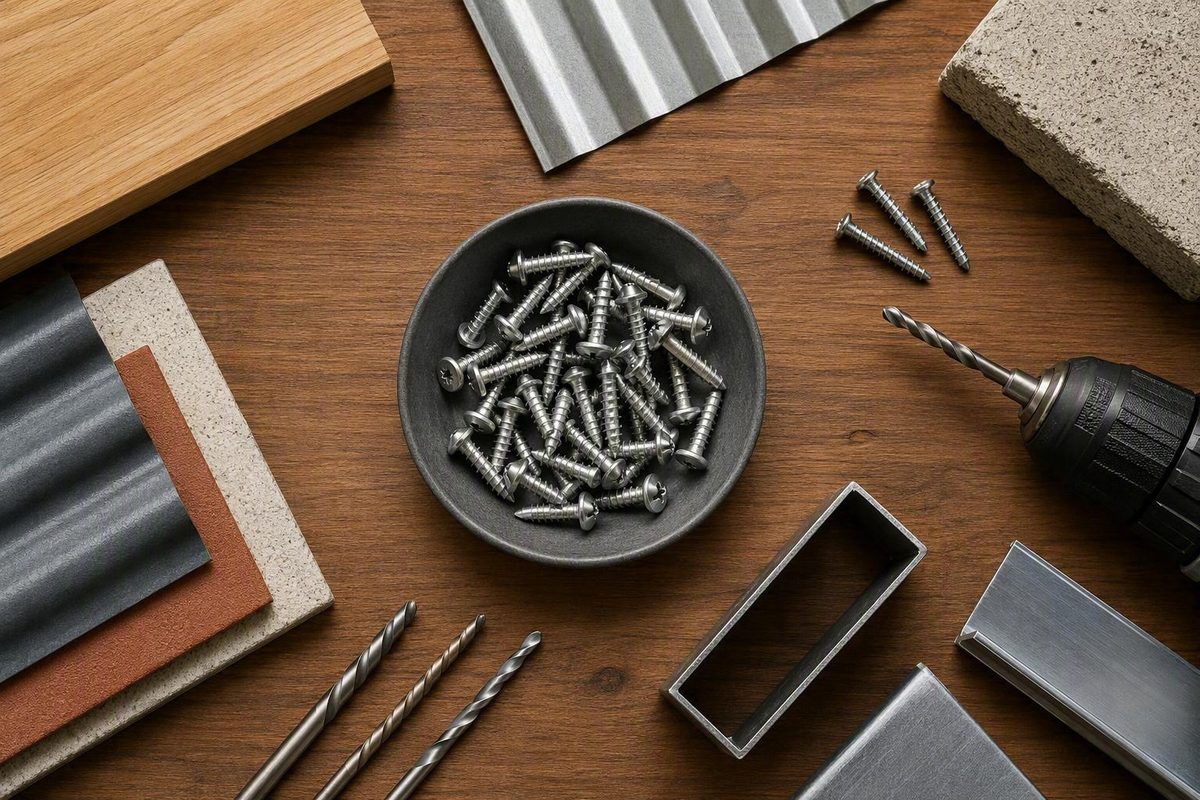
A self-tapping stainless steel screw forms its mating thread as it is driven. That does not automatically mean it drills its own hole. A self-drilling screw has a drill-point tip designed to cut a hole within its stated material and thickness limits.
Accu describes its stainless socket-cap self-tappers as screws for pre-drilled holes. Simpson Strong-Tie explains self-drilling screws using drill-bit principles: point geometry, speed, pressure, and work-material hardness all affect installation. Accu self-tapping product information, Simpson Strong-Tie self-drilling guidance.
Which Type Do You Need?
| Connection | Starting Point |
|---|---|
| Prepared hole in a stated compatible substrate | Self-tapping screw with the specified pilot hole |
| Metal sheet within a product’s drilling range | Self-drilling screw rated for that metal and total thickness |
| Existing tapped machine thread or nut | Matching machine screw, not a sheet-metal self-tapper |
| Concrete, structural connector, or safety-critical attachment | The approved fastening system for that connection |
Head shape also matters: a countersunk head seats differently from a pan or cap head. Our button-head socket-cap guide covers that separate choice. A stainless finish does not establish structural capacity.
Real Pilot-Hole Examples
These are two exact supplier examples, not a universal drill chart. The supplier says the required hole can vary with material thickness.
| Product | Stainless Designation | Published Pilot Hole |
|---|---|---|
| Accu No. 8 (4.2 mm), 45 mm countersunk self-tapper | A2 | 3.5 mm |
| Accu No. 12 (5.5 mm), 120 mm pan-head self-tapper | A4 / 316 | 4.8 mm |
Both sheets list wood, plastic, brass, and aluminum as suitable uses. They do not establish suitability for drilling into stainless sheet. No. 8 A2 data sheet, No. 12 A4 data sheet.
Do not substitute those dimensions for a different thread design, material, or gauge. A too-small hole can make driving difficult; a too-large hole leaves less material for the thread to engage. Confirm the product specification and test a noncritical sample before completing a run of identical connections.
Stainless Grade and Installation
Simpson offers fasteners in 304/305 and 316 stainless, and describes 316 in its wood-screw range as an option for more severe corrosion exposure. That does not mean every 316 screw has the same strength or drilling capability. Select the actual fastener for both the environment and the connection. Simpson stainless fasteners, Simpson fastening-system information.
Use the correct driver recess and the product’s installation instructions. If a drill-point screw is overheating or its cutting corners are wearing, Simpson identifies excessive speed as a possible cause; more pressure is not automatically the fix. Stop rather than forcing a failing fastener. For large wood connections, compare the separately specified lag-screw and lag-bolt options.