 MortarDesk
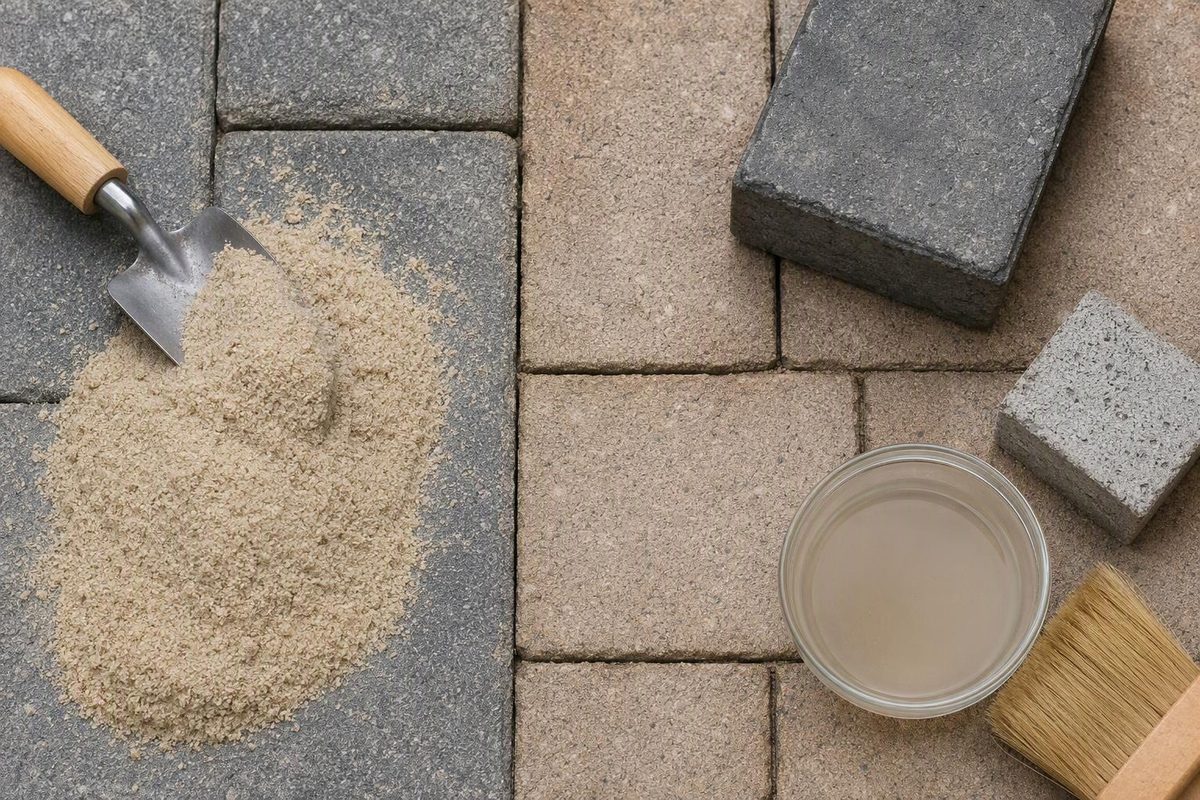
No. Polymeric sand hardens into a firm, cohesive paver joint, not a concrete-like structural mass. Water activates its binders, which hold the sand grains together. Alliance Gator explicitly distinguishes its polymeric sand from mortar and notes that it does not have shear strength like concrete. Techniseal’s explanation and Alliance Gator’s jointing-material FAQ describe these differences.
Use it to stabilize approved paver joints—not to replace concrete, repair a slab or compensate for poorly supported pavers.
What “hard” should mean
Properly installed polymeric sand should form a bonded joint rather than remain loose filling sand. However, maximum hardness is not the selection goal. Alliance Gator explains that an excessively hard joint can become brittle and crack with ground movement. Its sands are designed to transition between hard-and-dry and softer-when-wet conditions. Wet-weather softness therefore does not automatically mean failure. Rocking pavers can still crack the joints; the paving needs proper base support. Alliance Gator FAQ
In concrete, hydraulic cement reacts chemically with water through hydration, forming a structure that binds fine and coarse aggregate. Strength can continue increasing while moisture and unhydrated cement remain. Concrete does not harden simply by drying out. American Concrete Institute
The distinction is not that every polymeric sand is cement-free: the EZSAND sheet cited below lists hydraulic cement among its ingredients. It is still a paver-joint product, not a substitute for concrete. EZSAND technical sheet
How long does polymeric sand take to harden?
Check the exact product’s instructions: rain-safe time, traffic downtime and hardening time are different limits.
For example, Techniseal’s EZSAND technical sheet dated February 16, 2021, covering its 40 lb (18.1 kg) buckets, says the product may take up to 72 hours to harden, depending on weather, moisture and joint width and depth. It separately lists 24–48 hours for vehicle downtime and recommends planning for 24 hours without rain. These are product-specific figures, not universal polymeric-sand curing times; verify the instructions supplied with the material you buy. EZSAND technical sheet
If the joints stay soft or loose
First distinguish wet-weather softness from a joint that never bonded:
- Soft while damp, firm again after drying: consistent with the behavior described for these manufacturers’ sands.
- Persistently soft in wet areas: check drainage. Trapped moisture can prevent proper drying and hardening. EZSAND excludes submerged or constantly wet surfaces.
- Loose after the specified drying period: review compaction, activation watering and installation conditions against the product instructions.
- A thin layer over old sand: do not assume topping up will work. EZSAND prohibits use as capping sand, and Alliance Gator also warns against thin topping applications.
These checks follow the EZSAND installation requirements and Alliance Gator guidance. Do not add cement or improvise extra watering to make the joint “concrete hard.” Follow the product’s activation or repair procedure instead.
A buying check: width is not enough
Suppose your joints are 1/4 inch (6 mm) wide, but you can clear only 1/2 inch (13 mm) of depth. The cited EZSAND sheet permits widths from 1/8 to 1/2 inch (3–13 mm) but requires at least 1-1/2 inches (about 40 mm) of depth. The width fits; the available depth does not. Buying that product solely because it hardens would miss the controlling requirement. EZSAND technical sheet
Before ordering, match joint width, cleared depth, paver type and drainage arrangement to the current product sheet. For the broader material-selection checklist, see what polymeric sand is, its uses and limits.