 MortarDesk
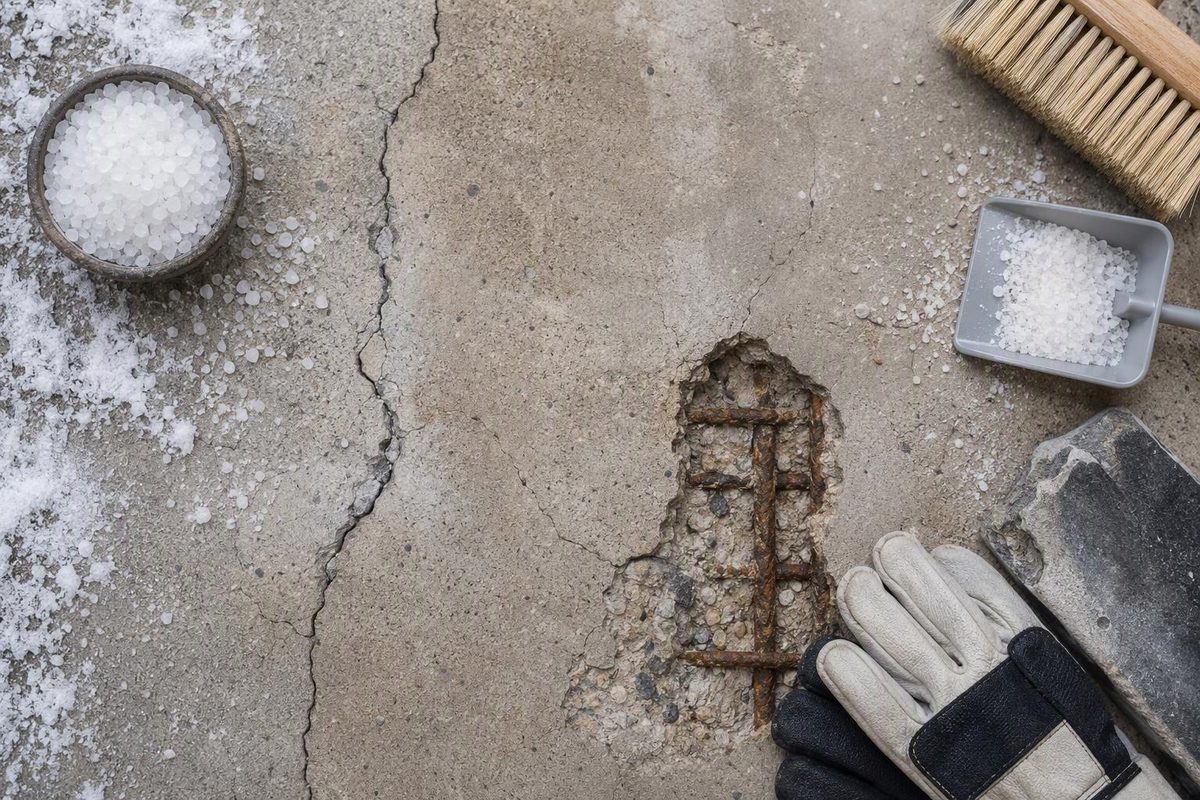
Yes—deicing salt can damage concrete, especially a wet driveway or walk exposed to repeated freezing and thawing. The usual surface damage is scaling: flakes of cement paste peel away, sometimes exposing the stone beneath. Risk increases with excessive deicer use, poor drainage, inadequate air entrainment, improper finishing or insufficient curing. Salt exposure does not mean every slab will deteriorate. NRMCA’s scaling guidance
For newly placed concrete, avoid deicing chemicals during the first winter where possible. Use clean sand for traction instead; sand does not melt ice. For older concrete, minimize chemical use rather than treating a “concrete-safe” label as a guarantee. NRMCA recommendations
How salt causes damage
There are three distinct concerns:
- Freeze–thaw scaling. Deicers increase surface saturation and aggravate the stresses associated with freezing and thawing. Properly entrained air provides small voids that help accommodate those stresses, but poor finishing can leave the surface less resistant than the concrete below. NRMCA
- Chemical attack. Concentrated calcium chloride and magnesium chloride solutions can react with cement paste and form expansive compounds. This is not simply ice expanding: FHWA documents damage in laboratory mortar specimens that were never frozen. Concentration and prolonged exposure matter, particularly where brine collects in joints. FHWA’s March 2018 technical brief
- Reinforcing-steel corrosion. Chlorides reaching embedded steel can disrupt its protective passive layer. Rust expands, potentially cracking and spalling the surrounding concrete. This concern also applies to seawater exposure and does not require freezing weather. NRMCA’s corrosion guidance
Which ice-melt ingredients should you buy—or avoid?
Check the actual ingredients, including those in blended products. Melting performance and concrete compatibility are different questions.
| Ingredient or material | Concrete-related buying check |
|---|---|
| Sodium chloride—rock salt | Can aggravate scaling and contribute chlorides to steel corrosion. NRMCA considers it acceptable for concrete when used moderately, but advises avoiding deicers in the first winter. |
| Calcium chloride | Also considered acceptable in NRMCA’s moderate-use guidance, but not harmless: FHWA documents chemical attack from concentrated solutions. |
| Magnesium chloride or other magnesium-based salts | NRMCA advises against using magnesium-based salts as concrete deicers because they are chemically aggressive. |
| Ammonium nitrate or ammonium sulfate | Do not substitute these fertilizer salts for a concrete deicer; NRMCA warns that they attack concrete surfaces. |
| Clean sand | A traction option without a deicing chemical; it does not remove or melt ice. |
Sources: NRMCA, CIP 2, NRMCA, CIP 25 and FHWA.
Selection example: For a driveway poured in autumn and entering its first winter, choose clean sand for traction rather than switching from rock salt to calcium chloride. Changing salts does not remove the new-concrete exposure concern. For an established driveway, check the ingredients and labeled application rate, and avoid repeated heavy applications or brine accumulation.
Reduce exposure—and specify the next pour correctly
Poor drainage allows salt solutions to accumulate and increases exposure severity. When conditions permit, hose off salt tracked onto driveways and garage slabs; do not create an icing hazard while cleaning. NRMCA also recommends considering a breathable silane- or siloxane-based concrete water repellent, applied to reasonably dry concrete according to its manufacturer’s instructions. A sealer is protection, not a repair for an already weak surface. NRMCA
For a new exterior slab, tell the ready-mix supplier about moisture, freezing and deicer exposure—not just the desired PSI. As a residential scaling reference, NRMCA’s 2014 CIP 2 guidance recommends 4,000 psi (28 MPa) concrete for continuously moist exterior slabs exposed to freezing and deicers, and 6% total air with ¾- or 1-inch (19- or 25-mm) coarse aggregate. These are not a complete project specification: verify current governing requirements, including any reinforced-concrete chloride-exposure requirements. Proper placement, finishing and curing remain essential. NRMCA
A concrete strength rating alone does not establish freeze–thaw durability.
If the surface is already flaking
Flaking is not proof that salt alone caused the problem: finishing defects can also produce peeling without freezing. Minor scaling may be cosmetic. A bonded repair requires removal of unsound material and a sound underlying surface; a coating over loose concrete is not an adequate repair. NRMCA
Use the concrete repair mortar selection guide for surface-repair considerations. Exposed corroding reinforcement, deep spalling or damage to a structural member warrants qualified assessment rather than a cosmetic patch.