 MortarDesk
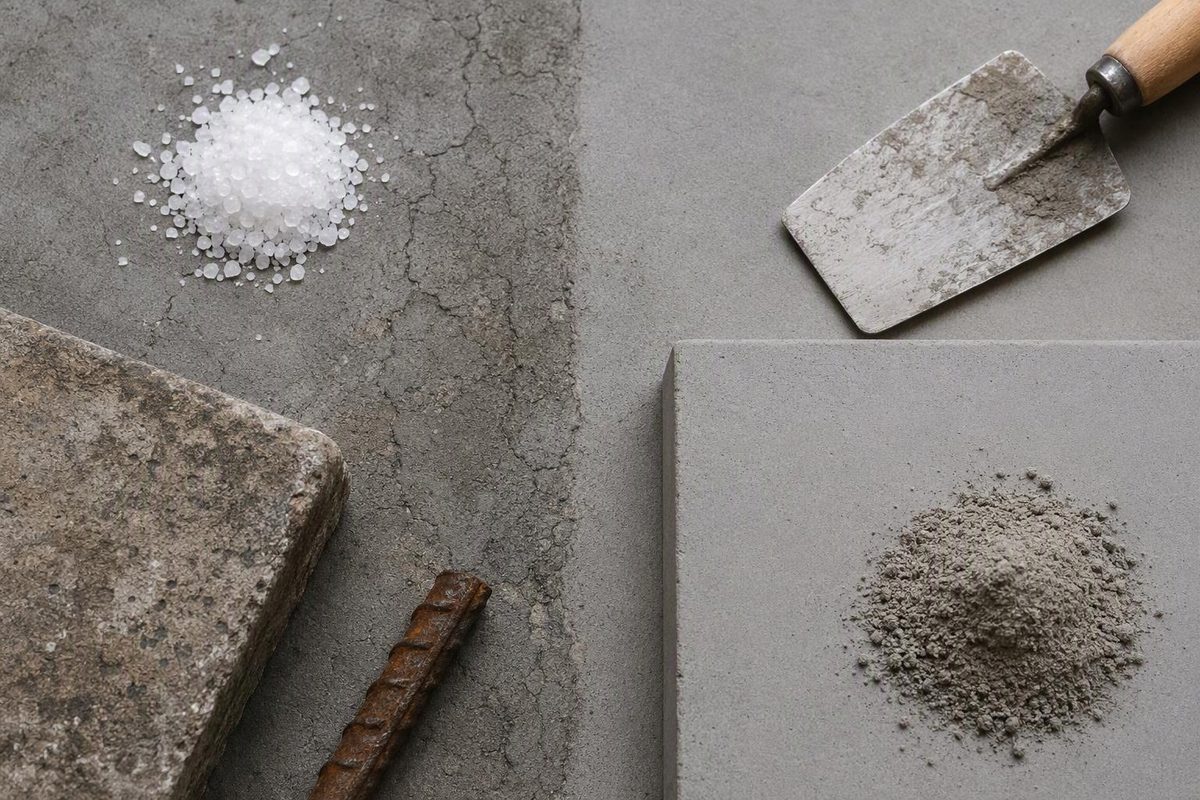
Calcium chloride is conditionally acceptable for concrete, not damage-free. As an ice melt, it can increase surface scaling and, in concentrated solutions, chemically damage hardened concrete. As an accelerator added to fresh concrete, it speeds setting and early strength development, but its chloride content creates corrosion concerns around embedded metal. Avoid chemical deicers during a new slab’s first winter; for a reinforced pour needing acceleration, ask the ready-mix supplier about a suitable nonchloride accelerator instead of adding calcium chloride yourself.
The buying decision starts with separating those two uses. A bag sold for melting ice is not a concrete admixture specification. An accelerator approved for a particular concrete mixture is not evidence that calcium chloride is harmless when repeatedly spread over its finished surface.
Select your intended use and concrete condition; read the recommendation beside the controls.
Calcium Chloride Use Check
Use Clean Sand For Traction
For a new slab’s first winter, avoid chemical deicers and remove snow. Clean sand provides traction; it does not melt ice.
Reaching 28 days of age does not automatically clear the first-winter precaution.
Limits And Fresh-Mix Guidance
Older concrete: NRMCA considers calcium chloride acceptable in moderate amounts, not damage-free. Scaling, concentrated brine and chloride exposure to steel remain concerns.
Fresh concrete: ACI E4-12 says no calcium chloride in prestressed concrete or where sulfate-resisting concrete is required; avoid it in reinforced concrete kept moist.
Nonreinforced concrete: E4-12 gives a 2% limit by mass of cementitious material, not total batch mass. This is not a product-dosing recipe or blanket code approval.
Embedded metal: NRMCA advises against chloride-based materials around embedded aluminum or galvanized metal. Consult the supplier.
Cold weather: An accelerator does not replace curing or cold-weather protection. Ask the supplier about a suitable nonchloride option.
Sources: NRMCA CIP 2 and CIP 15; ACI Education Bulletin E4-12, section 4.4; FHWA March 2018 pavement brief. Source links appear in the article.
First-Winter Concrete Should Not Receive Chemical Deicers
The National Ready Mixed Concrete Association’s CIP 2—Scaling Concrete Surfaces considers calcium chloride and sodium chloride acceptable deicers, but recommends avoiding deicing chemicals during the first winter and using only moderate amounts afterward. That is a conditional recommendation, not a guarantee against surface damage. For the first winter, remove snow and use clean sand for traction. Sand does not melt ice. (NRMCA CIP 2)
Do not replace this seasonal precaution with a simple concrete-age calculation. A slab that is 28 days old has not automatically passed the first-winter restriction. The question is not merely whether the concrete has hardened enough to walk or drive on; it is whether chemical deicing is appropriate for that surface and exposure.
For a driveway poured in autumn, this changes what to buy before the first snowfall. Clean sand addresses traction without depending on chemical melting. A product label saying “concrete-safe” does not remove the NRMCA first-winter precaution. If the bag gives additional age or surface restrictions, those also need to be followed.
| Concrete Condition | Calcium Chloride Decision |
|---|---|
| New slab, first winter | Avoid chemical deicers; remove snow and use clean sand for traction. |
| Older, sound exterior slab | May be acceptable in moderate amounts; damage remains possible. |
| Scaling surface or pooling brine | Address condition and drainage before relying on repeated applications. |
| Concrete containing reinforcement | Consider chloride exposure to embedded steel as well as the surface. |
“Older” and “sound” do not establish a damage-free application rate. The cited guidance recommends moderate use, but this draft’s sources do not supply a universal household spreading rate for every calcium chloride product and slab. Follow the particular product’s application limits rather than inventing a rate from a general statement of acceptability.
Older Concrete Still Faces Scaling And Chemical Attack
Surface scaling means the finished surface is peeling or flaking away. NRMCA identifies excessive deicer use, insufficient curing and inadequate entrained air among its causes. Concrete mixture, finishing, curing, saturation and exposure all matter; age alone does not establish resistance.
That distinction matters when comparing two driveways. A sound older slab and a slab already losing its surface should not receive the same confident recommendation merely because both are past their first winter. Existing peeling, poor drainage or pools of salty water are reasons to assess the concrete and exposure before making repeated applications the default response to ice.
There is also a chemical mechanism separate from freeze–thaw scaling. FHWA’s March 2018 pavement brief explains that calcium chloride can react with calcium hydroxide in hardened cement paste to form expansive calcium oxychloride. Concentrated solutions and salt accumulation in poorly draining joints increase concern. (FHWA Technical Brief)
Original laboratory research found that this reaction can damage cementitious materials above freezing temperatures. The finding establishes a chemical hazard; it does not predict that every light household application will ruin a driveway. Conversely, the absence of freezing at a particular moment does not make a concentrated calcium chloride exposure chemically harmless. (Original Research)
Keep the evidence in its proper setting. The FHWA brief concerns pavement exposure, and the research examines cementitious materials under laboratory conditions. Neither supplies a universal number of residential applications before damage occurs. The practical takeaway is to avoid treating concentrated or accumulated brine as equivalent to limited, moderate use on sound concrete.
Reinforcement adds another consideration. Surface appearance is not the whole compatibility check when chloride exposure also matters to embedded steel. A product that leaves a slab looking intact after an application has not, by that observation alone, established long-term compatibility with its reinforcement.
Bag Ingredients And Restrictions Matter More Than Safety Wording
Read the ingredient list, including the salts in a blend. “Concrete-safe” is not a description of the concrete mixture, its curing history, its drainage or the amount of product that will accumulate. Those variables remain relevant even when the marketing language sounds categorical.
Check the product’s concrete-age restrictions, permitted surfaces and application instructions. Treat these as product-specific limits, not permission to ignore broader first-winter guidance. If the instructions do not establish suitability for your surface, the missing information is still missing; the absence of a warning is not a concrete specification.
Drainage is part of this decision because repeated application can leave concentrated salts where water collects. Do not judge suitability solely by how quickly the ice disappears. A low spot or poorly draining joint can retain the resulting brine, which is the exposure of concern in the chemical-attack discussion.
Minimize salt accumulation. When weather permits without creating another ice hazard, hose off salts tracked onto driveways and garage slabs. Washing is not a reason to exceed application instructions, and it should not create a new frozen surface in the process.
Switching salts does not automatically solve the problem. NRMCA warns against magnesium-based deicers, ammonium sulfate and ammonium nitrate because of chemical attack. Sodium chloride remains associated with scaling and reinforcement-corrosion risks. A magnesium chloride label therefore should not be treated as proof of better concrete protection, and sodium chloride should not be described as harmless simply because NRMCA also considers it an acceptable deicer under limited use.
For a purchase comparison, the useful distinction is not “safe salt” versus “unsafe salt” in isolation. It is the actual ingredients, the slab’s condition, the applicable restrictions and whether the planned use will leave concentrated salts behind. Where those details are unknown, the recommendation cannot become more certain just because one product has stronger safety wording.
Fresh-Concrete Acceleration Requires A Different Specification
Calcium chloride added to fresh concrete serves a different purpose: accelerating setting and early strength development. It is not a substitute for cold-weather protection or proper curing. ACI’s Education Bulletin E4-12, section 4.4, states that accelerating admixtures normally do not act as antifreeze agents. (ACI E4-12)
For a cold-weather pour, faster setting does not remove the need for a protection plan. It also does not resolve whether a chloride-bearing admixture is compatible with the reinforcement, embedded items or project specification. Those are separate checks, even when the immediate concern is finishing the slab sooner.
The bulletin’s calcium chloride recommendations are specific:
| Concrete Or Requirement | E4-12 Guidance |
|---|---|
| Prestressed concrete | Do not use calcium chloride. |
| Reinforced concrete kept moist | Avoid calcium chloride. |
| Sulfate-resisting concrete required | Do not use calcium chloride. |
| Nonreinforced concrete | Limit to 2% by mass of cementitious material. |
Do not broaden or narrow these statements without checking the governing specification. The bulletin’s wording about reinforced concrete kept moist is not a statement that calcium chloride is prohibited in every reinforced application under every jurisdiction. It is also not permission to approve other reinforced applications without reviewing their chloride limits and exposure requirements.
For a structural pour, the adopted code and project documents control. Have the ready-mix supplier and responsible designer verify the admixture selection. The cited education bulletin provides guidance, not blanket approval under a current local code.
Nonchloride accelerators provide acceleration without the increased chloride-corrosion risk. That makes them the appropriate option to ask the supplier to evaluate where embedded steel is a concern. “Nonchloride” still does not mean that any product, at any dose, is suitable for every mixture; the selection remains a supplier and specification decision.
The 2% Limit Is Not A Whole-Batch Dosing Recipe
The 2% by mass of cementitious material figure in ACI E4-12 applies to its guidance for nonreinforced concrete. The denominator is cementitious material, not the total mass of concrete. Aggregate and mixing water are not a reason to reinterpret that percentage as a fraction of the entire batch.
This distinction prevents a serious specification error, but it does not turn the figure into instructions for adding a retail product. Product concentration and mixture compatibility still have to be checked. A calcium chloride solution, a solid product and a formulated admixture cannot be assumed interchangeable merely because their descriptions contain the same chemical name.
The draft does not provide a batch’s cementitious-material mass or a particular product’s concentration. There is therefore no supported product quantity to calculate here. Applying the percentage without those inputs would create an apparent dosing answer that the evidence does not establish.
Treat the figure as a boundary in the named bulletin, not a target dose. It does not establish that the maximum is needed, that a smaller amount will achieve the desired setting behavior, or that a particular job permits chloride addition at all. Ask the supplier to specify a compatible admixture and dosage rather than adding calcium chloride independently at the site.
Nonreinforced Concrete May Still Contain Vulnerable Metal
“No rebar” is not a complete embedded-metal check. NRMCA advises against chloride-based materials in concrete containing embedded aluminum or galvanized metal because of corrosion risk. It also recommends consulting the ready-mix supplier rather than independently selecting or adding admixtures. (NRMCA CIP 15)
Before describing a pour as eligible for a calcium chloride accelerator, identify embedded items as well as reinforcement. The absence of reinforcing steel does not establish the absence of aluminum or galvanized components. That is why the nonreinforced-concrete percentage alone cannot settle the purchase.
Give the supplier the concrete use, reinforcement and embedded-metal information, along with any sulfate-resistance requirement and the governing specification. The needed answer is whether a particular admixture is compatible with that pour—not whether calcium chloride accelerates concrete in general.
An Autumn Driveway Needs Two Separate Purchase Decisions
For a newly poured driveway facing its first winter, buy clean sand for traction rather than relying on a “concrete-safe” calcium chloride ice melt. Remove snow, retain the first-winter deicer precaution and do not assume that reaching 28 days of age changes that recommendation.
If the driveway has not yet been poured and faster setting is needed, ask the ready-mix supplier to evaluate a suitable nonchloride accelerator, especially where steel reinforcement is specified. Keep the cold-weather protection plan in place. A decision about accelerating the fresh mix does not answer the later question of what to spread on the finished driveway.
Keep both decisions separate from selecting a concrete curing compound. Faster setting does not replace curing, and neither makes first-winter salt exposure harmless. For an older driveway, calcium chloride may be acceptable in moderate amounts, but the slab’s condition, drainage, reinforcement and product restrictions still determine whether it is an appropriate choice.