 MortarDesk
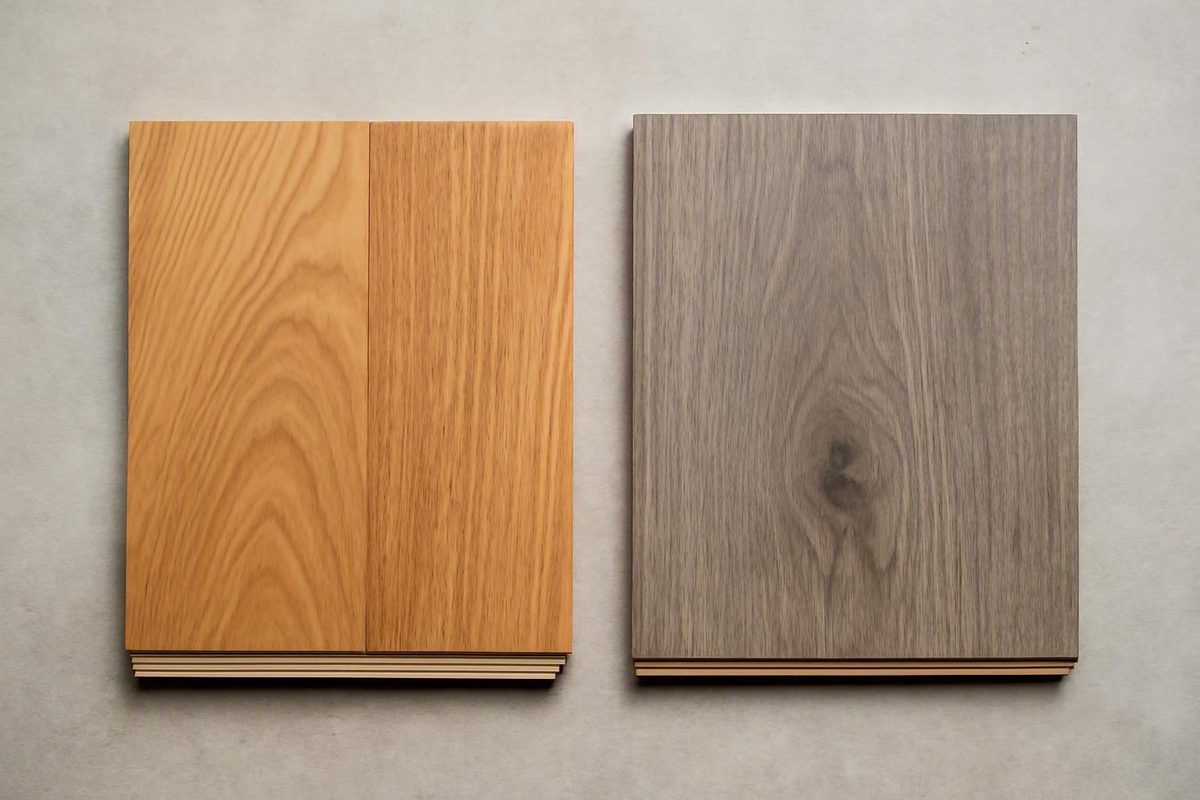
Quick comparison: where each flooring type has the advantage
For most buyers comparing engineered hardwood flooring vs laminate, the practical verdict is straightforward:
- Favor laminate when lower upfront cost, surface scratch resistance, heavy traffic, or approachable DIY installation leads the decision.
- Favor engineered hardwood when a genuine wood surface, natural plank-to-plank variation, and the possibility of future renewal matter more.
Neither is universally better. Product grade, installation quality, moisture exposure, subfloor conditions, warranty terms, and expected ownership period can matter as much as the category. Premium laminate may be more practical than entry-level engineered hardwood when scratch resistance and installation simplicity outrank having real wood underfoot.
The construction difference is fundamental. Engineered hardwood normally has a genuine hardwood veneer bonded to a layered plywood or fiberboard core. Laminate normally has a printed decorative image beneath a protective wear layer over a dense fiberboard core.
In its August 2025 comparison, Robbins estimated laminate materials at about $1–$3 per square foot and engineered hardwood at about $3–$10 or more per square foot. These are broad manufacturer estimates, not installed prices or current local quotes, and the ranges can overlap between product tiers. Robbins explains the construction and estimated material-price ranges.
| Comparison point | Engineered hardwood | Laminate |
|---|---|---|
| Surface material | Genuine hardwood veneer | Printed wood image beneath a manufactured protective wear layer |
| Core | Layered plywood or fiberboard | Usually dense fiberboard |
| Broad material-price estimate | About $3–$10 or more per sq. ft. | About $1–$3 per sq. ft. |
| Appearance | Natural grain, knots, color variation, and unique planks | Can reproduce wood convincingly, but printed patterns may repeat |
| Surface scratches | Real-wood surface can scratch; finish and species affect performance | Generally more resistant to everyday surface scratches |
| Water limitations | More dimensionally stable than solid hardwood, but not universally waterproof | Many products are water-resistant; water reaching an ordinary fiberboard core can cause swelling |
| Installation methods | Depending on the product: floating, glue-down, nail-down, or staple-down | Commonly click-lock and floated over underlayment |
| Refinishing | Possible only if veneer thickness, construction, condition, and manufacturer guidance permit | Cannot be sanded and refinished |
| Routine maintenance | Regular dry cleaning, approved cleaner, prompt spill removal, and controlled damp cleaning where permitted | Similar routine, with particular care not to saturate joints or edges |
| Likely buyer profile | Buyer prioritizing genuine wood, natural variation, and possible long-term renewal | Budget-conscious buyer, landlord, active household, or first-time floating-floor DIYer |
These are category tendencies, not promises. Laminate products differ in edge sealing, joint design, core construction, and wear surfaces. Engineered products vary in veneer thickness, finish, core composition, dimensions, and approved installation method. Water, scratch, dent, room-use, and warranty claims must be checked against the exact model.
The shortest useful decision rule is: choose laminate for practical surface protection and lower initial expenditure; choose engineered hardwood for authentic wood character and potential renewal. Then test that preliminary choice against the room, subfloor, installed quote, and warranty.
Construction, appearance, sound, and underfoot feel
Two floors can look similar on a display board yet behave differently because their visible surfaces and structural layers perform different functions.
An engineered-hardwood plank typically consists of:
- A factory-applied finish, which provides the immediate wear surface.
- A genuine hardwood veneer, supplying the visible species, grain, knots, stain color, and texture.
- A layered core, usually plywood or fiberboard, intended to provide structural stability.
- A backing or balancing layer, depending on the product design.
Because the visible layer is real wood, neighboring engineered planks naturally vary. Grain direction, mineral streaks, knots, color, and texture do not repeat with the mechanical regularity of a printed image. That variation is an advantage when authenticity is the goal, but it also means that a small sample cannot display the full installed color range.
A laminate plank normally consists of:
- A transparent protective wear layer.
- A printed decorative image, often reproducing a particular wood species, stain, or cut.
- A dense fiberboard core, which commonly contains processed wood fiber.
- A stabilizing backing layer.
It is therefore incomplete to describe laminate simply as wholly synthetic. Its visible decorative image and protective surface are manufactured, but its core commonly contains wood-derived fiber. The more important distinction for buyers is that the visible grain is an image rather than a slice of hardwood.
Modern printing, embossing, matte finishes, bevels, and varied board layouts can make laminate convincing. Its main visual limitation is repetition: the same photographed knots or grain formations may appear on several boards. Repeated prints become easier to notice in large open rooms or when identical planks are installed near one another.
Sound and underfoot feel are harder to rank by category. A floating laminate floor installed over unsuitable underlayment or an uneven subfloor may sound sharper or more hollow than expected. Underlayment can moderate that effect, but board construction, room dimensions, furnishings, subfloor stiffness, and installation quality also matter. A floating engineered floor can likewise sound or move differently from a glued or fastened assembly.
A thicker or heavier sample is not, by itself, proof that the installed floor will feel solid. The full assembly includes:
- Subfloor flatness and stiffness
- Board dimensions and joint design
- Underlayment density and compatibility
- Floating, glued, or fastened installation
- Expansion space around fixed boundaries
- Doorway and transition details
- Room size and furnishings
When shopping in person:
- Place several planks from the same line together.
- Look for repeated grain images, distinctive knots, and mirrored patterns.
- Hold the boards under angled light to assess gloss, embossing, bevels, and alignment between printed grain and surface texture.
- Inspect edges and locking profiles for visible chipping or inconsistent machining.
- Lay the samples over the proposed underlayment on a hard, flat surface.
- Walk on the mock-up and compare it with an engineered sample using its intended assembly.
- Ask to see a larger installed panel rather than relying on one loose board.
A showroom mock-up cannot reproduce the finished room perfectly, but it reveals more than an isolated plank displayed vertically under retail lighting.
Durability is not one score: scratches, dents, stains, traffic, and pets
“Durable” is too broad to settle this comparison. Separate the question into distinct performance traits:
- Surface scratch and scuff resistance
- Dent resistance
- Impact resistance
- Stain resistance
- Moisture resistance
- Resistance to traffic-related dulling
- Repairability and renewal
Laminate is generally more resistant to everyday surface scratches than conventional engineered hardwood. Its manufactured wear surface makes it a common practical choice for homes with dogs, children, rolling toys, frequent visitors, or rental turnover. That category advantage does not establish that every laminate resists dents, impacts, stains, or water better than every engineered product.
Consider what common incidents actually test:
- Dog claws: Primarily scratch and scuff resistance. Laminate often has the advantage, although tracked grit and the exact wear surface affect results.
- A dropped metal toy: Impact resistance and the possibility of chipping or denting. A scratch-resistant surface is not necessarily impact-proof.
- Heavy furniture: Concentrated loading under narrow feet. Engineered wood may dent, while laminate joints or core material may also be damaged by unsuitable loading or movement.
- A pet accident: Stain resistance, liquid exposure, seam penetration, odor, and exposure duration. A scratch claim says nothing about this event.
- A worn hallway: Finish or wear-surface performance over repeated traffic, plus the availability of recoating, refinishing, or replacement.
- A deep gouge: Engineered hardwood may permit touch-up, localized repair, recoating, or eventual refinishing. Laminate generally requires replacement of the affected plank or section.
Engineered hardwood’s susceptibility to visible scratches or dents can sometimes be offset by repairability. Minor marks may blend into a textured or character-grade wood surface. A product with suitable construction may eventually be recoated or sanded and refinished. Neither option is guaranteed merely because the floor is engineered hardwood.
Do not generalize proprietary claims. If a manufacturer calls a named product waterproof, pet-proof, scratch-resistant, or dent-resistant, the claim applies within that product’s test method, installation requirements, exposure limits, and warranty. It does not establish equivalent performance across the category.
For each exact product, record:
- Surface and finish description
- Published wear or abrasion information
- Total plank construction
- Engineered-hardwood veneer thickness
- Residential and commercial warranty terms
- Definition of normal wear
- Pet-related exclusions
- Stain, scratch, dent, and water exclusions
- Required cleaning products and maintenance
- Availability of matching replacement planks
Appearance tolerance also matters. A household expecting a uniform, nearly unmarked surface may prefer laminate’s wear layer. A buyer comfortable with small scratches becoming part of a natural patina may prefer engineered hardwood. The same physical mark can look conspicuous on a smooth, uniform floor and comparatively natural on rustic oak.
Water resistance and room-by-room suitability
Three concepts are often confused:
- Dimensional stability describes how a material responds to environmental changes such as humidity.
- Water resistance describes its ability to tolerate liquid exposure under stated conditions.
- Waterproof warranty coverage is a product-specific contractual promise subject to written installation rules, exposure limits, maintenance duties, and exclusions.
Engineered hardwood is generally more dimensionally stable than solid hardwood because its real-wood veneer is supported by a layered core. That does not make it waterproof.
Many laminate products are sold as water-resistant, while selected named products are marketed as waterproof. Ordinary laminate commonly has a fiberboard core, and prolonged exposure can cause swelling if water reaches it. Perry Floors’ buyer guide illustrates why standard water resistance and product-specific waterproof ratings should not be treated as interchangeable; the selected product’s current warranty remains controlling. Review the distinction and slab-related considerations.
Quickly wiping up a small spill is not the same as leaving water overnight. A top-down spill is also different from moisture migrating through a concrete slab. Evaluate at least four exposure types:
- Brief surface spills
- Prolonged standing water
- Water entering joints, edges, or the room perimeter
- Moisture originating below the flooring system
Room suitability should remain conditional:
| Room or condition | Engineered hardwood | Laminate | What to verify |
|---|---|---|---|
| Living room | Strong candidate when real wood and natural variation matter | Practical where traffic and scratches lead the decision | Sun exposure, furniture protection, installation method |
| Bedroom | Often suited to an authenticity-focused design | Lower-cost, easy-maintenance alternative | Sound, underlayment, transitions |
| Hall or busy family room | Viable, but real wood may show wear | Often favored for surface scratch resistance | Wear warranty and replacement-plank supply |
| Entryway | Requires control of tracked water and grit | Often practical, but seams and perimeter details remain important | Water rating, mats, exterior-door detailing |
| Rental | May suit a premium property where wood character matters | Often favored for cost and surface wear resistance | Turnover damage, repair procedure, spare planks |
| Kitchen | Use only when the exact product is approved | Use only with a suitable product-specific water rating | Appliance leaks, seams, cleanup obligations |
| Bathroom | Do not assume category-wide suitability | Do not assume category-wide suitability | Explicit room approval and water-warranty conditions |
| Below-grade basement | Product and assembly must be approved | Product and assembly must be approved | Slab moisture, vapor control, flood risk |
| Concrete slab | May be floated or glued when specifically permitted | Commonly floated when specifically permitted | Moisture testing, flatness, vapor control, adhesive or underlayment |
| Radiant heat | Approval varies by product and assembly | Approval varies by product and assembly | Temperature limits and complete-system approval |
For a concrete slab, do not stop at asking whether the flooring “can go over concrete.” Confirm that:
- The product is approved for the grade level and slab type.
- Required slab-moisture testing has been completed.
- Results comply with the flooring and adhesive instructions.
- The specified vapor-control system is compatible.
- The slab is sufficiently flat, clean, sound, and stable.
- The proposed floating or glue-down assembly is permitted.
- Perimeter and transition details follow the instructions.
Before treating a floor as suitable for a kitchen, basement, or bathroom, read the current warranty and installation manual. Check covered exposure duration, perimeter-sealing requirements, mandatory accessories, approved installation methods, cleanup obligations, and exclusions involving floods, plumbing failures, appliance leaks, pet urine, humidity, or moisture from below. Marketing language on a display card is not a substitute for the governing documents.
Price comparison: materials are only part of installed cost
Laminate generally costs less upfront, but material price is only one part of the project. As noted earlier, Robbins’ August 2025 manufacturer comparison placed laminate materials at about $1–$3 per square foot and engineered hardwood at about $3–$10 or more per square foot. The figures exclude installation and can overlap by product quality.
An itemized flooring quote should account for:
- Flooring material
- Waste and cutting allowance
- Freight or local delivery
- Acclimation and storage where required
- Underlayment
- Vapor retarder or other vapor-control materials
- Adhesive, fasteners, or staples
- Moldings and transitions
- Baseboard or shoe molding
- Stair noses, treads, risers, and landings
- Door trimming or jamb undercutting
- Existing-floor demolition
- Disposal fees
- Furniture and appliance moving
- Subfloor leveling or patching
- Structural or damaged-subfloor repair
- Slab-moisture testing and mitigation
- Installation labor
- Cleanup
- Taxes and other applicable project charges
Four purchasing scenarios show why material price alone can mislead.
DIY floating laminate usually has the lowest labor expenditure, but the buyer assumes responsibility for measurements, waste, preparation, transitions, expansion details, cutting, and compliance with instructions. Tools, delivery, disposal, and subfloor correction still cost money.
Professionally installed laminate adds labor but may reduce installation risk. It can be the more realistic comparison for a large, occupied, irregular, or transition-heavy area. Confirm whether preparation is included or priced after the existing floor is removed.
Floating engineered hardwood may avoid adhesive or fastening labor, but it is not automatically equivalent in cost to floating laminate. Board price, approved underlayment, preparation, trim, waste, and product-specific requirements can differ.
Glued, nailed, or stapled engineered hardwood introduces other materials, equipment, preparation, and skill requirements. Glue-down work over concrete may involve moisture-control measures; fastened installation requires a suitable subfloor and fastening system.
Use this worksheet:
Total quoted project cost ÷ installed square feet = effective installed cost per square foot
Calculate that figure only after normalizing the scope. If one contractor includes demolition, leveling, transitions, appliance moving, and disposal while another excludes them, the lower headline quote may not produce the lower final bill.
List future assumptions separately:
- Expected occupancy period
- Feasibility and cost of replacing damaged planks
- Availability of spare material
- Possible engineered-floor recoating or refinishing
- Disruption caused by sectional or complete replacement
- Moisture risk in the selected room
- Whether the flooring may later extend into adjacent rooms
Laminate may minimize initial expenditure. A suitable engineered floor may provide more renewal options during long ownership. That does not establish a lower lifecycle cost: such a conclusion requires project-specific installation, repair, refinishing, and replacement figures.
Obtain itemized local quotes based on the same measurements, demolition requirements, subfloor assumptions, installation method, and trim scope. Ask each bidder to state allowances and exclusions in writing.
DIY difficulty, installation methods, and subfloor requirements
Laminate commonly uses click-lock joints and is installed as a floating floor, meaning the planks connect to one another without being nailed or glued to the subfloor. This usually makes it the more approachable choice for a first-time DIY flooring project.
Engineered hardwood may be floated, glued, nailed, or stapled, depending on the product. More installation options do not automatically make installation easier. Each method has different requirements, and not every plank permits every method.
Before buying either floor, check:
- Flatness: Floating joints can flex or separate over low and high spots.
- Cleanliness: Debris may interfere with underlayment, adhesive, or plank support.
- Stability: Loose, damaged, or unsuitable substrate materials require correction.
- Slab moisture: Concrete requires the testing and controls specified for the selected assembly.
- Vapor control: Requirements vary by product, grade level, subfloor, and climate.
- Expansion space: Floating systems need the clearances and fixed-object details stated by the manufacturer.
- Doorways and stairs: Transitions, nosings, jamb cuts, and height changes require advance planning.
- Underlayment: Its material and thickness must be compatible with the flooring and warranty.
- Existing flooring: Installation over an old surface requires explicit approval and a suitable substrate.
- Radiant heat: Flooring, underlayment, adhesive, and heating system must be approved together.
- Finished height: Doors, appliances, cabinets, railings, and adjacent flooring may be affected.
A floating floor depends heavily on a flat, stable base and compatible underlayment. Floating installation avoids fastening into the substrate, but it does not eliminate preparation.
Nailed or stapled installations require a suitable wood subfloor, appropriate tools, correct fastening, and careful handling near walls. Stairs and fixed features may require methods different from those used across the open floor.
DIY buyers should verify warranty consequences before ordering. Ask whether self-installation affects structural, joint, wear, or water coverage; whether professional installation is required for certain claims; and what records must be retained.
Do not rely on universal online tolerances, moisture limits, fastening schedules, or acclimation periods. Those requirements depend on the exact flooring, subfloor, adhesive, installation method, and site conditions. Follow the current instructions for the selected products.
Cleaning, repairs, refinishing, and realistic service life
Both categories benefit from basic preventive care:
- Sweep or vacuum regularly to remove abrasive grit.
- Use entrance mats without trapping moisture beneath them.
- Fit suitable protectors under furniture.
- Lift rather than drag heavy objects.
- Remove spills promptly.
- Use only approved cleaners and equipment.
- Damp-clean only where permitted rather than saturating the floor.
- Do not assume steam cleaning is allowed.
- Maintain the indoor conditions specified by the manufacturer.
Repair and renewal should be divided into separate processes:
- Surface touch-up or recoating: Addresses limited finish wear without removing substantial wood.
- Sanding and refinishing: Removes part of the wood surface before applying a new finish.
- Individual-plank replacement: Removes and replaces one damaged board.
- Section replacement: Rebuilds a larger affected area.
- Complete replacement: Removes the floor throughout the room or connected area.
Laminate cannot be sanded and refinished because sanding would remove its protective layer and printed image. Worn, swollen, chipped, or deeply damaged laminate generally requires replacement of affected planks or sections.
Engineered hardwood may permit recoating or sanding and refinishing, but the category label does not guarantee either option. Eligibility depends on veneer thickness, construction, texture, remaining material, condition, installation, and manufacturer guidance.
Do not assume a universal minimum veneer thickness or fixed number of refinishing cycles. Before purchasing, request:
- Nominal veneer thickness
- Written refinishing eligibility
- Permitted process
- Restrictions associated with texture or finish
- Whether recoating is preferred to sanding
- Installer or warranty requirements
- Effect of refinishing on warranty coverage
Bruce’s August 2025 manufacturer comparison cited rough service-life estimates of approximately 15–25 years for laminate and 20–30 years for engineered hardwood. These are broad commercial estimates, not promises; product grade, traffic, moisture, maintenance, installation quality, and repairability can outweigh the category range. Bruce provides the estimates and qualifies engineered-floor refinishing by the real-wood layer.
A premium laminate in a low-risk bedroom could outlast a poorly installed engineered floor exposed to repeated leaks. Conversely, an engineered floor that can be maintained and renewed may remain serviceable after a non-refinishable surface would require replacement.
Individual-plank repair also depends on installation. In either case, repair is practical only when a matching board is available.
Order or retain spare planks from the original production run. Store spare boards in a dry, suitable location and keep the carton labels, receipt, technical sheet, warranty, and maintenance instructions.
How to choose: product-spec checklist and buyer profiles
The soundest decision compares exact products rather than generic categories. Create one comparison sheet for each candidate.
| Field | Product A | Product B |
|---|---|---|
| Product name and model | ||
| Flooring type | ||
| Surface material | ||
| Engineered veneer thickness, if applicable | ||
| Core type | ||
| Total board thickness | ||
| Published wear or abrasion information | ||
| Finish or wear-surface description | ||
| Water-resistance wording | ||
| Covered exposure-duration limit | ||
| Approved rooms and grade levels | ||
| Approved subfloors | ||
| Permitted installation methods | ||
| Required or attached underlayment | ||
| Vapor-control requirements | ||
| Radiant-heat approval | ||
| Cleaning restrictions | ||
| Residential warranty term | ||
| Water, pet, scratch, dent, and installation exclusions | ||
| Refinishing or recoating guidance | ||
| Replacement-plank availability | ||
| Material price | ||
| Complete installed quote |
Next, use a weighted scorecard. Assign each priority a weight from 1 to 5, where 5 means essential. Enter the candidate’s model name and flooring type, score it from 1 to 5, and multiply its score by the priority weight.
| Decision factor | Your weight | Product A score | Product B score |
|---|---|---|---|
| Low initial budget | |||
| Genuine wood appearance | |||
| Surface scratch exposure | |||
| Dent or impact exposure | |||
| Water risk | |||
| DIY installation plans | |||
| Subfloor compatibility | |||
| Expected ownership period | |||
| Willingness to maintain or refinish | |||
| Importance of localized repair |
Do not fill the scorecard using category assumptions alone. Use technical sheets, samples, warranty terms, room conditions, and installed quotes for the actual products.
Typical buyer profiles provide a starting point.
Choose laminate first if you have:
- A tight initial budget
- A rental or frequently changing occupancy
- Dogs, children, or scratch-prone circulation areas
- A busy hallway or family space
- A first-time floating-floor DIY project
- Limited interest in future sanding or refinishing
- A preference for consistent color and pattern
Choose engineered hardwood first if you want:
- A genuine hardwood surface
- Natural variation between planks
- The grain and texture of a particular wood species
- A floor intended for a long ownership horizon
- Possible future recoating or refinishing
- A surface that can develop a natural wood patina
- Authenticity to lead the design decision
There is meaningful overlap. Premium laminate may be preferable to entry-level engineered hardwood when surface wear resistance, budget control, and straightforward floating installation matter more than a real-wood veneer. Conversely, an engineered product with suitable construction and documented renewal options may be more useful to a long-term owner than similarly priced laminate.
Treat resale as a local-market question, not a guaranteed return. The supplied evidence does not establish that engineered hardwood reliably repays its additional cost. An older Houzz discussion contains conflicting consumer opinions and repeated suggestions to compare nearby homes, but it is anecdotal rather than market research. The discussion illustrates that uncertainty rather than proving resale performance. If resale is central to the purchase, review current comparable local listings and consult a real-estate professional familiar with the neighborhood and price segment.
Before ordering:
- Compare current technical sheets for the exact products.
- Read warranty definitions and exclusions, not only the headline term.
- Confirm room, grade-level, subfloor, and radiant-heat approval.
- Identify the required installation and vapor-control system.
- Obtain itemized quotes based on the same project scope.
- Inspect several planks or a large installed display.
- Verify cleaning, repair, and refinishing limitations.
- Purchase or retain spare boards.
- Keep receipts, carton labels, technical sheets, warranties, and maintenance guides.
Choose the specification, installation system, and warranty—not merely the category label. Laminate is generally the stronger starting point for lower upfront cost, surface scratch resistance, and straightforward floating installation. Engineered hardwood is generally the stronger starting point for genuine wood, natural variation, and possible renewal.
This guide provides general comparison and procurement information, not project-specific contracting or engineering advice. Specifications can change, so verify the current product documents and installation requirements before purchase.
Is engineered hardwood better than laminate for dogs and children?
Not automatically. Laminate is generally the stronger starting point when dog claws, tracked grit, toys, and heavy circulation make surface scratch resistance the main concern.
Engineered hardwood may be preferable when genuine wood matters and the buyer accepts that scratches or dents can develop. Depending on the product, some damage may be touched up, recoated, repaired, or removed during a permitted refinishing. Deeply damaged laminate generally requires plank or section replacement.
Pets and children also introduce moisture, stain, and impact risks. Compare the exact product’s wear surface, pet exclusions, water terms, cleaning rules, repair procedure, and spare-plank availability rather than deciding on scratch resistance alone.
Can engineered hardwood or laminate be installed in a kitchen or basement?
Potentially, but suitability must be confirmed for the exact product and complete installation assembly.
In a kitchen, check the water rating, seam and perimeter requirements, approved cleaning methods, and exclusions for appliance or plumbing leaks. Prompt cleanup of a small spill does not establish protection from prolonged standing water.
In a basement, verify below-grade approval, slab-moisture testing, vapor control, subfloor flatness, and the permitted installation method. Engineered hardwood’s dimensional stability relative to solid hardwood does not make it waterproof, and water reaching an ordinary laminate fiberboard core can cause swelling.
Can all engineered hardwood flooring be refinished?
No. Some engineered hardwood can be recoated or sanded and refinished, while other products cannot.
Eligibility depends on veneer thickness, plank construction, surface texture, remaining material, condition, installation, and manufacturer instructions. A product may permit recoating but not conventional sanding, or it may require a specialist process.
Request written refinishing guidance before purchase. Do not rely on a universal minimum veneer thickness or assume a fixed number of refinishing cycles.
Is laminate easier to install than engineered hardwood?
Usually, especially for a first-time DIYer. Laminate commonly uses click-lock joints and floats over approved underlayment without nails or glue.
Engineered hardwood may also be floated, but some products require adhesive, nails, or staples. These methods introduce different substrate, tool, moisture, and skill requirements. More installation choices do not make engineered hardwood inherently easier.
Either floor can perform poorly over an uneven, unstable, dirty, or moisture-affected subfloor. DIY buyers should verify preparation requirements and whether self-installation changes warranty coverage.
Does engineered hardwood add more resale value than laminate?
It may appeal to buyers who prefer genuine wood, but the supplied evidence does not establish a guaranteed price increase or return on the added cost. Product quality, installation, floor condition, neighborhood expectations, and the property’s price range may all affect how buyers respond.
Available anecdotal discussion is conflicting and should not be treated as appraisal or market evidence. Compare current nearby listings and sales where flooring details are available, then consult a qualified local real-estate professional before paying an engineered-hardwood premium solely for expected resale value.