 MortarDesk
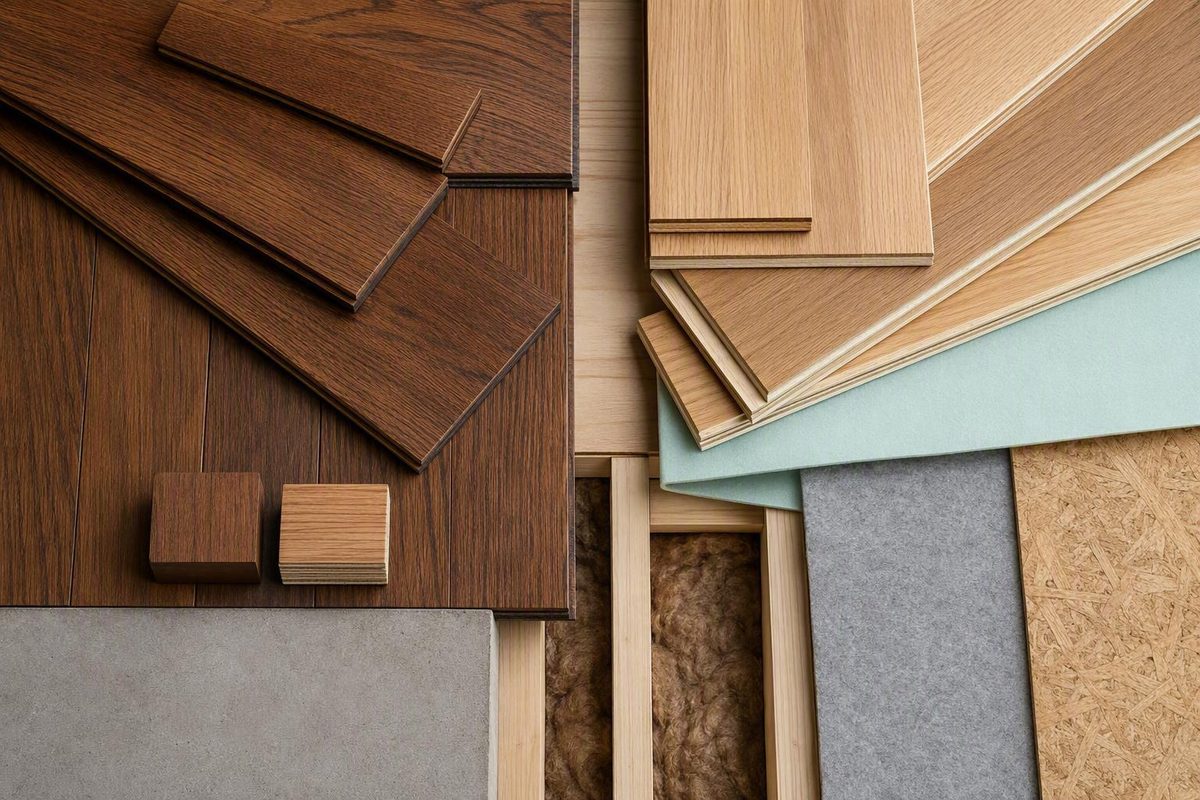
Choose solid hardwood when repeated future sanding is the priority and the approved installation is over a suitable wood subfloor. Choose engineered hardwood when the project involves concrete, a below-grade room, radiant heat or a floating installation—but verify the exact product approval.
“Engineered” does not mean imitation wood. Solid flooring is one piece of wood through its thickness. Engineered flooring has a real-wood surface over a multilayer core. The cross-layered construction reduces seasonal movement relative to solid wood, but neither type is waterproof. Shaw’s construction comparison likewise describes solid as a single piece and engineered as a real-wood veneer over plywood or fiberboard.
Quick comparison
| Buying question | Solid hardwood | Engineered hardwood |
|---|---|---|
| What is the plank? | One piece of wood | Real-wood wear layer over a layered core |
| Seasonal movement | More susceptible to gaps or distortion as moisture conditions change | Generally more dimensionally stable |
| Refinishing | Usually offers more wood above the tongue for future sanding, but profile and remaining thickness still control | Depends on the measured wear layer; some products should not be sanded |
| Typical installation choices | Commonly nailed or stapled; product instructions may permit other methods | Product-dependent nail/staple, glue-down or floating methods are widely available |
| Concrete or below grade | Do not assume approval | Many products are approved, but not every product is |
| Radiant heat | Often restricted | More products are designed for it; species and temperature limits still apply |
| Standing water | Not suitable | Not suitable unless the exact manufacturer explicitly approves the exposure |
Wood movement is not merely theoretical: U.S. Forest Service research identifies dimensional movement with changing moisture content as a principal performance characteristic of wood flooring and documents solid boards shrinking and swelling as conditions changed (USFS research abstract). Engineered construction reduces that movement; it does not eliminate the need for moisture testing, expansion space or indoor humidity control.
The number to request: wear-layer thickness
For solid flooring, total plank thickness is not the same as sandable thickness. The usable wood ends above the tongue-and-groove profile, and prior sanding reduces what remains.
For engineered flooring, ask for the real-wood wear-layer thickness in millimeters, not only the overall plank thickness. A 14 mm engineered board, for example, is not a 14 mm layer of sandable hardwood.
The NWFA’s voluntary Refinishable Program uses these minimum wear-layer benchmarks:
- Factory-finished smooth engineered flooring: 2.5 mm (3/32 in.)
- Sculpted or distressed engineered flooring: 2.5 mm (3/32 in.) measured at its lowest point
- Unfinished smooth engineered flooring: 3.2 mm (4/32 in.) before its initial sanding and finishing
NWFA also states that flooring with less than 2.5 mm (3/32 in.) of wear thickness generally should not be sanded (NWFA program details). These are program benchmarks, not a promise that every qualifying floor can be sanded a particular number of times. Board profile, flatness, damage and wood already removed all matter.
If a listing omits wear-layer thickness, request the technical sheet. “Can be refinished” without a dimension is incomplete buying information.
Match the construction to the substrate
Start with the room and subfloor, then select a product—not the other way around.
- Plywood or approved wood subfloor: either construction may work if its fastening schedule and subfloor requirements are met.
- Concrete slab: an engineered product specifically approved for glue-down or floating installation is usually the clearer route. The adhesive or underlayment must also be approved for the slab and measured moisture condition.
- Below grade: use only a product explicitly approved below grade. One Bruce engineered-flooring guide allows installation below, on or above grade while excluding full bathrooms; it also requires concrete moisture testing and permits glue-down or floating installation over concrete (Bruce installation instructions). That permission applies to flooring covered by that guide, not all engineered hardwood.
- Radiant heat: verify the flooring SKU, wood species, heating system, surface-temperature limit and installation method together.
Manufacturer instructions govern the selected product. The NWFA’s 2025 installation guidelines expressly say product-specific manufacturer recommendations supersede its general guidance and that local codes and climatic conditions still apply (NWFA installation guidelines).
Worked selection example
Project: 420 sq. ft. living area on an on-grade concrete slab, with the owner wanting a real-oak surface and the option of one future full refinish.
- Eliminate solid products whose instructions do not approve this slab assembly.
- Filter engineered oak products to those approved for on-grade concrete and the intended glue-down or floating method.
- Require a published wear layer of at least 2.5 mm for a factory-finished smooth product if using the NWFA refinishable benchmark. A thicker documented layer provides more sanding margin, but it does not guarantee a set number of refinishes.
- Compare the slab-moisture limits, vapor-control system, flatness tolerance, indoor-humidity range and expansion details in each installation sheet.
- Confirm transitions and finished floor height before ordering.
- Use the manufacturer’s waste allowance rather than assuming one percentage; layout, board lengths and defect allowance change the quantity.
In this example, engineered hardwood is the practical starting category because approved concrete installation is a requirement. The final choice is still the specific product whose technical sheet matches the slab test results and desired installation method.
Purchase checklist
Put these items on the comparison sheet:
- construction: solid or engineered;
- overall plank thickness and width;
- engineered wear-layer thickness in mm;
- approved grade level: below, on or above grade;
- approved subfloors and installation methods;
- moisture-test method and pass limits;
- required indoor temperature and relative-humidity range;
- radiant-heat approval and temperature limit, if relevant;
- refinishing statement or NWFA Refinishable certification;
- finish and structural warranty exclusions;
- carton coverage, approved waste allowance and matching stair/transition parts.
For a three-way material comparison, see engineered vs solid hardwood vs laminate. The key distinction here is that both solid and engineered hardwood present real wood at the surface; the hidden numbers—wear layer, substrate approval and moisture limits—decide whether a particular plank fits the project.