 MortarDesk
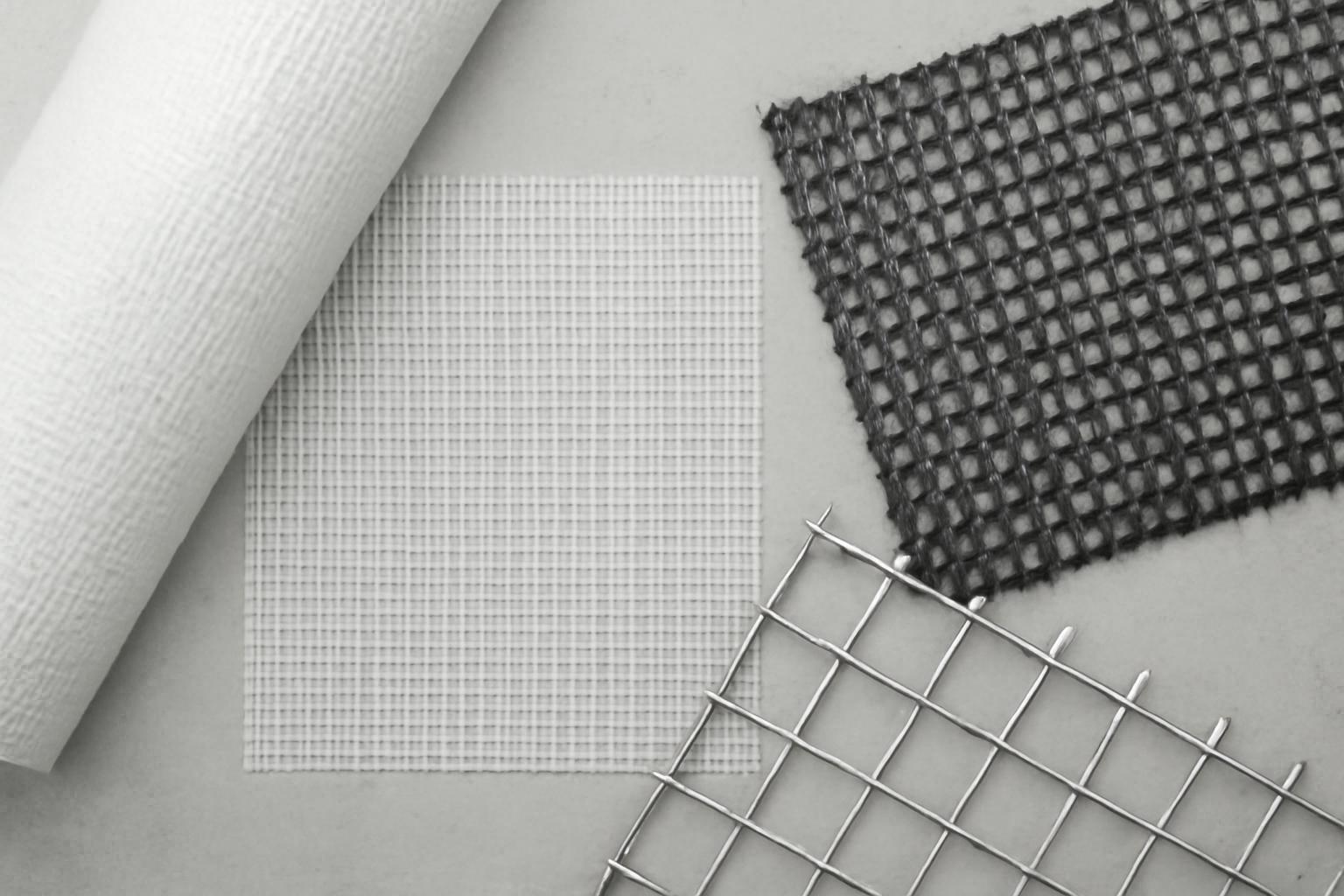
“Fiber mesh” is not one interchangeable construction product. Before comparing prices, dosages, roll sizes, or reinforcement claims, identify which of these three things you mean:
- Discrete concrete fibers: loose microfibers, synthetic macrofibers, steel fibers, or hybrids dispersed throughout wet concrete.
- Preformed fiberglass sheet mesh: an interwoven roll or strip embedded in a compatible cementitious coating, repair material, epoxy, or countertop system.
- Fiber Mesh in Subnautica: a fictional crafting material unrelated to construction.
The construction decision starts with function. Are you trying to reduce early plastic-shrinkage cracking, control later crack widening, obtain measured post-crack performance, replace a defined layer of secondary reinforcement, or reinforce a localized coating system?
This guide is a screening and procurement aid, not a project design. It explains terminology, limitations, evidence to request, and questions to take to the supplier, concrete producer, project specifier, or engineer of record. It does not establish that a particular fiber can replace reinforcement shown on drawings.
What “fiber mesh” means—and which meaning applies to your project
In the concrete trade, “fiber mesh” often means discrete fibers added to the concrete mixture. Despite the word mesh, the fibers do not form a sheet at a controlled elevation. They are distributed through the concrete volume during batching, mixing, placement, and finishing.
Dispersed fibers do not create a comparable fixed layer.
Depending on the product, it may be embedded in a cementitious coating, repair mortar, epoxy, or another specified layer. It reinforces that assembly locally or across a surface; it is not added to a concrete truck.
A quick identification test works in most buying situations:
- Bags or cartons added at a batch plant or into a mixer: dispersed concrete fibers.
- A roll described by width, length, mesh weight, opening size, and overlap: preformed sheet mesh.
- A welded steel grid or roll installed on supports: welded wire reinforcement.
- Bars installed at specified spacing and depth: rebar.
- A game recipe instead of a product data sheet: the Subnautica item.
For preformed mesh, the installation system matters as much as the roll. Mesh sold for a cementitious pool coating is intended to be embedded and covered by compatible material. Mesh sold for an epoxy-coated foam panel belongs within that seller’s undercoat, epoxy, and topcoat sequence. Neither description supports treating the bare roll as a substitute for concrete fibers, welded wire reinforcement, or rebar.
The Subnautica search result is unrelated to building materials. A community-maintained wiki displays a Fabricator recipe using two Creepvine Samples to make Fiber Mesh; because the wiki is unofficial, players should verify the recipe in their current game version (Subnautica community wiki’s Fiber Mesh entry).
Microfibers, synthetic macrofibers and steel fibers perform different jobs
The central distinction is not simply whether a fiber is “small” or “large.” It is the function the selected product can demonstrate in fresh or hardened concrete.
Microfibers
Synthetic microfibers are primarily selected to reduce plastic-shrinkage cracking.
Ordinary monofilament microfibers should not be assumed to provide the residual strength or crack-load transfer expected from macrofibers. Helping concrete through its early plastic condition does not make a product a substitute for reinforcement intended to control later crack widening under drying shrinkage, thermal movement, settlement, or applied loads.
A narrower exception applies to some fibrillated microfibers. Industry guidance says qualifying fibrillated products used at an adequate specified dosage may serve as an alternative to light-gage welded wire reinforcement for temperature-and-shrinkage crack control. That is a product-, dosage-, and function-specific allowance—not permission to treat every bag of microfiber as wire replacement (Chryso’s explanation of primary, secondary, micro- and macrofiber roles).
Synthetic macrofibers
Synthetic macrofibers are selected when hardened concrete must retain useful performance after cracking. Depending on their geometry, stiffness, bond, dosage, concrete mixture, and test results, qualifying products can provide:
- Post-crack residual strength
- Crack-load transfer
- Flexural toughness
- Resistance to progressive crack opening
- Three-dimensional distribution through the concrete volume
Calling a product a macrofiber does not prove that it is structural reinforcement for every application. It indicates a product category that can be specified around measured post-crack performance. The specification should state the required result, not merely a bag count.
Steel fibers
Steel fibers are also macrofibers, but “steel fiber” is not a complete specification. Performance may change with:
- Manufacturing type
- Length
- Effective diameter
- Aspect ratio
- Tensile properties
- Hooked, crimped, flattened, or other deformation
- Bond with the concrete
- Fiber count per unit mass
- Dispersion and orientation after mixing
Two steel-fiber products can have the same mass dosage yet deliver different fiber counts and spacing through the slab. Neither characteristic proves superiority without product-specific testing.
A technical review of steel-fiber floor specifications likewise identifies classification, length, effective diameter, aspect ratio, deformation, count, and incorporation into the mixture as important variables—not dosage alone (Construction Specifier’s steel-fiber specification review).
Primary and secondary reinforcement are not interchangeable terms
Primary reinforcement carries forces assigned by the structural design.
Secondary reinforcement is commonly assigned to temperature-and-shrinkage crack control. It limits crack propagation or opening after cracks occur; it does not guarantee crack-free concrete.
This distinction controls substitution. Evidence that a fiber can perform a defined secondary-reinforcement function does not establish that it can replace load-carrying bars.
| Fiber class | Principal function | Placement | Typical post-crack role | Potential substitution role | Specification priority |
|---|---|---|---|---|---|
| Microfiber | Reduce plastic-shrinkage cracking in young concrete | Dispersed through the mixture | Generally not relied upon for macrofiber-like residual capacity | Crack-control support; not presumed to replace load-carrying steel | Product classification and plastic-shrinkage performance |
| Fibrillated microfiber | Early-age crack reduction; qualifying products may also address limited temperature-and-shrinkage control | Dispersed through the mixture | Product- and dosage-dependent | Possible replacement for defined light-gage secondary reinforcement when documented | Fiber form, tested minimum dosage, permitted function |
| Synthetic macrofiber | Post-crack residual strength, toughness, crack-load transfer, and control of later crack widening | Dispersed through the mixture | Significant when properly selected, dosed, and tested | Possible engineered replacement for defined secondary reinforcement or another approved function | Required residual performance and product-specific test results |
| Steel fiber | Post-crack strength, toughness, and crack-load transfer | Dispersed through the mixture | Depends strongly on geometry, bond, count, dosage, and concrete properties | Possible engineered replacement or contribution in qualifying designs | Classification, geometry, count, deformation, dosage, and measured performance |
Manufacturer dosage examples vary because products and applications vary. A dosage associated with plastic-shrinkage control cannot be transferred to a macrofiber floor design. Historical steel-fiber examples developed around a particular slab calculation are not universal recipes.
Fiber mesh vs wire mesh and rebar: what can actually be replaced?
Fibers, welded wire reinforcement, and rebar reach the concrete in different ways.
Fibers are mixed into the batch and distributed throughout its volume. Welded wire reinforcement is installed as a grid and must remain at its specified elevation. Rebar is installed in selected directions and locations according to the drawings.
Each approach has construction risks. Fibers can be omitted, poorly dispersed, or added incorrectly. Conventional steel can be unsupported, displaced, or installed at the wrong depth. These risks do not make the systems interchangeable.
The relevant question is not “Is fiber better than wire?” It is:
Can this exact fiber product, at this tested dosage, perform the precise reinforcement function assigned to this wire or bar on this project?
Replacement matrix
| Required function or condition | Appropriate label | What the label means |
|---|---|---|
| Reducing plastic-shrinkage cracking in fresh flatwork | Commonly used for crack-control support | A tested microfiber may be suitable, but its inclusion does not replace load-carrying steel |
| Replacing light secondary reinforcement for temperature-and-shrinkage control | Conditionally suitable as secondary-reinforcement replacement | Requires a qualifying fiber, tested dosage, design basis, specification permission, and approval |
| Adding early-age crack control while retaining designed rebar | Supplemental only | Fibers and bars perform separately assigned functions |
| Replacing welded wire reinforcement in an engineered slab with a macrofiber system | Conditionally suitable as secondary-reinforcement replacement | Accept only where calculations, standardized performance data, project requirements, and approvals support it |
| Removing primary bars or other load-carrying steel merely because fibers are present | Not a presumed substitute | Existing reinforcement remains unless a project-specific engineered design explicitly changes it |
| Beams, columns, bridges, foundations, unusual loading, or safety-sensitive structural work | Not a presumed substitute | Rule-of-thumb equivalence is inappropriate; the engineer of record must define the system |
| Using fibers with welded wire reinforcement or rebar | Supplemental only, unless otherwise designed | The design should assign a role to each component |
Synthetic macrofibers and steel fibers may replace welded wire reinforcement in some slabs and assemblies, but approval is limited to the demonstrated function. A substitution accepted for temperature-and-shrinkage reinforcement does not automatically apply to reinforcement carrying structural forces.
Composite steel deck slabs illustrate the limitation. Qualifying fiber systems may be accepted for specified temperature-and-shrinkage functions, while negative-moment reinforcement remains where the design requires it. Fiber Reinforced Concrete Association guidance specifically says fibers are not currently used to replace negative-moment steel in composite deck assemblies (FRCA guidance on deck slabs and negative-moment reinforcement).
Universal equivalency claims are unreliable because equal mass does not mean equal reinforcement. Products dosed at the same pounds or kilograms per concrete volume can differ in stiffness, length, diameter, aspect ratio, surface texture, deformation, bond, count, dispersion, and tested residual performance.
Supplier software can help screen a proposal, but it cannot convert an incomplete specification into an approved design. Sika says its slab software considers factors such as loads, slab thickness, concrete grade, and ground conditions. It also limits the tool to knowledgeable professional users who must independently verify the results (SikaFiber software description and professional-use conditions).
Any structural substitution should be reviewed against the current project documents, applicable local requirements, product test reports, concrete properties, and construction controls. This is especially important for composite decks, elevated slabs, unusual loading, beams, columns, bridges, foundations, and other consequential work.
Match the reinforcement to the application and failure risk
Begin with the reinforcement objective rather than the product name.
Application decision tree
1. Is the material mixed into concrete or embedded as a sheet?
- Mixed into concrete: determine whether the proposed product is a microfiber, synthetic macrofiber, steel fiber, or hybrid.
- Embedded as a roll: verify the complete coating, repair, epoxy, or countertop system.
2. What event are you trying to control?
- Cracking while concrete is young and plastic: investigate tested microfibers.
- Later crack widening from shrinkage, temperature change, or service conditions: investigate macrofibers or properly designed conventional reinforcement.
- Required post-crack capacity: specify measurable residual performance for a qualifying macrofiber system.
- Primary structural loading: retain or redesign the required structural reinforcement through the responsible designer.
- A crack or transition within a coating: investigate compatible preformed fiberglass mesh.
3. What is the consequence of failure?
A cosmetic crack in a garden path is not the same problem as loss of capacity in an elevated slab. As loading, occupancy risk, structural consequence, or repair difficulty increases, generic product descriptions and rule-of-thumb substitutions become less acceptable.
The following application notes are screening guidance. They do not determine the reinforcement for a real project.
Patios, sidewalks and routine flatwork
For a patio or sidewalk, a microfiber may be worth investigating when the priority is reducing plastic-shrinkage cracking during placement and early curing. It does not eliminate the need for suitable concrete, subgrade preparation, joints, curing, drainage, thickness control, or reinforcement required by the design.
If the objective includes controlling hardened crack width or transferring load across cracks, a macrofiber or conventional reinforcement design may be required. Geometry, support, joints, exposure, loading, and the consequences of movement all matter.
Driveways
A quote that says only “fiber included” does not reveal whether the contractor proposes a light microfiber for early-age crack control or a macrofiber intended to replace secondary wire reinforcement.
Ask whether conventional steel is shown in the plans, what role the fiber performs, and what evidence supports any deletion. Microfibers should not be presented as an automatic replacement for reinforcement needed for later crack control or load-carrying behavior.
Industrial floors and heavily loaded slabs
For an industrial floor, the screening questions should cover:
- Point and rack loads
- Vehicle or material-handling loads
- Slab thickness and geometry
- Concrete strength
- Subgrade or subbase support
- Joint spacing and details
- Edge and corner conditions
- Required residual strength
- Exposure and service environment
- Finishing and floor-covering requirements
A high dosage is not proof of adequacy. The project specification should identify the required test result and the approved product and dosage used to achieve it.
Composite steel deck slabs
A deck-slab substitution must remain within the reinforcement function and assembly for which it is accepted. A qualifying fiber proposal for temperature-and-shrinkage reinforcement does not, by itself, authorize removal of negative-moment or other structural steel.
Beams, columns, bridges and foundations
Do not apply residential flatwork assumptions to beams, columns, bridges, foundation elements, retaining structures, or similarly consequential work. Fibers may be supplemental reinforcement or part of a specially engineered fiber-reinforced system, but the decision cannot be inferred from a bag dosage or supplier comparison chart.
Crack repairs and dissimilar-substrate transitions
Preformed fiberglass sheet mesh can reinforce a compatible coating over cracks, weakened areas, or transitions between different materials. It should be embedded in the manufacturer-specified wet layer, extended or overlapped as directed, and completely covered.
Surface preparation, coating thickness, overlap, curing, and compatibility affect the assembly. A Basecrete retailer, for example, describes a coated fiberglass mesh used within that coating system and gives a crack-repair sequence based on embedding and covering the mesh in fresh material (Basecrete Fibermesh listing and installation directions).
Concrete countertops
A mesh promoted for one countertop system should be evaluated within that system.
The FG50 seller positions its alkali-resistant fiberglass roll for use with specified countertop products and companion clips. That recommendation does not establish suitability for structural slabs or unrelated concrete.
Epoxy-coated foam shower and decorative panels
In an epoxy-coated panel assembly, fiberglass mesh can act as reinforcement within the layered system. The cited Stone Coat procedure embeds mesh into wet undercoat, follows it with finish-specific epoxy, and then applies a topcoat.
The seller describes the overall assembly as waterproof, but its listing does not establish the bare mesh as waterproofing. Any such performance belongs to the complete system, including substrate preparation, continuity, coating thickness, curing, corners, and penetrations.
| Application | Likely objective | Product category to investigate | Documentation needed | Main misuse to avoid |
|---|---|---|---|---|
| Patio or sidewalk | Early plastic-shrinkage reduction | Microfiber | Product data, relevant test results, batching instructions | Assuming it eliminates all cracking or replaces structural steel |
| Driveway | Early crack reduction and possibly later crack-width control | Microfiber with retained steel, or an engineered macrofiber system | Plans, loading assumptions, test results, substitution approval | Accepting “fiber mesh” without a class or function |
| Residential slab | Temperature-and-shrinkage control | Macrofiber, welded wire reinforcement, rebar, or a defined combination | Project specification and residual-performance data where relevant | Treating every dosage as equivalent |
| Industrial floor | Residual strength and service crack control | Synthetic macrofiber or steel fiber | Engineered slab design and product-specific testing | Selecting by bag count alone |
| Composite deck | Approved temperature-and-shrinkage function | Qualifying macrofiber or steel fiber | Current assembly requirements, specification, design, and approval | Removing negative-moment steel |
| Beam, column, bridge, or foundation | Primary structural capacity | Engineered reinforcing system | Project-specific design and current governing requirements | Rule-of-thumb steel replacement |
| Coating over a crack or transition | Localized system reinforcement | Fiberglass sheet mesh | Compatible coating, overlap, coverage, and curing instructions | Applying dry mesh without full embedment |
| Countertop | Thin-section system reinforcement | Alkali-resistant countertop mesh | Complete system instructions and placement details | Generalizing a seller’s countertop recommendation |
| Epoxy-coated panel | Reinforcement within a layered assembly | Compatible fiberglass sheet mesh | Undercoat, epoxy, topcoat, coverage, and curing instructions | Calling bare mesh waterproof |
How to read fiber specifications and performance tests
Dosage is an input. It is not proof of performance.
A useful specification connects four things:
- The reinforcement function
- The measurable performance requirement
- The approved product and tested dosage
- The field controls required to reproduce that performance
Synthetic-fiber information to request
For synthetic fibers, ask for:
- Fiber classification
- Polymer or other material
- Microfiber, macrofiber, or hybrid designation
- Cut length
- Equivalent diameter or linear density
- Monofilament, fibrillated, twisted, embossed, or other geometry
- Tensile properties
- Applicable product specification
- Product-specific test reports
- Concrete mixtures and dosages represented by those tests
- Limitations on pumping, placement, finishing, or exposure
Industry guidance identifies ASTM D7508/D7508M in connection with polyolefin chopped strands used in concrete, including synthetic microfibers, macrofibers, and hybrids. Classification alone does not establish that a product is suitable for a particular slab.
Steel-fiber information to request
For steel fibers, request:
- ASTM classification stated by the supplier
- Manufacturing type
- Length
- Effective diameter
- Aspect ratio
- Tensile properties
- Bendability where relevant
- Hooked, crimped, flattened, or other deformation
- Fiber count per unit mass
- Collated or loose form
- Addition and mixing procedure
- Approved dosage and tested performance
Secondary technical sources identify ASTM A820/A820M in connection with steel-fiber requirements and ASTM C1116 in connection with fiber-reinforced concrete and incorporation of fibers into the mixture. Before using either reference contractually, verify its current title, edition, scope, and applicability to the project.
Match each test to the question it is intended to investigate
The following is a high-level orientation, not a substitute for reading the current standard or obtaining professional interpretation.
| Test or reference identified in industry guidance | Question to ask about the submitted data |
|---|---|
| ASTM C1579 | Does the report evaluate plastic-shrinkage crack reduction under the test conditions? |
| ASTM C1399/C1399M | Does the report provide an average residual-strength result after cracking? |
| ASTM C1609/C1609M | Does the report describe flexural behavior and residual strength after cracking? |
| ASTM C1550 | Does the report evaluate energy absorption using a round-panel procedure? |
| ASTM D7508/D7508M | Does the synthetic-fiber documentation address the applicable material and classification requirements? |
| ASTM A820/A820M | Does the steel-fiber documentation address the applicable steel-fiber classification and requirements? |
| ASTM C1116 | Does the concrete documentation address the relevant fiber-reinforced-concrete classification and mixture provisions? |
| ACI 544 guidance | Which current design, production, specification, or testing guidance applies to this project? |
The Fiber Reinforced Concrete Association identifies C1579 for plastic-shrinkage evaluation and C1399, C1609, and C1550 for forms of post-crack testing. It also recommends specifying an applicable residual-strength, equivalent-flexural-strength, strength-ratio, or energy-absorption result rather than relying on dosage alone (FRCA test-method and specification guidance).
ACI 544 guidance may be a starting point, but the current document must be consulted directly. Historical dosage examples tied to older ACI, Steel Deck Institute, or manufacturer documents should not be presented as current universal requirements.
Preliminary bid-review checklist
This is a coordination checklist, not a validated inspection or acceptance procedure. The project specification must establish responsibilities, testing frequency, acceptance criteria, required records, and corrective action.
- [ ] Exact reinforcement role
- [ ] Governing drawings, specifications, standards, and local requirements
- [ ] Approved manufacturer and product
- [ ] Fiber classification and material
- [ ] Tested dosage for the intended function
- [ ] Required residual or crack-reduction performance
- [ ] Permitted substitutions and submittal procedure
- [ ] Concrete mixture represented by the supporting tests
- [ ] Batching location and addition method
- [ ] Required mixing procedure
- [ ] Trial-batch or trial-pour requirements
- [ ] Inspection and batch-record requirements
- [ ] Engineer-of-record approval where required
- [ ] Clear statement of which conventional reinforcement remains
Dosage, batching, workability and finishing
No universal fiber calculator covers every product and project. Required dosage depends on the fiber, reinforcement objective, tested performance, concrete mixture, loading, slab dimensions, support conditions, joints, equipment, and governing specification.
Published micro-, macro-, and steel-fiber dosages should therefore be treated as product or application examples—not default values to copy into an order.
Workability is likely to change
Fibers can make concrete more cohesive and reduce its apparent slump. For hydrophobic polypropylene and polyethylene fibers, association guidance attributes this apparent slump reduction to increased cohesion rather than water absorption.
Do not restore workability by adding unapproved water. Doing so changes the controlled mixture and may undermine the basis on which strength, durability, finishing, or fiber performance was evaluated. A compatible water reducer or superplasticizer may instead be considered within the approved mix design.
Common field problems
Potential problems include:
- Fibers added in the wrong sequence
- Insufficient mixing or dispersion
- Clumping or fiber balling
- Bags or cartons omitted from a load
- Unauthorized product substitutions
- Extra water added to recover workability
- Pump screens, hoses, or equipment incompatible with the fiber
- Difficult consolidation or placement
- Fibers collecting at edges or around tools
- Surface fibers remaining visible
- Tearing, dragging, or other finishing problems
- Appearance outside the specified tolerance
Fiber material, length, stiffness, shape, and dosage can affect pumping, placement, finishing, and appearance. A product that performs acceptably with one mixer, pump, concrete mixture, and finish may behave differently with another.
Manufacturer guidance recommends trial batches when workability is uncertain and project-specific trials before sensitive flooring work. It also notes that fiber material, geometry, dimensions, and dosage can alter the finished surface and required technique (Euclid Chemical’s contractor guide to fiber-reinforced concrete).
A trial batch or trial pour is especially prudent when any of these change:
- Fiber product or length
- Dosage
- Concrete mixture
- Mixer type
- Addition point
- Pump or hose arrangement
- Screed or finishing equipment
- Floor covering
- Surface appearance requirement
- Crew experience
The trial should reproduce the proposed production process closely enough to reveal mixing, pumping, placement, and finishing issues. A hand-mixed sample that bypasses the planned pump is not a complete pumpability trial.
Preliminary concrete-fiber coordination checklist
The project documents should convert relevant items into enforceable procedures and define who accepts or rejects the work.
- [ ] Verify the approved product before batching.
- [ ] Confirm the approved dosage and units.
- [ ] Determine which batch records or bag counts are required.
- [ ] Check that substitutions follow the formal approval process.
- [ ] Follow the documented addition sequence.
- [ ] Follow the product-specific mixing instructions.
- [ ] Observe for visible clumps, balls, or poor dispersion.
- [ ] Perform specified fresh-concrete tests.
- [ ] Record approved admixture adjustments.
- [ ] Prevent unauthorized water additions.
- [ ] Observe pumping, placement, consolidation, and finishing as required.
- [ ] Record surface-fiber or appearance concerns.
- [ ] Retain the records required by the project specification.
The evidence does not support one mixing time for all fibers, mixers, and concrete mixtures. It also does not establish a universal method for removing exposed surface fibers without affecting appearance. Follow the selected product instructions, approved mix documentation, and project specification.
Buying and installing preformed fiberglass mesh
Sheet mesh should be evaluated as a component of a complete assembly. Concrete-fiber questions such as pounds per cubic yard do not apply to it.
Sheet-mesh specification checklist
Request or verify:
- [ ] Glass-fiber type
- [ ] Alkali resistance
- [ ] Resin, polymer, or other protective coating
- [ ] Weight per unit area
- [ ] Opening size
- [ ] Warp tensile data
- [ ] Weft tensile data
- [ ] Warp and weft elongation
- [ ] Roll width and verified length
- [ ] Compatible substrates
- [ ] Compatible cementitious coating, mortar, epoxy, or resin
- [ ] Required wet-layer thickness or consumption
- [ ] Exposure and storage limits
- [ ] Minimum overlap
- [ ] Edge, corner, penetration, and transition details
- [ ] Complete-embedment requirements
- [ ] Curing conditions and time
- [ ] Number of layers
- [ ] System warranty requirements
- [ ] Effective rather than nominal coverage
Seller pages often omit enough data to prevent reliable strength comparisons. A listing may say “heavy duty” or “alkali resistant” without providing opening size, coating chemistry, tensile data, or test conditions. Products belonging to different systems should not be ranked by roll area or marketing language alone.
Basecrete example
The Basecrete retailer lists an interwoven, resin-polymer-coated fiberglass mesh weighing 4.5 ounces per square yard. The listed rolls are 4, 9.5, or 38 inches wide, each 150 linear feet long (Basecrete retailer product specifications).
For the seller’s crack procedure, installers are directed to embed the mesh in fresh Basecrete material, extend it beyond the crack by the stated amount, cover it until the mesh is no longer visible, and cure it according to the system instructions. Those directions are product-specific and should not become a universal overlap rule for other meshes.
FG50 countertop example
The FG50 seller lists a 2-by-50-foot roll with 100 square feet of nominal coverage and positions it as an alkali-resistant mesh for concrete products, including a countertop system using companion clips and concrete products (Walttools FG50 product listing).
The supplied page does not disclose opening size, mesh weight per area, tensile data, coating chemistry, detailed installation instructions, or downloadable technical resources. The nominal area is useful for an initial quantity check, but it does not prove structural capacity or compatibility outside the named system.
Stone Coat epoxy-panel example
The Stone Coat page demonstrates why roll information should be confirmed before ordering. One part of the listing describes a 36-inch-by-72-foot roll, while another says 36 inches by 75 feet; both state 225 square feet of coverage. The seller positions the mesh for embedment in wet Epoxy Quick Coat followed by finish epoxy and topcoat (Stone Coat fiberglass-mesh listing and system directions).
The conflicting length should remain unresolved until the seller or a controlled product document confirms it. It also shows why coverage figures alone are insufficient for ordering.
Nominal versus effective coverage
Calculate effective coverage after allowing for:
- Side and end overlaps
- Offcuts
- Corners and returns
- Penetrations
- Edge reinforcement
- Damaged or defective areas
- Layer count
- Directional installation requirements
- Practical waste
A roll with nominal area equal to the wall or countertop area may be insufficient after overlaps and details are included.
Most importantly, fiberglass mesh is reinforcement within a compatible assembly. The available product evidence does not establish bare mesh as a waterproofing membrane. Where waterproofing is claimed, it depends on the specified coating or epoxy system, substrate preparation, continuity, thickness, curing, and detailing.
A practical pre-purchase decision process
Use this process before ordering fiber reinforcement or accepting a proposed substitution.
1. Identify the physical format
Write down whether the item is:
- Discrete microfiber
- Discrete synthetic macrofiber
- Discrete steel fiber
- Hybrid concrete fiber
- Preformed fiberglass sheet mesh
- Welded wire reinforcement
- Rebar
Do not accept “fiber mesh included” as a complete quote description.
2. Define the reinforcement function
Identify the actual requirement:
- Plastic-shrinkage crack reduction
- Temperature-and-shrinkage crack control
- Control of later crack widening
- Post-crack residual strength
- Toughness or energy absorption
- Primary structural capacity
- Localized reinforcement of a coating or repair
- Reinforcement within an epoxy assembly
If more than one function applies, assign each function to a component.
3. Identify governing requirements
Review:
- Drawings
- Structural notes
- Concrete specifications
- Approved submittals
- Current standards
- Local requirements
- Listed assemblies
- Manufacturer system instructions
- Warranty conditions
If welded wire reinforcement or rebar appears in the documents, do not assume a supplier or contractor can remove it without formal approval.
4. Obtain product-specific evidence
For concrete fibers, request:
- Exact product and classification
- Material and geometry
- Approved dosage
- Relevant test reports
- Residual-performance documentation where required
- Concrete-mixture information represented by the tests
- Mixing and addition instructions
- Allowable substitutions
- Required quality-control records
For fiberglass sheet mesh, request:
- Verified roll dimensions
- Weight, openings, and tensile properties
- Coating and alkali-resistance information
- Complete compatible coating or epoxy system
- Substrate-preparation requirements
- Wet-layer thickness or consumption
- Overlap and edge details
- Layer count
- Curing conditions
- Warranty documentation
5. Confirm compatibility
For concrete fibers, check compatibility with the concrete mixture, mixer, pump, finishing method, exposure, floor covering, and appearance requirement.
For sheet mesh, check the glass and coating against the embedment material, substrate, alkalinity, exposure, and cure conditions. Similar-looking rolls are not automatically interchangeable.
6. Evaluate field installation
Determine:
- Who supplies the fiber or mesh?
- Who adds the fiber?
- Who verifies the approved dosage?
- Which records are required?
- Who evaluates visible dispersion?
- Who approves workability adjustments?
- Who installs and overlaps sheet mesh?
- Who confirms complete coverage?
- Who is responsible for corrective work?
These responsibilities should be assigned by the contract documents rather than assumed in the field.
7. Calculate effective quantities
For concrete fibers, base the order on the approved dosage and actual concrete volume, including the project’s ordering assumptions.
For sheet mesh, calculate effective area after overlaps, layers, returns, penetrations, offcuts, and waste. Resolve conflicting roll dimensions before relying on a seller’s coverage figure.
8. Secure required approval
A substitution request should identify:
- Reinforcement proposed for replacement
- Function assigned to that reinforcement
- Proposed fiber product
- Tested dosage
- Performance basis
- Concrete-mixture assumptions
- Construction and inspection requirements
- Reinforcement that remains
- Required professional approval
Supplier calculators may help with preliminary comparisons, but their assumptions must be visible and independently reviewed. The FullForce calculator, for example, is aimed at specifying engineers and engineers of record and references ACI 544.4R and ACI 360R. Its public page does not disclose enough formulas, assumptions, or validation evidence for an output to serve as an unreviewed design (FullForce calculator description).
Compare total installed cost, not an unsupported unit price
A useful cost comparison includes:
- Fiber dosage or mesh quantity
- Overlap and waste
- Required coatings or epoxies
- Shipping
- Ready-mix fiber charges
- Batching and handling
- Admixture or mix adjustments
- Labor
- Chairs, supports, cutting, or tying
- Pump and equipment requirements
- Trial pours
- Testing
- Inspection
- Finishing time
- Schedule risk
- Repair or rejection risk
Material-only prices do not establish which system will cost less when installed.
Frequently asked questions
Does fiber mesh stop concrete from cracking?
No reinforcement system guarantees crack-free concrete. Microfibers can reduce plastic-shrinkage cracking while concrete is young. Qualifying macrofibers or steel fibers can provide post-crack performance and help control later crack widening when selected and tested for that function.
Results also depend on the concrete mixture, support, joints, curing, weather, geometry, loading, placement, and finishing. Secondary reinforcement controls crack behavior; it does not promise that cracks will never form.
Can fiber mesh replace welded wire mesh or rebar in a driveway or slab?
Sometimes, but only for a defined reinforcement function.
A qualifying synthetic macrofiber or steel-fiber system may replace welded wire reinforcement assigned to temperature-and-shrinkage control when supported by the design, applicable performance data, project specifications, and required approvals. Some qualifying fibrillated microfiber products may also have limited light-gage secondary-reinforcement uses.
That does not mean fibers automatically replace rebar, primary reinforcement, or bars carrying structural or negative-moment forces. A proposal should identify the exact fiber, dosage, test basis, reinforcement function, approval route, and steel that remains.
What is the difference between microfiber and macrofiber?
Microfibers are primarily used to reduce plastic-shrinkage cracking before concrete hardens. Ordinary microfibers generally are not relied upon for substantial post-crack load transfer.
Macrofibers are selected for performance after cracking, including residual strength, toughness, and control of later crack widening. Suitability depends on geometry, bond, dosage, concrete properties, test results, and project design—not simply the word “macro.”
Is fiberglass mesh waterproof by itself?
Not based on the available product evidence. Fiberglass mesh is normally reinforcement within a compatible cementitious coating, epoxy, or other layered system.
Any waterproofing claim belongs to the complete assembly, including substrate preparation, coating continuity, required thickness, corners, penetrations, curing, and topcoats. Bare mesh should not be treated as a waterproof layer.
How do you make Fiber Mesh in Subnautica?
The community-maintained Subnautica wiki displays a Fabricator recipe using two Creepvine Samples to make Fiber Mesh. The item has no connection to concrete or fiberglass construction reinforcement, and the unofficial recipe should be checked against the current game version (Subnautica community wiki recipe).
The practical rule has four parts:
- Identify whether the product is dispersed fiber or sheet mesh.
- Define the exact reinforcement function.
- Compare verified performance and compatibility—not names or dosage alone.
- Obtain the required approval for any substitution of steel reinforcement.
Microfibers, synthetic macrofibers, steel fibers, welded wire reinforcement, rebar, and fiberglass sheets solve different problems. None should be substituted by assumption. Mortar Desk publishes general building-material reference information rather than contracting or engineering advice, so structural choices should be confirmed against current product documents, project specifications, local requirements, and qualified professional guidance (Mortar Desk’s publication scope).