 MortarDesk
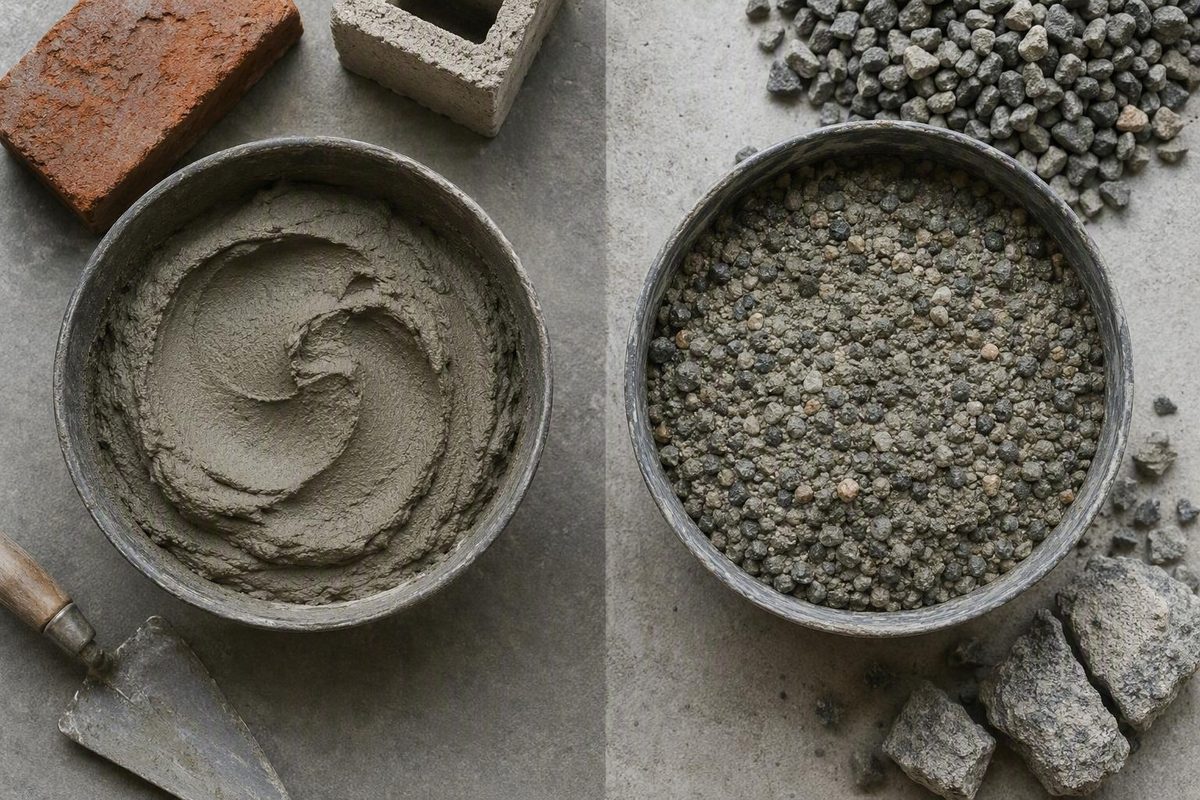
The difference at a glance
The simplest way to understand the difference between mortar and concrete is:
Concrete forms the element; mortar joins the elements.
Mortar is a fine-textured masonry material commonly used to bond brick, concrete block, and stone. It fills the joints between separate masonry units and helps them work together as an assembly.
Concrete is normally placed as a larger mass to create the element itself. Common examples include slabs, footings, foundations, driveways, paths, patios, post bases, and components specifically designed for concrete. Although the materials share several ingredients, concrete ordinarily contains coarse aggregate while masonry mortar does not. Concrete2You distinguishes cement as the binder, mortar as a fine masonry-bonding material, and concrete as a composite containing larger aggregate.
Ordinary mortar and ordinary concrete are not interchangeable. Their composition, consistency, placement method, and intended performance differ.
| Point of comparison | Mortar | Concrete |
|---|---|---|
| Primary purpose | Joins masonry units and fills masonry joints | Forms a slab, footing, foundation, path, driveway, post base, or other concrete element |
| Typical ingredients | Cementitious binder, water, and fine aggregate such as sand | Cementitious binder, water, fine aggregate, and coarse aggregate |
| Aggregate size | Fine; generally no gravel- or crushed-stone-sized aggregate | Fine and coarse aggregate, commonly including gravel or crushed stone |
| Wet consistency | Thick, creamy, and spreadable for trowel work | Plastic or flowable enough for the specified placement and consolidation method |
| Relative strength and rigidity | Generally lower in compressive strength and less rigid than concrete | Generally stronger and more rigid, depending on the specified mixture |
| Placement method | Spread with a trowel and compressed or tooled in masonry joints | Placed, poured, or pumped into a prepared area or form |
| Typical uses | Brick, block, stone, pointing, repointing, veneers, and specified setting beds | Slabs, patios, sidewalks, driveways, post bases, footings, foundations, walls, and designed structural elements |
These are general distinctions rather than definitions of fixed recipes. Both mortar and concrete are families of mixtures. Their properties vary with the binder, aggregate, water content, admixtures, curing, workmanship, exposure, product requirements, and project specification.
The deciding question is not, “Which material is better?” It is, “What must this material do?”
- If the job is to bond compatible masonry units or refill their joints, the answer is normally mortar.
- If the job is to form a new mass or element, the answer is normally concrete.
- If the job is to repair existing work, identify the existing material and the defect before selecting a product.
Ingredients: coarse aggregate is the clearest dividing line
Mortar and concrete commonly begin with a similar ingredient base:
- a cementitious binder;
- water; and
- fine aggregate, usually sand.
The clearest practical dividing line is coarse aggregate. Concrete normally adds gravel, crushed stone, or another stone aggregate. Masonry mortar generally omits that coarse material, producing a finer mixture that can be spread and compacted into relatively thin joints.
Sand is aggregate too, but it is fine aggregate. When a concrete description refers to aggregate, it may include both sand and larger stone. Mortar needs body from sand, but ordinary masonry joints would not accommodate the gravel-sized particles found in typical concrete.
What the ingredients do
The ingredients work together:
- Cementitious material forms the binding phase that hardens and holds the mixture together.
- Water enables the binder’s chemical reaction and makes the fresh material placeable.
- Fine aggregate gives the mixture body and helps create the texture needed for its application.
- Coarse aggregate in concrete becomes part of the hardened mass.
Adding stone to an arbitrary cement-and-sand mixture does not automatically create concrete suitable for a particular project. Aggregate grading, water content, binder selection, placement, curing, and any specified reinforcement affect the finished element.
Mortar terminology also requires care. Some mortars are made with portland cement, hydrated lime, sand, and water. Others use masonry cement with sand and water. A packaged mortar mix may already contain its cementitious components and aggregate. It is therefore incorrect to say that every mortar requires separately added lime. Sakrete describes portland-cement-and-hydrated-lime mortar and masonry-cement mortar as two recognized formulation approaches.
Lime or ingredients incorporated into masonry cement can affect qualities such as workability and water retention, but the formulation depends on the product. Read the bag and product data rather than inferring the recipe from the word mortar.
Why a universal ratio is unhelpful
Generic recipes can imply that mortar and concrete can be selected or designed by counting shovelfuls. Proportions and required performance vary with:
- product and binder type;
- mortar category;
- required concrete performance;
- aggregate moisture and grading;
- masonry unit;
- exposure;
- placement method; and
- project requirements.
A casual ratio cannot establish whether a product is appropriate for historic brick, a load-bearing wall, a foundation, or an exterior slab. For bagged materials, use the manufacturer’s stated water range and mixing procedure. For specified work, use the material identified in the project documents.
The useful ingredient rule is narrow but practical: mortar is normally a fine-aggregate bonding material, while concrete normally includes coarse aggregate so it can form a larger hardened mass. Proprietary and specialized products may not fit a simple visual rule, so the product label remains controlling.
Why concrete is stronger while mortar is easier to work
Concrete and mortar are optimized for different actions.
Concrete is generally formulated to become a strong, rigid mass. It is placed in enough volume to form a slab, footing, wall, base, or other element. Its coarse aggregate is integral to that mass, while the completed element may also depend on dimensions, support, joints, curing, and reinforcement where specified.
Mortar is formulated to bond masonry units while remaining workable enough to spread, adhere, fill irregularities, and compact into joints. A mason must be able to place a controlled bed, position the unit, fill the joint, and finish its exposed surface. A harsh mixture containing coarse stone would be poorly suited to that work.
Amerimix describes mortar as a fine, workable masonry-bonding material and concrete as a coarse-aggregate material intended for stronger, thicker applications such as slabs and structural elements. Its mortar-and-concrete comparison connects those formulations directly to their different uses.
Mortar’s lower strength is not automatically a defect
It is tempting to assume that the stronger material is always better. Masonry does not work that way.
A mortar joint must bond adjacent units, fill variations between them, and contribute to the behavior of the wall. A compatible joint may accommodate limited movement and remain the more practical part of the masonry to remove and renew during repointing. A replacement mortar selected only for maximum strength may be a poor match for older or softer masonry; the relationship between the joint and the masonry units matters, not just the mortar’s strength in isolation. Commercial mortar guidance similarly describes intentional differences in rigidity and repairability between mortar joints and concrete masses.
“Stronger” therefore does not automatically mean “more compatible.” This is particularly important when repairing existing brick or stone. Matching only the color or choosing the product with the most aggressive strength description does not establish suitability.
Mortar should not, however, be described simply as flexible. Hardened mortar is not an elastic sealant, and ordinary mortar cannot be assumed to absorb every movement without cracking. The more accurate statement is that mortar is typically less rigid than concrete and should be selected as part of a masonry system.
Material strength is not the same as assembly strength
A load-bearing masonry wall can contain mortar without using mortar as though it were a concrete slab or footing. The wall’s performance comes from the assembly: masonry units, mortar joints, geometry, support, connections, workmanship, and reinforcement or grout where the design calls for them.
Mortar can transfer and distribute forces between units and contribute to a load-bearing wall. That does not turn it into concrete or mean that a bag of mortar can be poured to form an independent structural element.
Likewise, concrete’s compressive strength alone does not establish whether a slab, footing, or wall is adequate. The element may also depend on dimensions, support, reinforcement, joints, drainage, exposure, and loading. The correct material designation is only one part of the project.
Actual strengths vary too widely to justify a universal mortar-versus-concrete figure. Formulation, water control, curing, testing, workmanship, age, exposure, and project requirements all matter. Qualitatively, ordinary concrete is generally stronger and more rigid than masonry mortar, but the specified product and completed assembly govern actual performance.
How each material is placed and where it belongs
Placement provides another practical distinction.
Fresh mortar is normally thick and spreadable. It is picked up and applied with a trowel, laid as a bed or pressed into a joint, and then compacted or tooled as the masonry work proceeds. It must remain workable enough to place the units and produce properly filled joints.
Concrete is normally placed, poured, or pumped into a prepared excavation, form, or bounded area. Depending on the project, it may then be distributed, consolidated, struck off, finished, protected, and cured. The procedure for a small post base is not the same as that for a driveway or building foundation, but in each case concrete forms the mass instead of serving as a thin bond between masonry units.
Common mortar applications
Mortar is commonly used for:
- laying brick;
- laying concrete masonry block;
- laying compatible stonework;
- filling bed and head joints;
- pointing new masonry;
- repointing deteriorated joints;
- installing masonry veneers under an appropriate system; and
- forming setting beds where the specified product permits it.
Repointing requires more than filling a visible gap. The replacement mortar must be suitable for the masonry and existing work. This is particularly important where the existing units or mortar differ substantially from current general-purpose products.
Common concrete applications
Concrete is commonly used for:
- slabs;
- patios;
- paths and sidewalks;
- driveways;
- post bases;
- equipment or utility pads;
- footings;
- foundations;
- concrete walls;
- steps and curbs; and
- structural elements designed for concrete.
A retailer’s buying guide likewise separates mortar products used to bond brick and stone from concrete mixes used for slabs, sidewalks, steps, driveways, posts, footings, and foundations. The Home Depot organizes these cement-based products by intended application rather than treating them as interchangeable.
Not every concrete element is structural in the same sense. A garden path and a building footing are both concrete applications, but their consequences and design requirements differ. Concrete used in a structural element may be part of a design that also specifies dimensions, support, reinforcement, and other requirements. Amerimix distinguishes ground-supported concrete from concrete serving structural functions and notes that reinforcement may be used to improve performance in relevant applications.
Quick project-selection table
| Project | Normal material choice | Important qualification |
|---|---|---|
| Brick or concrete-block joints | Mortar | Use the mortar specified for the units, exposure, and assembly |
| New stone masonry | Mortar | Confirm compatibility with the stone and construction system |
| Deteriorated masonry joints | Compatible repointing mortar | Match the existing masonry rather than selecting only by strength or color |
| Driveway or patio slab | Concrete | Preparation, thickness, joints, drainage, and curing still matter |
| Path or sidewalk | Concrete | Follow the product and project requirements for placement and finishing |
| Fence or structural post base | Concrete | Confirm the required dimensions and project details |
| Footing or foundation | Specified concrete | Follow the drawings, specifications, and local requirements |
| Concrete chip or surface defect | Product intended for that repair | Confirm suitability from the repair product’s documentation |
| Potentially structural or recurring damage | Assessment before product selection | Do not assume that filling the visible defect resolves its cause |
For load-bearing or specification-sensitive work, project plans, product documentation, and local requirements override a general comparison article. If the work needs a project-specific material designation and none is available, obtain qualified guidance rather than selecting a bag by appearance.
Why mortar and concrete should not be substituted
Mortar and concrete both contain cementitious binder and sand, but shared ingredients do not make them equivalent. Their proportions, aggregate structure, fresh properties, placement, and intended roles are different.
Why ordinary concrete is not masonry-joint mortar
Typical concrete contains coarse aggregate. That stone is useful when forming a concrete mass, but it interferes with creating relatively thin masonry joints. Ordinary concrete is not formulated to spread like mortar, form an even bed beneath masonry units, fill narrow joint geometry, or compact and tool in the same way.
Using concrete between bricks or blocks can produce poor workability, incomplete filling, inadequate bonding, cracking, or other unsatisfactory performance depending on the mixture and assembly. No single failure pattern applies to every situation, but ordinary concrete is not a substitute for specified masonry mortar. Angi’s comparison likewise assigns mortar to masonry joints and concrete to standalone elements such as slabs and foundations.
Why ordinary masonry mortar is not concrete
Mortar lacks the coarse-aggregate structure expected in normal concrete and is not formulated to become a slab, footing, driveway, or foundation. Pouring mortar into a form does not make it concrete; it creates a mortar mass being used outside its ordinary purpose.
Depending on the application, that substitution can result in cracking or insufficient performance. It may also conflict with the product’s stated placement limits or the project specification. A material that performs properly in a masonry joint should not be assumed to perform properly as the complete cross-section of a concrete element.
Buy by application, not by color
Dry mortar and concrete products can look similar in a bag. Once mixed, both may be gray and paste-like. After hardening, their color and texture can vary, so visual resemblance does not establish equivalence.
Before buying, identify the job in functional terms:
- Are you joining masonry units?
- Are you forming a concrete element?
- Are you repairing existing mortar, masonry, or concrete?
- Is the work load-bearing or otherwise governed by project requirements?
- Does the drawing, bag, or product data name a material or application?
Then check the complete product label and data sheet. Products labeled “mortar mix,” “concrete mix,” “masonry cement,” “repair mortar,” “resurfacer,” or “grout” may sit in the same aisle without being suitable for the same job.
The repair exception: when a repair mortar may be used on concrete
The rule that mortar should not replace concrete has an important but limited exception: some specialized products are marketed and specified as concrete repair mortars.
The word mortar in that product category describes a fine repair material, not ordinary masonry-joint mortar. A formulated repair mortar may be suitable for a particular concrete chip, spall, edge repair, or surface defect. Its suitability depends on the uses and limits stated in the manufacturer’s documentation.
This does not mean ordinary masonry mortar is a general concrete-patching product. Nor does it mean a repair mortar can replace the concrete required for a slab, footing, foundation, or other complete element. MudMixer distinguishes ordinary masonry mortar and concrete from mortar-form products intended for particular limited repairs.
Organize repair selection around three questions.
1. What is the existing material?
Determine whether the damaged area is concrete, a mortar joint, brick, block, stone, grout, a cementitious coating, or an earlier repair. A gray surface is not necessarily concrete, and hard material between masonry units is not necessarily original or compatible mortar.
2. Is this only a product-selection problem?
A small, stable surface defect may be suitable for a documented repair product. Damage that may involve the capacity or stability of the element, or whose cause is unclear, is not resolved simply by filling the visible opening. It requires qualified assessment before a repair material is chosen.
3. Does the product documentation cover the application?
Check whether the manufacturer identifies the existing material and defect as permitted uses. Also follow the stated substrate preparation, placement limits, mixing, application, curing, and environmental instructions. A product intended for one repair condition should not be assumed suitable for every other condition.
Do not use ordinary masonry mortar to rebuild a structural concrete section or replace specified concrete. Do not infer compatibility from similar color or texture. Use a product whose documentation expressly covers the proposed repair, and obtain qualified guidance when the work may be structural.
Cement, masonry cement, mortar, concrete, and grout are not synonyms
Several related products share cementitious ingredients, but their names identify different materials or stages of formulation.
Cement
Cement is a binding ingredient, not the finished concrete or mortar. When combined with water, cementitious material forms a paste that hardens and binds aggregate or other constituents. “Cement driveway” is common casual wording, but the placed material is normally concrete.
Masonry cement
Masonry cement is a manufactured cementitious product used to make certain mortars. It is not synonymous with finished mortar. It is combined with suitable aggregate and water according to the product instructions or project specification.
This distinction matters when purchasing. A bag of masonry cement may require field-added sand, while a bag labeled as a complete mortar mix may already contain aggregate. The label establishes what must be added.
Mortar
Mortar is the finished fine-aggregate material used primarily to bond masonry units and fill their joints. Its formulation may use portland cement and hydrated lime, masonry cement, or another specified binder system. Mortar is selected for masonry performance and compatibility, not simply for maximum compressive strength.
Concrete
Concrete is the finished composite that normally includes cementitious binder, water, fine aggregate, and coarse aggregate. It is placed as a mass to create the element. EasyMix separates cement as a binding powder from mortar and from concrete containing fine and coarse aggregates.
Grout
Grout is another cementitious material with its own formulations and applications. Depending on the system, grout may fill cells, joints, spaces, or voids, but its name does not make it an automatic substitute for masonry mortar or concrete. Masonry grout, tile grout, and other specialized grouts are not necessarily interchangeable with one another.
As a functional starting point:
- mortar normally bonds and beds masonry units;
- concrete normally forms the element; and
- grout normally fills a specified space or void.
Product data and project documents still control the actual selection.
Bag-label checklist
Before opening a bag or adding water, check:
- Product name: Is it cement, masonry cement, mortar mix, concrete mix, grout, resurfacer, or repair mortar?
- Stated application: Does the label name the intended use?
- Formulation: Is aggregate included, and must any additional material be added?
- Required water: What range and mixing method does the manufacturer specify?
- Placement limits: What joint size, thickness, patch depth, or application conditions are permitted?
- Substrate preparation: What cleaning or preparation does the product require?
- Curing and protection: What procedures and environmental limits apply?
- Referenced requirement: Does the product identify a mortar type, performance class, or project specification?
- Restrictions: What applications does the manufacturer exclude?
- Package yield: Is there enough material for the planned volume or joint area?
Avoid universal homemade ratios, particularly for structural, exterior, historic, or specification-controlled work. A generic recipe cannot account for binder type, aggregate condition, masonry compatibility, exposure, or required performance.
Selection limits: specifications override rules of thumb
“Concrete forms; mortar joins” is a dependable purchasing rule, but it is not a complete project specification.
The correct material may be affected by:
- masonry unit type and condition;
- age and condition of existing work;
- supported load;
- above-grade or below-grade location;
- climate and exposure;
- soil and drainage conditions;
- joint dimensions;
- reinforcement and grout;
- preservation requirements;
- appearance;
- product instructions; and
- project drawings and local requirements.
These variables are especially important for mortar. Recognizing the letters is not enough to select the correct type for a particular wall.
Do not treat those letters as a universal strongest-to-weakest shopping ladder. The highest-strength option is not automatically the most compatible choice, particularly when repointing older or softer masonry. Load, unit type, exposure, wall design, workmanship, and project requirements all affect the assembly.
A load-bearing wall should not be assigned a mortar type solely from a brief online chart. Follow the material designation in the project documents or obtain qualified guidance where a specification is required.
Setting, curing, and strength development are different
Several time-related terms are often confused:
- Setting describes the fresh material losing plasticity and becoming firm.
- Curing is the period and process in which appropriate conditions support continued hardening.
- Strength development continues over time and depends on the material and conditions.
- Readiness for loading or service depends on the product, element, environment, and project requirements.
Neither mortar nor concrete should be declared ready for every use after one universal number of hours or days. Follow the product data and project instructions rather than relying on a generic schedule.
When to stop relying on the basic rule
Seek project-specific guidance when the work involves:
- a foundation or other load-bearing element;
- engineered masonry;
- damage that may affect structural performance;
- historic or unusually soft masonry;
- uncertain existing materials;
- extensive repointing;
- a repair intended to restore structural capacity; or
- disagreement between the product label and the project documents.
Where instructions conflict, do not improvise a compromise mixture. Resolve the conflict with the manufacturer, designer, specifier, building official, or qualified trade responsible for the work.
Mortar Desk publishes general reference information about building materials. It is not a contractor and does not provide project-specific engineering advice; its published scope directs structural work to qualified trades or professionals working to local requirements. Specifications change, and applicable requirements vary by project and locality.
Frequently asked questions
Can concrete be used between bricks or concrete blocks?
Ordinary concrete should not be used as the jointing material between bricks or concrete blocks. Its coarse aggregate and mass-placement properties are not intended for thin, workable masonry joints. It can be difficult to spread evenly, compact fully, and tool correctly.
Use mortar specified for the masonry units and assembly. For load-bearing, reinforced, or otherwise engineered masonry, follow the project documents rather than selecting a mortar solely from a general-purpose label.
Can ordinary mortar be used to patch concrete?
Ordinary masonry mortar should not be assumed suitable for a concrete patch. Some specialized products are called concrete repair mortars, but those products are formulated and documented for particular repair conditions.
Identify the existing material and check whether the proposed product expressly permits the repair. If the damage may affect structural performance or its cause is uncertain, obtain qualified assessment instead of covering it with an improvised patch.
Is mortar strong enough for a load-bearing masonry wall?
Mortar can be part of a load-bearing masonry wall, but performance depends on the complete assembly and its specification. Masonry units, mortar, geometry, support, connections, workmanship, loading, and any specified reinforcement or grout all contribute.
That does not mean mortar can replace a concrete beam, slab, or footing. Use the mortar and associated materials identified by the project documents and applicable requirements.
Do all mortar mixes contain lime?
No. Some mortar formulations combine portland cement with separately added hydrated lime and sand. Others use masonry cement. Packaged products may contain a complete preblended formulation.
Read the bag to determine whether it is a complete mortar mix, masonry cement requiring added sand, or another product. Do not add or omit lime based only on a generic recipe.
How can I tell mortar from concrete by looking at it?
Visible coarse stone or gravel is a clue that the material may be concrete. Mortar normally has a finer, sand-textured appearance because it generally lacks concrete’s coarse aggregate. Location also provides context: material forming a slab or footing is likely concrete, while material in regular joints between bricks or blocks is likely mortar.
Appearance is not conclusive. Fine-aggregate products, grout, coatings, weathered surfaces, and previous repairs can blur the distinction. Color cannot reveal binder type, strength, compatibility, or intended use. When identification affects structural work or important existing masonry, rely on project records, product information, or qualified assessment rather than sight alone.
The final purchasing rule remains straightforward: use mortar when the job is to join compatible masonry units or repair their joints. Use concrete when the job is to form a slab, footing, foundation, driveway, post base, or another element designed for concrete. For repairs, engineered masonry, and structural work, identify the existing material and follow the specified product, project documents, and local requirements rather than substituting one cement-based material for another.