 MortarDesk
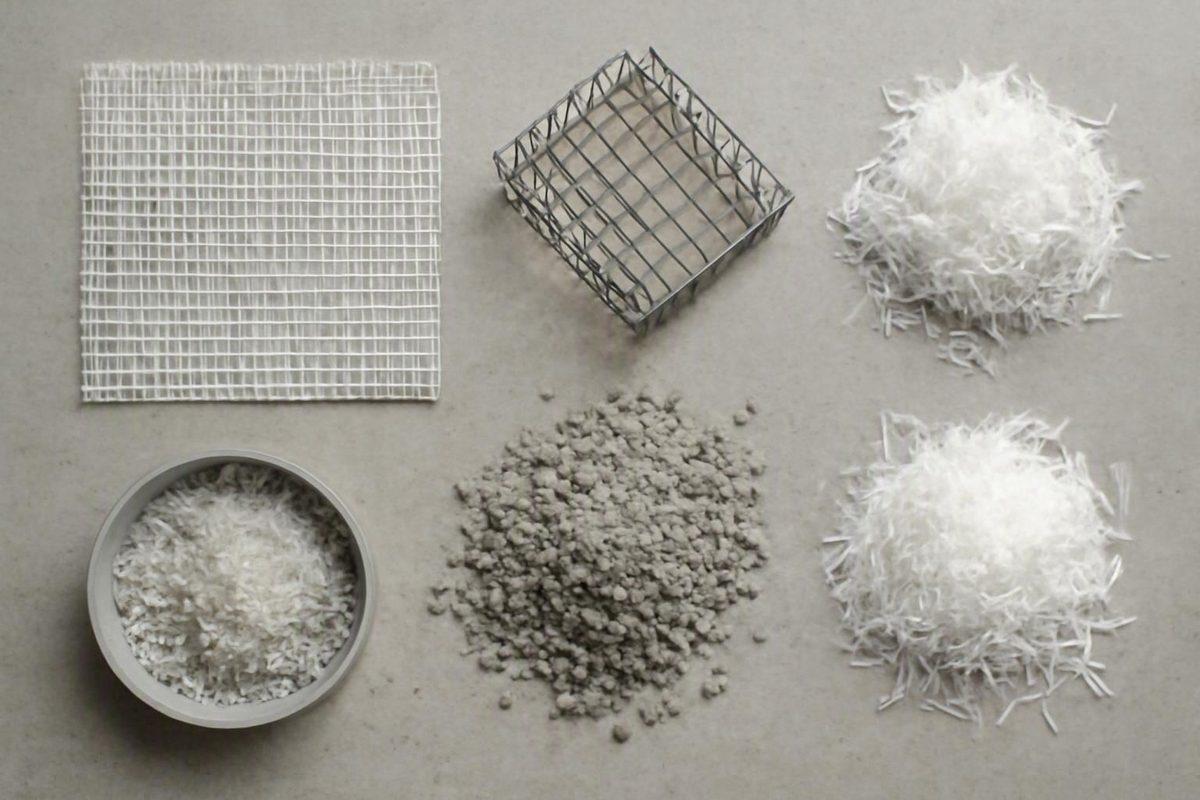
“Fiber mesh for concrete” can describe several products that are installed differently and perform different jobs. It may mean small synthetic fibers added during batching, engineered macrofibers intended to bridge hardened cracks, steel fibers, or a fiberglass sheet embedded in a countertop or repair system. The term is also commonly confused with welded-wire reinforcement and rebar.
Begin with the required function. Determine whether the concrete needs:
- Reduction of early plastic-shrinkage or settlement cracking
- Temperature-and-shrinkage crack control
- Measured post-crack residual capacity
- Primary structural tensile resistance
- Local reinforcement within a coating, repair, or countertop assembly
Then compare the exact product, dosage, composite test data, installation method, governing documents, local requirements, and approvals. A statement that “fiber replaces mesh” is incomplete unless it identifies the fiber, the reinforcement being replaced, the function of that reinforcement, and the conditions under which the substitution is accepted.
First identify what “fiber mesh” means
The quickest initial test is to ask how the product enters the work: Is it mixed into the concrete, positioned as a sheet, or tied in place?
Dispersed concrete fibers are discrete, discontinuous fibers introduced into the concrete mixture. Mixing distributes them throughout the concrete volume instead of holding them at one controlled elevation. Depending on the product, they may arrive in degradable bags, loose packages, or another batching format.
The principal dispersed-fiber categories are:
- Synthetic microfibers, generally associated with early-age crack reduction
- Synthetic macrofibers, which may provide tested post-crack performance
- Steel macrofibers, which may bridge cracks and retain load after cracking
- Hybrid systems, containing more than one fiber size or type
Other concrete fibers include alkali-resistant glass and cellulose products. Material name alone is not enough to identify the function. A glass microfiber mixed through concrete is not the same product as a fiberglass roll, just as a steel fiber is not equivalent to a continuous reinforcing bar.
Preformed fiberglass sheet mesh is supplied as a roll or strip and positioned within a compatible assembly. It may be embedded in a cementitious coating, repair mortar, epoxy, or countertop system.
Welded-wire reinforcement, often called wire mesh, is a steel grid made with defined wire sizes and spacing. It must be supported and maintained at the location required by the drawings or specification.
Rebar consists of reinforcing bars installed at specified sizes, spacing, depth, orientation, lap, and development length.
| Package or specification clue | Likely product | Installation method |
|---|---|---|
| Bags or cartons; dosage in lb/yd³ or kg/m³ | Dispersed concrete fiber | Added during batching or mixing |
| “Micro,” “macro,” fiber length, denier, or aspect ratio | Dispersed concrete fiber | Distributed throughout the concrete |
| Roll width and length, mesh opening, overlap, or embedment instructions | Fiberglass sheet mesh | Positioned within a compatible assembly |
| W-number, wire size, gauge, and grid spacing | Welded-wire reinforcement | Supported as a fixed steel layer |
| Bar number, diameter, spacing, cover, lap, or development requirements | Rebar | Tied and positioned as detailed |
| Several fiber types or lengths in one package | Hybrid dispersed-fiber system | Added and mixed under exact-product instructions |
FG50 illustrates the boundary between these categories. Its seller identifies it as alkali-resistant fiberglass sheet mesh for a cast-in-place countertop system and supplies it in a 2-by-50-foot roll. Those facts establish its product form and documented sales context, not its suitability for a driveway, foundation, pavement, or structural slab. The intended system and dimensions appear in the seller’s FG50 product description.
Names containing fiber or mesh do not make products interchangeable. First establish whether the reinforcement is mixed, positioned, or tied. Then establish the job it must perform.
Match the fiber to the stage and cause of cracking
Concrete cracks for different reasons and at different stages. A product that addresses one mechanism may do little for another. Separate the requirement into four objectives:
- Early plastic-shrinkage or settlement cracking: Cracks develop while the concrete is young and not fully hardened.
- Later temperature or drying-shrinkage crack control: Reinforcement limits crack opening as hardened concrete changes volume or is restrained.
- Post-crack residual capacity: Reinforcement crosses a formed crack so the section retains specified toughness, load transfer, or residual strength.
- Primary structural resistance: Reinforcement participates in the designed load path and resists required tension, bending, shear, or other actions.
Micro-synthetic fibers: early-age crack control
Ordinary micro-synthetic fibers are principally used to reduce plastic-shrinkage and plastic-settlement cracking. Their high fiber count distributes small filaments throughout fresh concrete, helping restrain small early cracks before they enlarge.
At typical dosages, ordinary microfibers generally do not carry significant loads across cracks in hardened concrete. They should not be presented as primary structural reinforcement or assumed to replace bars required for structural resistance. The distinction between the early-age role of microfibers and the post-crack role of macrofibers is summarized in the Sika fiber-reinforced concrete handbook.
A limited exception exists for certain qualified fibrillated microfiber applications involving a defined temperature-and-shrinkage function. That exception is product-, dosage-, specification-, and approval-dependent. It does not make every microfiber a substitute for welded wire or rebar.
Macro-synthetic and steel fibers: bridging hardened cracks
Properly designed macro-synthetic and steel fibers can cross cracks after they form. Through bond, anchorage, and pullout resistance, they may improve residual strength, toughness, crack-width control, and load transfer.
This performance belongs to the complete fiber-concrete composite rather than to the isolated fiber. Relevant variables include:
- Fiber material and stiffness
- Tensile strength
- Length and diameter
- Aspect ratio, or length relative to diameter
- Straight, embossed, twisted, crimped, fibrillated, hooked, or other geometry
- Mechanical anchorage and surface bond
- Dosage and the number of fibers crossing a potential crack
- Concrete strength and matrix quality
- Aggregate grading and mortar content
- Mixing quality and dispersion
- Orientation created by the element geometry and placement method
Longer or thinner fibers may provide more embedment and crack-bridging potential, while improved anchorage may increase pullout resistance. Those same features can make uniform dispersion more difficult. High aspect ratios, high dosages, or unsuitable mixture proportions can increase the risk of clumping or fiber balls.
More bond is not always better without qualification. If the fiber-matrix bond exceeds the fiber’s capacity, the fiber may rupture rather than pull out in a controlled manner. Composite testing is therefore more informative than comparing a single raw-fiber tensile-strength value from two data sheets.
What fibers do not do
No fiber makes concrete crack-proof. Fibers also do not eliminate the need for:
- Suitable slab or element thickness
- Correct joint layout and timely joint installation
- An appropriate concrete mixture
- Controlled water content
- Proper placement and consolidation
- Timely curing and weather protection
- Sound base or subgrade preparation
- Site-appropriate drainage
- Required air entrainment and exposure provisions
- Quality control during batching and construction
A crack-control product cannot reliably correct inadequate support, uncontrolled water addition, poor curing, or a slab that was not designed for its loads. It may reduce a selected cracking mechanism or improve behavior after cracking, but the rest of the concrete system still matters.
Concrete reinforcement options compared by function
There is no universal winner among microfibers, macrofibers, steel fibers, fiberglass sheet mesh, welded wire, and rebar. Each creates a different reinforcement arrangement.
| Option | Installation form | Main function | Post-crack role | Corrosion considerations | Evidence to request | Common context | Replacement limitations |
|---|---|---|---|---|---|---|---|
| Micro-synthetic fiber | Discrete fibers mixed through concrete | Primarily early plastic-shrinkage and settlement-crack reduction | Usually limited at ordinary dosage | Polymeric fibers do not rust; verify the actual material and exposure limits | Product data, dosage, plastic-shrinkage test data, batching instructions | Slabs, sidewalks, driveways, overlays, precast work | Not a default substitute for structural steel |
| Macro-synthetic fiber | Larger discrete synthetic fibers mixed through concrete | Tested residual strength, toughness, load transfer, or crack-width control | Potentially substantial when designed and tested | Noncorrosive in the conventional rusting sense; other exposure requirements still apply | Residual-strength results at the proposed dosage, design basis, approvals | Floors, pavements, precast work, selected engineered slabs | Replacement limited to approved functions and designs |
| Steel fiber | Discrete steel macrofibers mixed through concrete | Post-crack reinforcement and toughness | Potentially substantial when designed and tested | Exposed fibers may develop localized surface corrosion; finish and exposure matter | Classification, geometry, dosage, residual-strength data, finish criteria | Industrial floors, pavements, precast and other engineered work | Not automatically equivalent to synthetic macrofiber or rebar |
| Fiberglass sheet mesh | Roll or strip positioned in an assembly | Local or surface reinforcement within a compatible system | Depends on tensile capacity, embedment, overlap, and system design | Does not rust like steel; alkali resistance and compatibility must be documented | Opening, tensile data, alkali resistance, overlap, orientation, placement instructions | Countertops, coatings, repairs and other specified systems | Do not infer whole-slab or structural capacity from “mesh” |
| Welded-wire reinforcement | Fixed steel grid positioned within concrete | Specified temperature-and-shrinkage, crack-control, or other detailed function | Crosses cracks when correctly positioned and sufficiently anchored | Corrosion risk depends on exposure, cover, cracking, and material specification | Wire designation, spacing, supports, laps, placement and drawings | Slabs, walls and other specified concrete work | Function must be read from project documents |
| Rebar | Continuous bars at detailed spacing and depth | Primary or secondary tensile resistance, continuity, and structural detailing | Carries tension across cracks according to design | Requires specified cover and exposure detailing | Bar schedule, grade, cover, laps, development and calculations | Foundations, beams, walls, columns, suspended slabs and slabs on ground | Do not reduce or remove without design authorization |
Ordinary micro-synthetic fiber is distributed reinforcement, but distribution by itself does not make it equivalent to a fixed steel grid. Its ordinary role is early-age crack reduction, not meaningful load transfer across mature cracks.
Macro-synthetic fibers are also distributed. Their size, stiffness, anchorage, and dosage may enable the composite to retain measurable capacity after cracking. The exact product and dosage must still be supported by suitable testing and incorporated into the design.
Steel fibers can perform a similar broad post-crack role, but steel and synthetic macrofibers are not automatically interchangeable. Their stiffness, geometry, density, surface behavior, bond, dosage, and test results differ. A design based on one product cannot be transferred to another merely by matching package weight.
Fiberglass sheet mesh is different because it is deliberately positioned. A general retail claim that a fiberglass grid replaces steel does not establish a design value. Evaluation requires the engineering data, standards, system instructions, approvals, and placement criteria relevant to the proposed use.
Welded-wire reinforcement is also positioned. If it remains on the base, moves during placement, or lacks support at the required elevation, it may not perform as intended. Placement is part of the installed reinforcement system, not an optional labor detail.
Rebar is normally used where the design needs continuity, primary tensile resistance, or specific structural detailing. It may be combined with fibers when they perform different jobs. Microfibers might address plastic cracking while bars carry structural tension; engineered macrofibers might provide a defined slab post-crack function while bars remain at columns, openings, edges, or negative-moment regions.
Selection therefore depends on loads, exposure, element geometry, crack-control objective, appearance, placement method, schedule, specifications, approvals, and installed cost—not on which material sounds strongest in isolation.
When fibers may replace wire mesh—and when they cannot
The governing question is:
What function is the existing reinforcement required to perform?
“Wire mesh” and “steel” are product descriptions, not single reinforcement functions. Reinforcement may be intended for plastic-shrinkage control, temperature-and-shrinkage restraint, secondary reinforcement, post-crack capacity, negative-moment resistance, or primary structural resistance. A proposed substitution must address the actual requirement.
Limited substitutions can be valid
Some qualified fiber systems may replace light welded-wire reinforcement or another form of secondary reinforcement in narrowly defined applications. A valid substitution normally requires all of the following:
- The original reinforcement function is explicitly identified.
- The proposed fiber is the exact tested product.
- The proposed dosage satisfies the applicable minimum.
- The test method measures the required behavior.
- The governing design method, specification, agency, or adopted requirement permits the use.
- The responsible designer accepts the change.
Industry-association guidance provides one limited example: fibrillated microfibers at a minimum dosage of 1.5 lb/yd³ may serve as an alternative to light-gage welded-wire reinforcement, generally through 10-gage, for temperature-and-shrinkage crack control. The same guidance summarizes a composite steel-deck provision permitting qualifying steel fibers or synthetic macrofibers in place of welded-wire reinforcement for temperature-and-shrinkage control while preserving required negative-moment steel. These are conditional applications, not universal prescriptions for driveways, foundations, or structural slabs. See the association’s fiber-reinforced concrete guidance.
Agency acceptance is equally bounded. TxDOT permits approved macrofibers at listed minimum dosages to replace traditional reinforcement in specified nonstructural Class A and Class B concrete applications. That authorization operates within the agency’s own program; it does not establish approval under another jurisdiction, project specification, contract, or code. The limits are stated in the TxDOT Fiber Reinforced Concrete Technical Advisory.
Ordinary microfiber is not structural rebar
Microfiber intended for plastic-shrinkage control cannot be assumed to replace:
- Primary flexural reinforcement
- Reinforcement required for structural load resistance
- Negative-moment steel
- Bars around columns, openings, edges, or concentrated loads
- Reinforcement required for continuity, anchorage, or development
- Reinforcement shown on drawings without an approved substitution
A package may use the word reinforcement and still be unsuitable for the function at issue. Product terminology does not replace structural calculations or project authorization.
Use a five-gate substitution test
Before changing wire or bars to fiber, pass the proposal through five gates:
- Identify the function. Determine precisely why the existing reinforcement is required.
- Review governing documents. Check drawings, specifications, adopted requirements, local amendments, and owner or agency criteria.
- Review exact-product evidence. Obtain composite test results for the proposed product at the proposed dosage.
- Confirm applicable acceptance. Verify that any evaluation report, agency listing, standard, or product approval is current and applies to the element.
- Obtain written authorization. Secure acceptance from the responsible designer or engineer of record, tied to the element and reinforcement function.
Do not reduce slab thickness, widen joint spacing, eliminate joints, or alter reinforcement based only on a category claim or nominal dosage. Those changes affect system behavior and require an appropriate design basis.
Choose by project type, loading, and exposure
A practical screening process begins with seven questions:
- What concrete element is being built?
- Which cracking mechanism or reinforcement function matters?
- What loads, supports, and load concentrations apply?
- What environmental exposure will the concrete face?
- What appearance is acceptable?
- How will the mixture be batched, pumped, placed, consolidated, and finished?
- Which drawings, specifications, approvals, and local requirements govern?
Patios and sidewalks
Where early surface cracking is the principal concern, a specified polypropylene microfiber may be worth investigating. It should complement appropriate thickness, joint layout, curing, drainage, base preparation, and workmanship rather than displace those requirements.
Ask the supplier for the exact product name and plastic-shrinkage crack-reduction data at the quoted dosage. If later shrinkage control or post-crack capacity is also required, treat that as a separate performance objective.
Driveways
Microfiber can help address early-age cracking in driveway concrete, but it is not automatically reinforcement for vehicle loading. Wheel loads, slab thickness, subgrade support, drainage, joints, edges, and any required conventional steel or engineered macrofiber system must be considered together.
A quote stating only “fiber included” is incomplete. It should identify the fiber category, material, dimensions, dosage, and intended function.
Industrial floors and pavements
Floors exposed to forklifts, racks, machinery, impact, repeated traffic, or concentrated loads may require measured post-crack performance rather than early-age crack reduction alone. Investigate a performance-specified macro-synthetic or steel-fiber system supported by residual-strength testing at the proposed dosage.
The responsible designer should establish the required residual capacity and evaluate slab thickness, support, joints, load transfer, edges, openings, rack posts, and other critical regions. A supplier’s standard dosage is not a substitute for that work.
Composite steel deck slabs
Use only a fiber system permitted by the applicable deck specification and project documents. Confirm the exact product, dosage, test basis, and acceptance. Preserve required negative-moment reinforcement and any other bars detailed for structural behavior.
Countertops
An alkali-resistant fiberglass sheet may be suitable when documented as part of a compatible countertop system. Follow that system’s requirements for embedment, orientation, overlap, support, placement depth, and associated materials.
Do not transfer a countertop-mesh claim to a driveway or foundation. Suitability in one thin-section assembly does not establish capacity in a vehicle-loaded slab or primary structural member.
Foundations and structural elements
For foundations, columns, beams, retaining elements, suspended slabs, structural walls, and other primary members, do not remove specified rebar based on a generic fiber recommendation.
Apply exposure filters
Before selecting the material, consider:
- Corrosion: Polymeric fibers do not rust. Exposed steel fibers can develop localized surface corrosion, while conventional steel requires the specified cover and exposure detailing.
- Freeze-thaw conditions: Evaluate the complete concrete system, including any required air entrainment, drainage, curing, and mixture controls.
- Fire: Confirm the applicable fire-resistance requirements and tested assembly rather than relying on a general fiber claim.
- Abrasion and impact: Request evidence relevant to the actual service conditions.
- Chemical exposure: Check the exact material and concrete system against the expected environment.
- Magnetic restrictions: Determine whether steel reinforcement is acceptable.
- Visible fibers: Establish architectural tolerance and finish criteria before placement.
When loads, residual capacity, slab thickness, reinforcement reduction, or joint spacing are involved, structural suitability belongs with the responsible designer.
Dosage is a performance decision, not a generic recipe
Dosage is commonly stated in pounds of fiber per cubic yard of concrete, but the number is useful only when tied to an exact product and required result.
For broad context, technical sources report approximately 0.5–1.5 lb/yd³ for many micro-synthetic applications and approximately 3–15 lb/yd³ for macro-synthetic applications. These are descriptive ranges rather than project prescriptions; product type, application, engineering requirements, workability, and testing govern the actual selection, as explained in the Euclid Chemical contractor guide.
For a product-specific example, Sika identifies Fibermesh-150 as a polypropylene microfiber intended primarily to control plastic-shrinkage and plastic-settlement cracking and recommends 0.75–1.5 lb/yd³. That range belongs to that product and stated use; it should not be transferred automatically to another microfiber or a post-crack design. See the manufacturer’s Fibermesh-150 product information.
The governing dosage may depend on:
- Exact fiber product and geometry
- Required crack-control or residual-strength performance
- Concrete strength and mixture proportions
- Slab or element geometry
- Loading and support conditions
- Reinforcement being supplemented or replaced
- Project specifications
- Manufacturer minimums
- Agency, approval, or listing requirements
- Workability and placement constraints
Equal weight does not mean equal performance
Two products used at 4 lb/yd³ may place very different numbers of fibers into the concrete. They may also differ in length, diameter, stiffness, tensile strength, anchorage, density, orientation, bond, and dispersion.
Shared chemistry or equal package weight therefore does not establish equivalence. Compare composite test results at the proposed dosage, not just raw-fiber properties.
Turn standards into buying questions
Standard designations become useful when translated into questions:
- ASTM C1579: What plastic-shrinkage crack reduction was measured for this exact product and dosage?
- ASTM C1399: What average residual strength did the tested composite retain after cracking?
- ASTM C1609: What post-crack flexural behavior or residual capacity was measured at the required deflections?
- ASTM C1550: What energy absorption was demonstrated where that measure applies?
Product classifications answer a different question from composite performance tests. ASTM D7508/D7508M addresses polyolefin chopped strands, including synthetic micro-, macro-, and hybrid fibers; ASTM D7357 addresses cellulose fibers; and ASTM A820/A820M addresses steel fibers for fiber-reinforced concrete. These classifications and test distinctions are summarized by the Fiber Reinforced Concrete Association.
Treat that association page as secondary guidance. Verify the current official standard edition, locally adopted requirements, project specification, agency listing, and manufacturer documentation before relying on a designation. Citing a standard does not by itself authorize a substitution.
Data request
Before approving a fiber, request:
- Exact manufacturer and product name
- Current technical data sheet
- Fiber material, length, diameter, geometry, and classification
- Proposed dosage per cubic yard or cubic metre
- Reinforcement function being claimed
- Applicable test method
- Full test report at the proposed dosage
- Required concrete strength or mixture conditions
- Current evaluation reports, agency listings, or approvals
- Packaging and batching instructions
- Addition sequence and minimum mixing requirements
- Pumping, consolidation, and finishing guidance
- Written acceptance for any substitution
Plan for batching, slump, placement, and finishing
Fiber selection affects fresh concrete as well as hardened performance. A mixture that satisfies a residual-strength requirement must still be mixed, transported, pumped, placed, consolidated, and finished successfully.
Apparent slump and cohesion
Fibers commonly increase cohesion and reduce apparent slump. With hydrophobic polypropylene or polyethylene fibers, this visual change does not necessarily mean that the fibers absorbed mixture water. It can result from the way numerous fibers restrain movement in the fresh concrete.
Do not add uncontrolled water merely to recreate the appearance of a fiber-free mixture. Excess water can reduce concrete strength. Use only approved adjustments, such as a specified water-reducing admixture or producer-authorized proportioning change.
Balling and poor distribution
Fiber balls can develop when the mixture, dosage, addition sequence, or mixing energy does not disperse the material properly. Risk factors include:
- High fiber count
- Long fibers
- High aspect ratio
- High dosage
- Insufficient mortar volume
- Unsuitable aggregate grading
- Fibers added too quickly
- Incorrect package handling
- Inadequate mixing
- Unapproved jobsite addition
Follow the concrete producer’s and fiber manufacturer’s exact procedure. Do not assume that one sequence suits every degradable bag, loose fiber, mixer type, or plant.
One manufacturer handbook gives a general example of at least five minutes at full mixing speed after all constituents are present. That example is not a universal rule and remains subordinate to the product packaging, mixer capacity, producer procedure, and project requirements. The recommendation appears in the Sika handbook cited earlier.
Why trial batches matter
Trial batches are especially valuable for macrofiber and high-dose mixtures. They can reveal:
- Uniformity of dispersion
- Actual workability
- Pumpability through the intended equipment
- Hose or screen restrictions
- Consolidation and vibration needs
- Placement rate
- Bleed-water behavior
- Finishing timing
- Surface texture and exposed fibers
- Compatibility with admixtures and aggregate grading
The trial should resemble production conditions closely enough to expose practical problems.
Consolidation and finishing
Uniform fibers do not compensate for poor consolidation. Use the specified consolidation method, including vibration where required. TxDOT guidance identifies vibration as essential for adequate consolidation in the fiber-reinforced mixtures covered by its program and also warns against adding water merely to improve apparent workability. Its advisory further recommends sufficient mixing and discourages uncontrolled jobsite fiber addition.
Fibers may change bleed-water behavior and finishing timing. Plan from the accepted trial and exact-product guidance.
Some fibers may remain visible. Visibility depends on fiber type, dosage, mixture, placement, consolidation, finishing tools, timing, and surface treatment. Establish acceptance criteria before placing architectural concrete.
Troubleshooting checklist
Fiber balls
- Stop and identify the batching or sequencing problem.
- Check addition rate, package instructions, mixer loading, mortar content, and mixing time.
- Do not place visibly clumped material without an approved corrective decision.
Low apparent slump
- Confirm whether the concrete remains placeable and meets the specified workability requirement.
- Use only approved admixture or mixture adjustments.
- Do not add uncontrolled water.
Uneven distribution
- Review the addition point, sequence, mixer revolutions, batch size, and discharge observations.
- Verify that the fiber was actually added rather than merely shown on the order.
Exposed fibers
- Compare the surface with the accepted trial panel or finish criteria.
- Review finishing timing and tools.
- Determine whether the condition is cosmetic or affects the specified assembly.
Difficult finishing
- Check dosage, fiber dimensions, mortar volume, bleed timing, finishing sequence, and crew preparation.
- Do not change a performance-based dosage without design review.
Unapproved jobsite addition
- Do not add a bag to a partly discharged truck merely because the ticket appears short.
- Obtain direction from the producer and project authority.
- Document any approved correction.
Where delivered dosage matters, retain batch tickets or use another recognized verification process. TxDOT describes an optional washout-and-weigh method for its own program, but that agency procedure should not be transferred to another project without an approved sampling and acceptance plan.
Compare quotes and approve a product without relying on marketing
A useful quotation should say more than “fiber mesh included.” Ask each supplier or contractor to provide:
- Exact manufacturer and product name
- Microfiber, macrofiber, steel fiber, hybrid, or sheet-mesh category
- Fiber material and dimensions
- Package size and packages per batch
- Dosage per cubic yard or cubic metre
- Reinforcement function claimed
- Applicable classifications and test methods
- Full test reports at the proposed dosage
- Current listings, approvals, or evaluation reports
- Batching location
- Addition sequence
- Required mixing time or revolutions
- Pumping limitations
- Placement, consolidation, and finishing guidance
- Surface-fiber expectations
- Verification method and batch-ticket documentation
A technical data sheet provides product information. It does not authorize a contractor to disregard drawings, specifications, local requirements, or the responsible designer. Retail descriptions and contractor preferences provide even less authority for a structural substitution.
Questions for fiberglass sheet mesh
For a roll or strip, request:
- Mesh opening
- Roll width and length
- Fiber and coating composition
- Tensile capacity in relevant directions
- Alkali-resistance documentation
- Required overlap
- Support method
- Orientation
- Placement depth
- Compatible embedding material
- Edge and penetration details
- Complete system instructions
- Applicable approvals
A roll size alone cannot establish structural capacity or correct placement. Those properties must come from documentation for the exact system.
Questions for a fiber substitution
Require the seller to answer:
- Which existing reinforcement function is being replaced?
- What exact product and dosage are proposed?
- Which test measures the required performance?
- Was that exact dosage tested?
- What concrete properties and specimen geometry were used?
- Which design method converts the result into the proposed use?
- Which current listing, specification, or agency approval applies?
- Who has accepted the substitution in writing?
For plastic-shrinkage control, request crack-reduction evidence. For post-crack capacity, request residual-strength or flexural-toughness evidence. A plastic-cracking test does not prove structural residual capacity.
Compare installed cost, not package price
A fair comparison includes:
- Fiber or steel material
- Ready-mix and batching charges
- Freight and delivery
- Unloading and storage
- Handling and placement labor
- Chairs or permanent supports
- Sheet or wire overlaps and waste
- Pumping consequences
- Trial batches
- Testing and submittals
- Inspection and quality control
- Schedule effects
- Corrective-work risk
Published cost-per-square-foot examples depend on their assumptions. Slab thickness, production rate, crew, wire designation, fiber dosage, pump use, and regional pricing can all change the result. Use project quantities and current supplier quotations rather than treating an illustrative comparison as a national benchmark.
Ask whether the fiber quotation assumes a change to slab thickness, joint spacing, pumping, crew size, placement rate, or conventional reinforcement. Reject hidden design changes unless supported by calculations, relevant test data, and written approval.
Keep a decision record
Retain a short record containing:
- Project and concrete element
- Required crack-control or reinforcement function
- Original specified reinforcement
- Selected product and dosage
- Supporting test report
- Governing specification or approval
- Designer’s acceptance status
- Batching and mixing plan
- Trial-batch result
- Inspection and delivered-dosage verification plan
- Approved finish criteria
Mortar Desk describes itself as a building-material reference service rather than a contractor or engineering practice. Its editorial scope supports product screening and procurement questions, not project design or permission to remove reinforcement shown on drawings.
Frequently asked questions
Does fiber mesh make concrete crack-proof?
No. A suitable fiber may reduce a particular form of cracking or limit crack opening after cracks form, but it cannot guarantee crack-free concrete.
Performance still depends on mixture design, water control, placement, consolidation, curing, thickness, joints, loading, drainage, subgrade preparation, weather, and workmanship. Where post-crack capacity is required, it must be demonstrated for the exact fiber-concrete composite.
Can micro-synthetic fiber replace wire mesh in a driveway?
Not automatically. Ordinary micro-synthetic fiber is primarily used to reduce early plastic-shrinkage and settlement cracking. It should not be assumed to provide reinforcement for vehicle loading or replace steel shown on drawings.
A qualified fibrillated microfiber may perform a limited temperature-and-shrinkage function under an applicable specification, tested dosage, and approved design. First determine the wire’s required function, then evaluate loading, thickness, subgrade, drainage, joints, edges, and local requirements.
Should water be added when fiber-reinforced concrete appears to lose slump?
Do not add uncontrolled water merely to restore the visual slump of fiber-free concrete. Hydrophobic synthetic fibers can increase cohesion and reduce apparent slump without absorbing mixture water.
Confirm the specified workability and use only producer- and project-approved adjustments, such as an appropriate water reducer or authorized mixture change. Uncontrolled water can reduce concrete strength.
Will fibers remain visible after the concrete is finished?
Some may. Visibility depends on fiber material, dimensions, dosage, mixture, placement, consolidation, finishing timing, tools, and surface treatment.
Use a trial batch or finish panel where appearance matters and establish acceptance criteria before the pour.
Is fiberglass countertop mesh suitable for a driveway or foundation?
Not merely because it is sold as fiberglass reinforcement for concrete. Countertop mesh is a positioned sheet used within a documented countertop assembly. Its roll size, alkali resistance, and compatibility with that system do not establish capacity in a driveway, foundation, pavement, or structural slab.
Use it elsewhere only if tensile, durability, placement, overlap, design, and approval evidence specifically supports the proposed application.
The useful question is not whether fiber is broadly better than welded wire or rebar. It is which reinforcement function the concrete must satisfy. Identify whether the project needs early-age crack reduction, temperature-and-shrinkage control, tested post-crack capacity, or primary structural resistance. Then evaluate the exact product, dosage, composite test data, constructability, governing documents, and approvals.
Keep fiberglass countertop mesh within its documented assembly. Treat ordinary microfiber as early-age crack control rather than structural steel. Do not remove or reduce specified reinforcement without written acceptance from the responsible designer.