 MortarDesk
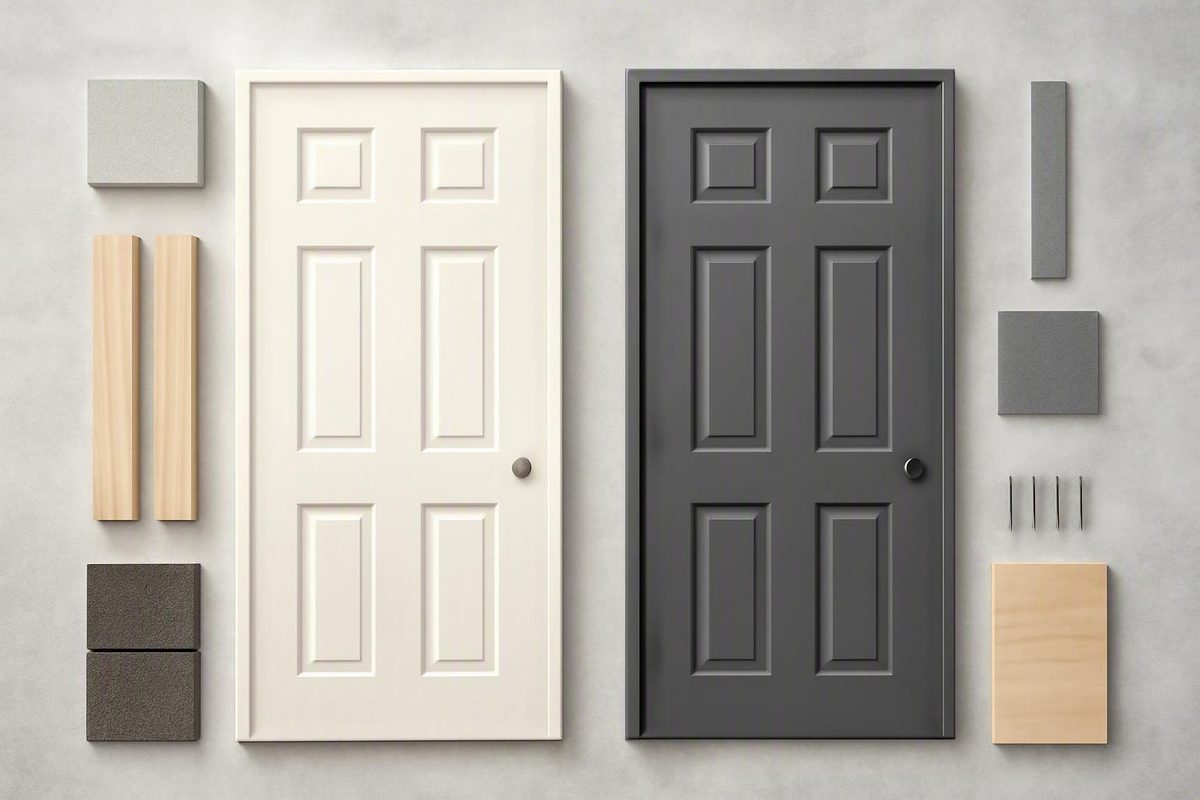
Quick verdict: when to choose fiberglass and when to choose steel
Neither material is universally better. In the fiberglass exterior doors vs. steel comparison, the right answer depends first on where the door will be installed, how exposed it is, what appearance you want, and how much you can spend on the complete installed system.
Start with fiberglass for an uncovered or prominent front entrance, persistent rain or humidity, coastal or salt-prone exposure, low tolerance for rust-related maintenance, or a stained wood-look design. Fiberglass does not rust, generally resists ordinary dents, and usually offers a broader range of embossed wood-grain finishes.
Start with steel for a covered porch, side or secondary entrance, garage or basement entry, rental property, smooth painted design, or project where a lower starting price matters most. Steel is strong, widely available, and often the practical value when an overhang limits direct weather exposure.
Both materials can produce durable, insulated, secure exterior doors when product quality and installation are comparable. A well-made steel door in a reinforced, weather-sealed frame can outperform a poorly made or badly installed fiberglass door.
| Comparison point | Fiberglass exterior door | Steel exterior door |
|---|---|---|
| Typical upfront cost | Usually higher | Usually lower |
| Rust risk | Does not rust | Can corrode where coating damage exposes metal |
| Ordinary dent risk | Generally low | Generally higher |
| Severe-impact damage | May chip or crack | May dent, crease, or suffer coating damage |
| Finish options | Strong choice for smooth, painted, embossed, and stained wood-look finishes | Commonly smooth, paneled, or painted; some wood-look products are available |
| Routine care | Cleaning plus product-specific finish or top-coat care | Cleaning plus prompt touch-up of scratches and chips |
| Exposed weather | Usually the safer corrosion-resistant choice | Practical if well coated, maintained, and preferably protected |
| Security | Strong when paired with a sound frame and hardware | Strong skin, but the frame and lock area remain critical |
| Thermal performance | Foam-core models can perform well; skin is nonconductive | Foam-core models can perform well; steel conducts heat more readily |
| Best-value tendency | Prominent, wet, exposed, or wood-look entrance | Covered, secondary, rental, or budget-focused entrance |
Consumer Reports characterizes fiberglass as weather-tolerant and dent-resistant and steel as generally more budget-friendly. It also notes that high-impact force can crack fiberglass, particularly in extreme cold, while untreated scratches can lead to rust on steel. Sealing, hardware, and installation remain important for either material (Consumer Reports’ entry-door buying guide).
Use-case matrix
| Opening or priority | Usual starting point | Why |
|---|---|---|
| Exposed front door | Fiberglass | Lower corrosion risk and good resistance to ordinary weather and dents |
| Covered front door | Either; steel for value | Protection from rain and direct sun reduces steel’s exposure disadvantage |
| Coastal or salt-prone home | Fiberglass | No steel skin to rust when finish damage meets salt and moisture |
| Cold climate | Compare exact models | U-factor, air leakage, glazing, seals, threshold, and installation matter more than the label alone |
| Rental property | Steel | Lower typical starting price and straightforward painted appearance |
| Garage, basement, or side entry | Steel | Often a cost-effective choice for a functional or protected opening |
| Premium architectural entrance | Fiberglass for stained wood simulation; compare specialty systems separately | Appearance, glass, custom dimensions, and hardware may dominate the decision |
Do not compare a mass-market foam-core residential steel door directly with a premium custom steel-and-glass entrance. Thermally broken profiles, high-performance insulated glass, specialty finishes, oversized configurations, and custom hardware place architectural steel systems in a different product and price class (custom steel-door system overview).
What fiberglass and steel exterior doors are actually made from
“Steel door” does not normally mean a solid slab of steel. Many residential steel doors use a relatively thin steel skin bonded around an insulated core. Perimeter components may be wood, composite, or another material. The skin supplies rigidity and impact resistance, while the core provides much of the slab’s insulation.
Many fiberglass doors follow a similar layered concept: a fiberglass-reinforced exterior skin over an insulated core, supported by perimeter stiles and rails. The exact skin formulation, reinforcement, edge construction, and internal framing vary by manufacturer and model. It is therefore misleading to treat “fiberglass” as one fixed construction specification.
Polyurethane and polystyrene are common core materials in these categories. A commercial installer’s construction overview describes residential steel doors as foam-core products enclosed by a thin shell and fiberglass doors as insulated assemblies with reinforced skins. It also illustrates why steel gauge and fiberglass construction should be checked at model level rather than inferred from the category name (steel-versus-fiberglass construction guide).
Steel gauge follows an inverse convention: a lower gauge number indicates thicker steel. That does not mean one gauge is automatically required for every home. A protected side entrance and a heavily used, security-focused front entrance may justify different specifications. Gauge is also only one variable; coating quality, edge construction, frame strength, lock preparation, and installation can be equally important.
When comparing doors, request these details:
- Steel gauge, if applicable
- Galvanization, primer, coating, and finish system
- Fiberglass-skin construction and reinforcement
- Top, bottom, hinge-edge, and lock-edge materials
- Insulation type and declared whole-product thermal performance
- Frame and jamb materials
- Weatherstripping and corner-seal design
- Threshold material, adjustment, and drainage details
- Glass type, spacer, coatings, number of panes, and decorative components
- Sidelite and transom construction
- Factory finish versus field finishing
- Hinge and lock preparation
- Reinforcement for deadbolts, strike plates, or multipoint locks
- Installation instructions and exposure limitations
- Finish, glass, component, installation, and labor warranties
Product grade can matter as much as skin material. A heavier, well-coated steel door with robust edges and a stable frame is not equivalent to the least expensive steel slab. Likewise, a premium fiberglass system with composite edges, carefully molded grain, upgraded glass, and a factory finish is not equivalent to every fiberglass door.
Compare matched prehung systems, not an inexpensive bare slab against a fully finished premium unit. Even then, verify whether the quoted package includes locks, glass, sidelites, trim, finishing, removal, disposal, and installation.
Durability is about how each door fails
A useful durability comparison asks how each material is likely to fail—not which one has a supposedly universal lifespan. Exposure, product grade, traffic, finish, maintenance, frame construction, and installation vary too widely for one reliable service-life promise.
How steel fails
Steel is strong and rigid, but its skin can dent or crease under impact. A minor dent may be primarily cosmetic; a deeper crease can damage the finish or affect the slab’s appearance more substantially.
Steel also depends on its protective finish. If a scratch or chip passes through the paint, primer, or galvanization and exposes metal, moisture can start corrosion. That does not mean every scratch immediately ruins a steel door. It means breached coating should be cleaned and repaired before rust spreads under the surrounding finish.
Pay particular attention to the door bottom and lower edges. Also inspect hinge and hardware areas where tools, keys, rings, or moving parts may damage the coating.
How fiberglass fails
Fiberglass cannot rust and usually tolerates ordinary moisture and dents better than steel. These traits make it a strong default for uncovered, humid, frequently wet, coastal, or salt-prone entrances.
It is not indestructible. A severe, concentrated impact can chip, puncture, or crack the skin. Deep damage may be difficult to conceal, and the appropriate repair depends on the skin, finish, location, and manufacturer. Replacement may be more sensible for some structural cracks, but the material label alone does not establish a universal replacement threshold.
Fiberglass finishes also age. Strong sun can cause fading, clear-coat wear, peeling, or other surface deterioration, particularly when the selected color, storm-door combination, or maintenance routine is unsuitable for the exposure.
Climate changes the inspection priorities
For steel in wet, snowy, or salt-prone conditions, inspect:
- The bottom edge and lower face
- Scratches around locks, hinges, and handles
- Blisters or discoloration beneath paint
- Seams, edges, and drainage points
- Contact with wet thresholds or trapped debris
For fiberglass, inspect:
- UV wear on dark or sun-facing finishes
- Peeling, fading, or clear-coat deterioration
- Chips at corners and hardware cutouts
- Cracks after concentrated impacts
- Sealant and glazing joints
Extreme cold can increase concern about brittle, high-impact fiberglass cracking, while frequent moisture and salt increase concern about breached steel coatings. A porch or overhang can improve the practical outlook for either material by reducing direct rain, snow, and solar exposure.
A simple inspection routine for either door
Include the opening in normal seasonal home maintenance and inspect it after severe weather or a significant impact:
- Wash away dirt and salt using methods approved by the manufacturer.
- Look for scratches, chips, cracks, blistering, fading, or peeling.
- Check the weatherstripping for gaps, compression loss, or torn sections.
- Verify that water drains away from the sill and does not collect at the threshold.
- Look for frame movement, open joints, or deteriorated sealant.
- Inspect glass for fogging, displacement, or failed perimeter seals.
- Open, close, latch, and lock the door without lifting or forcing it.
- Confirm consistent contact between the slab, seals, and adjustable threshold.
Avoid assigning either material a guaranteed lifespan. A protected steel door with intact coating may remain practical for a long time, while an exposed or poorly installed fiberglass door can suffer premature finish, seal, frame, or water-management problems.
Energy efficiency: compare the whole door, not just the skin
Both steel and fiberglass exterior doors commonly use insulated foam cores, so either can deliver good thermal performance. The skin affects heat flow, but it is only one part of the opening.
Fiberglass is nonconductive and tends to create less thermal bridging through its surface. Steel conducts heat more readily, which can make its surface feel colder in winter or hotter in direct summer sun. That physical tendency does not prove that every fiberglass door is more efficient than every steel door. Core density, slab thickness, edge construction, frame material, glass, seals, dimensions, and installation can reverse an assumed ranking.
Commercial door guides report similar nominal insulation for some windowless foam-core slabs in both categories. That does not establish equal whole-door performance across models. Nominal R-value descriptions may omit the frame, threshold, glass, sidelites, joints, and real-world air leakage.
Air movement around the perimeter can contribute more heat loss than conduction through the slab itself. Glass can also reduce insulation unless the assembly uses improved glazing such as low-E double- or triple-pane units. For that reason, compare ratings for the complete selected configuration rather than assuming performance from its skin material.
For the exact configuration under consideration, compare:
- Certified whole-product U-factor
- Certified air-leakage rating
- Glass U-factor and solar heat-gain characteristics where relevant
- Frame and threshold construction
- Weatherstripping design
- Sidelite and transom performance
- Applicable ENERGY STAR status
- Installation and perimeter-sealing requirements
A solid door and a door with a large decorative glass panel are not equivalent. Nor is a single slab comparable to an entrance containing two sidelites and a transom.
Low-E coatings and double- or triple-pane glass can reduce the penalty associated with glazing, but buyers should verify the specification for the exact decorative package rather than assuming all upgraded glass performs alike.
A manufacturer may offer qualifying solid models while only some glazed versions qualify. ProVia’s comparison, for example, describes qualification in terms of particular door systems and configurations rather than entire material categories (model-specific fiberglass and steel overview).
Do not expect a predictable energy-bill reduction from changing the skin material alone. Replacing a drafty, misaligned entrance with a properly sealed system may improve comfort, but the result comes from the complete assembly and installation—not simply from substituting fiberglass for steel or vice versa.
Security: steel is strong, but the opening is a system
Steel is strong under direct force, which is why it is often positioned as the security-focused material. But a steel skin does not make an exterior door burglar-proof, and it does not guarantee that the opening cannot be kicked in.
Prior Consumer Reports testing found a shared vulnerability among fiberglass, steel, and wood doors: the jamb near the strike plate. The lock-side frame could fail even when the slab remained comparatively strong. Consumer Reports recommends a quality deadbolt, reinforced strike area, and screws extending into structural framing (Consumer Reports’ entry-door security guidance).
Security depends on the combined resistance of:
- The slab
- Frame and jamb
- Deadbolt and latch
- Strike plate and reinforcement
- Fastener length, placement, and substrate
- Hinges and hinge screws
- Glass location
- Sidelites
- Hardware preparation
- Installation quality
- Wall framing around the opening
A practical security specification should include a quality deadbolt, reinforced strike plate, suitable long fasteners anchored into sound structural framing, secure hinge attachment, and a jamb-reinforcement method compatible with the door system. Sidelites can introduce similar concerns depending on their placement and glazing.
Both steel and fiberglass doors can be configured for deadbolts, smart locks, decorative glass, and multipoint locking systems, subject to the selected model and its hardware preparation. Do not assume every slab supports every lock without reinforcement or modification.
A properly installed fiberglass system in a strong, reinforced frame may resist forced entry better than a steel slab hung in a split, under-fastened, or poorly aligned jamb. If forced-entry resistance is the dominant buying criterion, request standardized test or certification documentation for the exact slab, frame, glass, lock preparation, and configuration—not merely a claim that one skin material is “more secure.”
Cost: compare equivalent installed systems
The defensible market tendency is simple: steel generally has a lower starting price than comparable fiberglass. The final result can change with product grade, dimensions, glass, finish, frame, hardware, and installation. Published commercial comparisons support that broad tendency, but their regional figures should not be treated as national averages (steel and fiberglass cost comparison).
Published prices are difficult to compare because they often describe different scopes:
- Bare slabs versus prehung systems
- Supply-only versus fully installed replacements
- Standard sizes versus custom dimensions
- Solid doors versus decorative glass
- Single doors versus systems with sidelites or transoms
- Factory paint versus premium stain finishes
- Builder-grade products versus premium lines
- Simple swaps versus openings requiring framing, flashing, or trim repair
- Different regional labor and disposal costs
Even within one market, two quotes may be incomparable if one includes removal, flashing, hardware, painting, disposal, and trim while the other includes only a prehung unit and basic labor.
Matched-quote worksheet
Ask each bidder to price the same scope:
| Quote item | Required comparison detail |
|---|---|
| Opening | Same rough opening and finished dimensions |
| Door format | Same single or double configuration and swing |
| System | Prehung frame rather than an unmatched bare slab |
| Core | Identified insulation type and comparable construction grade |
| Glass | Same dimensions, pane count, coatings, privacy, and decorative package |
| Sidelites/transoms | Same number, size, glass, and frame construction |
| Frame | Same material or clearly stated alternative |
| Finish | Factory or field finish, with the same color or stain level |
| Hardware | Same hinges, deadbolt, handle set, smart lock, or multipoint lock |
| Threshold | Same material, adjustment, drainage, and accessibility requirements |
| Weatherstripping | Complete perimeter and corner-seal package |
| Removal | Existing door, frame, trim, and debris removal |
| Installation | Sill preparation, flashing, anchoring, insulation, sealing, and adjustment |
| Trim | Interior and exterior casing, cladding, patching, and painting |
| Other work | Framing, siding, masonry, electrical, alarm, or access-control changes |
| Permits | Included where applicable |
| Warranty | Product, finish, glass, installation, and labor terms |
Decorative glass, sidelites, transoms, custom dimensions, custom colors, premium hardware, and complex installation can materially increase the price of either material. They may also affect insulation and forced-entry resistance, so they should not be treated as cosmetic cost items only.
Fiberglass’s premium may be worthwhile when it solves a real problem: persistent weather exposure, corrosion risk, frequent wetting, concern about ordinary dents, or the need for a convincing stained wood-grain appearance. Steel may provide stronger value when the entrance is protected, the appearance requirement is a straightforward painted finish, and someone can inspect and repair coating damage.
Evaluate total ownership cost as a framework rather than an invented long-term dollar figure:
Total ownership considerations = purchase + installation + finish care + likely repairs + excluded warranty work + replacement risk
No reliable material-level calculation can predict that total without the actual models, exposure, maintenance requirements, and warranty terms. Likewise, return-on-investment percentages based on dissimilar project types do not prove that one material is financially superior.
Appearance, finishes, and routine maintenance
Fiberglass generally offers the broader selection of embossed wood-grain textures and stain-like finishes. Manufacturers may model these appearances after species such as oak, cherry, mahogany, or fir. Better products can create convincing depth and color variation, but fiberglass remains a simulation. Its realism varies by mold quality, finish process, lighting, viewing distance, and price.
Steel is commonly selected for smooth, paneled, or modern painted entrances. It works particularly well when the design calls for a clean solid color rather than a stained appearance. Some steel products offer textured or wood-look surfaces, but fiberglass usually provides more choices for buyers prioritizing stained grain.
Do not select from a small online image alone. View full-size samples or installed doors if possible. Examine:
- Grain depth and repetition
- Sheen and color variation
- Panel definition
- Edge and glazing detail
- Finish appearance in daylight
- Touch-up visibility
- Interior and exterior finish coordination
Fiberglass maintenance
Fiberglass is low-maintenance, not maintenance-free. Routine care generally includes gentle cleaning and inspection of the finish, sealant, weatherstripping, glass, and hardware. Stained or clear-coated products may require renewed top-coat protection according to the manufacturer’s instructions.
Maintenance schedules are product-specific. One manufacturer’s annual or multiyear recoating instruction should not be generalized to every fiberglass door. Direct sun, dark colors, coastal exposure, storm doors, cleaning chemicals, and abrasive methods may affect both the finish and warranty.
Steel maintenance
Steel also needs routine cleaning, but coating damage deserves prompt attention. Clean scratches or chips, use compatible primer where required, and apply approved touch-up paint before exposed metal corrodes. Periodically inspect lower edges, seams, and hardware cutouts where water or abrasion may compromise the coating.
Repair expectations
Some steel dents can be filled, sanded, primed, and refinished. Results depend on dent depth, creasing, location, texture, and paint matching. Repair may restore protection without making the damage invisible.
Neither the material label nor the available evidence establishes a typical repair price.
Before buying, request written instructions covering:
- Approved cleaning products and methods
- Touch-up paint or stain availability
- Primer requirements
- Clear-coat or refinishing intervals
- Field repairs
- Dark-color and direct-sun limitations
- Coastal or salt exposure
- Warranty-preserving maintenance records
Installation details that can outweigh the material choice
A high-quality steel door can outperform a premium fiberglass door that is poorly installed. Installation determines whether the opening drains, seals, locks, and operates as designed.
The installer should evaluate:
- Water flow at the sill and surrounding wall
- Existing rot, corrosion, or framing damage
- Level, plumb, and square conditions
- Continuous sill support
- Flashing or sill-pan requirements
- Perimeter air and water sealing
- Threshold contact and adjustment
- Frame anchoring
- Hinge support
- Strike-area reinforcement
- Slab alignment and reveal
- Smooth latching and locking
- Interior and exterior trim interfaces
General good-practice checkpoints include flashed sill management where required, compatible sealants, appropriate low-expansion door-and-window foam, hinge screws reaching sound framing, and a reinforced strike area. Installer guidance identifies these details as important to leakage control, operation, and forced-entry resistance (exterior-door installation discussion).
These are screening points, not substitutes for the selected manufacturer’s printed instructions or applicable local requirements. Door systems differ in anchoring, shimming, flashing, sealant compatibility, finishing, and allowable exposure. This article provides general building-material guidance rather than project-specific contracting or engineering advice, consistent with Mortar Desk’s editorial scope.
Incorrect installation can cause:
- Drafts and uneven weatherstrip contact
- Water intrusion
- Threshold leakage
- Difficult latching or locking
- Frame distortion
- Slab rubbing or sagging
- Premature finish damage
- Weak forced-entry resistance
- Insulating-glass stress
- Warranty disputes
Storm doors and trapped solar heat
A full-view storm door can trap solar heat against a dark entry door, especially in direct sun with limited ventilation. A Michigan installer notes that some manufacturers restrict warranty coverage for certain storm-door, color, or exposure combinations. Confirm compatibility in writing before combining a dark entry door with a full-view storm door; do not assume the extra layer is automatically protective (storm-door and warranty guidance).
Clarify the installation quote
Confirm whether the price includes:
- Existing door and frame removal
- Inspection and repair of concealed damage
- Sill pan or flashing
- Insulation and perimeter sealant
- Frame anchoring and reinforcement
- Interior and exterior trim
- Cladding or capping
- Touch-up paint or complete finishing
- Disposal and cleanup
- Lock installation and programming
- Alarm or doorbell coordination
- Final adjustment after seasonal movement
- Labor warranty and service calls
After installation, retain the model number, serial information, purchase documents, glass configuration, finish code, installer details, maintenance instructions, and warranty. Photograph labels before they are concealed or removed.
Final buying checklist and five-step decision tree
Use material tendencies to create a shortlist, then make the purchase from model-level specifications and matched quotes.
Step 1: Classify the exposure
Record whether the opening is:
- Fully exposed
- Partly protected
- Covered by a porch or overhang
Then note direct rain, wind-driven rain, snow, salty slush, coastal air, humidity, morning or afternoon sun, roof runoff, and how quickly the threshold dries.
A fully exposed, persistently wet, or salt-prone opening generally pushes the shortlist toward fiberglass. A deeply covered opening makes steel easier to justify.
Step 2: Rank your priorities
Put these in order rather than calling all of them essential:
- Initial budget
- Stained wood appearance
- Corrosion resistance
- Dent resistance
- Security
- Thermal performance
- Low maintenance
- Custom glass or architectural design
Ranking exposes the actual tradeoff. If budget is first and the opening is covered, steel may be the clear starting point. If corrosion resistance and stained grain are first, fiberglass is more likely to earn its premium.
Step 3: Shortlist comparable systems
Compare steel and fiberglass doors with the same:
- Size and swing
- Prehung frame type
- Glass area and package
- Sidelites or transoms
- Hardware
- Finish level
- Threshold
- Weatherstripping
- Removal and installation scope
Do not compare an entry-level solid steel door with a premium fiberglass grand entrance and conclude that the price difference is caused solely by material.
Step 4: Review model-level documentation
Request and compare:
- Certified whole-product U-factor
- Certified air-leakage rating
- Applicable ENERGY STAR status
- Steel gauge or fiberglass-skin construction
- Coating or galvanization
- Core type
- Frame and edge materials
- Glass specification
- Hardware reinforcement
- Installation instructions
- Exposure and finishing limitations
For cold climates, model-level thermal data should decide the ranking. For security-focused projects, frame reinforcement, strike details, locks, hinges, glass, and test documentation should receive more weight than the skin label.
Step 5: Compare warranties and installed quotes
Read the warranty rather than relying on “lifetime” language in a sales summary. Check whether it covers or excludes:
- Rust or corrosion
- Coating failure
- Dents
- Chips and cracks
- Fading
- Peeling
- Delamination
- Insulated-glass seal failure
- Water intrusion
- Required finish maintenance
- Labor and service calls
- Transfer to a subsequent owner
- Direct-sun exposure
- Coastal or salt exposure
- Dark colors
- Storm-door combinations
- Improper installation
- Installation by an unauthorized party
- Consequential trim or wall repairs
Then compare complete installed prices, payment terms, service responsibility, warranty exclusions, and documentation.
Scenario recommendations
- Weather-facing front door with a stained wood look: Fiberglass is usually the stronger shortlist choice.
- Covered entrance where price matters most: Steel is often the better value.
- Persistent moisture, coastal air, or road salt: Fiberglass is the safer corrosion-resistant default.
- Cold-climate entrance: Compare certified U-factor, air leakage, frame, threshold, seals, and glass for the exact configurations.
- Security-focused replacement: Prioritize reinforced framing, strike hardware, structural fasteners, suitable locks, secure hinges, and careful glass placement.
- Premium custom steel-and-glass design: Evaluate it as a specialty architectural system, not as an ordinary residential steel door.
- Rental, garage, basement, or secondary entrance: A properly coated and installed steel door often provides the needed function at a lower starting price.
Material tendencies help narrow the field. The selected configuration, frame, glazing, hardware, installation, maintenance obligations, and warranty determine what you are actually buying.
Frequently asked questions
Are fiberglass exterior doors better than steel doors?
Not universally. Fiberglass is usually the better starting point for an exposed, wet, salt-prone, prominent, or stained wood-look entrance. It does not rust and generally resists ordinary dents.
Steel is often the better value for a covered, secondary, rental, garage, basement, or budget-sensitive opening. Both can be durable, insulated, and secure when product quality and installation are comparable.
Do steel exterior doors rust if they are scratched?
They can. If a scratch penetrates the protective paint, primer, or galvanization and exposes the steel, moisture can begin corrosion. The risk is greater where water, humidity, or salt remains in contact with the damaged area.
Clean and repair breached coating promptly using the manufacturer’s approved primer and touch-up system. Fiberglass does not rust, although its surface and finish can still chip, crack, fade, peel, or require maintenance.
Which is more energy-efficient, fiberglass or steel?
Neither material wins automatically. Both commonly use insulated foam cores and can provide good thermal performance. Fiberglass is nonconductive and tends to create less thermal bridging, while steel conducts heat more readily.
For a purchase decision, compare certified whole-door U-factor and air-leakage ratings for the exact frame, glass, sidelites, transoms, and threshold. Installation and perimeter sealing may matter more than the difference between the two skins.
Is a steel exterior door more secure than fiberglass?
Steel is strong under direct force, but the skin does not determine security by itself. The jamb, strike plate, deadbolt, fasteners, hinges, glass, sidelites, framing, and installation may be the weaker parts of the opening.
A reinforced and properly installed fiberglass system can be more secure than a steel slab in a weak frame. If security is the primary goal, request forced-entry documentation for the complete system and specify frame and hardware reinforcement.
Is fiberglass worth the extra cost for a covered entrance?
Sometimes, but the premium is less automatic when a porch or overhang limits rain, snow, salt, and direct sun. Fiberglass may still be worthwhile for its dent resistance, stained wood-look options, or lower corrosion risk.
If the entrance is deeply covered, appearance requirements are simple, and coating damage will be inspected and repaired, steel may deliver better value. Compare equivalent installed systems and warranties before deciding.
Final takeaway: Choose by exposure and complete-system specifications rather than material reputation alone. Fiberglass is usually the safer shortlist choice for a prominent, weather-facing, moisture-prone, or wood-look entrance. Steel is often the better value for a protected or secondary opening where initial cost and a painted finish matter most. Before buying, compare equivalent configurations, certified thermal data, frame and security details, maintenance instructions, warranty exclusions, and the full installation scope.