 MortarDesk
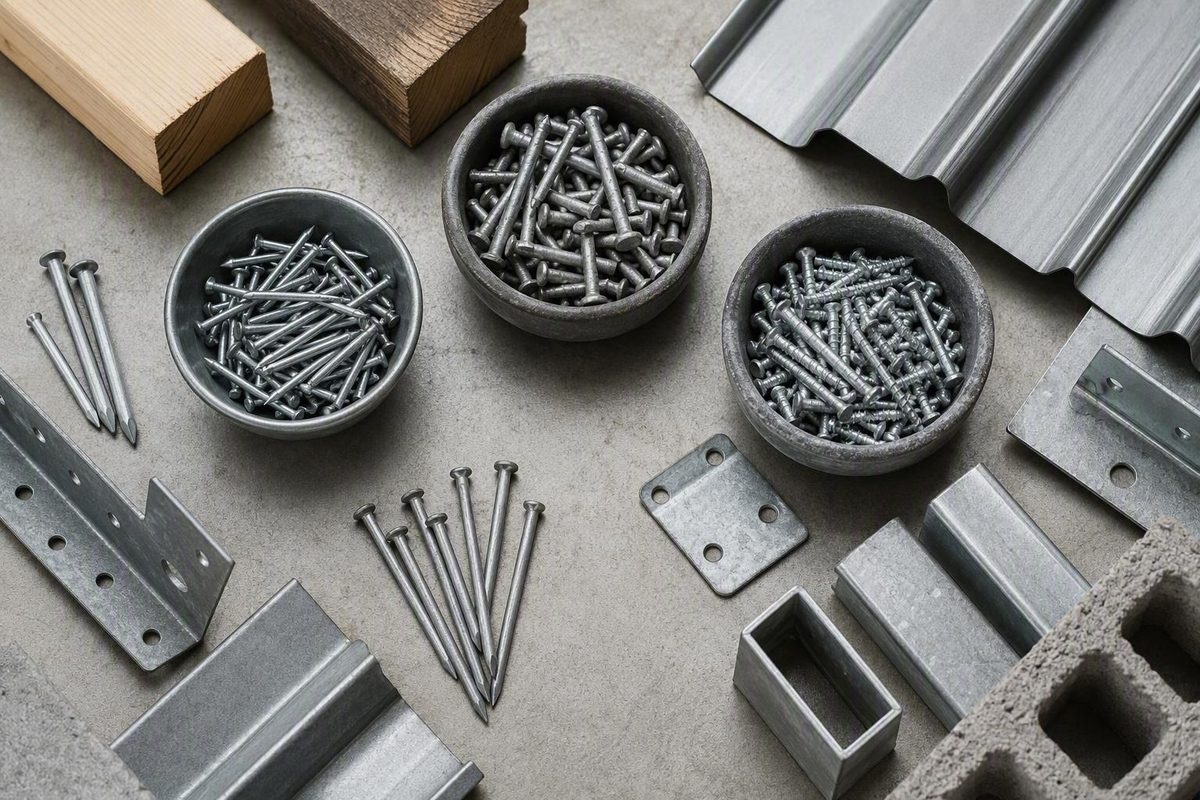
“Galv nails” means zinc-coated steel nails and nothing more precise than that. The shorthand does not name the galvanizing process (electrogalvanized, mechanically galvanized or hot-dip), the coating class, the actual diameter and length, the head and shank, the exposure the coating is rated for, whether it suits preservative-treated wood, or whether it is approved for a structural connector. Treat “galvanized” on a box or listing as a finish category, and get the manufacturer’s technical sheet before ordering.
Pick the exposure, wood and connector; the coating to look for and a filled order line appear beside them.
Galvanized Nail Spec Builder
Coating to look for
Electrogalvanized or hot-dip galvanized; confirm product approval.
- Electrogalvanized coatings are commonly positioned for dry interiors. The exposure limit still comes from the product sheet.
Verify before ordering
- Product sheet states the coating process and class, not just “galvanized”
- Listing wording (bright vs galvanized) matches the sheet
Order line
[nail type], [diameter] × [length], [head], [shank], [EG or HDG, class per sheet], for untreated wood, in dry interior, [quantity].
Fill in the nail details (optional)
Why penny size is not a spec: four “10d” nails
| Description | Diameter | Length |
|---|---|---|
| 10d common | 0.148 in | 3 in |
| 10d box | 0.128 in | 3 in |
| 10d sinker | 0.120 in | 2.875 in |
| Shortened 10d | 0.148 in | 2.5 in |
In one Simpson face-mount-hanger example, the 2.5 in nail in place of the 3 in nail cuts listed capacity by 15%; that figure applies to that hanger only.
Source: Simpson Strong-Tie treated-wood corrosion FAQ and connector-fastener guidance cited in the article. Suggestions are starting points; the product sheet, treatment tag and connector load table govern. No service-life figures exist for a given installation.
What the Word “Galv” Leaves Out
The zinc on a galvanized nail works as a barrier and as a sacrificial layer that corrodes before the steel underneath. It slows rust; it does not stop it. How long it slows it depends on the coating thickness and the service environment, and the label tells you neither.
On a list, box or product page, “galv” does not tell you:
- whether the coating is electrogalvanized, mechanically galvanized or hot-dip galvanized
- which coating specification and class apply
- the nail’s actual diameter and length
- its head, point and shank
- whether it is compatible with a particular preservative-treated wood
- whether it suits dry, exterior, ground-contact, marine or salt exposure
- whether it is approved for a structural connector
Every one of those comes from the product documentation, the lumber treatment tag or the connector instructions, not from the word on the box.
Electrogalvanized, Hot-Dip and Mechanical Coatings Are Not Interchangeable
The three process names describe how zinc reaches the steel. None of them, on its own, establishes a coating class, product compliance or suitability for a given job.
| Coating | Process | What to verify |
|---|---|---|
| Electrogalvanized (EG) | Zinc deposited by electric current; thin, smooth, uniform | Product approval, stated exposure limits, coating documentation |
| Hot-dip galvanized (HDG) | Prepared steel immersed in molten zinc; thicker and rougher than EG | Applicable standard, class, product certification |
| Mechanically galvanized | Zinc powder applied in a tumbler with impact media | ASTM B695 class, manufacturer documentation, application approval |
Electrogalvanizing is commonly offered for dry interiors or mild exposure. An “EG” label does not prove that a particular nail is suitable for the work; the product sheet has to state the exposure limit.
Hot-dip galvanizing generally produces the thickest coating of the three, but “HDG” still needs supporting documentation that names the standard and class.
Mechanical galvanizing is class-dependent. Whether it protects comparably to a specified hot-dip coating depends on the documented class and the manufacturer’s application guidance. Do not assume any mechanically galvanized nail can stand in for any HDG nail.
Choose the Coating by Exposure and Wood Treatment
Corrosion risk is not decided by indoor versus outdoor alone. Moisture, salts, preservative chemicals, soil, industrial contaminants, wood species and contact between dissimilar metals all change the outcome.
| Exposure or material | What to verify before buying |
|---|---|
| Dry interior | The exact coating is approved for the application and protected from expected moisture |
| Occasional dampness | The product’s stated exposure limits against the likely duration of wetting |
| General exterior moisture | Product-specific instructions for the identified exterior conditions |
| Preservative-treated wood | Treatment tag, preservative chemistry, retention level, fastener instructions |
| Soil or ground contact | Exact treatment and exposure category, plus product-specific corrosion guidance |
| Marine, salt air, splash, de-icing salts | Guidance for chloride exposure and compatibility of base metal and connector |
For treated lumber, Simpson Strong-Tie reports that the treated-wood industry recommends hot-dip galvanized or stainless-steel fasteners. Suitability still depends on preservative chemistry, retention level, wood moisture, species, exposure and the current product instructions. Preservative formulations change, so read the treatment tag and the treater or preservative manufacturer’s directions rather than relying on what was true for the last batch of lumber.
Soil, high-retention treatments, airborne chlorides, marine splash and de-icing salts create elevated corrosion conditions. A compatible stainless-steel fastener may be worth considering there, but stainless is neither universally required nor immune to corrosion. Simpson describes Type 316 stainless steel as more resistant to chloride pitting than Types 304 or 305, which matters in high-chloride environments such as seawater exposure (treated-wood and corrosion guidance).
Do not turn a coating label into a promised number of service years. The available guidance does not support service-life predictions for a specific installation.
What ASTM A153, ASTM B695, G90 and G185 Actually Cover
These labels appear together on listings even though they describe different products and processes:
- ASTM A153 is identified by Simpson as the specification for batch or post-hot-dip-galvanized fasteners.
- ASTM B695 covers mechanical zinc coatings. Simpson’s comparison with the hot-dip coating used on certain connectors and fasteners refers specifically to mechanical galvanizing at Class 55 or higher.
- G90 and G185 are galvanized sheet-steel coating designations for connector stock. They are not automatically valid specifications for individual finished nails.
- Salt-spray hours describe performance in a laboratory test and should not be converted into years of field service (Simpson’s explanation of galvanizing specifications).
A seller’s statement that a nail “meets ASTM A153” is a claim, not proof. Ask which class applies and get documentation or certification for the exact product.
Conflicting retail wording is a signal to investigate. One common-nail listing describes the same product as both “Bright finish” and “STORMGUARD double hot-dipped galvanized” while asserting ASTM A153 compliance without stating the class anywhere in the page text (view the ambiguous product listing). The manufacturer’s technical sheet should resolve that before purchase, and if it cannot, the product is not specified.
A label such as “1,000 hours galvanized” reports a salt-spray-test duration. Field exposure to moisture, salts, treatment chemicals and dissimilar metals is not a laboratory test cycle.
A Correct Coating Can Still Be the Wrong Nail
Corrosion resistance and structural suitability are separate checks. A heavily galvanized nail can still be wrong because its diameter, length, head, shank, quantity, or installation pattern does not match the connection.
Penny size is particularly ambiguous. Simpson gives four nails that may all be described as 10d:
| Description | Diameter | Length |
|---|---|---|
| 10d common | 0.148 in | 3 in |
| 10d box | 0.128 in | 3 in |
| 10d sinker | 0.120 in | 2.875 in |
| Shortened 10d | 0.148 in | 2.5 in |
For the connector nails it discusses, Simpson also calls for full round heads and identifies ASTM F1667 Table S1 bending-yield requirements. Connector fasteners should be ordered by type, actual diameter, length, head, quantity and finish, never by penny size alone (manufacturer connector-fastener guidance).
Substitutions have measurable consequences. In one Simpson face-mount-hanger example, replacing a required 0.148-by-3-inch nail with a 0.148-by-2.5-inch nail reduces the listed capacity by 15%. That figure applies only to the described hanger configuration; it is not a general rule for shorter nails. Nails and screws also must not be mixed in one connector unless the applicable load table expressly permits the combination (the bounded substitution example and installation rule).
A screw that fits through a connector hole is not an approved replacement for a connector nail. The current load table and installation instructions for the exact connector model govern.
Match the Nail to the Connector Metal
A metal connector requires two separate corrosion checks:
- Environmental corrosion: can the fastener and connector tolerate the expected moisture, treatment chemicals, salts, soil and other contaminants?
- Galvanic compatibility: are the fastener and connector metals or coatings compatible where they touch?
Two corrosion-resistant components are not automatically a compatible pair. Contact between dissimilar metals introduces a further corrosion mechanism.
For its own systems, Simpson pairs hot-dip galvanized nails with ZMAX or HDG connectors and recommends stainless-steel nails with stainless-steel connectors. It warns against combining galvanized fasteners with stainless-steel connectors (Simpson connector and fastener compatibility guidance).
Those pairings are manufacturer-specific. Do not transfer them to another brand, connector finish or product line without that maker’s documentation.
Turn “Galv Nails” Into an Order Line
Before ordering, record:
- [ ] Nail type: common, connector, roofing, siding, finishing or another defined type
- [ ] Actual diameter: not penny size alone
- [ ] Length
- [ ] Head: including full-round-head requirements where applicable
- [ ] Shank: smooth, ring, spiral or another specified form
- [ ] Drive method: hand-driven or collated
- [ ] Tool compatibility: checked against the nailer manual and the fastener documentation
- [ ] Coating process: electrogalvanized, mechanically galvanized or hot-dip galvanized
- [ ] Documented coating class: where the specification requires one
- [ ] Intended exposure: dry, damp, exterior, ground contact, marine, salt or another defined condition
- [ ] Wood treatment: preservative chemistry and retention or use category from the tag
- [ ] Connector system: manufacturer, exact model, material and finish
- [ ] Required quantity: including fasteners per connector
- [ ] Package quantity
The order line then reads:
[nail type], [diameter] × [length], [head], [shank], [coating process and documented class], for [wood treatment or connector], in [exposure], [package quantity].
For connector work, do not swap “10d galv nails” for another generic phrase. Copy the exact diameter, length, head, quantity and approved finish from the current connector table, then confirm that the package label and product sheet match every field.
Three checks close the order:
- Does the treatment tag permit it?
- Does the connector table list it?
- Does the product sheet document the claimed coating?
Specifications change, and code editions and amendments vary by jurisdiction. Check the locally applicable requirements rather than assuming a national edition governs the project. Structural substitutions and uncertain high-corrosion conditions need product-specific guidance or qualified local review.