 MortarDesk
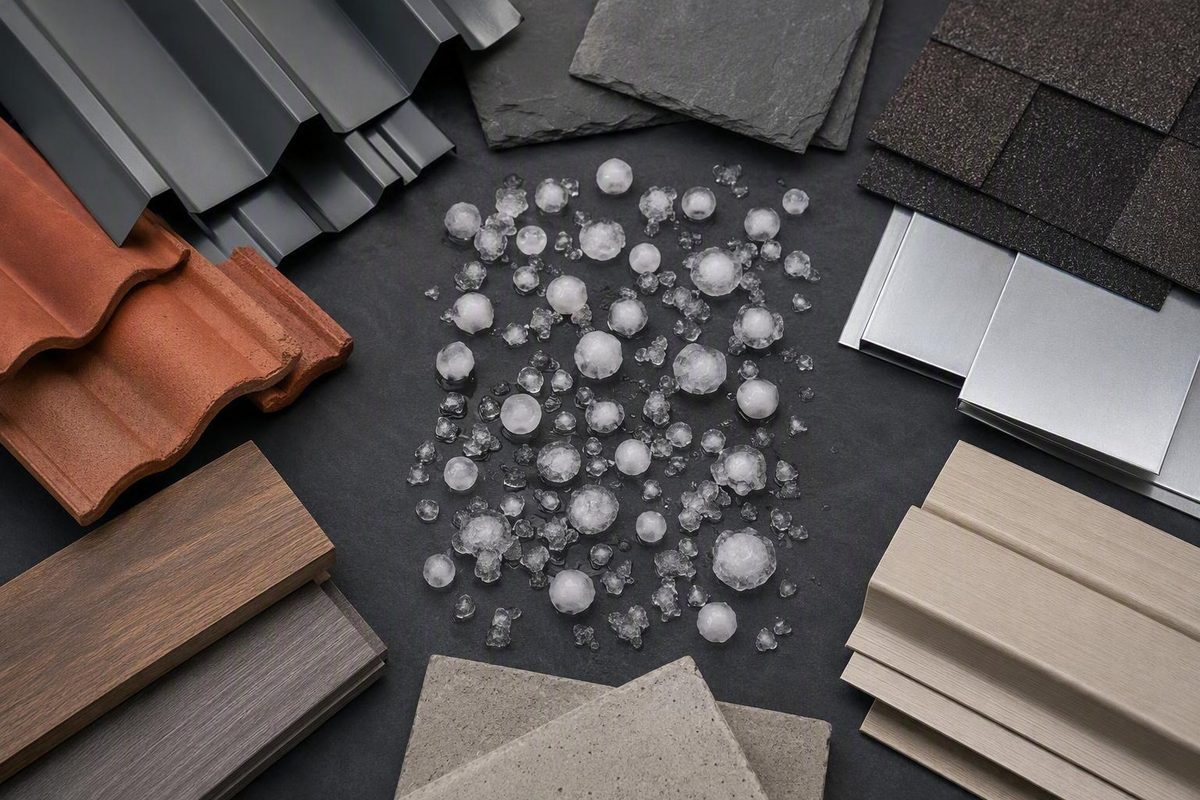
The direct answer: no roof is completely hail-proof
No roofing material or installed system can be guaranteed immune to every combination of hail size, shape, velocity, wind, temperature, repeated impact, product age and installation condition. “Hail-proof roof” is common marketing shorthand, but hail-resistant roof is the more accurate description. Engineering guidance recommends selecting a system for the property’s hail exposure rather than treating any roof as invulnerable (Simpson Gumpertz & Heger’s overview of hail risks and test standards).
Resistance can reduce the probability or severity of damage; it cannot eliminate it. Even highly rated roofing may sustain:
- Dents or other cosmetic changes
- Granule displacement or coating damage
- Concealed damage beneath an apparently intact surface
- Reduced remaining service life
- Functional damage that eventually permits water entry
Three concepts must remain separate when comparing products:
- Laboratory impact classification: How a new product specimen performed under a defined test.
- Contractual hail warranty: What the manufacturer promises to cover, for how long and subject to which conditions and exclusions.
- Expected storm performance: How the complete, installed and weathered roof may respond to natural hail at a particular property.
A Class 4 label, for example, is evidence of impact resistance under prescribed laboratory conditions. It is not automatically a hail warranty. Neither the rating nor a warranty promises that an actual storm will leave the roof unchanged.
The practical starting point is therefore not “Which material is hail-proof?” It is:
Which exact product has a documented impact rating appropriate for my local exposure, and what installation, warranty and insurance conditions apply to it?
Record the manufacturer and full model or product-line name. Verify the applicable test standard and classification, required installation configuration, written warranty and insurer acceptance. Do not rely on material-level claims such as “metal is Class 4,” “synthetic roofing cannot crack” or “rubber is hail-proof.”
How hail damages different roof coverings
Hail damage is often divided into functional and cosmetic damage.
Functional damage impairs the roof’s ability to shed water or reduces the covering’s remaining service life. Examples include punctures, splits, open seams, broken flashing details or reinforcement damage shown to affect water shedding or service life. Cosmetic damage changes appearance without necessarily impairing immediate performance—for example, shallow dents in otherwise intact metal panels.
The distinction is useful but not always obvious from the ground. A mark that appears cosmetic could involve coating damage or a concealed fracture. Conversely, an unattractive metal dent may leave a panel watertight. The absence of an immediate leak is reassuring, but it does not establish that the roof escaped functional or cumulative damage.
Asphalt shingles may bruise, crack or lose protective surface granules. Repeated granule displacement can expose more asphalt to ultraviolet light and may accelerate deterioration. An impact can also damage the reinforcement or underside while leaving the upper surface comparatively intact. Technical literature defines functional hail damage by reduced water shedding or remaining service life, not appearance alone (IIBEC’s technical article on asphalt-shingle impact testing).
Metal roofing generally does not fail in the same way as brittle tile or asphalt shingles. Hail may dent a panel without creating an opening. Functional concerns arise when impacts puncture the metal, open seams, deform critical laps, damage flashing, loosen attachments or compromise a protective coating.
Stone-coated steel may show disturbed or displaced surface granules even when the steel substrate remains intact. Coating loss is not automatically a functional failure, but coating condition, corrosion protection and compatible repair methods still matter.
Concrete, clay and natural slate are rigid products. Specific products may perform well under impact testing, but sufficiently severe impact can chip, crack or break individual units.
Wood shakes may split or crack.
There is no universal natural-hail diameter at which every roof begins to fail. Damage depends on more than nominal stone size:
- Hail density, shape and velocity
- Wind direction and speed
- Roof slope and orientation
- Product age and temperature
- Existing wear or brittleness
- Deck and substrate support
- Impact location
- Repeated strikes in the same area
Statements such as “safe up to two-inch hail” should not be treated as general physical guarantees. If the figure comes from a warranty, it describes a contractual coverage boundary subject to the warranty’s complete terms—not guaranteed absence of damage.
What a UL 2218 Class 4 rating actually means
UL 2218 is a laboratory impact-resistance classification system for roof coverings. It uses Classes 1 through 4, with Class 4 the highest classification within that system.
In the cited Class 4 procedure, specimens receive repeated impacts from a two-inch steel ball dropped 20 feet at prescribed locations, followed by examination for specified forms of failure. The cited procedure includes vulnerable areas such as edges, corners, unsupported locations, overlaps and joints rather than testing only the strongest uninterrupted portion of a specimen (Haag Research & Testing’s description of UL 2218 and ANSI/FM 4473 procedures).
A Class 4 result addresses impact resistance under that procedure. By itself, it does not establish:
- Wind resistance
- Fire resistance
- Energy efficiency
- Waterproofing of the complete installed assembly
- Resistance to every severe-weather hazard
- Hail coverage under the manufacturer’s warranty
- Insurance eligibility or a premium reduction
Most importantly, a two-inch steel test ball must not be translated into a promise that the roof will survive a two-inch natural hailstone without damage. Natural hail varies in shape, density, hardness, temperature, velocity and impact angle. Wind can alter speed and trajectory, and a storm can deliver many irregular impacts across weathered materials. Steel and ice projectiles also do not transfer energy in precisely the same way.
FM 4473 is a different test method that uses propelled ice balls rather than dropped steel balls. Both methods provide controlled comparisons, but neither recreates every possible natural storm. Certification testing also generally evaluates new specimens rather than roofing that has spent years exposed to heat, ultraviolet radiation, moisture, foot traffic and previous impacts.
Because standards, listings and accepted editions can change, obtain current documentation for the proposed product and verify it against project requirements. Ask:
- Which test standard applies?
- What class did the exact product achieve?
- Does the listing cover the proposed thickness, profile, backing and configuration?
- Are special deck, fastening or installation conditions part of the listed system?
- Is the documentation current and accepted in the project’s jurisdiction?
One Class 4 asphalt shingle does not make every architectural shingle Class 4. The same principle applies to metal panels, synthetic products, rubber roofing, stone-coated steel and rigid tiles.
Why Class 4 still is not a damage guarantee
A laboratory pass does not necessarily mean the specimen showed no visible change. Prescribed criteria can permit effects such as dents or crushed granules when the required examination finds no disqualifying tear, crack, split, fracture or rupture. A classification therefore should not be interpreted as a “zero marks” standard.
This distinction is particularly important with asphalt shingles. In a limited study, Haag Research & Testing examined five new impact-resistant shingle designs from four unidentified manufacturers. Four were marketed as UL 2218 Class 4 and one as Class 3. Duplicate panels were tested using UL 2218 steel-ball and ANSI/FM 4473 ice-ball procedures. The researchers then used a separate solvent-desaturation process to remove asphalt so that internal reinforcement could be examined (study methods and results published by IIBEC).
Reinforcement fractures were found in every tested design at Class 1 impacts and above, including in specimens that passed applicable visual criteria. Reinforced backing sometimes obstructed visual confirmation of fractures.
Those findings must remain within the study’s limits:
- Only five designs were examined.
- Product identities were withheld.
- All specimens were new.
- Solvent desaturation was an additional investigative method, not part of the cited standards’ normal pass/fail procedure.
- The results do not prove that every Class 4 shingle contains concealed impact damage.
- The study did not establish the long-term field outcome of every observed fracture.
The defensible conclusion is narrow: visual pass/fail inspection can miss concealed reinforcement damage in some impact-resistant asphalt-shingle designs. The study does not invalidate every Class 4 classification or establish a universally superior alternative. Nor should every detected reinforcement fracture automatically be called functional damage without evidence that it reduced water shedding or remaining service life.
Field performance adds further variables. Aging and weathering can make some products more brittle. Roof temperature changes material behavior. Fastener placement, deck support and impact location may differ from laboratory conditions. Repeated storms can also produce cumulative effects that certification testing on new specimens does not fully represent.
Class 4 remains useful comparative evidence. It indicates that a product met defined criteria at the highest impact level of that test system. It is simply not proof of an indestructible roof.
Comparing hail-resistant roofing materials by failure mode
Material categories are best compared by likely failure mode, not marketing superlatives. Ratings vary within every category, so the existence of Class 4 products does not mean all products of that material qualify.
| Material | Class 4 availability | Likely hail damage mode | Cosmetic-damage concern | Structural weight | Installation considerations | Repairability | General relative cost |
|---|---|---|---|---|---|---|---|
| Impact-rated asphalt shingles | Yes, for specific products | Bruising, granule loss, cracking or concealed reinforcement damage | Moderate | Relatively light | Exact nailing, starter, hip, ridge, deck and flashing details matter | Individual shingles may be replaceable, but matching aged or discontinued products can be difficult | Often a lower entry point among rated steep-slope options |
| Standing-seam or other metal | Yes, for specific systems | Dents, coating damage, seam deformation or puncture | Often high where smooth panels are prominent | Usually light to moderate | Metal type, thickness, profile, clips, seams, substrate and flashing matter | Component repair may be possible; field-panel replacement can be disruptive | Commonly above asphalt, but market-dependent |
| Stone-coated steel | Yes, for specific products | Granule displacement, coating damage, panel deformation or fastening failure | Often less obvious than on smooth metal | Usually light | Coating quality, compatible accessories and experienced fastening are important | Individual panels may be replaceable, subject to access and matching | Commonly above asphalt, but market-dependent |
| Rubber or synthetic roofing | Yes, for some products | Product-specific deformation, tearing, puncture, surface damage or attachment failure | Product-specific | Often light | The category is broad; substrate, seams and fastening vary substantially | Depends on modular or membrane format | Highly product-dependent |
| EPDM membrane | Product-specific | Puncture, seam damage or membrane deformation | Usually secondary on low-slope roofs | Light | Primarily used in low-slope assemblies; seam and penetration details are critical | Local membrane repair may be possible after assessment | Not directly comparable with steep-slope systems |
| Concrete or clay tile | Some impact-rated products exist | Chipping, cracking or breakage | Moderate | Heavy | Structure, battens or deck, fastening and walking practices require attention | Individual units may be replaceable if matching stock is available | Generally a premium option |
| Natural slate | Product-specific | Cracking, edge breakage or concealed fractures | Moderate | Heavy | Requires suitable structure and specialist installation | Individual units may be replaceable, but access and matching can be difficult | Generally a premium option |
| Wood shakes | Ratings and performance vary | Splitting, cracking and moisture retention | Moderate | Moderate | Grade, fastening, ventilation and local code constraints matter | Individual shakes may be replaceable | Highly market- and grade-dependent |
These are broad purchasing comparisons, not product specifications. Rating, weight, cost, repairability and performance vary by exact product, assembly, building and market. Commercial material comparisons generally place asphalt below metal, slate, clay and concrete in initial cost, but they do not establish a universal price relationship for every project (overview of material tradeoffs and impact classes).
Impact-rated asphalt shingles
Impact-resistant asphalt products commonly use polymer-modified asphalt, stronger reinforcement, additional backing or increased thickness. Class 3 and Class 4 options exist, but ordinary architectural shingles should not be assumed to have a formal impact classification.
For buyers with tighter budgets, exact Class 4 asphalt products are often reasonable products to price against other rated systems. They preserve a familiar shingle appearance and installation format without necessarily moving to a premium rigid or metal assembly. The tradeoff is that granule loss, bruising and concealed damage remain possible, and the product’s limited warranty may not cover hail.
Standing-seam and other metal roofing
Metal generally resists the cracking and splitting associated with brittle coverings, but it can dent. A smooth standing-seam panel may make dents more visible than a textured or profiled panel. Thickness alone does not determine performance: alloy, temper, profile, seam design, coating, support and exact system rating also matter.
A dent may be cosmetic if seams, coatings, attachment and water shedding remain intact. It becomes functionally concerning when impact creates a puncture, opens a seam, damages flashing or compromises a protective finish in a way that affects performance.
Buyers considering exposed metal should decide how much visible denting they can tolerate. They should also ask their insurer, in writing, how the proposed policy would treat cosmetic-only damage; contractor guidance for hail-prone markets notes that some policies exclude cosmetic-only metal damage (discussion of metal denting and insurance considerations).
Stone-coated steel
Stone-coated steel combines shaped steel panels with a granular surface. Specific Class 4 products are available. Hail may displace granules while leaving the steel intact, but that outcome should not be assumed for every product or storm.
Improper fastening or flashing can create leaks even if the panel material itself resists impact.
Rubber, synthetic and low-slope products
Some rubber and synthetic products carry Class 4 ratings, but this category includes substantially different materials and assemblies. Verify the rating for the exact model and installation configuration.
EPDM is generally associated with low-slope or flat roofs rather than a typical steep-slope residential roof. It should be evaluated as part of a membrane assembly—including substrate, seams, perimeter attachment, penetrations and drainage—not as a generic “rubber roof” said to make hail bounce away.
Concrete, clay and natural slate
Rigid roofing can offer premium appearance and product-specific impact resistance, but sufficiently severe hail can crack individual units. These materials also impose greater dead load than many shingle or metal options. A qualified local professional should confirm that the structure can support the proposed assembly before purchase.
Do not infer structural suitability from the fact that another house nearby has tile or slate. Framing, span, existing load and roof configuration are property-specific.
Conditional shortlists
There is no universal winner, but these shortlists can narrow the search:
- Tighter budget: Obtain comparable bids for exact Class 4 asphalt products and their full installation scopes.
- Low tolerance for cracking but some tolerance for dents: Consider rated metal systems while examining appearance and insurance terms.
- Premium appearance: Compare rated synthetic profiles, stone-coated steel and suitable rigid products.
- Low-slope application: Evaluate purpose-designed membrane assemblies, including seams, attachment and drainage.
- Home potentially capable of supporting heavier roofing: Consider exact impact-rated concrete, clay or slate products after structural confirmation.
- Priority on component replacement: Investigate whether shingles, tiles or modular panels can be replaced individually and whether matching stock is likely to remain available.
The roof system matters beyond the outer covering
A product rating does not describe every aspect of the completed roof. The covering works with the deck, underlayment, flashing, fasteners, edges, penetrations, ventilation components and drainage details. Weakness in any of those areas may lead to leakage even when the field material has a strong impact classification.
Relevant variables include:
- Deck material, attachment and existing deterioration
- Underlayment type and compatibility
- Roof slope, valleys, transitions and geometry
- Eave, rake and edge details
- Flashing around walls, chimneys and roof-to-roof intersections
- Seams, laps, clips and fastening patterns
- Vents, skylights and other penetrations
- Hip and ridge accessories
- Installer workmanship
- Age and condition of retained components
Underlayment is a secondary moisture barrier between the covering and roof deck. It may help manage incidental water that reaches beneath the covering, but it does not make a roof hail-proof. Premium underlayment also does not excuse unsuitable flashing, deteriorated decking or incorrect fastening.
Improper attachment or flashing can cause leaks and premature failure. Installation can also affect warranty eligibility when the written warranty requires particular accessories, methods or installer qualifications; manufacturer guidance specifically warns that improper installation may reduce performance and affect warranty coverage (GAF’s Class 4 installation and warranty discussion).
Older coverings can perform differently from new certification specimens because heat, ultraviolet exposure, moisture and previous impacts may have changed their flexibility or strength.
For concrete, clay or natural slate, structural capacity is a separate decision. Confirmation may require examination of the existing framing and proposed roof load by an appropriately qualified local professional. Codes and accepted standards editions vary by location, so check project requirements against those used by the local authority or inspector. Mortar Desk’s editorial scope and code limitations likewise emphasize that structural work belongs with qualified trades working to local code.
Ask bidding contractors:
- What manufacturer and exact product model are you proposing?
- Which impact standard and class apply to that precise product?
- Can you provide the current listing or certification document?
- What deck inspection and repairs are included?
- Which underlayment, flashing and ventilation components are specified?
- What fastening pattern or attachment system will be used?
- Are required starter, ridge, trim and penetration accessories included?
- Does the written warranty require an approved or certified installer?
- Who provides workmanship coverage, for how long and subject to what exclusions?
- Which local code edition and manufacturer instructions govern the installation?
Require the answers in the written proposal. That makes bids easier to compare and clarifies what the contractor has actually included.
How to verify ratings, warranties, and insurance terms before buying
Treat every hail-resistance claim as a document-verification exercise.
1. Identify the exact product
Record:
- Manufacturer
- Full model and product line
- Material
- Thickness, profile or configuration where relevant
- Impact-test standard
- Impact class
- Listing or certification reference
- Required substrate and attachment method
- Matching accessories included in the proposed system
Do not accept “metal is Class 4” or “all synthetic roofing is hail-proof.” A classification attaches to a tested and listed product or configuration, not automatically to an entire material category.
2. Obtain the supporting document
Ask for the current product data sheet, listing, evaluation report or other certification documentation. Confirm that its name and configuration match the written quote.
Watch for similar product names, outdated documents or brochures that discuss a broad product family without establishing the classification of the proposed model.
3. Separate certification from warranty coverage
An impact-rated roof may have no manufacturer hail warranty. A product advertised with hail coverage may instead have limits that differ from its laboratory classification.
For example, one manufacturer markets Class 4 rubber products alongside warranties containing stated hailstone-size and coverage-period terms. The manufacturer’s claims illustrate why buyers must read the full warranty instead of inferring coverage from an impact rating (Euroshield’s product and hail-warranty claims).
Review the complete warranty for:
- Maximum covered hailstone size
- Coverage period
- Proration
- Cosmetic-damage exclusions
- Material-only versus labor coverage
- Tear-off and disposal
- Interior or consequential-damage provisions
- Required installer qualifications
- Approved accessories and installation methods
- Registration requirements
- Inspection and maintenance obligations
- Transferability
- Claim-notice deadlines
- Required proof of purchase and storm documentation
- Exclusions involving substrate, workmanship or prior damage
A hailstone-size limit is a contractual boundary, not proof that smaller hail cannot damage the roof. Whether a claim qualifies depends on the actual warranty language and documented circumstances.
4. Consult the insurer before signing
Ask the insurer or agent:
- Is this exact manufacturer and model accepted as impact-resistant?
- Which test standard or listing is required?
- Is a premium discount available at this address?
- What invoice, certificate, photographs or inspection proof must be retained?
- How would the proposed policy treat cosmetic-only metal damage?
- Would choosing this product change the wind-and-hail deductible?
- What do the policy’s replacement-cost and matching provisions say?
- Is an approved contractor required?
- What documentation is required for a future claim?
Premium discounts are possible but not guaranteed. Eligibility varies by insurer, policy, region, exact product and documentation; manufacturer guidance likewise describes discounts as provider- and region-dependent rather than automatic.
If a discount is offered, ask the insurer to provide the amount and any associated policy changes in writing. Then compare the complete roof bid and policy terms rather than relying on a verbal estimate of savings.
5. Compare equivalent bid scopes
Do not compare bids only by price per roofing square. Make sure each proposal addresses the same:
- Tear-off and disposal
- Number of existing layers
- Deck inspection and repair allowances
- Underlayment
- Water-management details where applicable
- Flashing replacement
- Ventilation work
- Valleys, walls and penetrations
- Starter, ridge and edge accessories
- Gutters or other affected components
- Permit and inspection responsibilities
- Manufacturer warranty
- Contractor workmanship warranty
A lower bid may omit deck repairs, flashing replacement or rated accessories. A higher bid is not automatically better unless its scope and documentation explain the difference.
A practical decision path before and after a hailstorm
Start with local exposure rather than a preferred material. Consider hail frequency and severity, wind conditions, local code, insurer requirements, budget, appearance, structural capacity, expected ownership period and tolerance for cosmetic damage.
Class 4 products are a strong comparison point in hail-prone areas because they document performance at the highest level of that test system. The designation should narrow the shortlist, not end the investigation.
Before buying
Use this sequence:
- Assess local risk. Ask local professionals and the insurer about recurring hail, wind conditions and applicable requirements.
- Eliminate unsuitable categories. Consider roof slope, architecture, structural capacity, appearance and budget.
- Identify exact rated products. Verify model-specific listings rather than category claims.
- Examine likely failure modes. Decide how you view dents, granule loss, coating damage, cracking and repair complexity.
- Review the assembly. Confirm deck work, underlayment, fastening, flashing, penetrations, edges and accessories.
- Read the complete warranty. Look beyond summary brochures and highlighted hailstone sizes.
- Consult the insurer. Verify acceptance, required documents, discounts and policy terms.
- Compare equivalent bids. Require comparable material and installation scopes.
- Retain records. Keep the contract, invoices, product labels, certification, warranty registration and installation photographs.
After a hailstorm
From the ground or an accessible interior area, look for:
- Missing, lifted or cracked shingles
- Concentrated granule displacement
- Broken tile, slate or shake units
- Dents or punctures in metal
- Open or distorted seams
- Damaged flashing
- Loose or damaged vents
- Exposed or displaced fasteners
- Dented gutters and downspouts
- Blocked or impaired drainage
- Moisture staining in the attic or interior
- Active dripping, damp insulation or unusual odors
Gutters, vents and other metal surfaces can indicate that hail reached the property, but damage to those components does not establish the condition of the roof covering.
Use three response levels:
- Isolated marks with no signs of water entry: Photograph and date them, retain available storm information, and review the warranty and policy language.
- Possible concealed or uncertain damage: Arrange assessment by an appropriately qualified roofing professional or building-envelope specialist.
- Active leak, puncture, open seam, displaced covering or other condition requiring immediate attention: Contact an appropriate professional promptly and limit interior water damage only through measures that do not require roof access.
This checklist is for observations from the ground or accessible interior areas; it is not an instruction to conduct a DIY roof walk. Do not use it as authorization to access a wet, steep, damaged, tile or slate roof.
Repair versus replacement depends on the extent and location of damage, remaining roof life, availability of matching material, applicable policy terms and professional assessment. No general article can determine the correct remedy for an individual property.
The central buying lesson is straightforward: a buyer cannot verify a universally hail-proof roof because no impact rating establishes universal immunity. The defensible purchase is an exact, documented impact-rated product selected for local exposure and installed as a complete system. Verify the listing, assembly, warranty exclusions, insurance terms, structural constraints and local code before signing. After a storm, do not treat the absence of an immediate leak as conclusive.
Mortar Desk supplies general reference information, not property-specific contracting, engineering, insurance or damage advice.
Frequently asked questions
Is there such a thing as a completely hail-proof roof?
No. No roof can be guaranteed immune to every hailstone, wind condition, impact pattern, temperature, product age and installation variable. “Hail-resistant” is the more defensible description.
The goal is to reduce risk with an exact impact-rated product, suitable assembly, qualified installation and carefully reviewed warranty—not to assume indestructibility.
Will a Class 4 roof survive 2-inch hail without damage?
Not necessarily. The cited UL 2218 Class 4 procedure uses a two-inch steel ball dropped 20 feet, but a two-inch natural hailstone is not physically equivalent in every respect. Natural hail varies in density, shape, speed, temperature and impact angle, and an installed roof may be aged or repeatedly struck.
Class 4 roofing can also show permitted cosmetic effects or sustain damage that is not immediately visible. Treat the rating as comparative laboratory evidence, not a guarantee of zero damage.
Is UL 2218 or FM 4473 the better hail test?
Neither is universally “better” for every buying decision. UL 2218 uses dropped steel balls, while FM 4473 uses propelled ice balls. Ice may resemble natural hail more closely in some respects, but neither procedure reproduces every storm condition.
The more useful questions are which standard applies to the product, what classification it achieved, how the pass/fail criteria work and whether the listing matches the proposed installation. If products use different protocols, do not compare class numbers without understanding those differences.
Are dents in a metal roof cosmetic or functional damage?
They can be either. A shallow dent may be cosmetic if the panel continues to shed water and its seams, attachment and coating remain intact. Damage is functionally significant when hail punctures the panel, opens a seam, deforms flashing, loosens attachment or compromises a protective coating in a way that affects water shedding or remaining service life.
Physical condition and insurance treatment are separate questions. Ask the insurer how the exact policy would treat cosmetic-only metal damage before selecting an exposed metal system.
Will installing Class 4 roofing lower my insurance premium?
Possibly, but never assume it will. Discounts depend on the insurer, policy, property location, exact product, accepted certification and proof of installation.
Ask for a written estimate before buying, confirm what records must be retained and ask whether any other policy terms would change. Evaluate Class 4 roofing primarily as a documented impact-resistance option; any premium reduction remains product-, property- and policy-specific.