 MortarDesk
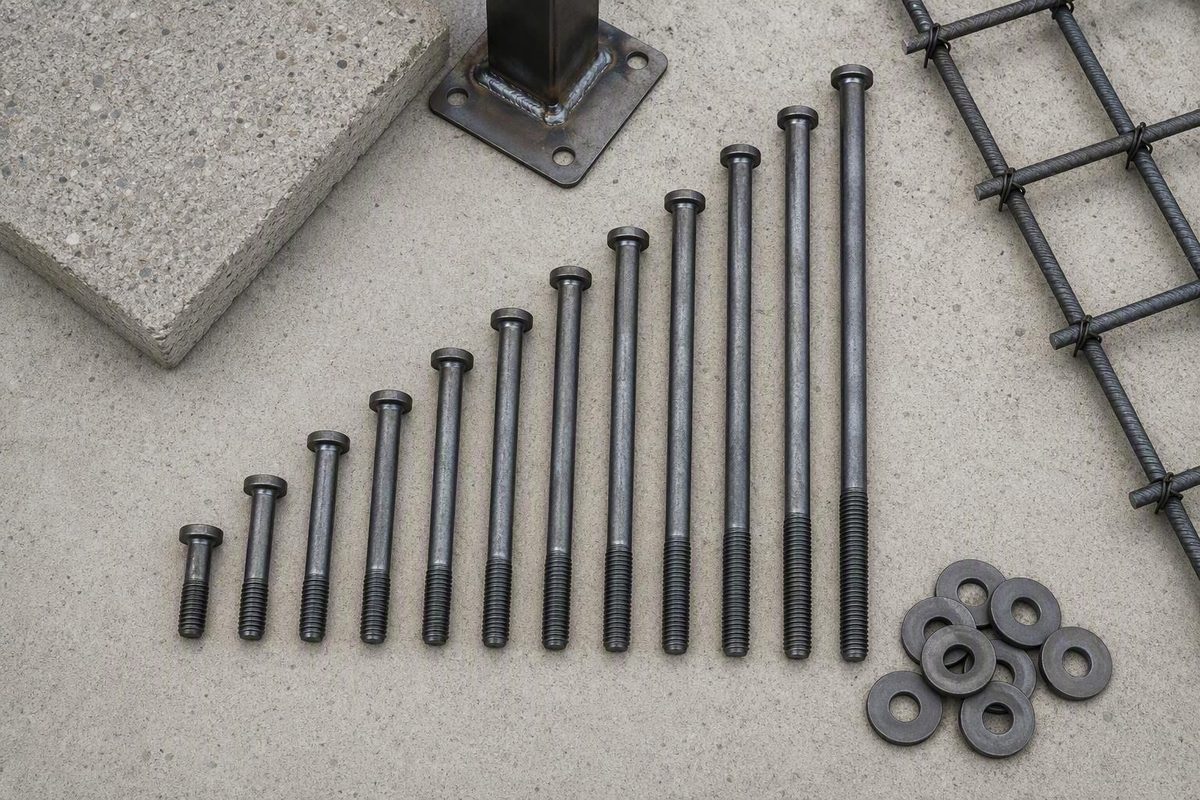
The headed studs covered here are low-carbon-steel headed concrete anchors welded to steel for concrete-connection work. Before ordering, confirm the connection’s function, determine the required finished height, convert that requirement to the correct pre-weld length, and verify the material, ferrule, quantity, documentation, welding procedure, and inspection requirements. This is a catalog-reading guide to one seller’s product—not a universal specification for every type of headed stud.
Headed studs, defined within the limits of the evidence
“Headed studs” is a broad, potentially ambiguous term. This guide specifically addresses the 1/2-inch Headed Concrete Anchor Studs listed by Stud Welding Products, which says they are installed on steel with an arc stud-welding system and supplied with flat ferrules. These details are commercial catalog claims and have not been independently verified against the linked certificates, evaluation report, or governing standards. See the Stud Welding Products catalog listing.
The seller identifies HCA as the product part number and also uses CA, H-4L, HA, HCA, and H4L Concrete Anchors as alternate designations. These labels may help when requesting a quotation, but they do not replace a complete description of the required product, dimensions, material, and connection function.
Do not assume that headed concrete anchors, composite-beam shear connectors, threaded weld studs, cast-in anchors, or mechanically installed concrete anchors are interchangeable. Similar names or appearances do not establish equivalent geometry, material, installation method, qualification requirements, or structural function.
The first purchasing question should therefore be: What connection is the stud intended to perform? Confirm whether the drawings call for an anchor on an embed plate, a shear connector, or another specifically defined component before comparing diameters and lengths.
Where the referenced headed studs are used
Stud Welding Products lists the following applications for this product:
- Embedment plates
- Insert plates
- Bearing plates
- Precast concrete
- Marine work
- Composite construction
The catalog also says the studs can be welded to a flat surface, inside an angle, or on the heel of an angle. This describes possible installation geometries, not automatic suitability for every plate or angle.
An application label is not a design capacity or environmental rating. For example, the appearance of “marine work” in an application list does not establish corrosion resistance or show that uncoated low-carbon steel is suitable for a particular exposure. Likewise, “composite construction” does not by itself establish compliance with a connection’s shear-transfer, fatigue, fire, or other design requirements.
The ordering variables to put on a headed-stud checklist
The listing offers a 1/2-inch product in selectable pre-weld lengths from 1-1/8 inches through 12-1/8 inches. According to the same catalog, box quantities vary by length, orders are limited to full boxes, flat ferrules are included, and made-to-order lengths are available on request. —Stud Welding Products, “Headed Concrete Anchor Studs 1/2″”
Use a checklist that separates catalog information from project-specific decisions:
| Item | Catalog information available | Still to verify |
|---|---|---|
| Stud function | Headed concrete anchor | Exact connection type and engineered function |
| Diameter | 1/2 inch | Required diameter and tolerance |
| Pre-weld length | 1-1/8 to 12-1/8 inches listed | Exact ordering length |
| Finished height or projection | Approximate shortening guidance | Required finished dimension and tolerance |
| Material | Identified as low-carbon steel | Grade, traceability, coating and exposure suitability |
| Welding geometry | Flat surface, inside angle or angle heel listed | Access, clearance, base-metal thickness and procedure |
| Ferrule | Flat ferrules included | Correct ferrule for the selected stud and geometry |
| Box quantity | Varies by length; full boxes only | Required count, waste allowance and packaging |
| Certificates | Seller says certificates are provided | Document type, lot traceability and acceptance |
| Specification sheet | Size-specific sheets are linked | Correct sheet and revision for the order |
| Standard or code edition | Multiple conformity claims appear | Applicable edition, provisions and project requirements |
Obtain a configuration-specific written quotation. The displayed starting price cannot reliably be assigned to a particular stud length, box quantity, or purchase quantity from the catalog information alone.
Engineering inputs also remain unresolved. Buyers should not infer any of these values from the stud diameter or length.
Pre-weld length versus finished stud height
The seller specifies catalog length before welding. Its approximate guidance says studs with diameters of 1/2 inch and smaller shorten by about 1/8 inch, while 5/8-inch studs shorten by about 3/16 inch. —Stud Welding Products, “Headed Concrete Anchor Studs 1/2″”
Applying that seller-specific allowance to the product covered here gives this ordering estimate:
6-1/8-inch pre-weld length − 1/8-inch approximate shortening = about 6 inches finished height
This is an estimate, not a guaranteed finished dimension. The result must be checked against the exact stud, welding equipment, setup, qualified procedure, production conditions, and required dimensional tolerance.
Do not apply these shortening allowances automatically to another manufacturer, diameter, material, ferrule configuration, or welding procedure. If finished projection is critical, state the required finished dimension and tolerance in the project or purchase documents, then have the fabricator confirm the corresponding pre-weld ordering length and inspection method.
Material properties and standards: catalog claims are not design capacities
Stud Welding Products identifies the product as low-carbon steel under ASTM A29 and ASTM A108. Its displayed property table also refers to 1010–1020 low-carbon steel under ASTM A29 and gives the following Type B minimums. These remain seller-published values unless confirmed by the applicable product specification and delivered-lot documentation.
| Property | Displayed Type B minimum |
|---|---|
| Tensile strength | 65,000 psi |
| Yield strength | 51,000 psi |
| Elongation in 2 inches | 20% |
| Elongation in five diameters | 15% |
| Reduction of area | 50% |
Source for the displayed values: Stud Welding Products’ product page and document links.
These mechanical properties are not allowable tensile, shear, or combined-load capacities for an installed concrete connection.
The catalog makes the following conformity statements:
- AWS D1.1 Type B
- AASHTO/AWS D1.5 Type B
- ISO 13918
- AWS D1.6 Type A
- International Building Code Section 19 requirements
These are unverified catalog statements, not independent proof of certification or project compliance. The wording does not identify every applicable edition, provision, amendment, product configuration, or limitation. Before relying on any statement, review the current manufacturer specification and certificate, the exact standard or code edition, the relevant evaluation report, and the project’s governing documents.
The product page also links to ESR-2577, ferrule specifications, shipping weights, safety information, and size-specific specification sheets. The page’s inclusion of those links does not establish that each document is current or applicable to the selected diameter, length, material, installation geometry, and intended use.
Final specification, welding, and inspection checks
Before releasing headed studs for purchase or fabrication, complete this handoff checklist:
- Confirm the connection function with the responsible engineer.
- Confirm the exact product and material, including diameter, grade, coating if any, and traceability requirements.
- Establish the required finished height and tolerance, then confirm the corresponding pre-weld ordering length.
- Verify the base-metal geometry and thickness, including welding access, ferrule clearance, and equipment clearance.
- Obtain the applicable welding procedure for the exact stud, base material, equipment, and welding position.
- Confirm installer qualifications, production testing, inspection requirements, and acceptance criteria.
- Retain certificates and product documentation corresponding to the delivered lot and configuration.
Those decisions cannot be made from a commercial listing alone.
Structural sizing, welding qualification, inspection, and code applicability require coordination among the responsible engineer, fabricator, welding professional, inspector, and local authority, as appropriate. Specifications and locally adopted code editions can differ. Mortar Desk publishes general reference information and does not provide contractor or engineering advice, as described in its site scope.
The practical buying rule is: identify the exact connection type first and use the required finished height as the design input, then convert it to a confirmed pre-weld ordering length and tolerance. Before fabrication, verify the material, ferrule, full-box quantity, certificates, welding procedure, inspection requirements, and governing project documents with the responsible professionals.