 MortarDesk
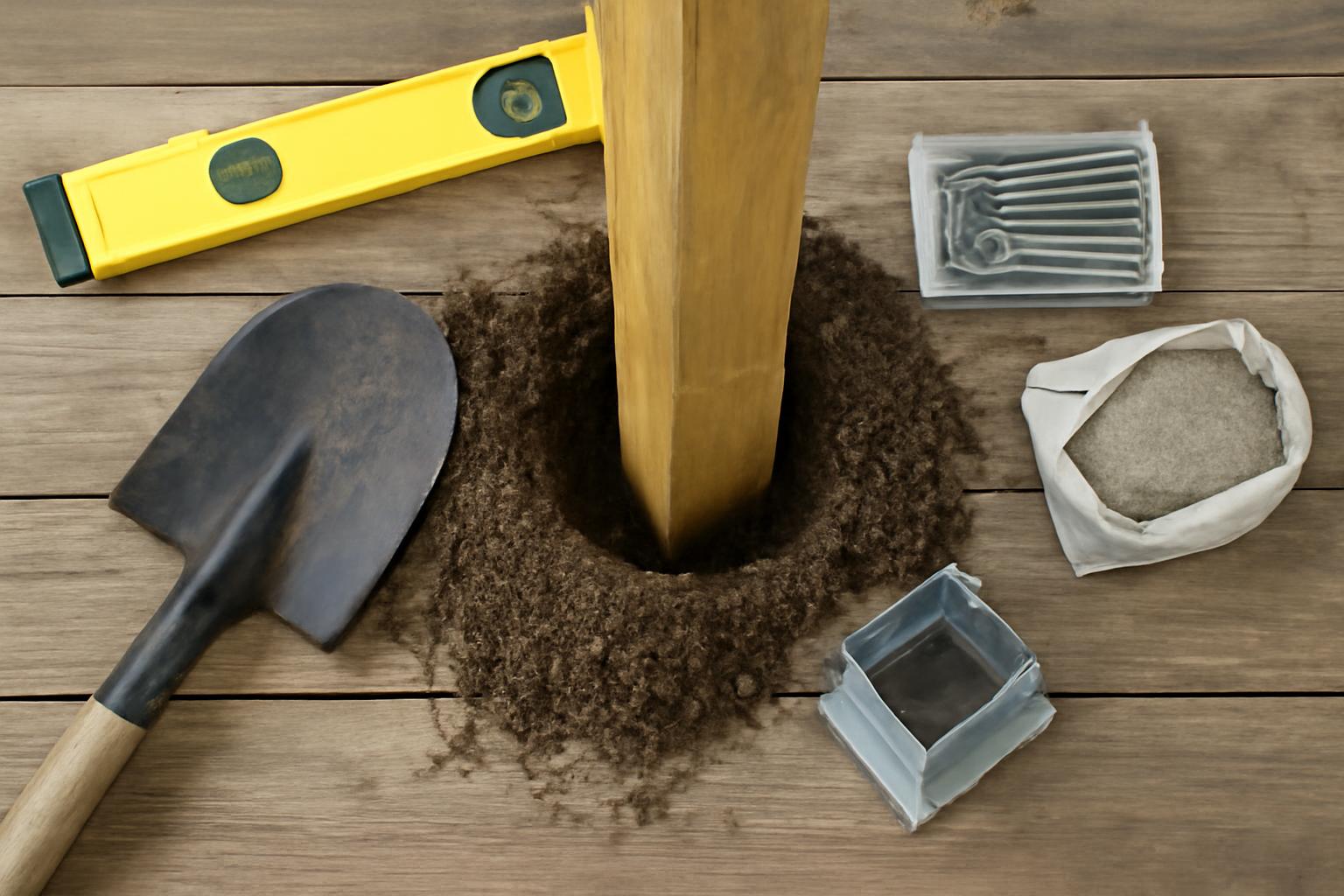
If you want the short answer to how deep should fence posts be, start here: bury at least one-third of the post’s total length and dig a little deeper so the post can sit on a gravel drainage base rather than native soil. That is the common baseline for many residential fences, but it is a baseline, not a universal answer (ProWood’s fence post-hole guide).
That matters because post depth changes when the site changes. A 6-foot privacy fence in stable, well-drained soil is one job. A gate post in wet clay on a windy lot in a freeze-thaw climate is another.
So the best way to think about fence post depth is as a hierarchy, not a single number:
- Local code and frost depth come first
- Then fence height and wind load
- Then soil and drainage
- Then whether the post is a line post or a high-stress corner, end, or gate post
Used that way, the one-third rule is very useful. Used as a universal answer, it is not.
The 1/3 Rule: Baseline for Fence Post Depth
The standard starting point is simple: bury about one-third of the total post length and leave room for a 4- to 6-inch gravel layer at the bottom of the hole. That same approach shows up in contractor guidance aimed at cold-climate installs, where the gravel is there for drainage and leveling as much as for support.
A familiar example is a 6-foot fence built with an 8-foot post. One-third of 8 feet is 32 inches below grade. Add a 6-inch gravel base, and the hole lands at roughly 38 inches in ordinary loam or clay where frost and code do not require more (Ontario fence-post guidance).
The useful part of this rule is that it starts with the post, not just the visible height of the fence. People often say “a 6-foot fence needs 2 feet in the ground,” but that shortcut tends to ignore the drainage layer and can lead to under-digging. Thinking in total post length keeps the math cleaner.
This baseline also carries across common residential fence types. Whether the fence is wood, vinyl, or chain-link, the buried portion still has the same job: resist overturning, reduce rocking, and stay stable through wet periods, wind, and seasonal soil movement. The fence material changes load, but it does not eliminate the need for adequate embedment.
The gravel layer matters because it helps water move away from the bottom of the post and gives you a firmer, more level bearing surface than soft bottom soil. For wood posts especially, that drainage detail is commonly recommended because prolonged wet contact at the bottom of the hole is exactly what you are trying to avoid.
Still, this is only the baseline. If local frost depth is deeper, the soil is loose, the fence is tall and solid, or the post is supporting a gate, the final answer usually gets deeper.
Post Depths by Fence Height: Reference Table
For planning purposes, the table below is a useful starting reference for loam or clay soil in areas where the frost line is under 36 inches. These numbers come from a contractor guide that scales buried depth upward with fence height instead of treating 2 feet as a universal answer (NMI Fence’s depth table).
| Fence height | Typical post length | Buried depth | Gravel base | Total hole depth |
|---|---|---|---|---|
| 3 ft | 5 ft | 20 in | 6 in | 26 in |
| 4 ft | 6 ft | 24 in | 6 in | 30 in |
| 5 ft | 7 ft | 28 in | 6 in | 34 in |
| 6 ft | 8 ft | 32 in | 6 in | 38 in |
| 7 ft | 10 ft | 40 in | 6 in | 46 in |
| 8 ft | 11 ft | 44 in | 6 in | 50 in |
| 10 ft | 14 ft | 56 in | 6 in | 62 in |
Two patterns matter more than any single row.
First, post length is driven by finished fence height plus buried depth. A 6-foot fence commonly calls for an 8-foot post. Once you get into 7-foot and 8-foot fencing, 10-foot and 11-foot stock starts to appear because the underground portion has to grow along with the visible portion.
Second, taller fences usually need deeper embedment faster than shorter ones. That is not just because they are taller. It is because solid, taller panels present more area to the wind, and the post acts like a lever buried in soil. The taller and more solid the fence, the more cautious you should be about using a shallow “standard” depth.
This is why simplified advice like “just dig 2 feet” can mislead. It may describe a workable minimum in some mild conditions, but it does not automatically scale up to taller privacy fences, high-wind sites, loose soil, or freeze-thaw climates.
If you want a practical takeaway from the table, it is this: use it as a starting reference, then let frost depth, soil behavior, and post function decide whether your actual hole needs to be deeper.
Frost Line: Dig Deeper in Cold Climates
In cold regions, the most important answer to how deep should fence posts be is often: below the local frost line. Guidance aimed at frost-prone installs commonly describes frost depth as falling somewhere in the 30- to 60-inch range by region, with the exact figure coming from local authorities rather than a national one-size-fits-all rule (frost-heave installation guidance).
Frost heave is the main reason this matters. When moisture in frost-susceptible soil freezes, it expands and shifts the surrounding ground. A post set too shallow can be lifted a little during winter, then settle imperfectly when the soil thaws. Repeated cycles loosen the soil around the post, which is why a fence can look acceptable right after installation but lean or rack after a few winters.
Regional examples show why generic internet advice fails so often. In Ohio, installer guidance puts the frost line at about 32 inches in Columbus, 36 inches in Cleveland, and 30 inches in Cincinnati, with deeper settings commonly used for gates, corners, taller fences, and sandy soil (Ohio post-depth guide).
A Minnesota frost-heave case study tells the same story from the failure side. The author replaced earlier 8-foot posts buried 2 feet deep with 10-foot posts buried at least 3 feet 6 inches after recurring frost problems, citing a southern Minnesota frost depth of 3 feet 6 inches (Minnesota frost-heave case study).
Canadian examples can be deeper still. In the Ottawa–Gatineau region, published guidance puts frost depth at roughly 48 to 60 inches, which is a sharp reminder that advice that works in a milder climate may be badly undersized for heavy freeze-thaw conditions (Ottawa–Gatineau frost-depth guidance).
In warmer climates, frost depth may be shallow enough that the height-based one-third rule still governs. But that is something to verify, not assume. If your local building department, inspector, or extension office gives a frost number deeper than your baseline depth, the deeper local number is usually the controlling one.
A good mental shortcut is simple: if your height-based rule gives you one number and your local frost depth gives you a deeper one, build to the deeper one.
Soil Type Adjustments for Post Depth
Soil changes how much lateral resistance the ground gives the post. Most rule-of-thumb depth tables quietly assume a reasonably stable soil such as loam or clay with moderate drainage. Once you move away from that “average” condition, the hole often has to change.
Loose or sandy soil usually means going deeper because the soil gives the post less side support. One contractor guide suggests going about 20% deeper in sandy conditions than you would in ordinary loam or clay (NMI Fence’s soil adjustment guidance).
Clay is different. But clay also tends to hold water, expand, and shrink. That makes it more vulnerable to frost movement and seasonal swelling than a quick “seems firm enough” test would suggest.
In clay-heavy yards, the problem is often not initial stiffness but long-term movement plus trapped moisture. That is why drainage details matter so much there.
A simple field check can help you stop treating every site like average loam. If the spoil from the hole is sticky, smooth, and clumps together when squeezed, you are probably dealing with clay or silt. Neither condition automatically kills the project, but both are signals to stop using generic assumptions.
Poor drainage deserves its own adjustment. If water stands along the fence line after rain, or if grade funnels runoff toward the posts, deeper holes alone may not solve the problem. You may also need to:
- keep the bottom of the hole on crushed gravel
- use backfill that does not trap water
- slope the finished surface slightly away from the post
- avoid leaving a depression around the post collar
- pay special attention to low spots where old posts already moved
Rocky ground is the awkward exception. The theory may say you need 42 inches, but the site may refuse to give it to you.
Line Posts vs Corner, End, and Gate Posts
Not every post does the same work. A straight run of line posts mainly keeps the fence aligned and resists ordinary wind loads. Corner, end, and gate posts carry concentrated stress from changes in direction, latch pressure, hinges, repeated movement, and the extra weight of gate framing and hardware.
That is why stress posts are usually treated more conservatively than line posts. Ontario installation guidance describes 6 to 8 feet as a common spacing range for residential line posts, notes that chain-link terminal posts are often set 12 inches deeper than line posts below frost depth, and recommends moving up to 6x6 posts for heavier 8- to 10-foot gates, while 4x4 posts can serve lighter 3- to 6-foot gates (Ontario post sizing and spacing guidance).
The practical lesson is straightforward: the posts at the ends and openings of the fence usually deserve more depth, more section, or both. A gate that drags, sags, or goes out of square is often the first visible sign that the underground work was undersized.
This is also where concrete is easiest to justify.
The bigger and more solid the fence, the more this distinction matters. Tall privacy fences, exposed corner lots, and sites that take sustained wind all push the design closer to the limits of the soil. On those jobs, many installers prefer to overbuild the terminal points first, because that is where failure is most expensive and most visible.
Hole Size, Gravel Base, and Backfill Basics
Depth gets most of the attention, but hole diameter matters too. A common rule is to make the post hole about three times the width of the post. For a 4-inch post, that usually means a hole around 12 inches wide. The same guidance commonly places the post on a 3- to 4-inch tamped gravel base instead of directly on native soil (Long Fence’s post-hole guide).
That extra width is not wasted space.
The post should sit on gravel, not on muddy bottom soil. In colder or wetter conditions, many installers step that gravel layer up to something closer to 4 to 6 inches and use angular crushed stone rather than rounded rock so it compacts better and drains more effectively (frost-heave installation guidance).
Concrete is helpful, but it is not automatically mandatory for every post. It is most useful where the soil is loose, the fence is tall or solid, the site is windy, or the post carries gate hardware. When you do use it, the top should shed water away from the post rather than create a little basin around it.
Cure time matters too. Installer guidance commonly recommends waiting about 24 to 48 hours before fully loading fresh concrete footings with panels or gate weight.
Backfill choice depends on climate and soil. In well-drained conditions, tamped gravel or compacted soil lifts can work. In wet clay, a full plug of concrete all the way to the surface can sometimes hold water where you do not want it. A draining base, careful backfill choice, and a crowned top surface are often better than thinking only in terms of “concrete versus no concrete.”
If you are doing the work by hand, this is where tamping discipline matters.
Local Codes, Utilities, and Prep Steps
There is no universal depth that applies everywhere. Post-hole depth is commonly described as depending on fence height, frost line, soil conditions, and local building codes, and local officials may also care about footing method or materials depending on climate and fence type.
Before you dig, call 811 or your local utility-marking service. That is basic jobsite safety, not a nice extra. Striking buried electric, gas, water, irrigation, or communications lines can turn a fence project into an emergency or an expensive repair.
Then lay out the fence before the first full-depth hole. Run a string line. Mark corners, ends, and gate openings. Check slope changes. Measure planned spacing. Look for low spots where water collects. If an old fence failed in one section, assume that section deserves extra attention rather than a repeat of the same detail.
If you use Mortar Desk’s broader home improvement and building material specifications as a reference, treat this article the same way: as planning information, not approval for a specific site. As explained on the About Mortar Desk page, the site is a reference desk rather than a contractor or engineering service.
The safest mindset is to treat online tables as planning tools, then confirm the final depth locally. Codes are local, site conditions vary, and even nearby yards can behave differently if one side stays wet or exposed. For straightforward residential work, that usually means checking with the building department and utility locator first. For unusually tall fencing, severe slope, drainage trouble, or other structural concerns, it may also mean calling a qualified local installer.
FAQ
What is the frost line and how do I find mine?
The frost line is the deepest level the ground is expected to freeze in winter. Posts set above that depth are more vulnerable to frost heave, where freezing soil lifts the post and repeated freeze-thaw cycles gradually loosen it.
To find yours, start with the local building department or inspector. In some areas, a county extension office can help too. Generic online charts can be useful for rough context, but they should not replace the local number used by your jurisdiction.
For fence planning, if the local frost depth is deeper than your normal height-based rule of thumb, use the deeper local figure.
Is concrete always needed for fence posts?
No. Concrete is often useful, but it is not automatically required for every fence post. Shorter, lighter fences in well-drained soil can sometimes perform well with tamped gravel or compacted soil, while tall fences, solid panels, loose soils, and gate posts usually justify a more reinforced approach. Cure time guidance for concrete footings is commonly in the 24- to 48-hour range before loading the posts.
The key question is not “concrete or nothing.” It is whether the footing, backfill, drainage, and post size fit the load and the soil.
How deep for a 6-foot fence post?
A common planning answer for a 6-foot fence is roughly 2 to 3 feet in the ground, with many DIY guides landing near 30 inches as a general example before you adjust for gravel, frost depth, and site conditions. If you are adding a drainage layer and following a one-third-of-post-length method, the hole can end up deeper than that baseline.
In practice, that means a 6-foot fence often lands somewhere around the high-20s to upper-30s in ordinary conditions, but the final number still depends on soil, frost, drainage, and whether the post is carrying a gate or sitting on an exposed run.
Do vinyl or metal posts need different depths?
Usually not by much. For ordinary residential work, depth is driven more by height, wind exposure, frost depth, and soil conditions than by whether the visible fence is wood, vinyl, or metal. Ohio installation guidance, for example, notes that vinyl fences often need similar post depths to wood once frost and stability are considered.
What can change by material is post size, manufacturer instructions, and footing method. So use the general depth rules as a starting point, then check the product-specific requirements.
What tools for digging deep post holes?
For manual digging, the basic kit is straightforward: tape measure, line level, post-hole digger, shovel, digging bar, stakes, and mason line. If the soil is hard, rocky, or you have many holes to dig, a power auger can save a lot of time, and rental options are common for typical fence work.
Hand tools still matter even if you use an auger. A digging bar helps break compacted soil and trim the hole, while a clamshell digger or shovel helps clean out loose spoil the auger leaves behind. Once you are going much beyond ordinary fence depth in hard clay or rocky ground, the case for renting equipment gets stronger fast.
The best general answer to how deep should fence posts be is still the same: start with the one-third rule and a gravel base, then adjust upward for frost, soil, drainage, wind exposure, and high-stress posts such as corners and gates. Use online tables as reference points, not as permission to skip local code and site checks.